Championnat de France des Clubs 2026 | Elimination | Groupe A
Puranik Outgrinds Amin in 52-Move French Club Championship Win


Amin's Endgame
Puranik Grinds Down Amin in French Club Championship Endgame
Abhimanyu Puranik converted a lengthy endgame against Bassem Amin in Round 6 of the Championnat de France des Clubs 2026, securing a crucial point for Mulhouse Philidor against Clichy Echecs 92. The Indian GM, rated 2603, needed 52 moves to break down the Egyptian's defenses in what became a clinic in rook endgame technique. For Amin, rated 2628, it continues a frustrating stretch — the same player who was "tricked into a draw again in a winning position" at the Ciudad de Leon earlier this year found himself on the wrong end of a technical grind.
The game opened with the King's Indian Attack via Double Fianchetto, a system that typically promises White long-term pressure but rarely leads to fireworks. Both players castled early and maneuvered their knights with care, the position hovering near equality through the first dozen moves. The engines saw nothing — evaluations stayed within 0.2 pawns for most of the opening. But equality on a computer screen and equality at the board are different animals, especially when one player is hunting for a win and the other is content to hold.
The Double Fianchetto Dance
The opening sequence 1.Nf3 d5 2.g3 g6 3.Bg2 Bg7 4.O-O e5 5.d3 Nc6 6.e4 established the characteristic double-fianchetto structure that gives White's bishop on g2 long-term pressure against Black's queenside. Amin's setup is solid but committal — once you've fianchettoed both bishops and pushed e4, your central pawn structure is largely fixed.
Puranik responded with 6...Nge7, a flexible choice that keeps options open for the d5 knight. After 7.exd5 Nxd5 8.Nc3 Nxc3 9.bxc3, White accepted doubled c-pawns in exchange for the half-open b-file and central control. The evaluation remained dead equal, but the position had acquired a distinct character: White would press on the queenside while Black looked for counterplay in the center.
The early middlegame saw both players jockeying for position. 10.Rb1 put the rook on the open file, and Puranik responded with 10...Rb8, mirroring the pressure. When Amin tried 11.Ng5, probing for tactical opportunities against f7, Puranik calmly retreated with 11...Ne7, sidestepping any complications. The knight returned to c6 after 13.Nf3 Nc6, and the position had essentially reset — both players had developed their pieces, neither had achieved anything concrete.
The Central Break and Its Consequences
The game's character shifted with 14.d4, Amin's attempt to open the position and create imbalances. This is the kind of move that looks logical — White has been preparing central action, and the doubled c-pawns become less of a liability if the center opens up. But it also gives Black clear targets and simplifies the position in ways that favor the defender.
After the exchanges that followed, the position transitioned into a rook endgame where Puranik held a small but persistent edge. The engines still showed near-equality, but there's a crucial difference between defending a rook endgame against a computer and defending one against a 2600+ GM who has all day to probe your weaknesses.
This is where the human element matters most. Engines can hold these positions indefinitely because they never get tired, never miscalculate a single tempo, never lose patience. Human players, even grandmasters, face a different reality. Every move requires energy. Every decision carries the weight of time pressure and fatigue. Amin, who has shown vulnerability in technical positions before — his stalemate tricks at Ciudad de Leon suggest a player who sometimes loses the thread in simplified positions — was facing exactly the kind of grind that exposes those weaknesses.
The Long March to Victory
What followed was a lesson in endgame technique from Puranik. The Indian GM, born in 2000 and currently ranked around 94th in the world, has built his career on exactly this kind of patient accumulation. He didn't need brilliancies or sacrifices — he needed accuracy, persistence, and the ability to keep asking questions until his opponent ran out of answers.
The rook endgame stretched past move 40, then past move 50. Each move required calculation, each decision carried consequences. Puranik's technique was impeccable: he activated his king, improved his rook's position, and gradually pushed Amin into increasingly passive squares. The evaluation crept from 0.0 to -0.3 to -0.5, then accelerated as Amin's defensive resources dwindled.
The final phase saw Puranik convert his advantage with clinical precision. By move 52, Amin's position had collapsed, and the Egyptian GM resigned rather than play out a hopeless ending. The full point went to Mulhouse Philidor, a result that could prove significant in the team standings.
Context and Consequences
This result fits a pattern for both players. Amin, the 2628-rated Egyptian who once topped the African rating list, has shown inconsistency in technical positions throughout 2026. His rating has slipped slightly — down from 2633 to 2628 — and losses like this one explain why. He's not making tactical blunders or getting crushed in the opening; he's losing the kinds of games that require 50 moves of precise defense.
For Puranik, this is exactly the kind of result that keeps him in the world's top 100. The 25-year-old Indian GM finished 8th at the Ciudad de Leon earlier this year with 8/11, and his form in the French Club Championship has been solid. He drew with Idani and beat Van Foreest in earlier rounds, and this victory over Amin continues his positive trajectory.
The French Club Championship's elimination stage brings together an eclectic mix of French regulars and international reinforcements. Nihal Sarin, rated 2723, has been playing for one of the top teams, while players like Suleymanli, Mendonca, and Santos Latasa add depth to the field. In this context, Puranik's victory over Amin is a meaningful result — not the game of the tournament, but a solid professional performance that earns his team a crucial point.
The Broader Picture
Team chess creates different pressures than individual tournaments. A draw might be acceptable when your teammates are winning; a loss can be catastrophic if it swings the match result. Puranik's willingness to grind for 52 moves, to squeeze every drop of advantage from a position that engines called equal, reflects the mentality required for team competition.
The position after the central break — bishops fianchettoed, pawns fixed, rooks circling — is the kind of structure that appears simple but contains hidden depths. We turned this one into a print. It's not flashy, but there's something satisfying about a position where every piece has a purpose and the outcome depends entirely on technique.
For Amin, the loss is a setback but not a disaster. He's still a 2600+ GM with decades of experience, and one difficult endgame doesn't define a career. But the pattern is concerning: at Ciudad de Leon, he let winning positions slip; here, he couldn't hold a drawable endgame. At this level, those margins matter.
The French Club Championship continues with more rounds to come, and both Mulhouse Philidor and Clichy Echecs 92 will need results from their top boards. Puranik has delivered for his team; Amin will look to bounce back. That's the rhythm of team chess — today's loss becomes tomorrow's motivation, and the next game is always waiting.
For those following the tournament, the broadcast on Lichess provides move-by-move coverage of all the games. The depth of talent in the French Club Championship makes it one of the stronger team events in Europe, even if it doesn't carry the prestige of the Bundesliga or the 4NCL. Games like Puranik-Amin remind us that chess at the 2600 level is decided not by brilliancies but by technique, patience, and the ability to maintain concentration for 50 moves when the position offers no easy answers.
Puranik showed all of those qualities. Amin, on this day, came up short. The point goes to Mulhouse Philidor, and the tournament rolls on.
1.Nf3 d5 2.g3 g6 3.Bg2 Bg7 4.O-O e5 5.d3 Nc6 6.e4 Nge7 7.exd5 Nxd5 8.Nc3 Nxc3 9.bxc3 O-O 10.Rb1 Rb8 11.Ng5 Ne7 12.Re1 h6 13.Nf3 Nc6 14.d4 Be6 15.Nxe5 Nxe5 16.dxe5 Qxd1 17.Rxd1 Rfd8 18.Rxd8+ Rxd8 19.Be3 Bxe5 20.Bxb7 Bxc3 21.a4 a5 22.Bxh6 Bf5 23.Bf4 Bb4 24.Rc1 Ba3 25.Ra1 Bb4 26.c4 Be6 27.Rc1 c5 28.Bd5 Bf5 29.Be5 Re8 30.f4 g5 31.Kf2 Bd7 32.Ra1 g4 33.h3 gxh3 34.g4 Kf8 35.Kg3 Bc3 36.Rf1 Bd4 37.Kxh3 Bxa4 38.Bc7 Re3+ 39.Kg2 Bd7 40.Bxa5 Bxg4 41.Rb1 Kg7 42.Rb7 Bh3+ 43.Kh2 Bf1 44.Rxf7+ Kh6 0-1
How would it look as art?


Own a piece of chess history. Transform this legendary game into a unique piece of art for your home or office.
Perfect For
- Unique Gifts for chess enthusiasts and players
- Tournament Prizes that winners will treasure
- Club Decor for chess clubs and gaming spaces
- Office Art showcasing strategic thinking
- Personal Collection of historic games
Turn Your Games Into Art
Whether it's your own game from Chess.com or Lichess, or another historic masterpiece, transform any chess game into a stunning visual artwork.
You might also like
More legendary chess game stories

Wenjun Ju vs Humpy Koneru
Wenjun Ju vs Humpy Koneru
Koneru Finds Redemption Against the World Champion Humpy Koneru entered round ten of Norway Chess Women 2026 in last place with just three points, having lost three Armageddon games already in Oslo....
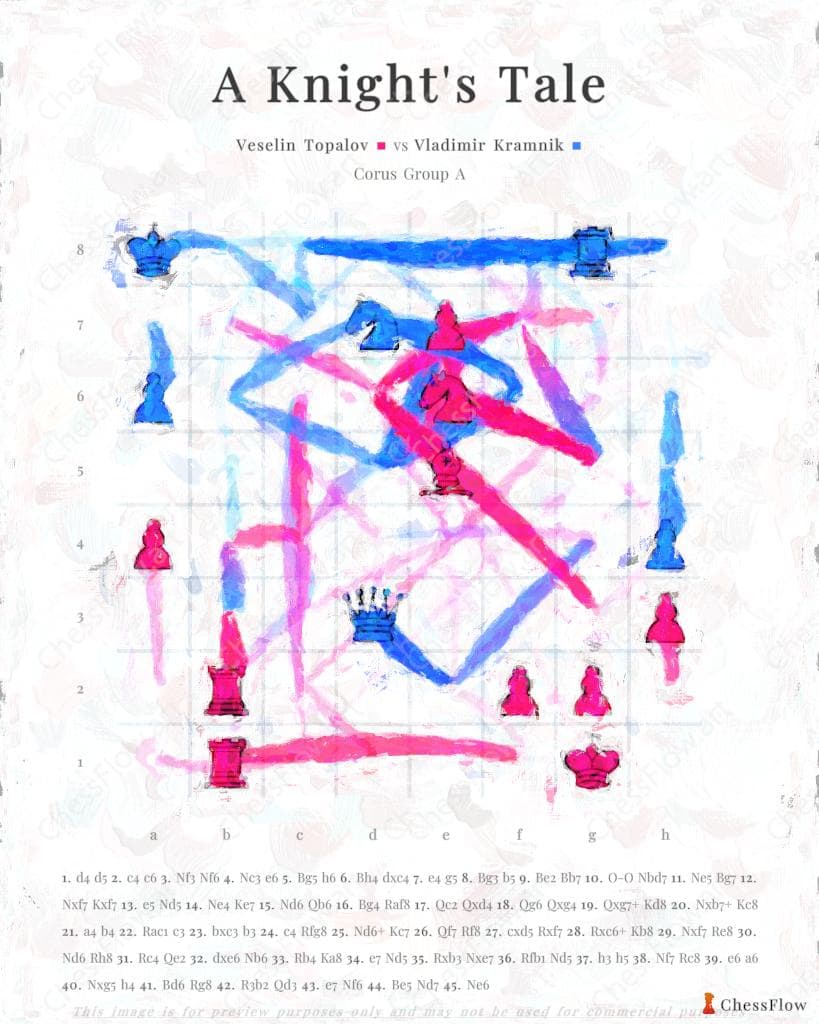
Veselin Topalov vs Vladimir Kramnik
Veselin Topalov vs Vladimir Kramnik
The Knight Sacrifice That Shook Wijk aan Zee Veselin Topalov pulled off one of the most spectacular attacking victories of the 2008 Corus tournament, defeating Vladimir Kramnik with a brilliant knigh...

Jiner Zhu vs Aleksandra Goryachkina
Jiner Zhu vs Aleksandra Goryachkina
Goryachkina Takes Down Zhu in Round 13 Aleksandra Goryachkina scored a crucial victory over Jiner Zhu in round 13 of the FIDE Women's Candidates Tournament 2026, dealing a blow to the Chinese GM's ch...