London
Adolf Anderssen vs Lionel Kieseritzky


The Immortal Game
On June 21, 1851, amid the bustle of London’s Great Exhibition and between rounds of the world’s first international chess tournament, Adolf Anderssen and Lionel Kieseritzky sat down for an informal skittles game. What followed—twenty-three moves of audacity—became “The Immortal Game.” The exact table is debated (many name Simpson’s-in-the-Strand’s famed Grand Divan; some sources hedge on the precise venue), but there is no dispute about the brilliance or the date: Anderssen’s attacking masterpiece was played in London and first published weeks later in La Régence. (ChessHistory/Edward Winter; Chess.com; Wikipedia). ([chesshistory.com][1])
The Players
Adolf Anderssen (1818–1879) arrived in London as a respected master and left as the tournament’s winner and the era’s unofficial number one. His style epitomized the Romantic school: rapid development, open lines, and an almost contemptuous attitude toward material. Lionel Kieseritzky (1806–1853), the Paris-based teacher and Café de la Régence stalwart, was famed for odds-giving prowess and deep opening study—particularly in gambits—yet was less successful against the very strongest peers (a contrast often noted in contemporary accounts). (Wikipedia; Chess.com). ([Wikipedia][2])
The Game
Opening: King’s Gambit Accepted, Bishop’s Gambit; Bryan Countergambit Moves given: 1.e4 e5 2.f4 exf4 3.Bc4 Qh4+ 4.Kf1 b5 5.Bxb5 Nf6 6.Nf3 Qh6 7.d3 Nh5 8.Nh4 Qg5 9.Nf5 c6 10.g4 Nf6 11.Rg1 cxb5 12.h4 Qg6 13.h5 Qg5 14.Qf3 Ng8 15.Bxf4 Qf6 16.Nc3 Bc5 17.Nd5 Qxb2 18.Bd6 Bxg1 19.e5 Qxa1+ 20.Ke2 Na6 21.Nxg7+ Kd8 22.Qf6+ Nxf6 23.Be7# 1–0.
From the outset, the players dive into C33 territory. After 3…Qh4+ 4.Kf1, Kieseritzky unleashes the Bryan Countergambit with 4…b5—an idea he analyzed extensively—trying to rip lines while harassing the c4-bishop. Anderssen accepts the pawn with 5.Bxb5 and calmly completes development under fire. (Wikipedia; Chess.com). ([Wikipedia][2])
The midgame is pure Romantic chess. With 11.Rg1 and 12.h4, White chases the black queen and pries open files on the kingside. Black’s 17…Qxb2 snatches a pawn but lures the queen offside; Anderssen replies with the celebrated 18.Bd6!!, a move that both interferes with Black’s coordination and, most importantly, tempts 18…Bxg1, clearing lines for a mating net. The thrust 19.e5! seizes the initiative, and after 20…Na6 (a defensive try to cover c7), Anderssen detonates 21.Nxg7+!! and the iconic 22.Qf6+!!, a queen sacrifice forcing 22…Nxf6 and the model mate 23.Be7# delivered by three minor pieces alone. (Chess.com; Wikipedia). ([Chess.com][3])
Turning Points
- 4…b5!? (Bryan Countergambit) — An ambitious counter in the Bishop’s Gambit that courts danger by loosening the queenside in exchange for tempi and initiative. Modern theory is skeptical, but in 1851 it fit perfectly with Romantic principles. (Wikipedia). ([Wikipedia][2])
- 18.Bd6!! — The move that makes the game immortal. It invites material grabs that fatally misplace Black’s forces and opens decisive lanes to the black king. (Chess.com). ([Chess.com][3])
- 22.Qf6+!! — A stunning clearance/sacrifice motif; Black must accept, and the follow-up 23.Be7# is a textbook model mate—every white piece contributes; every flight square is singly covered. (Wikipedia). ([Wikipedia][2])
A note on the ending: Several historical sources (cited in modern summaries) report that the final moves may not all have been played over the board—Kieseritzky is said to have resigned earlier, with the mating line supplied in publication; nonetheless the mating net is forced and has long been presented as the game’s conclusion. (Wikipedia; ChessHistory). ([Wikipedia][2])
Aftermath and Legacy
Kieseritzky himself telegraphed the moves to Paris immediately, evidently impressed; the game appeared in La Régence in July 1851, and in 1855 Ernst Falkbeer christened it the “Immortal Game.” Its fame spread quickly in English-language circles via Kling & Horwitz. Whether or not it was played at Simpson’s Grand Divan, the London skittles setting became part of its legend. (Chess.com; ChessBase; ChessHistory; Wikipedia). ([Chess.com][3])
The game endures for at least three reasons:
- Aesthetic clarity: a clean sacrificial story ending in a pure, instructive mate.
- Historical emblem: it captures the Romantic era’s spirit—initiative over material, open kings, daring calculation.
- Pedagogical value: it’s still used to teach coordination, development, and how activity can outweigh material (even if modern engines and theory frown on several decisions). (Wikipedia; Chess.com). ([Wikipedia][2])
Sources (selected)
- La Régence (July 1851), report attributed to Kieseritzky; summarized and documented by Edward Winter, Chess Notes (accessed via Chesshistory.com). (Winter; July 1851). ([chesshistory.com][1])
- “The Immortal Game,” background and annotated move-by-move features (Chess.com, 2008 & 2018). (Chess.com 2008/2018). ([Chess.com][4])
- “Immortal Game” overview and contextual notes (Wikipedia). (Wikipedia, updated). ([Wikipedia][2])
1.e4 e5 2.f4 exf4 3.Bc4 Qh4+ 4.Kf1 b5 5.Bxb5 Nf6 6.Nf3 Qh6 7.d3 Nh5 8.Nh4 Qg5 9.Nf5 c6 10.g4 Nf6 11.Rg1 cxb5 12.h4 Qg6 13.h5 Qg5 14.Qf3 Ng8 15.Bxf4 Qf6 16.Nc3 Bc5 17.Nd5 Qxb2 18.Bd6 Bxg1 19.e5 Qxa1+ 20.Ke2 Na6 21.Nxg7+ Kd8 22.Qf6+ Nxf6 23.Be7# 1-0
How would it look as art?


Own a piece of chess history. Transform this legendary game into a unique piece of art for your home or office.
Perfect For
- Unique Gifts for chess enthusiasts and players
- Tournament Prizes that winners will treasure
- Club Decor for chess clubs and gaming spaces
- Office Art showcasing strategic thinking
- Personal Collection of historic games
Explore more
Turn Your Games Into Art
Whether it's your own game from Chess.com or Lichess, or another historic masterpiece, transform any chess game into a stunning visual artwork.
You might also like
More legendary chess game stories
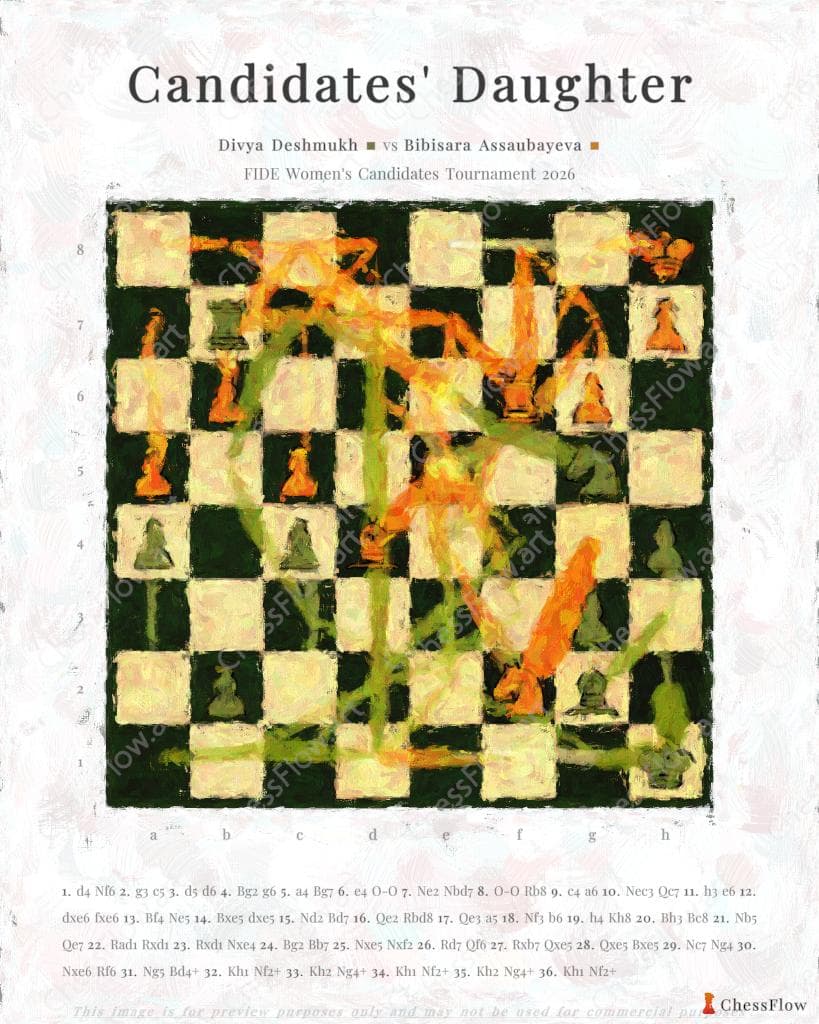
Divya Deshmukh vs Bibisara Assaubayeva
Divya Deshmukh vs Bibisara Assaubayeva
The Final Round Showdown Round 14 of the 2026 FIDE Women's Candidates Tournament delivered a crucial draw between GM Divya Deshmukh (2497) and GM Bibisara Assaubayeva (2516). With Assaubayeva enterin...
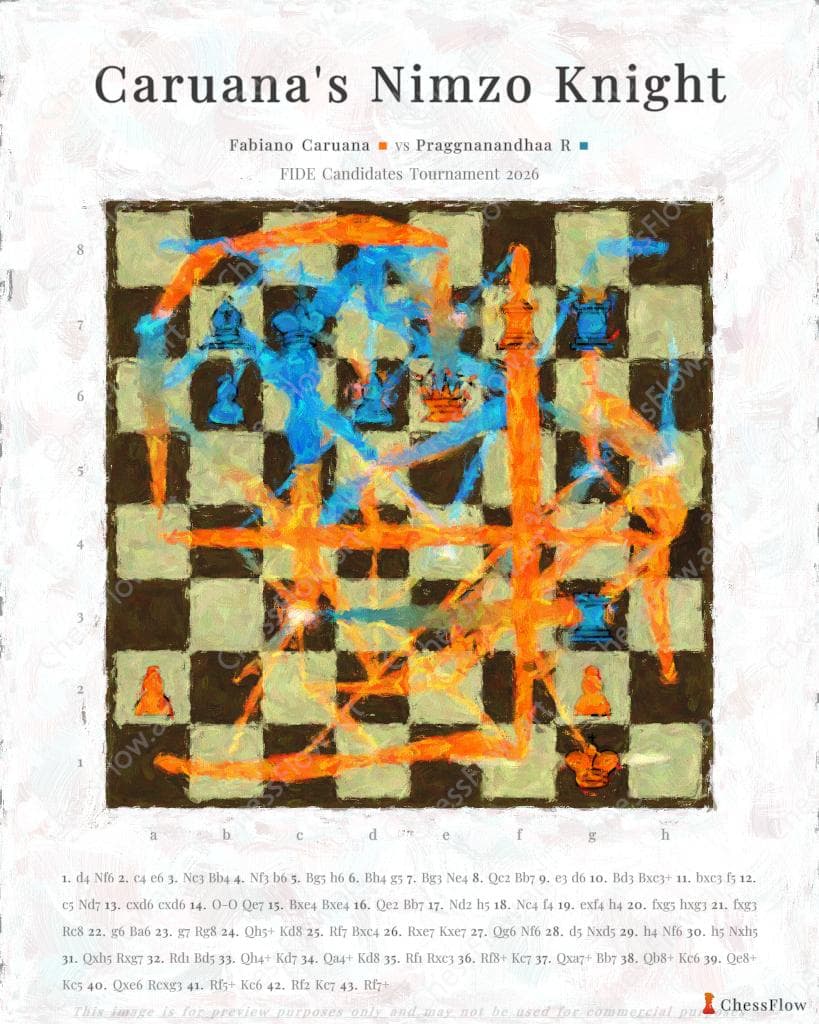
Fabiano Caruana vs Praggnanandhaa R
Fabiano Caruana vs Praggnanandhaa R
The Opening Choice Fabiano Caruana opened with 1.d4 against Praggnanandhaa in round 13 of the 2026 FIDE Candidates Tournament, leading to the Nimzo-Indian Defense after 1.d4 Nf6 2.c4. The American gr...
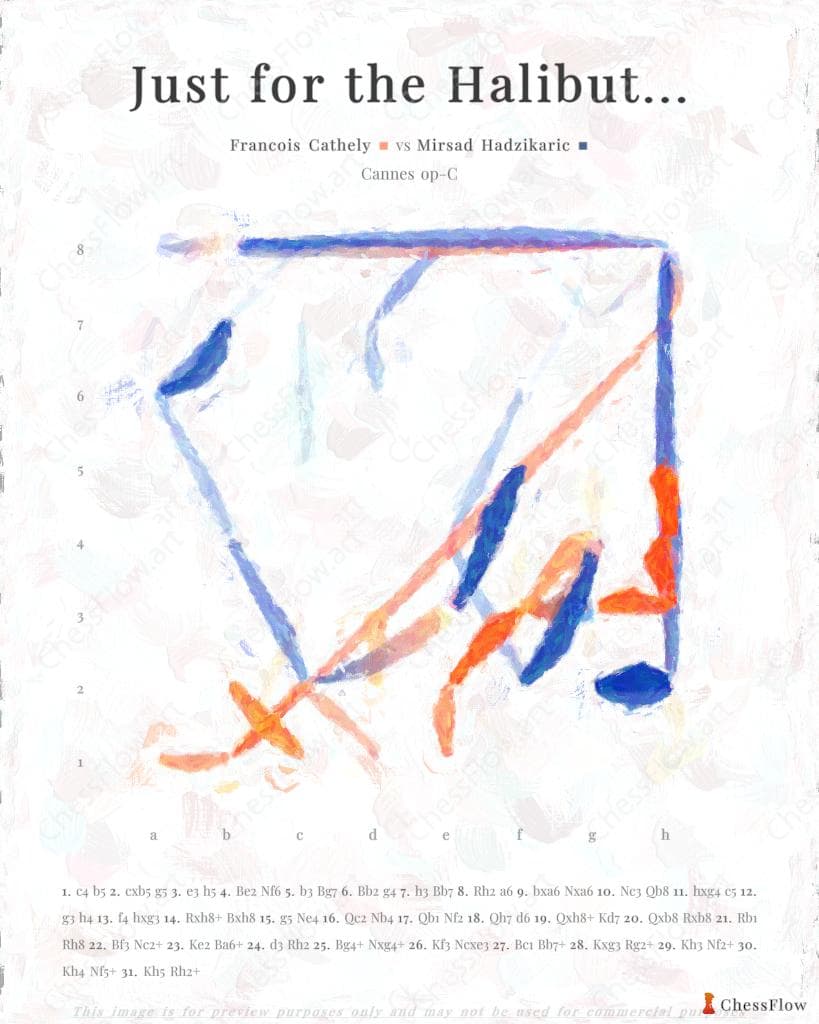
Francois Cathely vs Mirsad Hadzikaric
Francois Cathely vs Mirsad Hadzikaric
The Opening Gambit Francois Cathely and Mirsad Hadzikaric faced off in the 1995 Cannes op-C tournament with an opening that immediately signaled chaos was coming. After 1.c4 b5, Black's Polish Defens...