TePe Sigeman Chess Tournament 2026
Erigaisi Beats Van Foreest in Round 5 at TePe Sigeman 2026


Arjun's Ascent
Arjun Finally Gets His Win
Arjun Erigaisi entered Round 5 of the TePe Sigeman Chess Tournament 2026 desperately needing a result. After drawing against Magnus Carlsen in Round 1, letting a winning position slip against Yagiz Kaan Erdogmus in Round 2, beating Nils Grandelius in Round 3, and then surviving a scare against Nodirbek Abdusattorov in Round 4, the Indian number two had been running hot and cold in Malmö. Against Jorden Van Foreest—who had just handed Carlsen his first classical loss since Gukesh's famous Norway Chess 2025 victory—Arjun needed to prove he could sustain pressure against a player riding high on confidence.
He did exactly that. Playing the white pieces in a Slav Defense, Erigaisi built a slow positional bind that gave Van Foreest little counterplay, converting his structural advantages into a victory that pushed him firmly into contention with two rounds remaining.
The Opening: A Quiet Slav Turns Sharp
The game opened with 1.d4 d5 2.c4 c6 3.Nf3 Nf6, entering the Slav Defense: Modern Line. Arjun's choice of 4.Qb3 was an early signal that he wasn't looking for theoretical battles—this sideline puts immediate pressure on d5 and b7 while avoiding the main Slav tabiya. Van Foreest responded with 4...h6, a somewhat unusual move that prevents any Bg5 ideas and prepares to develop the light-squared bishop without worrying about pins.
After 5.Nc3 dxc4 6.Qxc4 Bf5, the position resembled a typical Slav structure where Black has solved the problem of the c8-bishop. But Arjun had other ideas. With 7.Ne5, he centralized his knight aggressively, challenging Black to prove the position was as comfortable as it looked. Van Foreest responded sensibly with 7...e6, solidifying his center and preparing to develop.
The engines showed near-equality throughout these moves—hovering between +0.14 and +0.31—but the practical reality was different. Arjun had a clear plan: push e4, establish space, and squeeze. Van Foreest had to find accurate moves just to stay level.
The Middlegame Squeeze
After 8.a4 Nbd7 9.Nxd7 Qxd7, Arjun had traded off Black's knight but gained something more valuable: time. The move 10.f3 signaled his intentions clearly—he was preparing e4 and building a broad pawn center. Van Foreest tried to create counterplay with 10...a5, fixing the queenside and preventing any a5 ideas from White, but this also meant his pawns were committed.
11.e4 Bh7 saw the bishop retreat to a passive square, and here the position began to tilt. Not dramatically—engines still showed only +0.21—but in a way that experienced players recognize. White has more space, a flexible structure, and clear plans. Black has to wait and react.
The sequence 12.Bf4 Bb4 13.Be2 O-O 14.O-O brought both kings to safety, but the contrast in their positions was stark. Arjun's pieces were harmoniously placed: the bishop on f4 controlled key dark squares, the bishop on e2 supported future kingside play, and the pawns on d4 and e4 gave him a commanding center. Van Foreest's pieces were functional but cramped—the bishop on b4 was biting on granite (the c3-knight wasn't going anywhere), and the bishop on h7 was essentially a tall pawn.
Van Foreest's 14...Kh8 was a prophylactic move, stepping off the g1-a7 diagonal and preparing potential counterplay with ...f5. But it also highlighted the defensive nature of his position. When you're moving your king to h8 in a quiet middlegame, you're not the one setting the agenda.
The Position That Tells the Story
After 15.R (the game continues from here), the position crystallized into something instructive. White's structure is ideal for a long squeeze: the e4-d4 center controls space, the bishop pair has scope, and there are no weaknesses to target. Black's position is solid but passive—the c6 pawn is a potential target, the h7-bishop does nothing, and the knight on f6 is the only active piece.
This is the kind of position where engines shrug and say "+0.27" while humans know the truth: White is playing for two results, Black is playing for one. The practical winning chances are heavily in White's favor, even if the computer sees no forced advantage.
The game illustrated a recurring theme in Arjun's play at this tournament. Against Grandelius in Round 3, he won a racing endgame. Against Abdusattorov in Round 4, he defended tenaciously and calculated his way to safety. Here, he showed the other side of his game—patient positional chess where the advantage accumulates move by move until the opponent cracks.
Tournament Implications
This victory was crucial for Arjun's tournament hopes. After five rounds, the standings had become congested at the top, with Erdogmus holding the sole lead after his win over Grandelius in Round 4. Van Foreest, despite his historic win over Carlsen, now had to regroup after this loss.
For Arjun, the result also had rating implications. He had climbed back into the world top 10 after his Round 3 win over Grandelius, and this victory against the 2735-rated Van Foreest would solidify that position. In a tournament featuring Carlsen, Abdusattorov, and the rising star Erdogmus, every point matters.
The contrast between the two players' recent form made this result somewhat surprising. Van Foreest had just beaten Carlsen—the first player to do so in classical chess since Gukesh's Norway Chess 2025 victory—and seemed to be in excellent form. But chess doesn't work that way. The high of beating the world number one can sometimes lead to a letdown, and Arjun was exactly the wrong opponent to face when not at 100%.
The Broader Context
The TePe Sigeman Chess Tournament 2026 had already delivered drama before this round. The fire alarm at 1:30 a.m. before Round 4 had disrupted everyone's sleep, and Van Foreest had mentioned the incident to Peter Doggers. Whether that played a role in this game is impossible to say, but tournament chess is about managing everything—preparation, energy, psychology—not just the moves on the board.
Arjun's approach in this game was notable for its maturity. After the missed opportunity against Erdogmus in Round 2, where he was winning in a queen endgame but only drew, he could have pressed too hard. Instead, he played within himself, building advantages methodically rather than forcing the issue.
The Slav Defense choice by Van Foreest was interesting. Against a player of Arjun's positional understanding, the Slav can become a grind if Black doesn't generate active counterplay early. The 4...h6 move, while preventing Bg5, also cost a tempo that Van Foreest could have used for development. These small decisions compound over the course of a game.
Looking Ahead
With two rounds remaining, the tournament picture was far from settled. Erdogmus led with his aggressive play, but Arjun, Abdusattorov, and others were within striking distance. Carlsen, after his shock loss to Van Foreest, faced Zhu Jiner in a game he desperately needed to win to keep any title hopes alive.
For Van Foreest, this loss was a reminder that chess tournaments are marathons, not sprints. Beating Carlsen was a career highlight, but the tournament doesn't stop to let you celebrate. The Dutch grandmaster would need to regroup quickly.
Arjun's game here—the quiet opening, the patient buildup, the gradual squeeze—is the kind of chess that doesn't make highlight reels but wins tournaments. We turned this one into a print. Sometimes the most instructive games aren't the ones with sacrifices and fireworks, but the ones where a top player slowly outplays another top player in a position that looks equal to amateurs but feels crushing to professionals.
The TePe Sigeman 2026 continued to deliver interesting chess, and with Carlsen, Abdusattorov, Erdogmus, and now Arjun all in the mix, the final two rounds promised more drama in Malmö.
1.d4 d5 2.c4 c6 3.Nf3 Nf6 4.Qb3 h6 5.Nc3 dxc4 6.Qxc4 Bf5 7.Ne5 e6 8.a4 Nbd7 9.Nxd7 Qxd7 10.f3 a5 11.e4 Bh7 12.Bf4 Bb4 13.Be2 O-O 14.O-O Kh8 15.Rfd1 Ng8 16.Na2 Bd6 17.Bxd6 Qxd6 18.b4 axb4 19.Qxb4 Qxb4 20.Nxb4 Rfd8 21.Kf2 f5 22.Ke3 fxe4 23.fxe4 Nf6 24.Bf3 g5 25.h3 e5 26.dxe5 Nd7 27.e6 Nc5 28.e7 Re8 29.Rac1 Rxa4 30.Rd8 1-0
How would it look as art?


Own a piece of chess history. Transform this legendary game into a unique piece of art for your home or office.
Perfect For
- Unique Gifts for chess enthusiasts and players
- Tournament Prizes that winners will treasure
- Club Decor for chess clubs and gaming spaces
- Office Art showcasing strategic thinking
- Personal Collection of historic games
Explore more
Turn Your Games Into Art
Whether it's your own game from Chess.com or Lichess, or another historic masterpiece, transform any chess game into a stunning visual artwork.
You might also like
More legendary chess game stories
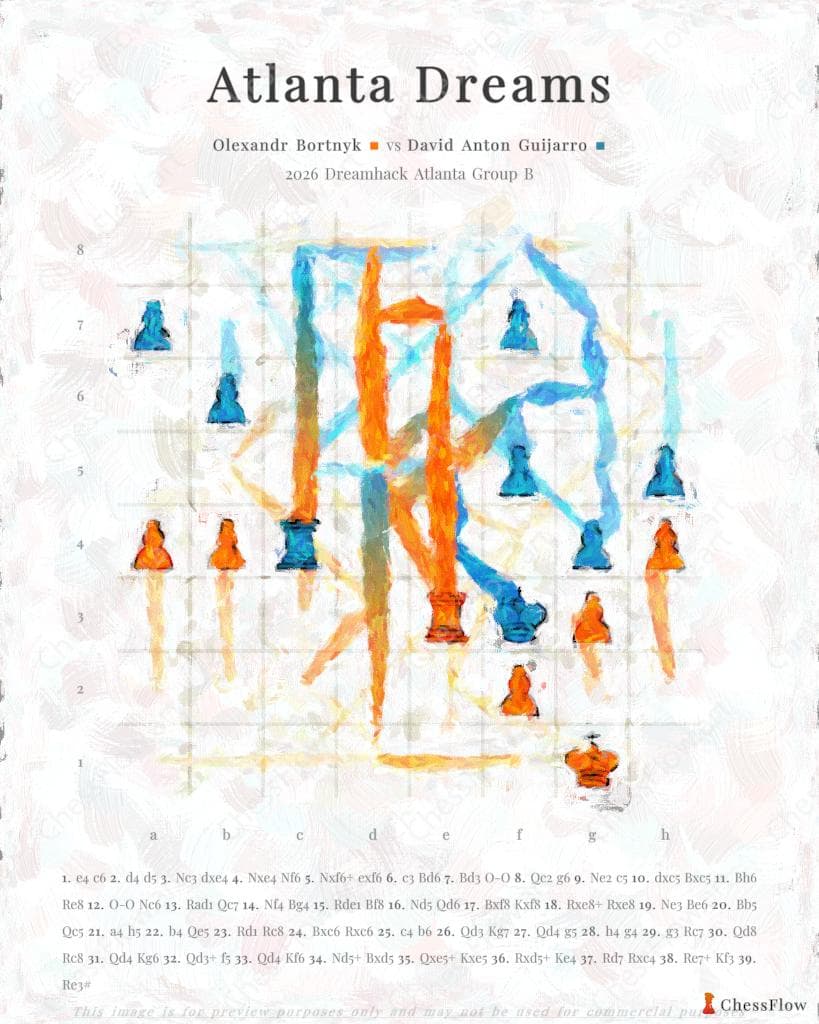
Olexandr Bortnyk vs David Anton Guijarro
Olexandr Bortnyk vs David Anton Guijarro
Checkmate in the Quarterfinals Olexandr Bortnyk ended David Anton Guijarro's DreamHack Atlanta run with actual checkmate on the board — not a resignation, not a time scramble, but the king cornered a...
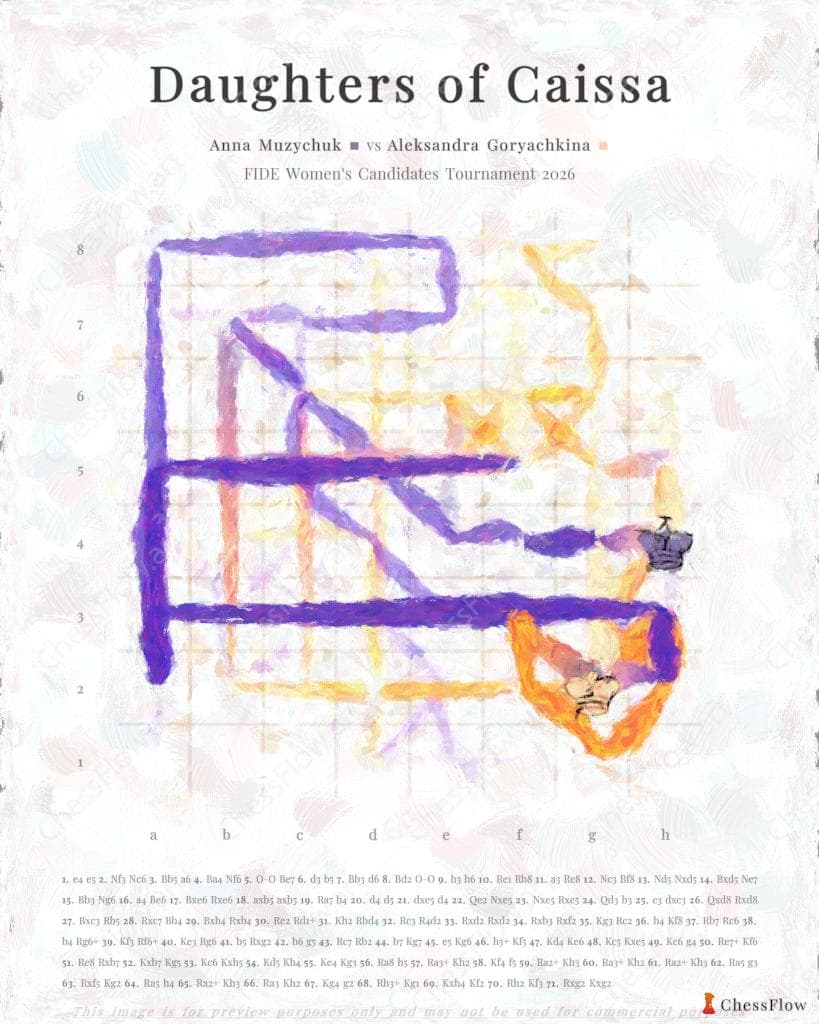
Anna Muzychuk vs Aleksandra Goryachkina
Anna Muzychuk vs Aleksandra Goryachkina
A Quiet Draw in the Ruy Lopez Anna Muzychuk and Aleksandra Goryachkina split the point in round 12 of the 2026 FIDE Women's Candidates Tournament, playing to a draw in the Ruy Lopez: Closed, Martinez...

Jiner Zhu vs Aleksandra Goryachkina
Jiner Zhu vs Aleksandra Goryachkina
Goryachkina Takes Down Zhu in Round 13 Aleksandra Goryachkina scored a crucial victory over Jiner Zhu in round 13 of the FIDE Women's Candidates Tournament 2026, dealing a blow to the Chinese GM's ch...