Third Rosenwald Trophy
Donald Byrne vs Robert Fischer
The Game of the Century
On the evening of October 17, 1956, inside New York’s Marshall Chess Club, a 13-year-old Bobby Fischer conjured a queen sacrifice so audacious that Chess Review editor Hans Kmoch immediately christened the encounter “The Game of the Century.” The game took place in the Third Lessing J. Rosenwald Trophy tournament, a prestigious invitational shared between the Manhattan and Marshall clubs, and it earned the boy from Brooklyn the event’s brilliancy prize and instant national fame (Wikipedia 2025; US Chess). ([Wikipedia][1])
The Players
Donald Byrne (1930–1976) was among the top U.S. masters of the 1950s: winner of the 1953 U.S. Open and later an Olympiad team member, recognized for elegant, classical play and refined technique (Wikipedia 2025). Robert James “Bobby” Fischer, by contrast, arrived as a prodigy fresh off a U.S. Junior title, already notorious at New York clubs for ferocious calculation and nervous energy. In hindsight it was a meeting of styles: Byrne’s cultured positional sense versus Fischer’s restless, hyper-active piece play (Wikipedia 2025; ChessBase 2011). ([Wikipedia][1])
The Game
Opening. Byrne begins with 1 Nf3 and soon steers into an English/Grünfeld hybrid:
1 Nf3 Nf6 2 c4 g6 3 Nc3 Bg7 4 d4 O-O 5 Bf4 d5 6 Qb3 dxc4 7 Qxc4 c6 8 e4 Nbd7 9 Rd1 Nb6 10 Qc5 Bg4
At this moment, Byrne played the natural-looking 11 Bg5?, repeating a developed piece and ceding time. Fischer replies 11…Na4!, the first crack of thunder: the queen on c5 is harassed; c3 is under pressure; e4 is tactically loose (Wikipedia 2025; Lichess PGN). ([Wikipedia][1])
The central skirmish. After 12 Qa3 Nxc3 13 bxc3, Fischer uncorks 13…Nxe4!, grabbing the e-pawn with tempo. When White counters 14 Bxe7, Black calmly places the queen on 14…Qb6, eyeing f2 and b2. Now comes the famous clearance: 15…Nxc3! 16 Bc5 Rfe8+ 17 Kf1, and instead of rescuing his endangered queen, Fischer stuns the room with 17…Be6!!, offering the queen (Wikipedia 2025). If White declines, Black’s activity overwhelms; if he accepts, a force of rooks and bishops floods the board. Byrne accepts: 18 Bxb6?? Bxc4+!, and suddenly every black piece is hunting the white king (Wikipedia 2025). ([Wikipedia][1])
The cascade. Fischer’s minor pieces then conduct a driving attack:
…19 Kg1 Ne2+ 20 Kf1 Nxd4+ 21 Kg1 Ne2+ 22 Kf1 Nc3+ 23 Kg1 axb6
The rook swing 24…Ra4 and the swarm on dark squares leave White’s queen marooned while Black’s bishops and knights do the damage. The game ends with 41…Rc2#, a picturesque mate that underlines how thoroughly Black’s army dominated after the queen sacrifice (Lichess PGN; Chess.com explainer). ([lichess.org][2])
Turning Points
- 11 Bg5? — The subtle mistake. By moving the bishop again instead of completing development (e.g., Be2 and castling), Byrne allowed …Na4 and …Nxe4 to seize the initiative (Wikipedia 2025). ([Wikipedia][1])
- 13…Nxe4! — Fischer’s first tactical commitment, opening lines with tempo and preparing the queen tour to b6 (Wikipedia 2025; Lichess PGN). ([Wikipedia][1])
- 17…Be6!! — The immortal queen offer. After 18 Bxb6 Bxc4+, Black’s material balance becomes rook + two bishops + pawn for the queen with a raging attack—more than sufficient given piece activity and king safety (Wikipedia 2025; Chess.com 2008). ([Wikipedia][1])
- 18 Bxb6?? — The losing capture. Stronger was 18 Qxc3, when Black still presses but White remains in the game; the text move allowed a forced, flowing attack (Lichess PGN). ([lichess.org][2])
Aftermath and Legacy
Kmoch’s cover story and annotations in Chess Review propelled the brilliancy into popular culture, and contemporary American media quickly embraced the narrative of a teenage genius felling a seasoned master (US Chess; New Yorker 1957). As history unfolded, the tale became prologue: within two years Fischer was a grandmaster; by 1972 he was world champion. The game remains a staple in anthologies for its didactic lessons—development over material, piece coordination vs. queen’s power, and the art of dynamic compensation (Wikipedia 2025; ChessBase 2011). ([US Chess.org][3])
Sources
- Wikipedia. “Game of the Century (chess)” (2025). (Wikipedia 2025). ([Wikipedia][1])
- Lichess. PGN: [Event “Third Rosenwald Trophy”], dated 1956-10-17, with full move list (Lichess PGN). ([lichess.org][2])
- Chess.com. “The game of the century” (2008) & overview explainer page (Chess.com 2008/2024). ([Chess.com][4])
- US Chess. “Throwback Thursday: Game of the Century Goes Viral in November 1956” (US Chess). ([US Chess.org][3])
- ChessBase. “Brady – Bobby Fischer’s Game of the Century” (2011) and later retrospectives (ChessBase 2011/2024). ([ChessBase][5])
1.Nf3 Nf6 2.c4 g6 3.Nc3 Bg7 4.d4 O-O 5.Bf4 d5 6.Qb3 dxc4 7.Qxc4 c6 8.e4 Nbd7 9.Rd1 Nb6 10.Qc5 Bg4 11.Bg5 Na4 12.Qa3 Nxc3 13.bxc3 Nxe4 14.Bxe7 Qb6 15.Bc4 Nxc3 16.Bc5 Rfe8+ 17.Kf1 Be6 18.Bxb6 Bxc4+ 19.Kg1 Ne2+ 20.Kf1 Nxd4+ 21.Kg1 Ne2+ 22.Kf1 Nc3+ 23.Kg1 axb6 24.Qb4 Ra4 25.Qxb6 Nxd1 26.h3 Rxa2 27.Kh2 Nxf2 28.Re1 Rxe1 29.Qd8+ Bf8 30.Nxe1 Bd5 31.Nf3 Ne4 32.Qb8 b5 33.h4 h5 34.Ne5 Kg7 35.Kg1 Bc5+ 36.Kf1 Ng3+ 37.Ke1 Bb4+ 38.Kd1 Bb3+ 39.Kc1 Ne2+ 40.Kb1 Nc3+ 41.Kc1 Rc2# 0-1
How would it look as art?


Own a piece of chess history. Transform this legendary game into a unique piece of art for your home or office.
Perfect For
- Unique Gifts for chess enthusiasts and players
- Tournament Prizes that winners will treasure
- Club Decor for chess clubs and gaming spaces
- Office Art showcasing strategic thinking
- Personal Collection of historic games
Explore more
Turn Your Games Into Art
Whether it's your own game from Chess.com or Lichess, or another historic masterpiece, transform any chess game into a stunning visual artwork.
You might also like
More legendary chess game stories
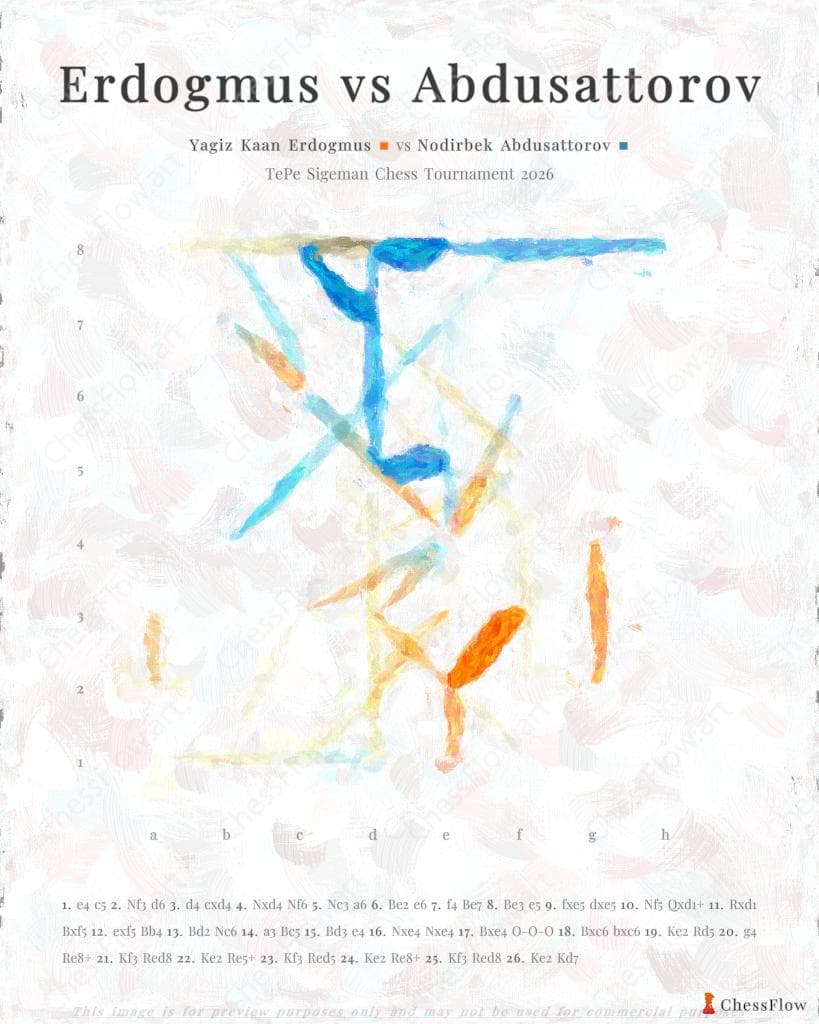
Yagiz Kaan Erdogmus vs Nodirbek Abdusattorov
Yagiz Kaan Erdogmus vs Nodirbek Abdusattorov
Erdogmus Holds Abdusattorov to a Draw in Critical Round 6 Clash Yagiz Kaan Erdogmus, the 14-year-old Turkish prodigy who recently became the youngest player ever to cross 2700, held Tata Steel Master...

Wenjun Ju vs Humpy Koneru
Wenjun Ju vs Humpy Koneru
Koneru Finds Redemption Against the World Champion Humpy Koneru entered round ten of Norway Chess Women 2026 in last place with just three points, having lost three Armageddon games already in Oslo....

Yi Wei vs Andrey Esipenko
Yi Wei vs Andrey Esipenko
Wei's First Strike Wei Yi finally broke through at the 2026 FIDE Candidates Tournament, defeating Andrey Esipenko 1-0 in round 13 with a sharp attacking game that emerged from the normally solid Petr...