TePe Sigeman Chess Tournament 2026
Erigaisi Beats Carlsen in Sigeman Tiebreak to Claim Title


Nordic Thunder
Erigaisi Takes Down Carlsen When It Mattered Most
Arjun Erigaisi is the 2026 TePe Sigeman Chess Tournament champion. The Indian GM defeated Magnus Carlsen in the tiebreak, converting a Pirc Defense into a full point when the tournament was on the line. After seven rounds of classical chess left them tied, it came down to rapid games — and Erigaisi proved the steadier hand.
The result caps a dominant week in Malmö for the 21-year-old, who entered the final round as sole leader on 4.5/6 before drawing with Andy Woodward to finish level with Carlsen. But when the tiebreak began, Erigaisi showed the same fighting spirit that had carried him through the tournament. "I wanted to get a game and try to take my chances," he had said after his round six win over Zhu Jiner, and that aggressive mindset carried into the playoff.
Carlsen, who had clawed his way back into contention after an early loss to Jorden van Foreest, needed a win with White to force further games. Instead, he found himself on the wrong side of a Pirc setup that gave Erigaisi exactly the kind of complex, unbalanced position he thrives in.
The Pirc Gambit
Erigaisi's opening choice was a statement. Against the highest-rated player in the field, with the tournament title at stake, he went with 1.e4 d6 2.d4 Nf6 3.Nc3 g6 — the Pirc Defense, an opening that invites White to build a big center and then looks to undermine it. It's not what you play when you're looking to hold a draw. It's what you play when you want a fight.
Carlsen responded with the Classical Variation, Quiet System, opting for 5.Be2 rather than the more aggressive Be3-Qd2-0-0-0 setups. The Norwegian was clearly looking to keep the game under control, to use his experience and technique to grind down his younger opponent. But Erigaisi had other plans.
The early middlegame saw both players maneuvering carefully. After 6...e6, Black signaled he wasn't going for the typical Pirc structure with ...c5 and ...Nc6-d4. Instead, Erigaisi was playing for a more solid setup, keeping his options open while waiting for White to commit.
Carlsen pushed forward on the queenside with 7.a4 and 8.a5, gaining space but also fixing his own pawn structure. The engine approved — evaluations hovered around +0.7 to +0.9 through the early moves — but this is exactly the kind of position where engine assessments and human reality diverge. White has "an edge," sure, but converting that edge against a top-10 player who's comfortable in the position is another matter entirely.
Carlsen's Queenside Ambitions
The pawn thrust 11.a6 was a committal decision. Carlsen was betting that the a6 pawn would become a permanent thorn, restricting Black's queenside and potentially providing a hook for future operations. The engine liked it, showing White up around +1.2, but engines don't have to sit across from Arjun Erigaisi for four hours.
Black's knight retreated with 11...Ne7, a modest move that repositioned the piece toward better squares. Erigaisi tucked his king away with 12...Kh7, a prophylactic move that removed any back-rank tricks and prepared to expand in the center when the moment was right.
The position after 13.Bd3 was instructive. White had a space advantage, a well-placed bishop, and that annoying a6 pawn cramping Black's queenside. But Black's position was solid, his pieces were coordinated, and most importantly, he had a clear plan: wait for White to overextend, then strike back.
This is where Carlsen made his first questionable decision. 14.Ne2?! was flagged as an inaccuracy by the engine, which preferred 14.Bf4 to maintain pressure. The knight retreat to e2 looked logical — repositioning toward g3 or f4 — but it gave Black a tempo to improve his position. The evaluation dropped from around +1.3 to +1.0, not a disaster, but in a game where small edges matter, every inaccuracy adds up.
The Human Factor
What followed was a tense middlegame where both players were operating on the edge. Carlsen, who had described his round five win over Zhu Jiner as "incredibly shaky" and admitted "I certainly was not capable" of calculating all the complications, was clearly not at his sharpest this week. The fatigue of a seven-round tournament, followed immediately by a high-stakes tiebreak, takes its toll even on the best.
Erigaisi, by contrast, seemed to grow stronger as the tournament progressed. His round six win over Zhu had been a 67-move grind, the kind of game that can either exhaust you or build momentum. For the Indian star, it was clearly the latter.
The Pirc is an opening that requires patience. Black often spends the first 15-20 moves simply surviving, waiting for White's initiative to fade, then launching a counterattack. It's not glamorous chess, but it's effective — especially against opponents who expect quick results.
Carlsen's approach with 7.a4 and the subsequent queenside expansion was theoretically sound but practically double-edged. Yes, the a6 pawn restricted Black's queenside, but it also meant White had to commit significant resources to defending it. And in a rapid tiebreak, where time pressure amplifies every decision, having a pawn stranded on a6 can become a liability rather than an asset.
Tournament Context
This tiebreak victory was the culmination of a week where Erigaisi simply outperformed the field. He entered the final round as sole leader after grinding out wins against Zhu Jiner and Jorden van Foreest, while also holding draws against tough opposition. His only "loss" of momentum came in round two, when Yagiz Kaan Erdogmus held him to a 78-move draw despite being worse for most of the game.
Carlsen's tournament was more turbulent. After losing to Van Foreest in round four — a game where the Dutch GM found a spectacular way to punish Carlsen's ambitious play — the Norwegian needed to win his remaining games just to stay in contention. He managed it against Zhu and Woodward, but the effort seemed to take something out of him.
The final standings had Erigaisi and Carlsen tied on 5/7 in the classical portion, with Erdogmus finishing half a point back. The Turkish teenager, just 14 years old, had announced himself as a serious talent by leading or co-leading for most of the tournament, but couldn't quite keep pace with the leaders in the final rounds.
What This Means
For Erigaisi, the Sigeman title is another milestone in what's becoming a remarkable career. The 21-year-old has been knocking on the door of the absolute elite for years, and victories like this one — against Carlsen, in a tiebreak, with the title on the line — prove he belongs. His live rating after this tournament should see him firmly established in the world's top ten.
For Carlsen, it's a rare instance of coming up short when it mattered most. The Norwegian has been nearly unbeatable in these situations for over a decade, but at 35, facing a hungry young opponent who had nothing to lose, the magic wasn't quite there. His comments throughout the tournament — calling games "shaky," admitting he "felt lucky" to survive certain positions — suggested a player not quite at his best.
The game itself, while not featuring any spectacular sacrifices or tactical fireworks, was a clinic in practical chess. Erigaisi showed that you don't need to play for brilliancies to beat the best. Sometimes, you just need to be solid, patient, and ready to pounce when your opponent makes a small mistake.
We turned this final position into a print — there's something about a Pirc Defense victory over Carlsen that deserves to be on a wall.
The TePe Sigeman Chess Tournament continues to punch above its weight as one of the most interesting events on the calendar. The combination of elite players, rising stars, and the intimate atmosphere of Malmö's Elite Plaza Hotel creates exactly the kind of chess we want to see: fighting games with real stakes. Erigaisi's victory ensures the 2026 edition will be remembered as one of the best.
1.e4 d6 2.d4 Nf6 3.Nc3 g6 4.Nf3 Bg7 5.Be2 O-O 6.O-O e6 7.a4 Nc6 8.a5 Rb8 9.h3 h6 10.Be3 b6 11.a6 Ne7 12.Qd2 Kh7 13.Bd3 c6 14.Ne2 b5 15.Ng3 Rb6 16.b3 Qc7 17.c4 bxc4 18.bxc4 c5 19.d5 e5 20.Nh2 Bxa6 21.f4 exf4 22.Bxf4 Nd7 23.Ra2 Ne5 24.Bxe5 Bxe5 25.Ng4 Bd4+ 26.Kh1 Ng8 27.e5 dxe5 28.Ne4 f5 29.Nxh6 Nxh6 30.Ng5+ Kg7 31.Ne6+ Rxe6 32.dxe6 Bc8 33.Qg5 Bxe6 34.Ra6 Rf6 35.Rb1 e4 36.Be2 Nf7 37.Qd2 Bc8 38.Rxf6 Bxf6 39.Qd5 Bd4 0-1
How would it look as art?


Own a piece of chess history. Transform this legendary game into a unique piece of art for your home or office.
Perfect For
- Unique Gifts for chess enthusiasts and players
- Tournament Prizes that winners will treasure
- Club Decor for chess clubs and gaming spaces
- Office Art showcasing strategic thinking
- Personal Collection of historic games
Turn Your Games Into Art
Whether it's your own game from Chess.com or Lichess, or another historic masterpiece, transform any chess game into a stunning visual artwork.
You might also like
More legendary chess game stories
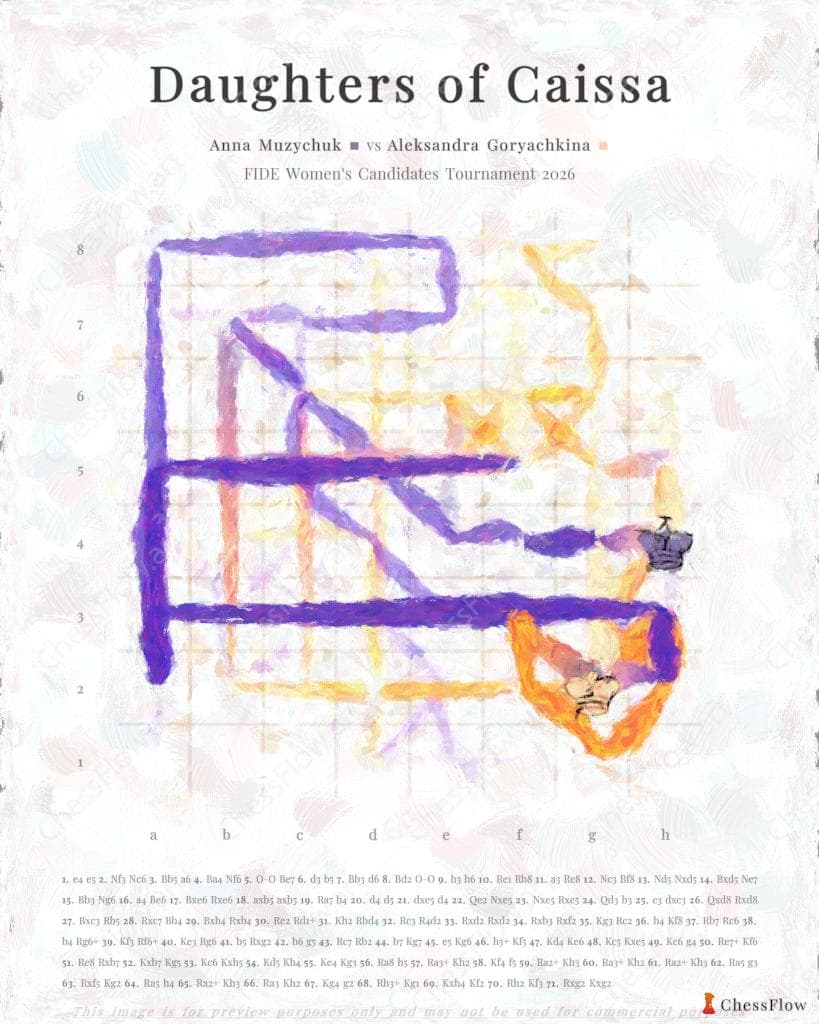
Anna Muzychuk vs Aleksandra Goryachkina
Anna Muzychuk vs Aleksandra Goryachkina
A Quiet Draw in the Ruy Lopez Anna Muzychuk and Aleksandra Goryachkina split the point in round 12 of the 2026 FIDE Women's Candidates Tournament, playing to a draw in the Ruy Lopez: Closed, Martinez...
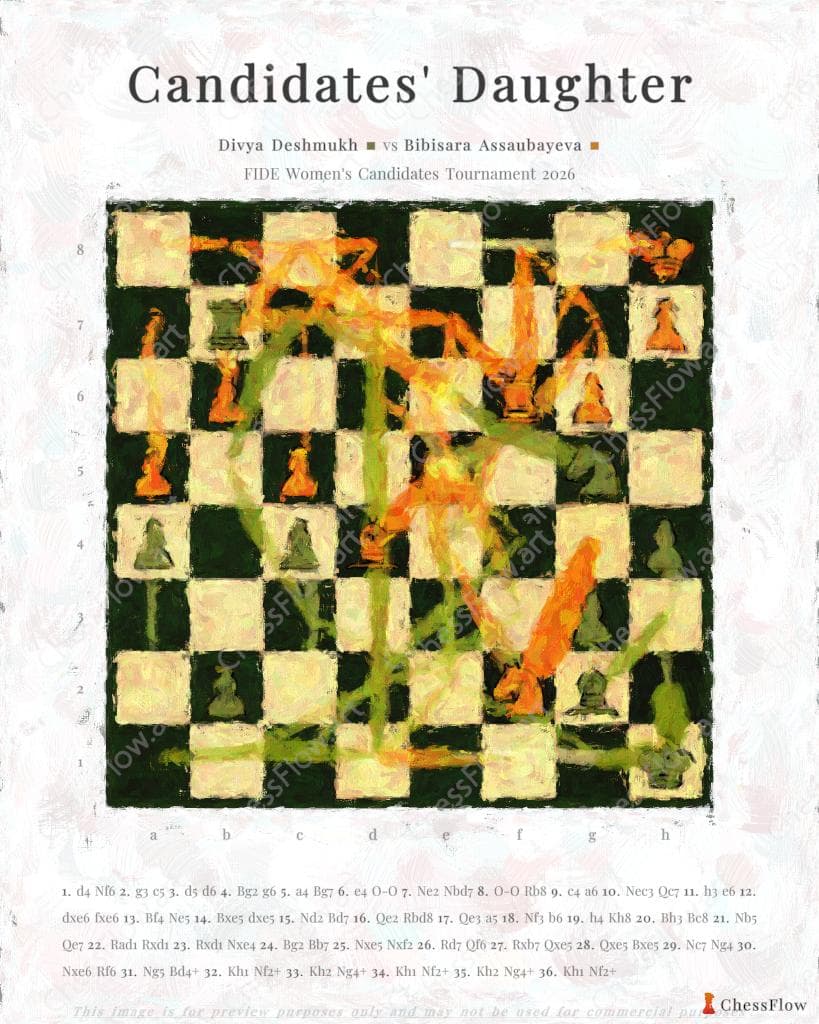
Divya Deshmukh vs Bibisara Assaubayeva
Divya Deshmukh vs Bibisara Assaubayeva
The Final Round Showdown Round 14 of the 2026 FIDE Women's Candidates Tournament delivered a crucial draw between GM Divya Deshmukh (2497) and GM Bibisara Assaubayeva (2516). With Assaubayeva enterin...
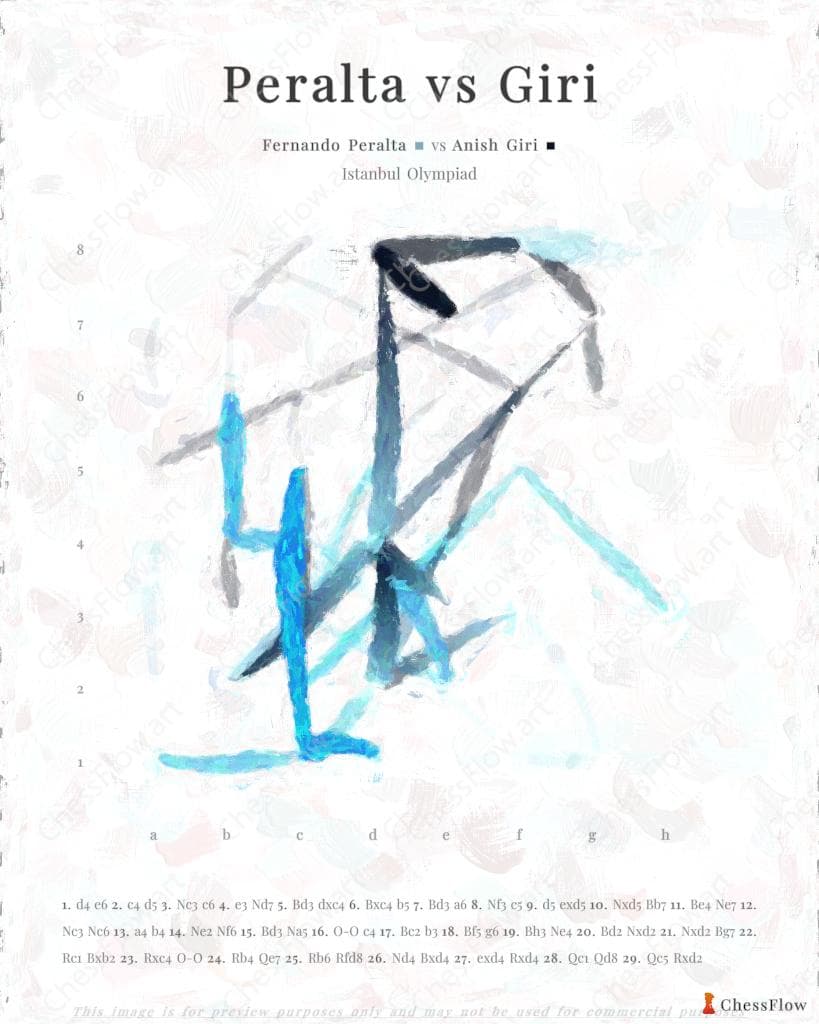
Fernando Peralta vs Anish Giri
Fernando Peralta vs Anish Giri
The Opening Battle Fernando Peralta (2606) faced off against rising Dutch talent Anish Giri (2711) in round 5 of the 2012 Istanbul Olympiad. The game opened with the Queen's Gambit Declined, Semi-Sla...