TePe Sigeman Chess Tournament 2026
Carlsen Beats Erdogmus to Win TePe Sigeman 2026


Magnus in D Minor
Carlsen Clinches First Place in Final-Round Showdown
Magnus Carlsen defeated Yagiz Kaan Erdogmus in round seven of the TePe Sigeman Chess Tournament to clinch first place, turning what was billed as a generational clash into a methodical positional squeeze. The win gave Carlsen clear first with 5½/7 points, while Erdogmus—the youngest player ever to cross 2700—finished half a point behind alongside Arjun Erigaisi.
The pairing had been circled since the tournament began. Erdogmus, at 2708, had entered Malmö as one of the most closely watched young players in the world. His recent rise past the 2700 mark made this more than a tournament game—it was a measuring stick, a chance to see how the Turkish teenager would handle Carlsen with everything on the line.
What Erdogmus got instead was a lesson in how Carlsen grinds out wins from nothing. The game never featured a single moment of tactical fireworks. There was no sacrifice, no attack, no clock scramble. Just a slow, relentless accumulation of small advantages that eventually became insurmountable.
The Queen's Gambit Accepted Goes Quiet
Carlsen opened with 1.d4 d5 2.Nf3 c5 3.c4 dxc4, entering the Queen's Gambit Accepted via the Gunsberg Defense. The early queen exchange after 4.e4 cxd4 5.Qxd4 Qxd4 6.Nxd4 signaled Carlsen's intentions immediately: no middlegame complications, just a long technical battle where his experience would count.
This is a critical strategic choice. Against a rising star like Erdogmus, many players would opt for sharp positions where anything can happen. Carlsen chose the opposite approach—he wanted to play chess, not roll dice.
After 6...Bd7 7.Bxc4 Nc6 8.Be3 Nxd4 9.Bxd4, the position had simplified considerably. Both sides had developed naturally, but White retained a slight edge thanks to the bishop pair and better central control. The evaluation hovered around +0.35 to +0.40 throughout—nothing dramatic, but Carlsen has built a career on converting these margins.
The Maneuvering Phase
What followed was a lesson in... no, strike that. What followed was pure Carlsen: patient piece shuffling that gradually improved his position while Erdogmus struggled to find counterplay.
The move 10.f3 secured the e4 pawn and prepared to centralize the king. Erdogmus responded with 10...Ne7, and here the clock differential started to matter. Carlsen had used only about ten minutes of thinking time through the first ten moves, while Erdogmus had already burned through nearly half an hour.
After 11.Kf2, Carlsen's king walked toward the center—a typical endgame technique that's easier to describe than to execute against a 2700+ player. The king on f2 supports the f3 pawn, keeps an eye on the e3 square, and prepares to march further into the game if needed.
Erdogmus tried 11...Nc6, retreating the knight to challenge the d4 bishop. Carlsen simply played 12.Be3, sidestepping the exchange and maintaining flexibility. The bishop had done its job on d4 and now relocated to a safer diagonal.
Erdogmus Seeks Counterplay
The position after 12...Rc8 13.Nd2 Ne5 14.Be2 shows the kind of structure where engines claim equality but humans feel the pressure. Black's pieces are developed, the rooks are connected, and there's no immediate tactical problem. But what's the plan?
Erdogmus played 14...Bc5, offering a bishop trade that would ease his defensive burden. This is sensible—when you're slightly worse, exchanges usually help. But it also acknowledges that Black has no active prospects.
The challenge in such positions is psychological as much as technical. Erdogmus had to sit across from the greatest player in chess history, knowing that any small mistake could snowball. The engines might show +0.25, but no human wants to defend this for 40 moves against Magnus Carlsen with the tournament on the line.
The Gap Between Engine and Human
This game illustrates something important about modern chess: evaluation numbers don't capture the human experience of a position. Throughout the opening and early middlegame, Stockfish showed White with advantages between +0.2 and +0.4—technically almost nothing.
But "almost nothing" against Carlsen is different from "almost nothing" against most grandmasters. His ability to maintain pressure, avoid errors, and convert minimal advantages is what made him world champion for a decade. Erdogmus wasn't losing to tactics or blunders; he was losing to the accumulated weight of having no good moves while Carlsen always had something useful to do.
The time situation reflected this pressure. By move 14, Erdogmus had used over 40 minutes while Carlsen had spent barely 20. That gap would only widen as the game progressed, and in a position requiring precise defense, clock pressure becomes another weapon.
Tournament Context: Everything on the Line
Going into this final round, Erigaisi led with 4½/6 points. Carlsen and Erdogmus were both half a point behind at 4/6. The math was simple: Carlsen needed to win to have any chance at first place, while Erdogmus could have secured at least a share of the lead with a draw.
This context made Erdogmus's task even harder. He wasn't just playing Black against Carlsen—he was playing Black against Carlsen when a draw would be a good result, which creates a defensive mindset that's difficult to shake. Meanwhile, Carlsen had nothing to lose by pressing.
The pairing also carried symbolic weight. As the research noted, "Erdogmus' recent rise past the 2700 rating mark has made him one of the most closely watched young players in the world, and his meeting with Carlsen comes with the added interest of a potential future successor facing the player who has long stood at the top of the chess world."
Future successor or not, Erdogmus learned something in Malmö: there's a difference between reaching 2700 and beating Carlsen when it matters.
Carlsen's Tournament Arc
This win capped a typical Carlsen performance: not flawless, but ultimately successful. Earlier in the tournament, he had described his win against Zhu Jiner as "incredibly shaky," admitting "I just feel really, really lucky that I managed to survive—it was very difficult to calculate, and I certainly was not capable!"
He had also lost to Jorden van Foreest in round four—the first player to beat Carlsen in classical chess since Gukesh's famous win at Norway Chess 2025. That loss dropped him from the lead and set up the must-win scenario in the final round.
The contrast between those games and this one shows Carlsen's range. Against Zhu, he scrambled and survived. Against Van Foreest, he ground down and lost. Against Erdogmus, he controlled the game from the opening and never let his opponent generate meaningful counterplay.
After round two, Carlsen had commented that the tournament was helping him "shake off the rust" after limited classical activity—just one official classical game since Norway Chess in June 2025 before arriving in Malmö. By round seven, the rust appeared to be gone.
Erdogmus: Defeat, But Not Disgrace
For Erdogmus, this loss stings but doesn't diminish what he accomplished in Malmö. He entered the tournament having just become the youngest player ever to cross 2700, and he competed for first place until the final round. His current live rating of 2716.3 places him 27th in the world, within a point of former world number-two players Shakhriyar Mamedyarov and Maxime Vachier-Lagrave.
Earlier in the tournament, Erdogmus had shown the maturity that makes him such a interesting prospect. After beating Grandelius with a beautiful knight maneuver, he kept his feet on the ground: "The important thing is just to play good chess... He just made two big blunders—that's why I won the game!"
That attitude will serve him well. Losing to Carlsen in a must-win situation is no shame, especially when the loss came through positional pressure rather than blunders. Erdogmus defended well; he just didn't have enough to hold against relentless pressure.
The Final Standings
Carlsen's win gave him clear first place with 5½/7. Erigaisi, who faced Woodward with White in the other crucial game, finished alongside Erdogmus on 5/7. The tournament delivered on its promise of competitive chess, with the title decided only in the final round.
For Carlsen, it's another trophy in a career full of them. For Erdogmus, it's a learning experience against the best—the kind of game you study and grow from. The position after move 14, with all that quiet pressure building, is the kind of thing you hang on a wall.
What This Means Going Forward
Carlsen continues to prove that reports of his decline are premature. Yes, he lost to Van Foreest. Yes, he admitted to being "incredibly shaky" against Zhu. But when the tournament was on the line, he delivered exactly the kind of controlled, professional performance that defined his decade at the top.
Erdogmus will be back. At his age, with his trajectory, tournaments like this are stepping stones. He held his own against Erigaisi in round two, survived a 104-move marathon against Woodward, and competed for first place until the final game. The sky really is the limit for the teenager from Bursa.
The TePe Sigeman Chess Tournament once again delivered a memorable finish. The Elite Plaza Hotel in Malmö has become a reliable stop on the chess calendar, producing decisive games and meaningful results year after year. Carlsen's fifth win of the event—or however many it is now—only adds to that legacy.
1.d4 d5 2.Nf3 c5 3.c4 dxc4 4.e4 cxd4 5.Qxd4 Qxd4 6.Nxd4 Bd7 7.Bxc4 Nc6 8.Be3 Nxd4 9.Bxd4 e6 10.f3 Ne7 11.Kf2 Nc6 12.Be3 Rc8 13.Nd2 Ne5 14.Be2 Bc5 15.Bxc5 Rxc5 16.Rhc1 Rxc1 17.Rxc1 Nc6 18.e5 Ke7 19.f4 Rc8 20.a3 f6 21.exf6+ gxf6 22.Rc3 Nd4 23.Rxc8 Bxc8 24.Bd3 h6 25.Ke3 Nc6 26.Nf3 b6 27.g4 e5 28.h3 Kd6 29.Nd2 exf4+ 30.Kxf4 Ne5 31.Bf5 Bb7 32.Bc2 Bg2 33.Kg3 Bd5 34.Kf4 Bg2 35.h4 Ke7 36.b3 Bh3 37.Bf5 Bg2 38.Ne4 Bxe4 39.Bxe4 Nf7 40.Bd5 Nd6 41.a4 Kd7 42.b4 Nc8 43.Ke4 Ne7 44.Kd4 f5 45.g5 hxg5 46.hxg5 Kd6 47.Bb7 Ng6 48.Kc4 Nf8 49.Bc8 Ne6 50.g6 Ke7 51.Kb5 f4 52.Ka6 f3 53.Kxa7 b5 54.g7 Nxg7 55.axb5 f2 56.Bh3 Ne6 57.b6 Nd4 58.b7 Nc6+ 59.Ka8 1-0
How would it look as art?


Own a piece of chess history. Transform this legendary game into a unique piece of art for your home or office.
Perfect For
- Unique Gifts for chess enthusiasts and players
- Tournament Prizes that winners will treasure
- Club Decor for chess clubs and gaming spaces
- Office Art showcasing strategic thinking
- Personal Collection of historic games
Explore more
Turn Your Games Into Art
Whether it's your own game from Chess.com or Lichess, or another historic masterpiece, transform any chess game into a stunning visual artwork.
You might also like
More legendary chess game stories
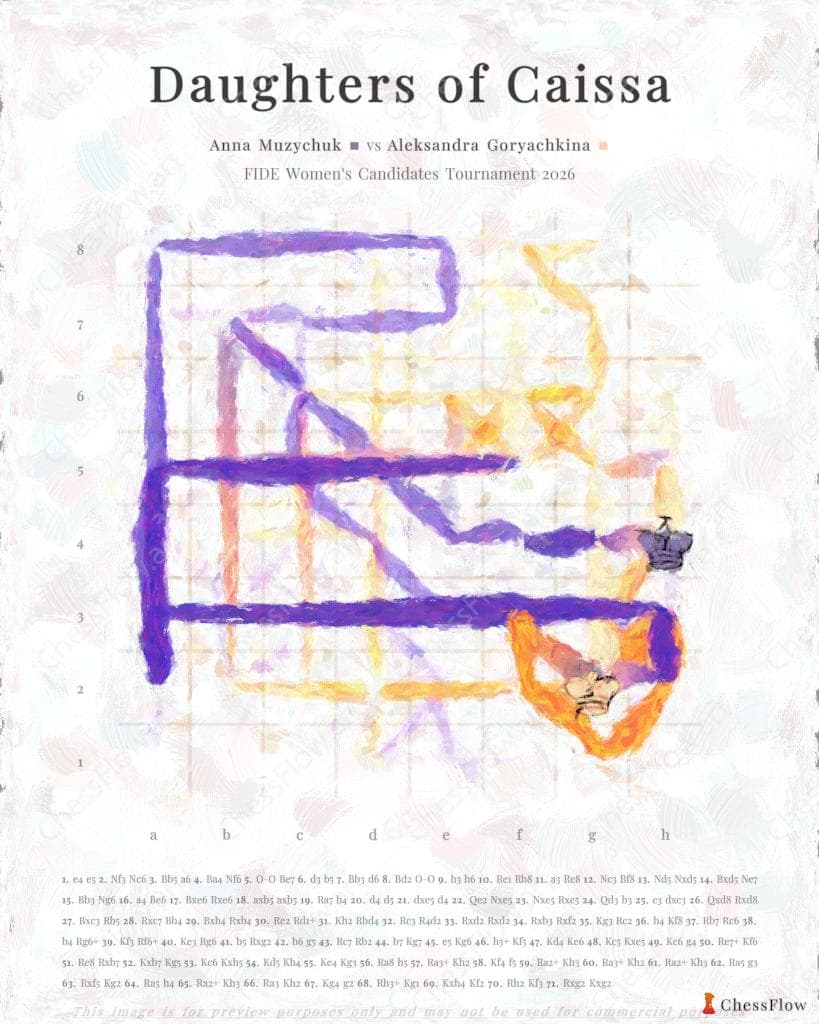
Anna Muzychuk vs Aleksandra Goryachkina
Anna Muzychuk vs Aleksandra Goryachkina
A Quiet Draw in the Ruy Lopez Anna Muzychuk and Aleksandra Goryachkina split the point in round 12 of the 2026 FIDE Women's Candidates Tournament, playing to a draw in the Ruy Lopez: Closed, Martinez...

Jiner Zhu vs Aleksandra Goryachkina
Jiner Zhu vs Aleksandra Goryachkina
Goryachkina Takes Down Zhu in Round 13 Aleksandra Goryachkina scored a crucial victory over Jiner Zhu in round 13 of the FIDE Women's Candidates Tournament 2026, dealing a blow to the Chinese GM's ch...
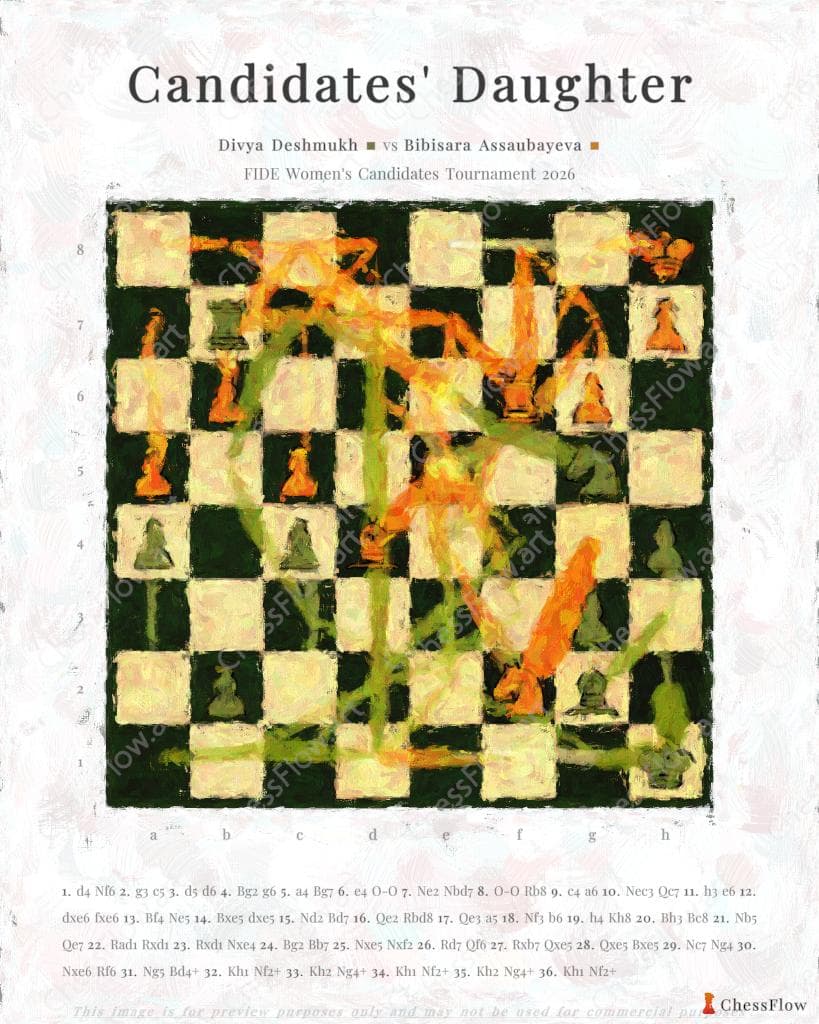
Divya Deshmukh vs Bibisara Assaubayeva
Divya Deshmukh vs Bibisara Assaubayeva
The Final Round Showdown Round 14 of the 2026 FIDE Women's Candidates Tournament delivered a crucial draw between GM Divya Deshmukh (2497) and GM Bibisara Assaubayeva (2516). With Assaubayeva enterin...