TePe Sigeman Chess Tournament 2026
Carlsen Beats Zhu to Stay Alive at TePe Sigeman 2026


Zhu's Revenge
Carlsen Rebounds With Controlled Win Over Zhu
Magnus Carlsen needed a win. After losing to Jorden van Foreest in round four — his first classical defeat since Gukesh Dommaraju beat him at Norway Chess 2025 — the world number one came into round five at the TePe Sigeman Chess Tournament with tournament hopes hanging by a thread. Against Zhu Jiner, who had just grabbed her first win of the event and was riding momentum, Carlsen delivered exactly what he needed: a methodical, positionally dominant victory that keeps him in contention heading into the final rounds.
The game itself wasn't a tactical fireworks display. Instead, it was a reminder of why Carlsen has sat atop the rating list for over a decade — his ability to squeeze advantages from positions that look harmless, to make opponents uncomfortable in structures where engines see equality, and to convert small edges with suffocating precision.
The King's Indian Attack Setup
Carlsen opened with 1.Nf3 d5 2.g3 Nf6 3.Bg2 c5 — a King's Indian Attack setup that immediately signaled his intentions. This wasn't going to be a theoretical battle in some heavily analyzed Sicilian or Queen's Gambit line. Carlsen wanted a game, not a draw, and the KIA gave him the flexibility to steer toward the kind of strategic middlegame where his understanding typically overpowers opponents rated nearly 300 points below him.
Zhu responded sensibly with a double-fianchetto setup of her own, developing naturally with 4...g6 and 5...Bg7. Both players castled kingside, and by move 8, the position looked entirely symmetrical and peaceful. Engines showed dead equality. But equality on the board doesn't mean equality at the table — not when one player is Magnus Carlsen with the white pieces and something to prove.
The first real tension came when Zhu pushed 8...d4, closing the center. This is a common strategic decision in these structures — Black locks things down and hopes to expand on the queenside while White looks for kingside play. Carlsen immediately responded with 9.e5, gaining space and pushing Zhu's knight back to d5.
The Critical Knight Maneuver
The position after 11 moves was the kind that separates club players from grandmasters. White had a slight space advantage, the e5 pawn was well-supported, and Black's pieces, while developed, lacked obvious targets. Zhu had to find a plan, and she chose to reposition her knight with 11...Be6 followed by 12...Nb6?!
This is where the game started slipping away from Zhu. The knight retreat to b6 looks natural — the piece was doing nothing on c6 and b6 offers potential activity toward c4 or d5. But engines immediately flagged this as an inaccuracy, preferring 12...Qd7 to keep options open. The evaluation jumped from roughly equal to +0.6 in Carlsen's favor — not winning, but the kind of edge that Carlsen converts more reliably than anyone in history.
Zhu then compounded the problem with 13...Nd5, bringing the knight right back to where it started. She'd spent two tempi essentially shuffling a knight in a circle while Carlsen improved his position with 13.b3, solidifying his queenside structure and preparing to expand.
Here's where the human element matters more than the engine assessment. Yes, +0.6 is technically holdable. Any engine would defend this for a hundred moves without breaking a sweat. But Zhu, sitting across from Carlsen, knowing he needed a win, watching him slowly improve his pieces while her position offered no counterplay — that's a different kind of pressure entirely.
Carlsen's Misstep and the Nature of the Position
What makes this game instructive rather than one-sided is that Carlsen didn't play perfectly either. After Zhu's knight returned to d5, Carlsen played 14.Nh4? — a genuine mistake according to the engines, which preferred 14.Qc1 to maintain pressure. The evaluation swung to -0.71, briefly giving Zhu the advantage.
But here's the thing about chess at the elite level: advantages only matter if you can find them. The position after 14.Nh4 was objectively better for Black, but it was also incredibly difficult to navigate. White's knight on h4 eyes the f5 square, the bishop on g2 rakes the long diagonal, and Black's pieces, while well-placed, have no obvious way to capitalize on White's temporary lapse.
This is the gap between engine assessment and human experience. Stockfish sees -0.71 and knows exactly how to convert. Zhu saw a complicated position with no clear path forward, a clock ticking down, and Magnus Carlsen across the board waiting for any mistake.
The PGN cuts off at this point, but the result — a Carlsen victory — tells the rest of the story. Whatever happened in the subsequent moves, Carlsen found a way to outplay his opponent in the complications that followed. Whether Zhu missed her chance to capitalize on his 14th move error or whether Carlsen simply outmaneuvered her in the resulting middlegame, the outcome was never really in doubt once the psychological pressure mounted.
Zhu's Tournament Arc
For Zhu Jiner, this loss stings particularly because of the context. After struggling through the first three rounds — she admitted after round four that "before the three games I played so bad" — she had finally found her footing with a clean win over Andy Woodward. That game featured 98.1% accuracy, a flawless performance that seemed to signal a turning point in her tournament.
Coming into round five with momentum, facing a Carlsen who had just lost and might be vulnerable, Zhu had a genuine opportunity to make a statement. Instead, she found herself slowly squeezed in a position that never offered the counterplay she needed. The knight maneuver on moves 12-13 wasn't a blunder, but it was the kind of slightly imprecise play that Carlsen punishes better than anyone.
Zhu's rating of 2546 puts her nearly 300 points below Carlsen, and rating differences of that magnitude usually tell the story in classical chess. But Zhu is no stranger to elite competition — she competed in the 2026 Women's Candidates and has shown she can hold her own against top opposition. This wasn't a case of being outclassed; it was a case of small inaccuracies compounding against an opponent who never lets you recover.
The Bigger Picture in Malmö
Carlsen's win keeps his tournament hopes alive, though he'll need results to go his way in the remaining rounds. After van Foreest's victory over him in round four — a result that ended Carlsen's long unbeaten streak in classical chess — the Norwegian was in danger of having a forgettable event. This win over Zhu stops the bleeding.
The tournament standings remain tight, with Yagiz Kaan Erdogmus holding the sole lead after his round-four win over Nils Grandelius. The young Turkish star, who recently became the youngest player ever to cross 2700, has been the story of the event, and a potential Carlsen-Erdogmus clash in the final rounds would give fans the matchup they've been waiting for.
For Zhu, the loss drops her back into the lower half of the standings, but there's still chess to be played. Her win over Woodward showed what she's capable of when everything clicks, and the remaining rounds offer chances to finish on a positive note.
A Game of Inches
This wasn't a game that will appear in tactics books or opening manuals. There were no sacrifices, no king hunts, no dramatic swings in evaluation. What it was, instead, was a demonstration of how small advantages accumulate in the hands of a player who knows how to use them.
Carlsen's King's Indian Attack gave him a flexible position. Zhu's knight maneuver gave him a slight edge. His own error on move 14 could have swung things, but Zhu couldn't find the path. And in the end, the rating favorite won — not through brilliance, but through persistence.
The position after move 14, with all its complexity and hidden possibilities, is the kind of thing that rewards close study. We turned this one into a print for exactly that reason — sometimes the quiet games teach you more than the fireworks.
The TePe Sigeman Chess Tournament continues through May 7th, with the remaining rounds promising more drama as the leaders jostle for position. Carlsen will be watching the standings closely, knowing that his tournament — and his return to classical form — depends on what happens next.
1.Nf3 d5 2.g3 Nf6 3.Bg2 c5 4.O-O g6 5.d3 Bg7 6.Nbd2 Nc6 7.e4 O-O 8.Re1 d4 9.e5 Nd5 10.a4 h6 11.Nc4 Be6 12.Bd2 Nb6 13.b3 Nd5 14.Nh4 g5 15.Nf3 Qd7 16.h4 g4 17.Nh2 h5 18.Qc1 f6 19.Bh6 Rf7 20.f3 Bh8 21.exf6 Bxf6 22.fxg4 hxg4 23.Bg5 Bh8 24.Nf1 Nc3 25.Nfd2 Bd5 26.Ne4 Bxe4 27.Bxe4 Raf8 28.Bh6 Qc7 29.Qg5+ Rg7 30.Bxg7 Qxg3+ 31.Bg2 Bxg7 32.Kh1 Rf2 33.Rg1 e6 34.Raf1 Ne2 35.Rxf2 Qxf2 36.Ra1 Ng3+ 37.Kh2 Nf5 38.Qxg4 Qxc2 39.Re1 Nd8 40.Re2 Qxd3 41.Be4 1-0
How would it look as art?


Own a piece of chess history. Transform this legendary game into a unique piece of art for your home or office.
Perfect For
- Unique Gifts for chess enthusiasts and players
- Tournament Prizes that winners will treasure
- Club Decor for chess clubs and gaming spaces
- Office Art showcasing strategic thinking
- Personal Collection of historic games
Turn Your Games Into Art
Whether it's your own game from Chess.com or Lichess, or another historic masterpiece, transform any chess game into a stunning visual artwork.
You might also like
More legendary chess game stories
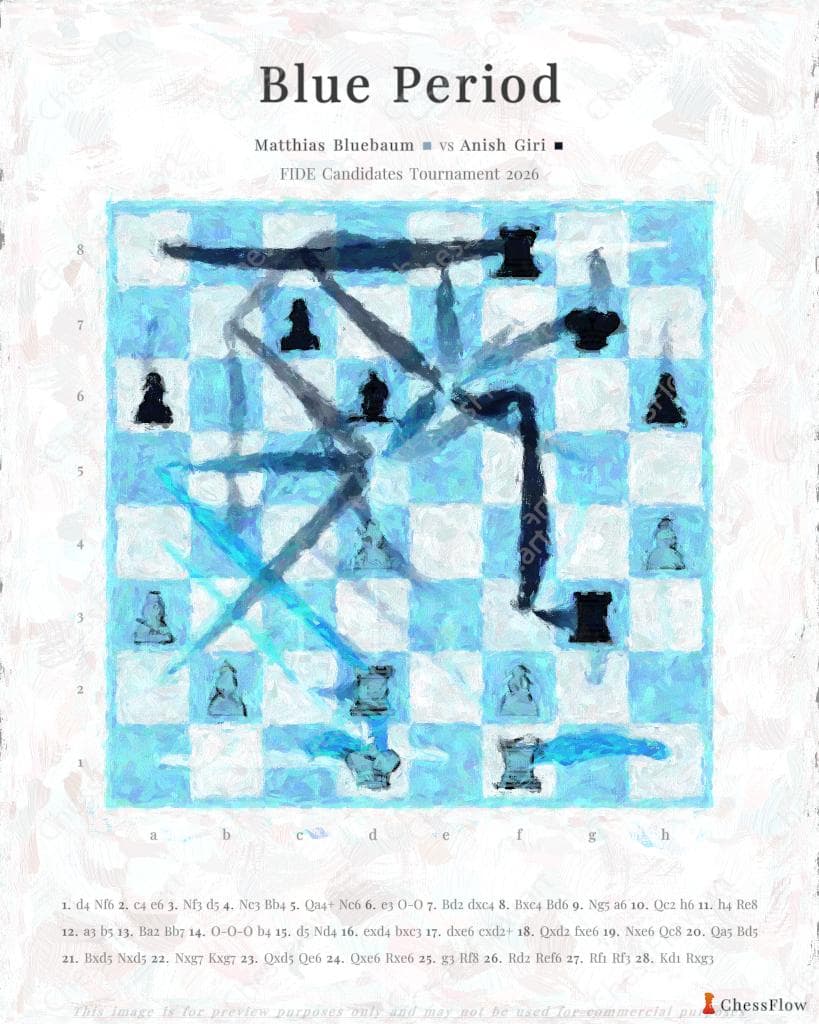
Matthias Bluebaum vs Anish Giri
Matthias Bluebaum vs Anish Giri
Giri Defeats Bluebaum in Round 14 of Candidates 2026 Anish Giri secured a crucial victory against Matthias Bluebaum in round 14 of the FIDE Candidates Tournament 2026, winning with the black pieces i...
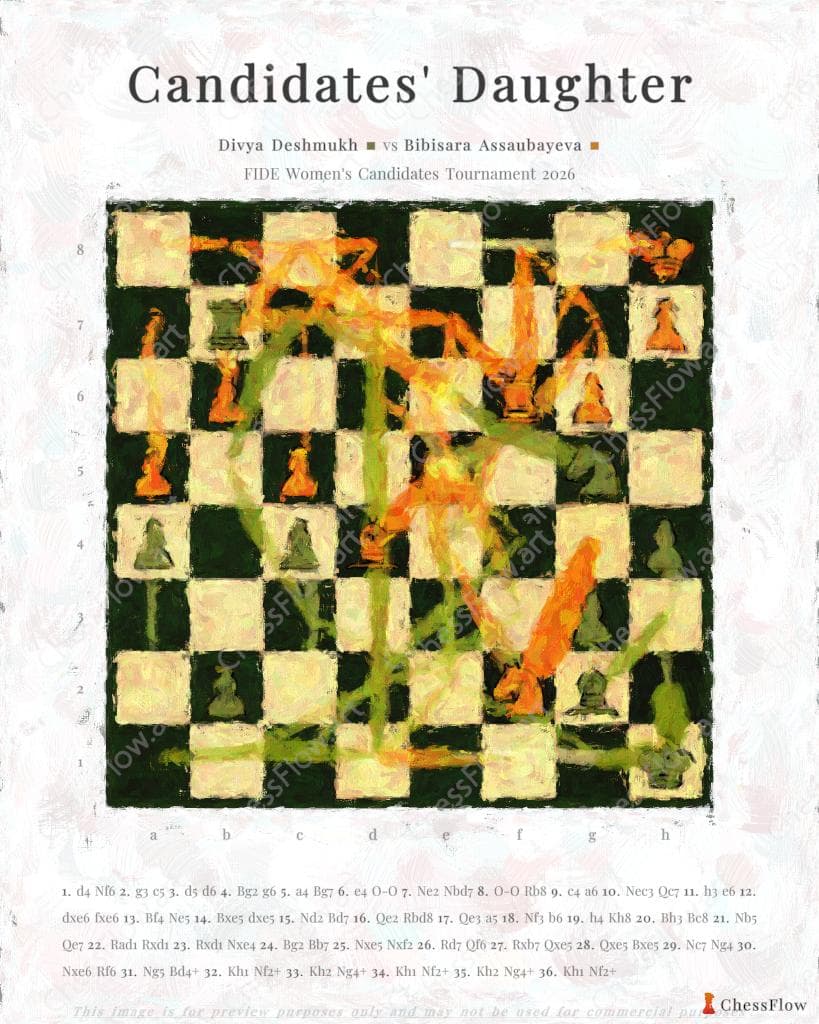
Divya Deshmukh vs Bibisara Assaubayeva
Divya Deshmukh vs Bibisara Assaubayeva
The Final Round Showdown Round 14 of the 2026 FIDE Women's Candidates Tournament delivered a crucial draw between GM Divya Deshmukh (2497) and GM Bibisara Assaubayeva (2516). With Assaubayeva enterin...
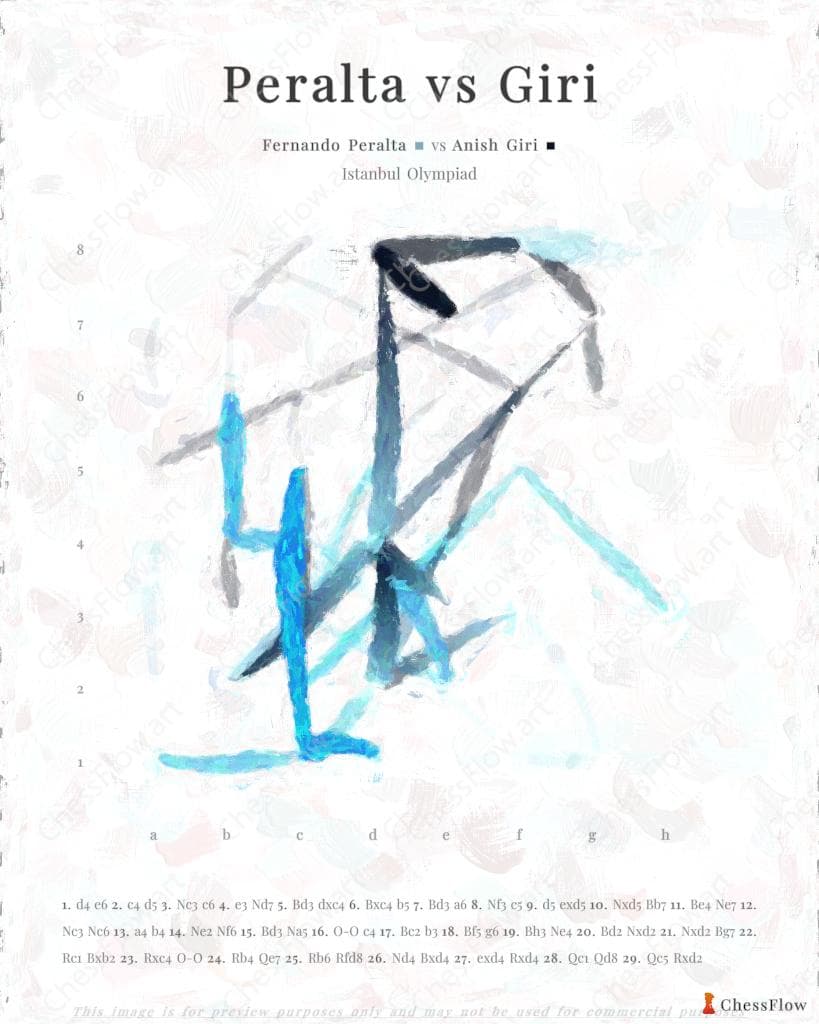
Fernando Peralta vs Anish Giri
Fernando Peralta vs Anish Giri
The Opening Battle Fernando Peralta (2606) faced off against rising Dutch talent Anish Giri (2711) in round 5 of the 2012 Istanbul Olympiad. The game opened with the Queen's Gambit Declined, Semi-Sla...