Super Rapid & Blitz Poland
Caruana and Firouzja Draw Tense Blitz Battle in Poland


Rapid Fire Symphony
A Half-Point in the Hunt
Fabiano Caruana and Alireza Firouzja traded punches for 38 moves before agreeing to a draw in Round 26 of the 2026 Super Rapid & Blitz Poland, a result that kept Caruana within striking distance of tournament leader Hans Niemann while Firouzja continued his blitz recovery after a rough rapid segment.
The game, played at the POLIN Museum in Warsaw with a 5+2 time control, saw Caruana opt for the English Opening with a Neo-Catalan setup—a flexible choice that avoided the sharp theoretical battles both players are capable of producing. What emerged was a positional struggle where Firouzja's ambitious queenside expansion created the game's critical moment, only for the position to simplify into a drawn rook ending.
For Caruana, this was a measured outcome. Earlier in the day, he had torn through the field with wins against Javokhir Sindarov, Maxime Vachier-Lagrave, Gukesh Dommaraju, Jan-Krzysztof Duda, and Firouzja himself in a different round. "I'm happy I'm at least in striking distance," Caruana told GM Cristian Chirila during the broadcast, noting that outside of Magnus Carlsen, elite players "rarely run away with it" in blitz.
Firouzja, meanwhile, was in the middle of his own redemption arc. After scoring just 6/18 in the rapid portion—a disappointing start that left him near the bottom of the standings—the French-Iranian star had found his rhythm in blitz, posting 6½/9 on the day's first nine rounds, the best performance of anyone in the field.
The Neo-Catalan Setup
Caruana opened with 1.Nf3 d5 2.c4 e6 3.g3, steering the game toward a Neo-Catalan structure that promised a slow strategic battle rather than immediate fireworks. Firouzja responded with the solid 3...Nf6 4.Bg2 Nbd7, setting up a Queen's Indian-style formation with his bishop headed to b7.
The early moves followed well-trodden paths. Caruana fianchettoed both bishops with 5.b3 and 7.Bb2, creating a harmonious setup where his pieces coordinated along the long diagonals. Firouzja matched this with 6...Bb7 and 7...Bd6, developing naturally while keeping his options open.
The position after 8.d4 O-O 9.Nc3 a6 was the kind of balanced structure that engines evaluate as roughly equal but humans know can go wrong in a hundred different ways. Caruana had a slight space advantage and the more flexible pawn structure; Firouzja had solid development and no obvious weaknesses.
What makes these positions tricky in blitz is that both players understand the strategic ideas perfectly—the question is who will execute better with seconds ticking away.
Caruana Seizes the Center
The game's first real tension came when Caruana played 10.Nd2, rerouting his knight toward e4 where it would eye both the c5 and f6 squares. Firouzja responded with 10...Rb8, preparing the b5 push that would become the game's turning point.
Caruana struck in the center with 11.e4, the natural break that challenged Firouzja to make a decision about the pawn structure. After 11...dxe4 12.Ndxe4, White had achieved a pleasant position—his knight on e4 was beautifully placed, and the bishop on g2 now had an open diagonal pointing toward Black's kingside.
Firouzja tried to create counterplay with 12...Bb4, pinning the knight on c3 and threatening to win the bishop pair. The move made sense strategically—in positions where White controls the center, Black often needs the bishops to generate counterchances. But it also cost time, and in blitz, every tempo matters.
Caruana responded with 13.Qe2, calmly defending the knight and maintaining the tension. Firouzja decided to follow through with 13...Bxc3 14.Nxc3 Bxg2 15.Kxg2, a sequence that traded off both pairs of bishops but left White with a knight that could hop to d5 or e4 at will.
Firouzja's Queenside Gambit
With the position simplified but still requiring precision, Firouzja pushed forward with 15...b5?!, an ambitious attempt to seize queenside space and create a passed pawn. The engine immediately flagged this as an inaccuracy, jumping from roughly +0.30 to +1.06—a significant shift in a position that had been balanced for 14 moves.
The problem with 15...b5 is that it weakens the a6 pawn and opens lines that favor White's pieces. Caruana could now consider c4xb5, opening the c-file for his rooks, or simply maintain the tension while Black's pawns become targets. In classical chess, this might be a reasonable practical try; in blitz, handing your opponent a clear target is asking for trouble.
What makes this moment interesting from a human perspective is that Firouzja almost certainly understood the risks. He had been clawing back from a disastrous rapid segment all day, and passive defense wasn't going to get him the points he needed. Sometimes the only way to fight is to create complications, even if the engine disapproves.
The evaluation swing to +1.06 sounds decisive, but experienced players know that converting such advantages in blitz—especially against a defender at this level—is far from automatic. An edge of one pawn equivalent with rooks still on the board and the clock ticking? That's the kind of position where anything can happen.
The Simplification
After 15...b5, the game continued but the PGN shows the players eventually reached a position where neither side could make progress. Caruana had the better structure and the more active pieces, but Firouzja defended accurately enough to hold the balance.
The draw was agreed after 38 moves, with the final position likely featuring a rook endgame where White's extra pawn (or structural advantage) wasn't enough to break through. In blitz, these endings are notoriously difficult to win—one inaccurate move and the defender can activate their rook, create counterplay, or simply run the opponent out of time.
For Caruana, the half-point was acceptable but not ideal. He had already beaten Firouzja earlier in the day in a game that featured, according to chess.com's coverage, "an exchange sacrifice to leave White with a bad bishop against two superb knights" and the finishing blow 36...c4!!, described as "the nail in the coffin." Taking another full point from the same opponent would have been gravy, but a draw against a player in form was a reasonable outcome.
The Standings Picture
This result kept Caruana tied for third place on 15 points, a full point behind Wesley So and 1.5 points behind leader Hans Niemann. With nine rounds of blitz remaining, the tournament remained tightly bunched—even Firouzja in eighth place was only four points off the pace.
The tournament's structure—rapid games worth 2 points, blitz games worth 1—meant that the blitz portion offered plenty of opportunities for movement. Caruana's five wins on the day had already demonstrated that big swings were possible; Firouzja's 6½/9 showed that struggling players could fight back.
Niemann, who had won the rapid section as the only undefeated player, scored just 3½/9 in Friday's blitz—a mediocre result that kept him in first only because his pursuers couldn't capitalize. The American's lead, once commanding, was now precarious.
Two Approaches to the Same Tournament
What this game illustrated was the different paths Caruana and Firouzja were walking through the same event. Caruana, the methodical grinder, was playing solid chess and picking his spots—his wins came against opponents who overextended or blundered, not from wild sacrificial attacks. Firouzja, the creative risk-taker, was swinging for the fences after his rapid disaster, generating complications even in positions where caution might have been wiser.
Neither approach is wrong. Caruana's consistency had him in contention; Firouzja's aggression had produced the day's best individual performance. In a double round-robin blitz event, you need both—the ability to grind out half-points and the willingness to push for wins when the situation demands it.
The English Opening choice itself reflected Caruana's mindset. Rather than engaging Firouzja in the sharp Sicilians or King's Indians where the younger player's tactical vision might shine, Caruana steered toward a positional battle where experience and technique would matter more than calculation speed. It was a smart practical decision, even if it produced a less memorable game than their earlier encounter.
Looking Ahead
The 2026 Super Rapid & Blitz Poland, the inaugural event of the Grand Chess Tour season, had already produced its share of storylines: Niemann's rapid dominance, Gukesh's fist-pump after beating World Championship challenger Sindarov, Radoslaw Wojtaszek's surprising blitz resurgence despite being the lowest-rated player in the field.
Caruana and Firouzja would face the remaining rounds with different goals. For Caruana, the target was clear: catch Niemann and So, win the event, start the GCT season with momentum heading into the Super Chess Classic Romania. For Firouzja, the mission was rehabilitation—prove that the rapid struggles were an aberration, not a sign of deeper problems.
The position after move 15, with Firouzja's ambitious b5 push creating the game's critical imbalance, is the kind of moment that captures what blitz chess is really about. Not the perfect engine move, but the human decision to fight. We turned this one into a print.
Both players would be back at the board soon enough, with 200,000 dollars in prize money and Grand Chess Tour points on the line. In blitz, fortunes can reverse in a single session. Caruana knew it. Firouzja was counting on it.
1.Nf3 d5 2.c4 e6 3.g3 Nf6 4.Bg2 Nbd7 5.b3 b6 6.O-O Bb7 7.Bb2 Bd6 8.d4 O-O 9.Nc3 a6 10.Nd2 Rb8 11.e4 dxe4 12.Ndxe4 Bb4 13.Qe2 Bxc3 14.Nxc3 Bxg2 15.Kxg2 b5 16.cxb5 axb5 17.Nxb5 Nd5 18.Nc3 N7f6 19.Nxd5 Nxd5 20.Ba3 Re8 21.Bc5 Qd7 22.Qf3 f5 23.Rfe1 Nf6 24.Re5 Ng4 25.Re2 e5 26.dxe5 Nxe5 27.Qc3 Qd5+ 28.f3 Nxf3 29.Rxe8+ Rxe8 30.Qxf3 Qxc5 31.Rf1 g6 32.Rf2 Re3 33.Qa8+ Kg7 34.Qb7 h5 35.b4 Qc4 36.b5 Re6 37.a4 Rb6 38.Qa8 Rd6 39.Qb7 Rb6 40.Qa8 h4 41.Rd2 h3+ 42.Kxh3 Qf1+ 43.Qg2 Qc4 44.Rd7+ Kh6 45.Qd2+ g5 46.Kg2 Re6 47.Rd3 Qxa4 48.h4 Qe4+ 49.Kf2 f4 50.hxg5+ Kxg5 51.Qxf4+ Qxf4+ 52.gxf4+ Kxf4 53.Rc3 Rb6 54.Rxc7 Rxb5 1/2-1/2
How would it look as art?


Own a piece of chess history. Transform this legendary game into a unique piece of art for your home or office.
Perfect For
- Unique Gifts for chess enthusiasts and players
- Tournament Prizes that winners will treasure
- Club Decor for chess clubs and gaming spaces
- Office Art showcasing strategic thinking
- Personal Collection of historic games
Explore more
Turn Your Games Into Art
Whether it's your own game from Chess.com or Lichess, or another historic masterpiece, transform any chess game into a stunning visual artwork.
You might also like
More legendary chess game stories
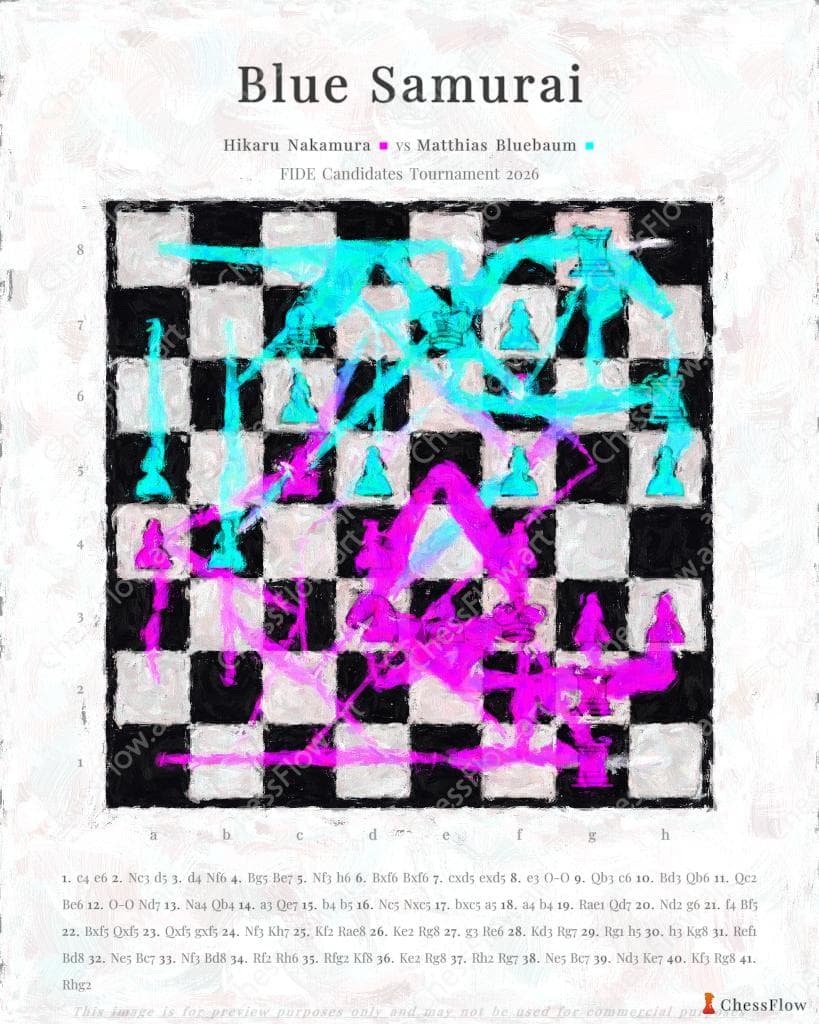
Hikaru Nakamura vs Matthias Bluebaum
Hikaru Nakamura vs Matthias Bluebaum
The Queen's Gambit Declined in Round 13 Hikaru Nakamura and Matthias Bluebaum settled for a draw in round 13 of the 2026 FIDE Candidates Tournament, with Nakamura playing White in a Queen's Gambit De...
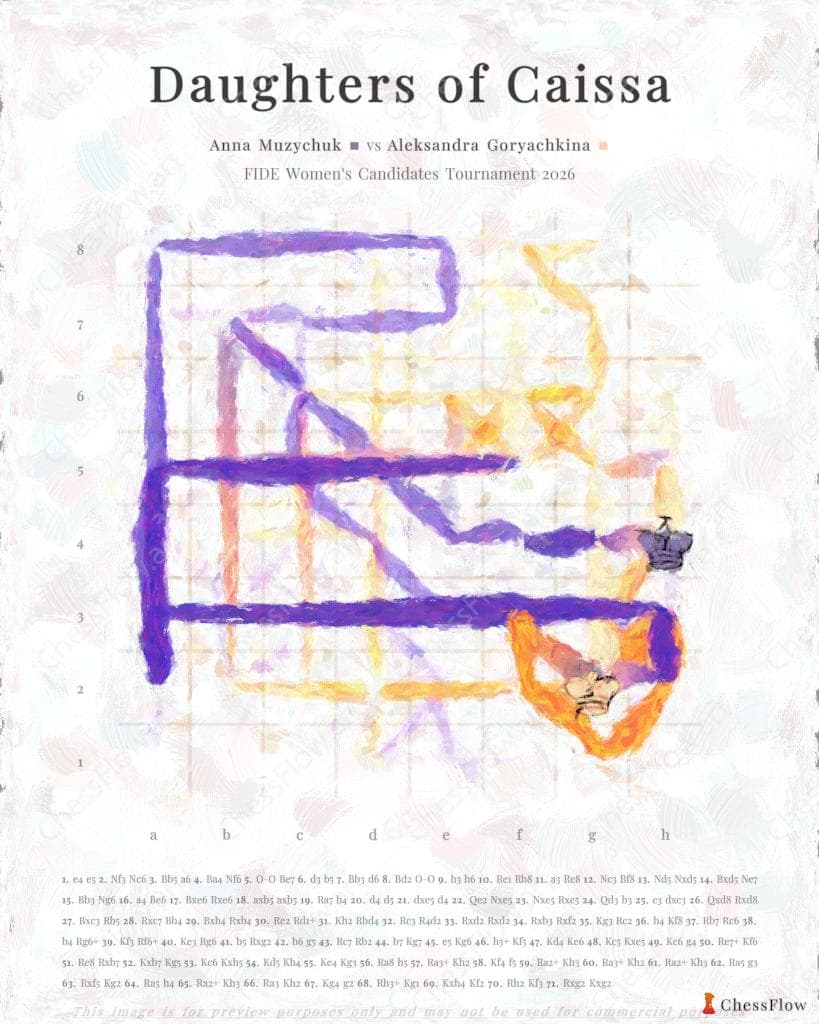
Anna Muzychuk vs Aleksandra Goryachkina
Anna Muzychuk vs Aleksandra Goryachkina
A Quiet Draw in the Ruy Lopez Anna Muzychuk and Aleksandra Goryachkina split the point in round 12 of the 2026 FIDE Women's Candidates Tournament, playing to a draw in the Ruy Lopez: Closed, Martinez...

Wenjun Ju vs Humpy Koneru
Wenjun Ju vs Humpy Koneru
Koneru Finds Redemption Against the World Champion Humpy Koneru entered round ten of Norway Chess Women 2026 in last place with just three points, having lost three Armageddon games already in Oslo....