1er Open International de Lecci
Van Wely Outmaneuvers Cornette in Corsican Endgame Battle


Corsican Duel
Van Wely Grinds Down Cornette in Corsican Endgame Struggle
Loek Van Wely added another full point to his campaign at the 1er Open International de Lecci, defeating French GM Matthieu Cornette in 58 moves after the game transformed from a maneuvering Sicilian into a queen endgame where the Dutch veteran's knight proved decisively superior to White's passive pieces. The win pushed Van Wely to 6.5 points, tying him for second place in the strong Corsican open.
The game began with a Moscow Variation of the Sicilian — 1.e4 c5 2.Nf3 d6 3.Bb5+ Nd7 — an opening that typically leads to slower, more strategic battles than the sharper Najdorf or Dragon lines. Cornette, rated 2573, was the lower-rated player against Van Wely's 2625, and the Frenchman seemed content to steer the game toward a position where both sides would have to demonstrate patience and technique.
The Maneuvering Phase
For the first 25 moves, both players engaged in the kind of piece shuffling that makes open tournament chess so different from the theoretical battles at the elite level. Van Wely moved his queen from c7 to b8 to a8 to a7 and back again, probing for weaknesses while Cornette reorganized his pieces on the kingside.
The position after 17.Kh1 saw Cornette preparing kingside operations with 18.Qh4 and 19.Qh3, but Van Wely's setup with the knight maneuvering via 18...Ne5 and 19...Ng6 proved solid. Black's pieces were coordinated, if somewhat passive, and the light-squared bishop on b7 was doing important defensive work along the long diagonal.
The repetition of moves with 22.Bd2 Qa7 23.Be3 Qa8 24.Bd2 Qa7 25.Be3 suggested both players were content to shuffle while the clock ticked down, but Van Wely had other ideas.
The Central Break
The game's character changed completely with 26...d5!, Van Wely's well-timed central break. After White's bishop retreated to b1, Black struck with the thematic pawn advance that challenged White's entire setup.
The sequence that followed — 27.exd5 exd5 28.cxd5 Rxc3 — saw Van Wely sacrifice the exchange temporarily, but the point became clear after 29.Rxc3 Nxd5. Black had regained material equality and now possessed the more active pieces. The knight on d5 was a monster, centralized and controlling key squares, while White's pieces were scattered and uncoordinated.
After 30.Bd2 Rxe1+ 31.Bxe1 Nxc3 32.Bxc3, the position had simplified to a queen and minor piece endgame where Van Wely held a slight but persistent edge. His knight was more active than White's bishop pair, and the pawn structure favored Black's long-term prospects.
The Knight's Dominance
What followed was a clinic in knight versus bishop play. Van Wely maneuvered with 32...Qc7 33.Ne2 Qe7, keeping his queen active while preparing to improve his knight's position. Cornette tried to generate counterplay with 35.Qf5 and 36.Ng3, but the French GM was fighting an uphill battle.
The critical moment came when Van Wely pushed 37...h5, gaining space on the kingside and creating potential weaknesses in White's camp. Cornette responded with 38.Be1 and 39.Bg3, but after 40.Bxc7 Qxc7, Black had traded his passive bishop for White's more active one, and the resulting position was clearly better for Van Wely.
The sequence 41.Be4 Bxe4 42.Qxe4 saw the last minor pieces come off, leaving a queen endgame where Black's knight on g6 (which had arrived via 19...Ng6) was ready to spring into action. Van Wely's 42...Qc1 put immediate pressure on White's position, and after 43.Kg1 Qc5+ 44.Qe3 Qc2, Black was clearly pressing.
The Decisive Phase
Cornette defended tenaciously, but Van Wely's technique was up to the task. After 47.Ne3 Qa1 48.Nd5 Ne5, Black's knight found its ideal square, supporting potential queen infiltrations while eyeing key squares in White's position.
The knight dance continued with 49.Nc7 h3, Van Wely pushing his h-pawn to create additional threats. Cornette tried to grab the a6 pawn with 50.Nxa6, but after 50...Qh1 51.Kg3 hxg2 52.Qxg2 Qc1, Black's queen was wreaking havoc.
The final sequence was instructive. After 53.Qe2 Ng6 54.Qe4 Qg1+ 55.Kh3 Kh6 56.Nc7 Qg5 57.Qg4 Qe5, Van Wely had maneuvered his pieces to optimal squares. Cornette's 58.f4 was a desperate attempt to create counterplay, but it backfired immediately — the pawn push weakened White's king position fatally, and Van Wely's resignation-forcing threats were impossible to parry. Cornette stopped the clocks.
Tournament Implications
The result was significant for both players' standing in the Lecci Open. Van Wely moved to 6.5 points with this win, tying him with Murali Karthikeyan for second place behind the leaders. The Dutch GM, playing for Clichy-Echecs-92, had already shown his form earlier in the tournament with wins against Francesco Bettalli, Milosz Szpar, and Luis Paulo Supi.
For Cornette, this loss dropped him to 5 points, a disappointing result in his home country's open. The French GM had started the tournament well with wins over Tristan Breuil and Thibault Fantinel, but this defeat to Van Wely was a setback in his campaign.
The game itself was a reminder of how endgame technique can decide games between grandmasters. Van Wely's patient maneuvering in the middlegame, followed by the well-timed 26...d5 break and precise endgame play, showed why the 52-year-old Dutch GM remains a dangerous opponent in open tournaments.
The position after move 48, with Black's knight landing on e5 while White's pieces scrambled to defend, captures that moment when technique meets pressure. We turned this one into a print.
The 1er Open International de Lecci continues with the final round, where Van Wely will look to secure his share of the prizes while Cornette will aim to bounce back in the remaining games. In a field featuring strong Indian contingents from Cannes Echecs and Mulhouse Philidor, plus Armenian GM Haik Martirosyan and German GM Alexander Donchenko, every point matters in the race for top honors on the beautiful island of Corsica.
1.e4 c5 2.Nf3 d6 3.Bb5+ Nd7 4.O-O Nf6 5.Re1 a6 6.Bf1 b6 7.d4 cxd4 8.Nxd4 Bb7 9.c4 e6 10.Nc3 Be7 11.f3 O-O 12.Be3 Rc8 13.Rc1 Qc7 14.Qd2 Qb8 15.Qf2 Bd8 16.b3 Re8 17.Kh1 Bc7 18.Qh4 Ne5 19.Qh3 Ng6 20.Bd3 Qa8 21.Bg5 Bd8 22.Bd2 Qa7 23.Be3 Qa8 24.Bd2 Qa7 25.Be3 Qb8 26.Bb1 d5 27.exd5 exd5 28.cxd5 Rxc3 29.Rxc3 Nxd5 30.Bd2 Rxe1+ 31.Bxe1 Nxc3 32.Bxc3 Qc7 33.Ne2 Qe7 34.Bd3 Bc7 35.Qf5 Qd6 36.Ng3 b5 37.Nf1 h5 38.Be1 Qe7 39.Bg3 h4 40.Bxc7 Qxc7 41.Be4 Bxe4 42.Qxe4 Qc1 43.Kg1 Qc5+ 44.Qe3 Qc2 45.Qd2 Qb1 46.Kf2 Kh7 47.Ne3 Qa1 48.Nd5 Ne5 49.Nc7 h3 50.Nxa6 Qh1 51.Kg3 hxg2 52.Qxg2 Qc1 53.Qe2 Ng6 54.Qe4 Qg1+ 55.Kh3 Kh6 56.Nc7 Qg5 57.Qg4 Qe5 58.f4 0-1
How would it look as art?


Own a piece of chess history. Transform this legendary game into a unique piece of art for your home or office.
Perfect For
- Unique Gifts for chess enthusiasts and players
- Tournament Prizes that winners will treasure
- Club Decor for chess clubs and gaming spaces
- Office Art showcasing strategic thinking
- Personal Collection of historic games
Explore more
Turn Your Games Into Art
Whether it's your own game from Chess.com or Lichess, or another historic masterpiece, transform any chess game into a stunning visual artwork.
You might also like
More legendary chess game stories
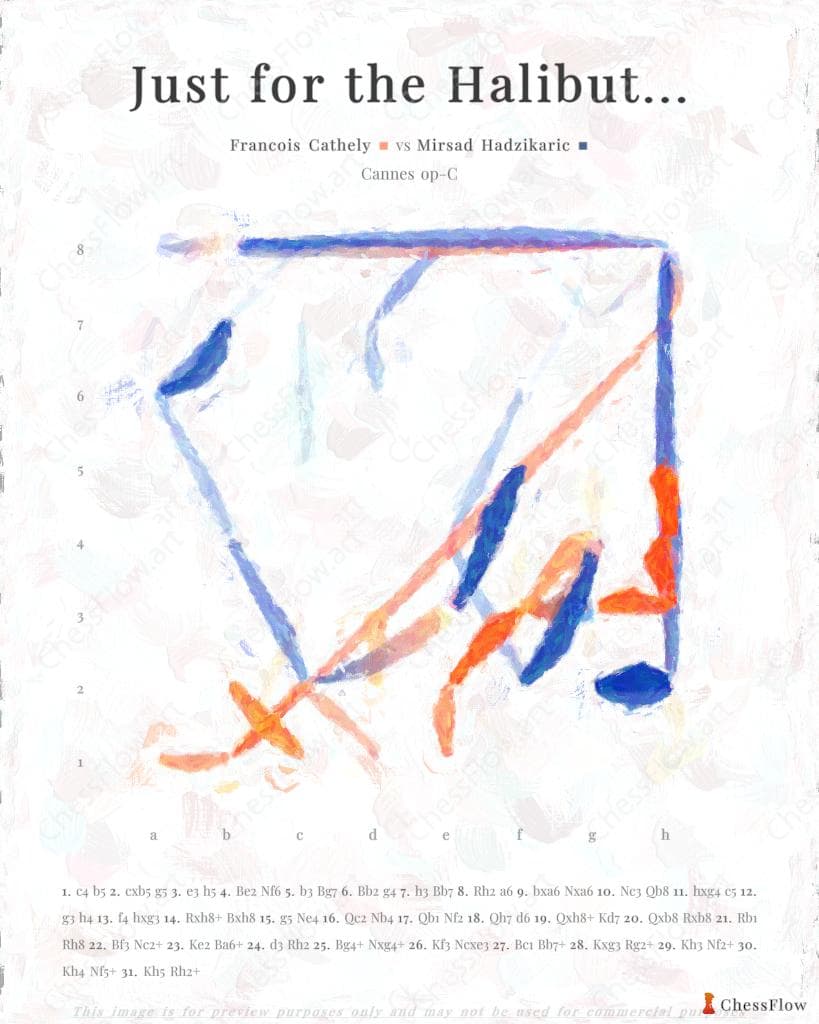
Francois Cathely vs Mirsad Hadzikaric
Francois Cathely vs Mirsad Hadzikaric
The Opening Gambit Francois Cathely and Mirsad Hadzikaric faced off in the 1995 Cannes op-C tournament with an opening that immediately signaled chaos was coming. After 1.c4 b5, Black's Polish Defens...
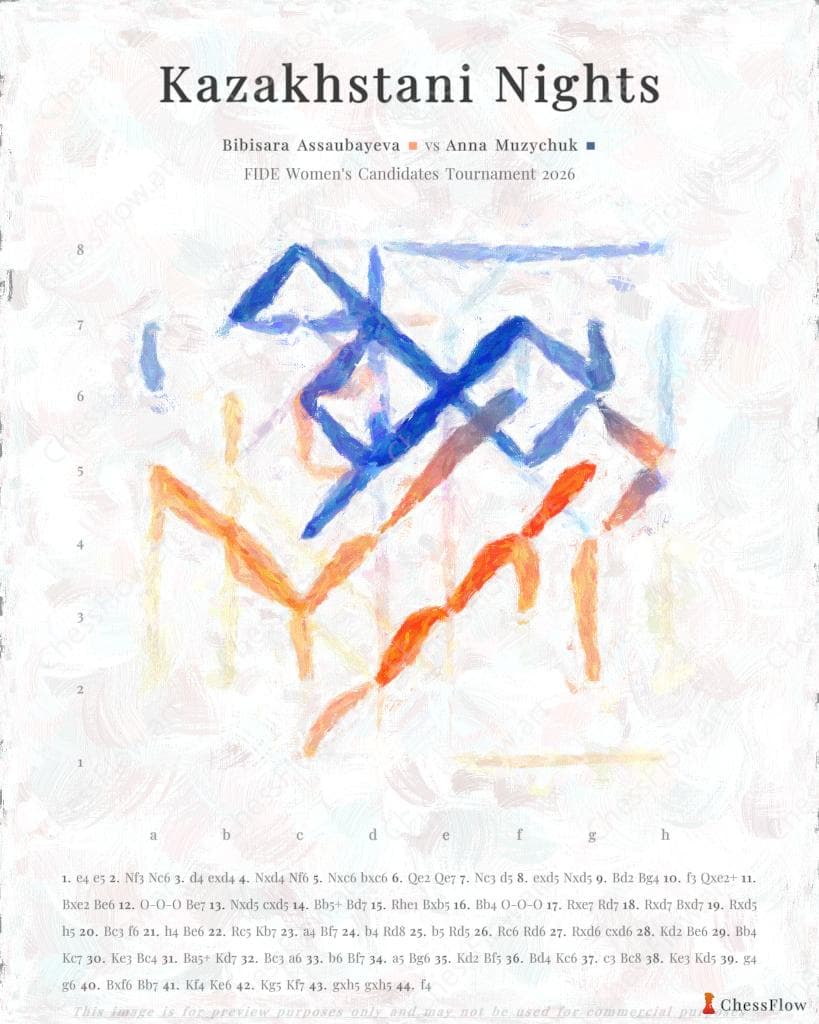
Bibisara Assaubayeva vs Anna Muzychuk
Bibisara Assaubayeva vs Anna Muzychuk
Assaubayeva Strikes Back in Round 13 Bibisara Assaubayeva bounced back from recent struggles to defeat Anna Muzychuk in round 13 of the FIDE Women's Candidates Tournament 2026. The Kazakhstani GM, ra...
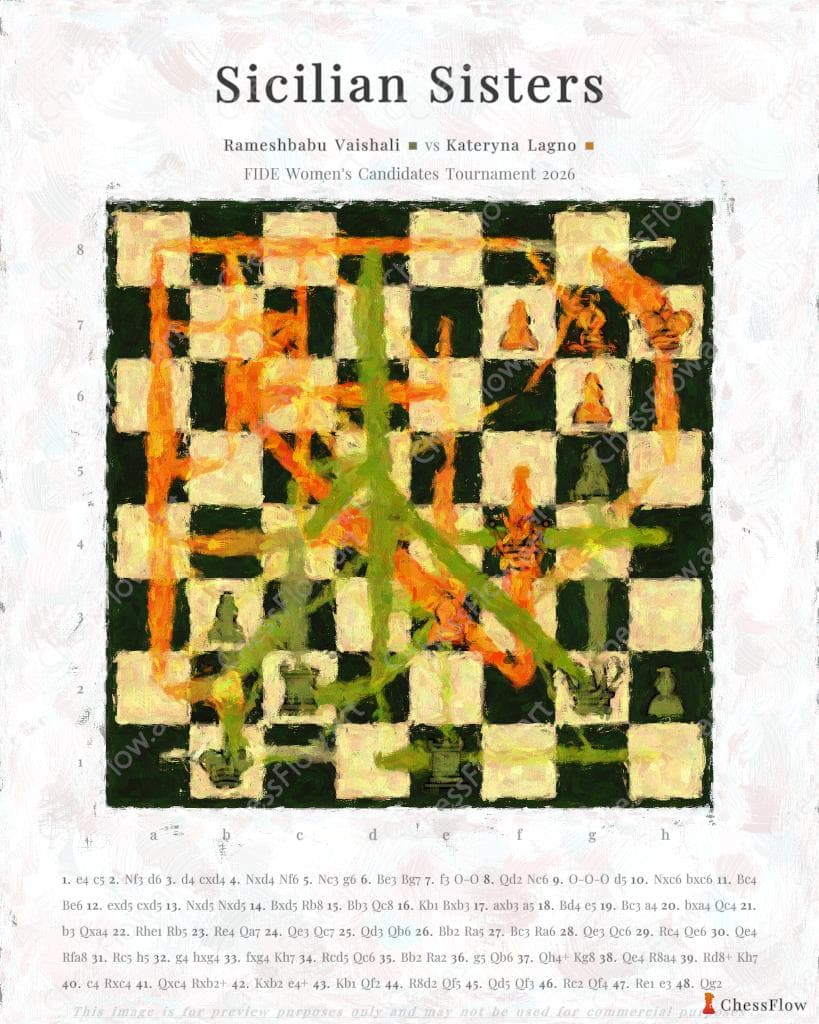
Rameshbabu Vaishali vs Kateryna Lagno
Rameshbabu Vaishali vs Kateryna Lagno
Vaishali Strikes in the Dragon Vaishali Rameshbabu defeated Kateryna Lagno in round 14 of the FIDE Women's Candidates Tournament 2026, playing a sharp Sicilian Dragon that ended in White's favor. The...