2026 Norway Chess Women
Muzychuk Beats Deshmukh in Norway Chess Round 8 Armageddon


Fjord Gambit
Muzychuk Takes the Armageddon After Deshmukh's Position Crumbles
Anna Muzychuk claimed 1.5 points against Divya Deshmukh in Round 8 of Norway Chess Women 2026, winning their Armageddon tiebreaker in just 17 moves after the classical game ended in a draw. The Ukrainian grandmaster's victory came at a crucial moment in the tournament, where every half-point matters in the unique Norway Chess scoring system.
The result adds another chapter to what's becoming a fascinating rivalry between these two players. Just months earlier at the FIDE Women's Candidates, Deshmukh had beaten Muzychuk in a grueling five-hour encounter where the Ukrainian held a clearly superior position before blundering in a queen endgame. This time, with the colors reversed and the format compressed, Muzychuk got her revenge.
The Opening: Deshmukh's Unusual Choice
Deshmukh opted for the Zukertort Opening with 1.Nf3 Nf6 2.b3, the Nimzo-Larsen Variation — a hypermodern approach that delays central occupation in favor of piece development and fianchettoed bishops. It's the kind of flexible system that can transpose into various structures, but against a prepared opponent, it can also leave White without a clear plan.
Muzychuk responded with 2...c5, immediately staking a claim in the center. The position evolved into a reversed Sicilian structure after 4.c4 d5 5.cxd5 Nxd5, where Black had comfortable equality and natural piece play.
The early engine evaluations tell the story: after 6.g3, the position was already slightly in Black's favor at -0.28. Not a disaster by any means, but a sign that Deshmukh's opening choice wasn't generating the kind of pressure White typically wants.
Muzychuk Builds a Fortress
What followed was a methodical expansion by Muzychuk. After 6...f6, she established a solid pawn chain protecting her center, and 7...e5 gave her a space advantage that would prove difficult to challenge.
The sequence 8.O-O Be7 9.d3 O-O 10.h3 Be6 saw both players complete their development, but Black's position was simply more harmonious. Muzychuk's pieces coordinated naturally — the bishop on e6 supported the d5 knight, the rooks could easily connect, and the queen found a useful post on d7.
Deshmukh tried to create counterplay with 11.Nc3 Qd7 12.Kh2, tucking the king away and preparing potential kingside expansion. But Muzychuk continued to improve her position with 12...Rac8 13...Rfd8, doubling on the d-file and maintaining pressure.
By move 14, the engine assessment had drifted to -0.68 after 14.Nd2. Again, this isn't a losing position for White, but in Armageddon — where Black only needs a draw to win the mini-match — this slight disadvantage becomes psychologically significant. Deshmukh needed to create complications, but the position refused to offer them.
The Knight Maneuver That Sealed It
The critical sequence began with 15.Nc4, an attempt to activate the knight and potentially target the b6 pawn. But Muzychuk had a simple and strong reply: 15...Nxc3 16.Rxc3 Nd4.
This knight hop to d4 is the kind of move that looks obvious in hindsight but represents everything going right for Black. The knight on d4 is a monster — it attacks the rook on c3, eyes the e2 and f3 squares, and can't be easily dislodged. White's position, which had been merely slightly worse, was now becoming uncomfortable.
The game ended after move 17, with the position clearly favoring Black and Deshmukh's clock situation presumably dire (Armageddon games feature asymmetric time controls where White has more time but must win, while Black can draw to advance).
The Armageddon Format: Blessing and Curse
Norway Chess's unique format — where drawn classical games lead to Armageddon tiebreakers — creates fascinating strategic dilemmas. Deshmukh has proven herself an Armageddon specialist in this very tournament, having won tiebreakers against Ju Wenjun, Koneru Humpy, and even tournament leader Bibisara Assaubayeva in earlier rounds.
But as Deshmukh herself said after Round 1: "Playing armageddon is very heavy on the brain and also on the body, so it's a relief to just be done with it." After Round 3, she was even more emphatic: "I don't want to play any more armageddons!"
The format's intensity clearly takes a toll. Deshmukh had entered this round having won every Armageddon she'd played, but that streak came to an end against Muzychuk's solid, patient approach.
What This Means for the Tournament
With this result, Muzychuk climbs in the standings while Deshmukh, who had been in sole second place just a round earlier, loses ground to leader Assaubayeva. The tournament remains wide open — Assaubayeva leads, but her margin has been fluctuating throughout, and with multiple rounds remaining, any of the top players can still claim victory.
For Muzychuk, this win represents a form of redemption. Her loss to Deshmukh at the Women's Candidates was particularly painful given she had held a winning position for most of the game. The Ukrainian noted in pre-tournament interviews that her late entry to the Candidates had affected her preparation, but at Norway Chess, she's showing the form that has made her one of the world's elite players for nearly a decade.
Deshmukh, meanwhile, will need to regroup. The 19-year-old Indian star has had an incredible year — winning the FIDE Women's World Cup, performing well at Prague, and entering the Candidates as a genuine contender. A single Armageddon loss won't define her tournament, but it's a reminder that at this level, even the smallest edges matter.
The Broader Picture
The game itself was relatively quiet — no sacrifices, no tactical fireworks, no moments that will appear in puzzle books. But that's often how elite chess works. Muzychuk's victory came from understanding what the position required: steady improvement, patient maneuvering, and the discipline to avoid overreaching.
The position after 16...Nd4 is the kind of thing that looks simple but contains layers of strategic depth — Black's knight dominates the board while White struggles to find active play. We turned this one into a print.
For chess fans following Norway Chess, the women's event continues to deliver drama through its unique format. The classical games may be quiet, but the Armageddon tiebreakers add a layer of tension that keeps every mini-match interesting until the final move.
Looking Ahead
Round 9 will see the players face new opponents, with Deshmukh looking to bounce back and Muzychuk hoping to build on this momentum. Assaubayeva remains the player to catch, but as we've seen throughout this tournament, leads can evaporate quickly when every match can swing on a single Armageddon game.
The Norway Chess Women's event has already produced memorable moments — Assaubayeva's classical win in Round 1, Zhu Jiner's miraculous escape against Ju Wenjun, and now Muzychuk's revenge against Deshmukh. With several rounds still to play, the race for the title remains deliciously uncertain.
What's clear is that women's chess at the elite level continues to produce fascinating battles. The depth of talent on display in Oslo — featuring world champions, Candidates contenders, and rising stars — ensures that every round brings new storylines and new opportunities for drama.
For Muzychuk and Deshmukh, their rivalry appears far from over. They've now split results in their recent encounters, and given their trajectories, more clashes seem inevitable. This particular chapter went to the Ukrainian, but the story continues.
1.Nf3 Nf6 2.b3 c5 3.Bb2 Nc6 4.c4 d5 5.cxd5 Nxd5 6.g3 f6 7.Bg2 e5 8.O-O Be7 9.d3 O-O 10.h3 Be6 11.Nc3 Qd7 12.Kh2 Rac8 13.Rc1 Rfd8 14.Nd2 b6 15.Nc4 Nxc3 16.Rxc3 Nd4 17.Ne3 Nf5 18.Nc4 Nd4 19.Qd2 Bd5 20.e4 Be6 21.Rd1 b5 22.Ne3 c4 23.a3 Nxb3 24.Qe1 Nd4 25.dxc4 bxc4 26.Rcc1 Qa4 27.Nd5 Bc5 28.Qf1 Bxd5 29.exd5 Qb3 30.Rd2 Bb6 31.Bc3 Qxa3 32.Bxd4 Bxd4 33.Rxc4 Rxc4 34.Qxc4 Qc5 35.Qa6 Qb6 36.Qa2 h6 37.Rc2 Qb4 38.Rc7 Qb2 39.d6+ Qxa2 0-1
How would it look as art?


Own a piece of chess history. Transform this legendary game into a unique piece of art for your home or office.
Perfect For
- Unique Gifts for chess enthusiasts and players
- Tournament Prizes that winners will treasure
- Club Decor for chess clubs and gaming spaces
- Office Art showcasing strategic thinking
- Personal Collection of historic games
Turn Your Games Into Art
Whether it's your own game from Chess.com or Lichess, or another historic masterpiece, transform any chess game into a stunning visual artwork.
You might also like
More legendary chess game stories
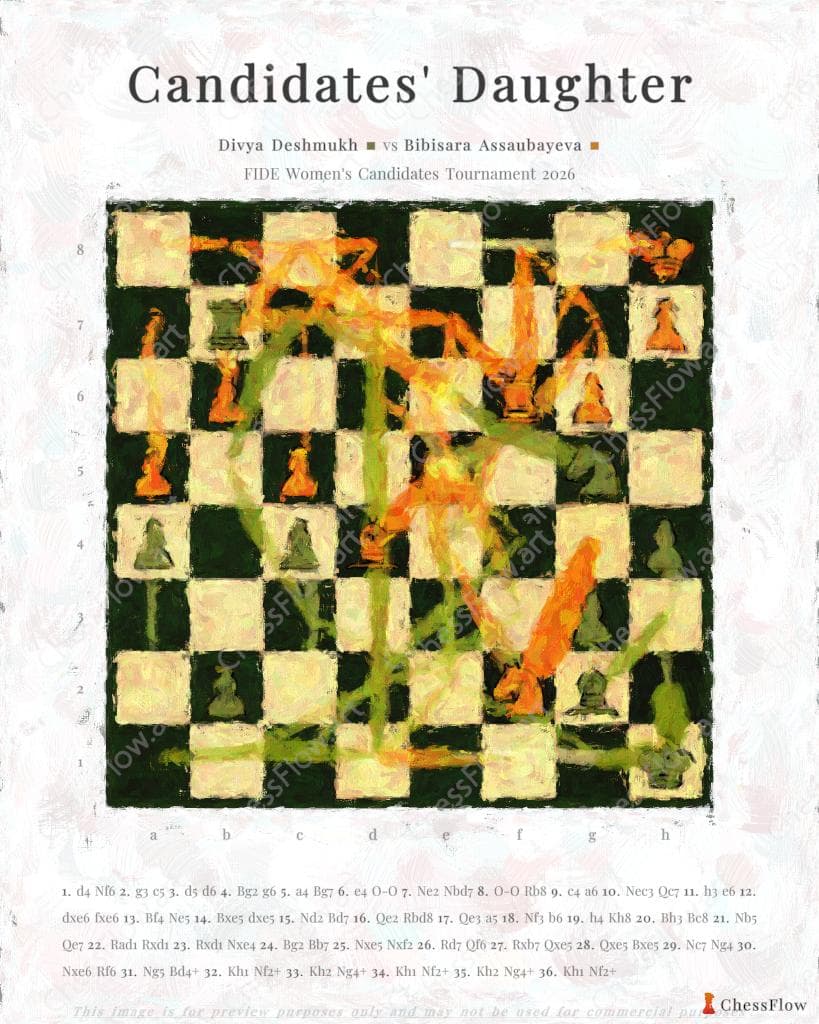
Divya Deshmukh vs Bibisara Assaubayeva
Divya Deshmukh vs Bibisara Assaubayeva
The Final Round Showdown Round 14 of the 2026 FIDE Women's Candidates Tournament delivered a crucial draw between GM Divya Deshmukh (2497) and GM Bibisara Assaubayeva (2516). With Assaubayeva enterin...

Jiner Zhu vs Aleksandra Goryachkina
Jiner Zhu vs Aleksandra Goryachkina
Goryachkina Takes Down Zhu in Round 13 Aleksandra Goryachkina scored a crucial victory over Jiner Zhu in round 13 of the FIDE Women's Candidates Tournament 2026, dealing a blow to the Chinese GM's ch...
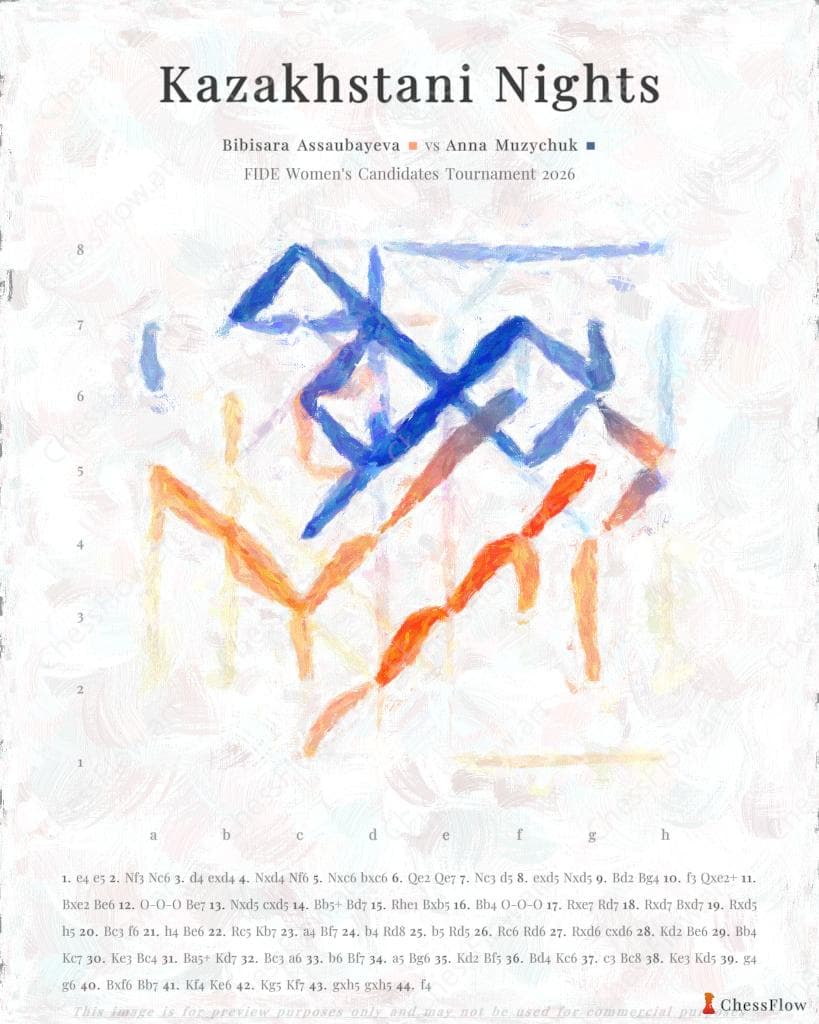
Bibisara Assaubayeva vs Anna Muzychuk
Bibisara Assaubayeva vs Anna Muzychuk
Assaubayeva Strikes Back in Round 13 Bibisara Assaubayeva bounced back from recent struggles to defeat Anna Muzychuk in round 13 of the FIDE Women's Candidates Tournament 2026. The Kazakhstani GM, ra...