1er Open International de Lecci
Idani Upsets Donchenko in Nimzo-Indian Grind at Lecci Open


Lecci Lightning
Idani Grinds Down Donchenko in Corsican Slugfest
Pouya Idani handed Alexander Donchenko his first loss of the 1er Open International de Lecci on Friday, converting a queenless Nimzo-Indian middlegame into a full point that reshapes the tournament standings heading into the final round. The Iranian GM, rated 51 points below his German opponent, found a way to squeeze pressure from what looked like a sterile position — the kind of game where engines shrug and humans suffer.
Donchenko came into Round 8 as one of the tournament's form players. He'd beaten Carissa Yip in Round 4, drawn with Bilel Bellahcene in Round 5, and dispatched Sebastien Maze in Round 6. His preparation had been sharp, his technique solid. But against Idani, the 2645-rated German found himself on the wrong side of a slow positional squeeze that engines never quite flagged as dangerous until it was too late.
The Nimzo-Indian Goes Sideways
The game opened with the Nimzo-Indian Defense via 1.d4 Nf6 2.c4 e6 3.Nc3 Bb4 4.Qc2, the Classical Variation that Donchenko has faced countless times. Idani opted for the Keres Defense setup with 4...O-O followed by 5...Bxc3+, willingly giving up the bishop pair in exchange for a solid pawn structure and quick development.
The early moves followed well-trodden theory. After 6.Qxc3 b6 7.Bg5 c5, both players were still in book territory. But Donchenko's 8.dxc5 bxc5 created an interesting pawn structure — Black's doubled c-pawns aren't a weakness so much as a statement of intent. The c5-pawn controls d4, the c8-bishop has a clear diagonal, and White's bishop pair needs open lines to prove its worth.
Then came the first sign that this wouldn't be a routine theoretical battle. Donchenko played 9.Nh3, an unusual knight development that avoids blocking the f-pawn but leaves the piece awkwardly placed. The idea is to reroute to f4, but it costs time. Idani immediately challenged with 9...h6, forcing a decision about the g5-bishop.
Queens Come Off, Problems Remain
The critical sequence began with 10.Bxf6 Qxf6 11.Qxf6 gxf6. On the surface, this looks like a comfortable simplification for White — the queens are off, Black has doubled f-pawns, and the position should be a technical draw with best play. Engines evaluate it around -0.2, essentially equal.
But here's where human chess diverges from silicon analysis. Black's pawn structure, while ugly on paper, gives Idani concrete targets and a clear plan. The half-open g-file, the potential to activate the bishop on the long diagonal, the pressure against White's queenside — these elements combine into something more dangerous than the evaluation suggests.
Donchenko continued with 12.Nf4, finally getting the knight to its intended square, but Idani was already preparing counterplay with 12...Rd8. The rook eyes the d-file, and more importantly, it clears the f8-square for the king to activate via g7 eventually.
Donchenko's Queenside Gamble
The position took a decisive turn when Donchenko played 13.O-O-O. This is a committal decision — castling queenside in a queenless middlegame means the king is closer to the action, and the a2 and b2 pawns become potential targets. Idani responded with 13...Bb7, developing the bishop to its most natural square and putting pressure on the long diagonal.
Here's where the game starts to turn. After 14.e3 Kf8, Idani began the slow process of activating his king. In endgames and queenless middlegames, the king is a fighting piece, and Idani understood this perfectly. Meanwhile, Donchenko played 15.Nd3, retreating the knight to a more central square but also signaling that he wasn't finding a clear plan.
The position after 15...Rc8 is instructive. Black has completed development, the rooks are connected, the bishop controls the long diagonal, and there's latent pressure against the c4-pawn. White has the two bishops, but where are the open lines? The position is closed enough that the knights might actually be the better minor pieces.
The Slow Squeeze
What followed was a textbook example of how to convert a small edge in a technical position. Idani didn't need flashy tactics — he needed patience and precision. The kind of chess where you improve your worst-placed piece, create small threats, and wait for your opponent to crack under the pressure of defending an unpleasant position for hours.
This is where the human element becomes crucial. Engines might evaluate the position as roughly equal, but they don't feel the psychological weight of defending a position where every move feels like it could be a mistake. Donchenko, who had been burning more time than Idani throughout the game, found himself in the uncomfortable position of having to find accurate moves while his opponent simply improved his pieces.
The time control at Lecci is 90 minutes plus 30 seconds increment — enough time to think deeply, but not enough to calculate every variation when you're under pressure. By the time the position reached its crisis point, Donchenko was playing on fumes while Idani still had time to spare.
What This Means for the Tournament
Idani's victory is significant for multiple reasons. First, it's an upset — taking down a player rated 51 points higher is always noteworthy, especially in a tournament with €32,000 in prize money. Second, it disrupts what had been a smooth tournament for Donchenko, who now needs to regroup for the final round.
The 1er Open International de Lecci has been a strong event, featuring players like Haik Martirosyan, Leon Luke Mendonca, Loek Van Wely, and Abhimanyu Puranik alongside Donchenko and Idani. With one round remaining, every half-point matters for the final standings and prize distribution.
For Idani, this game represents exactly the kind of result he needed. The Iranian GM, who plays for FC Bayern München in the German Bundesliga, has shown before that he can compete with the world's best — his World Cup match against Andrey Esipenko went to tiebreaks before Esipenko prevailed. Today's win proves that wasn't a fluke.
The Technical Details
Looking back at the game, a few key decisions stand out. Donchenko's 9.Nh3 was creative but perhaps too slow — the standard 9.Nf3 keeps more tension and doesn't commit the knight to an awkward square. The exchange on f6 followed by castling queenside gave Idani exactly the kind of position he wanted: clear targets, a straightforward plan, and time to execute it.
The Nimzo-Indian has always been about this trade-off — Black gives up the bishop pair but gets structural concessions and easy development. Today, Idani proved that in the right hands, those structural concessions can be converted into a full point.
We turned this one into a print at ChessFlow — sometimes the quiet games make the most interesting art.
Looking Ahead
Round 9 will determine the final standings, and both players will need to refocus quickly. For Donchenko, the question is whether this loss affects his confidence going into the final round. For Idani, it's about maintaining the momentum from a signature win against a higher-rated opponent.
The 1er Open International de Lecci concludes on May 17th, with the final round promising more drama as players jockey for position in the final standings. After today's result, nothing is settled — and that's exactly how an open tournament should be.
1.d4 Nf6 2.c4 e6 3.Nc3 Bb4 4.Qc2 O-O 5.a3 Bxc3+ 6.Qxc3 b6 7.Bg5 c5 8.dxc5 bxc5 9.Nh3 h6 10.Bxf6 Qxf6 11.Qxf6 gxf6 12.Nf4 Rd8 13.O-O-O Bb7 14.e3 Kf8 15.Nd3 Rc8 16.Rg1 d6 17.Be2 Nc6 18.Bf3 Rab8 19.Kb1 Ba6 20.Nf4 Ne5 21.Rxd6 Rxb2+ 22.Kxb2 Nxc4+ 23.Kc2 Nxd6 24.Rb1 Bb5 25.Ne2 Ba4+ 26.Kc1 Nb5 27.Ng3 Rd8 28.Ne4 f5 29.Nd2 a6 30.Rb2 Rd3 31.Nb1 Nc3 32.Rd2 Rxd2 33.Nxd2 Bb5 34.Kc2 Na4 35.e4 fxe4 36.Nxe4 Ke7 37.g3 f5 38.Nc3 Nb6 39.h4 Kd6 40.g4 fxg4 41.Bxg4 Bc6 42.Kd3 c4+ 43.Ke3 e5 44.f4 exf4+ 45.Kxf4 Nd5+ 46.Nxd5 Kxd5 47.Ke3 Ke5 48.Bc8 a5 49.Ba6 Bd5 50.Bb5 Be6 51.h5 Bf7 0-1
How would it look as art?


Own a piece of chess history. Transform this legendary game into a unique piece of art for your home or office.
Perfect For
- Unique Gifts for chess enthusiasts and players
- Tournament Prizes that winners will treasure
- Club Decor for chess clubs and gaming spaces
- Office Art showcasing strategic thinking
- Personal Collection of historic games
Explore more
Turn Your Games Into Art
Whether it's your own game from Chess.com or Lichess, or another historic masterpiece, transform any chess game into a stunning visual artwork.
You might also like
More legendary chess game stories
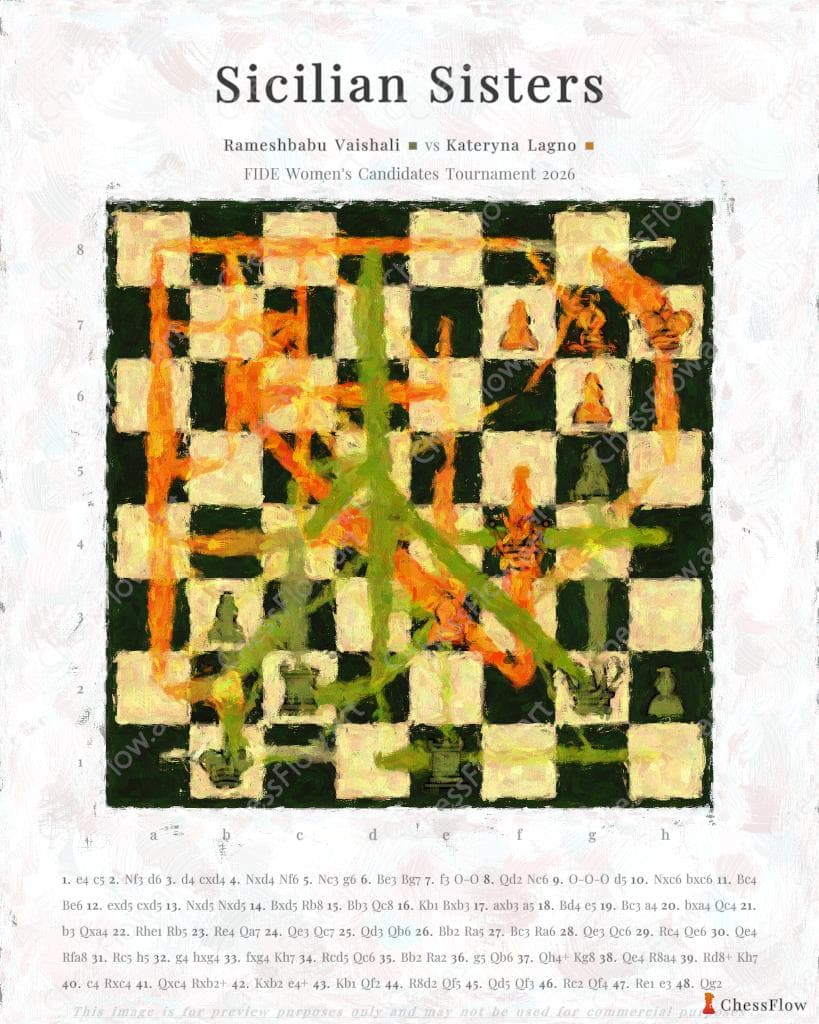
Rameshbabu Vaishali vs Kateryna Lagno
Rameshbabu Vaishali vs Kateryna Lagno
Vaishali Strikes in the Dragon Vaishali Rameshbabu defeated Kateryna Lagno in round 14 of the FIDE Women's Candidates Tournament 2026, playing a sharp Sicilian Dragon that ended in White's favor. The...
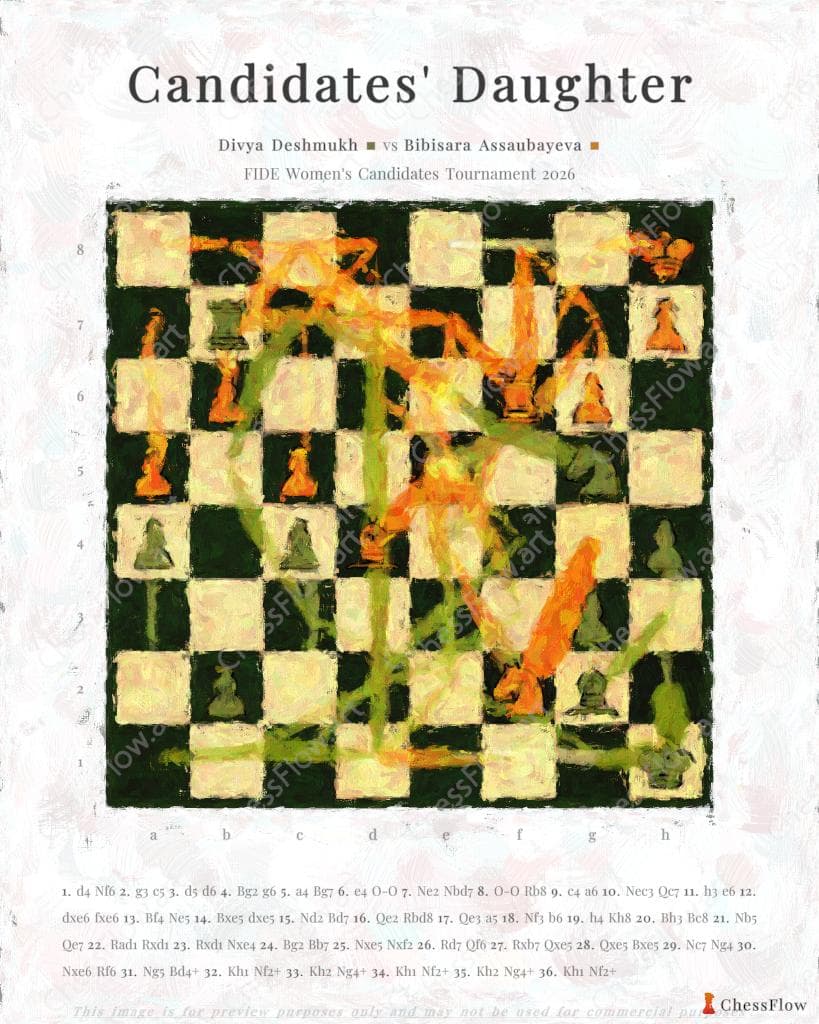
Divya Deshmukh vs Bibisara Assaubayeva
Divya Deshmukh vs Bibisara Assaubayeva
The Final Round Showdown Round 14 of the 2026 FIDE Women's Candidates Tournament delivered a crucial draw between GM Divya Deshmukh (2497) and GM Bibisara Assaubayeva (2516). With Assaubayeva enterin...

Ruslan Ponomariov vs Alexei Shirov
Ruslan Ponomariov vs Alexei Shirov
Two Legends Split the Point in Estonia Ruslan Ponomariov and Alexei Shirov, two players who have been trading blows at the highest levels of chess for over two decades, played to a quiet draw in Roun...