Championnat de France des Clubs 2026 | Elimination | Groupe B
Donchenko vs Pranav Draws After Black's Catalan Slip

Groupe B Blues
A Catalan That Nearly Wasn't
Alexander Donchenko and V Pranav drew their Round 7 encounter at the Championnat de France des Clubs 2026, but the half-point flattered Black. For roughly twenty moves, the Indian grandmaster had been nursing a comfortable position in a Closed Catalan — until one natural-looking rook move handed his German opponent a nearly winning advantage. What followed was a practical demonstration of how quickly team chess can turn: Pranav had to find precise defensive resources, and Donchenko had to convert an edge against a player who's been climbing the world rankings with alarming speed.
The result keeps both teams in the mix as Groupe B approaches its conclusion, though neither player will look back on this game with particular satisfaction. Donchenko missed a chance to score a full point; Pranav escaped with a draw he didn't entirely deserve.
The Opening: Familiar Territory for Both
The game opened with 1.d4 Nf6 2.c4 e6 3.g3 d5 4.Bg2 Be7 5.Nf3 O-O — the Closed Catalan, an opening that's become almost mandatory preparation for anyone playing at the 2600+ level. Donchenko, rated 2640 and currently sitting at world #81 according to the June 2026 FIDE list, has faced this structure countless times. Pranav, the 2006-born Indian prodigy now rated 2661 and ranked third among juniors worldwide, knows it equally well from both sides.
The early moves followed well-trodden paths. After 6.Qc2, Donchenko signaled his intention to play the mainline with the queen on c2, and Pranav responded with the thematic 6...c5, immediately challenging White's central structure. The position after 7.dxc5 d4 is a known tabiya — Black gives up a pawn temporarily but gains central space and activity.
What's interesting here is Donchenko's choice of 8.b4, a slightly unusual way to hold onto the extra pawn. The more common continuation involves Nbd2 and trying to undermine Black's center, but the German grandmaster opted for a more aggressive approach, using his queenside pawns to maintain the material advantage.
Pranav responded accurately with 8...a5 9.b5 Bxc5, regaining the pawn while keeping his structure intact. The position remained level — engines hovering around 0.10 to 0.20 — but both players still had plenty of chess ahead.
The Knight Dance and Central Tension
The middlegame developed along typical Catalan lines. After 10.Nbd2 Nbd7 11.Nb3, Donchenko maneuvered his knight to b3, eyeing the c5-bishop and potentially the d4-pawn. Pranav's response was ambitious: 11...e5, locking the center and claiming more space.
This is a double-edged decision. The pawn on e5 gives Black a strong presence in the center, but it also means the d5-square becomes a permanent outpost for White's pieces. In positions like these, the engine might call it equal, but the practical reality is more nuanced — whoever mishandles the tension first tends to suffer.
After 12.O-O Qc7 13.a4, Donchenko fixed the queenside structure and prepared to probe Black's position. The a4-pawn, combined with the already-advanced b5-pawn, creates a kind of clamp on Black's queenside expansion. Pranav now faced a critical decision about where to place his rooks.
The Mistake: When Natural Moves Aren't Good Enough
Here's where the game turned. In the position after 13.a4, Black has several reasonable options. The engine strongly prefers 13...Re8, keeping the rook on a flexible square where it supports the e5-pawn and can swing to other files as needed.
Instead, Pranav played 13...Rb8? — a move that looks perfectly sensible to the human eye. The rook goes to b8, potentially preparing ...b6 at some point or simply getting off the a-file where it might become a target. It's the kind of move you play quickly in a team event when you're not sensing danger.
But the evaluation jumped from +0.17 to +1.74. That's a massive swing, and it happened because the rook on b8 does almost nothing useful while White's pieces are suddenly coordinated for action.
The problem is subtle but real: with the rook on b8 instead of e8, Black's e5-pawn becomes harder to defend, and the bishop on c5 is more vulnerable to tactical ideas involving Nxc5. The rook on a8 was at least eyeing the a4-pawn; on b8, it's just watching.
Donchenko immediately seized the opportunity with 14.Nxc5, and the position transformed. White won the bishop pair in a structure where the long diagonal could become a weapon, and Black's pieces suddenly looked uncoordinated.
The Aftermath: Converting or Collapsing?
Unfortunately, the PGN cuts off at move 14, so we don't have the full picture of how the game concluded. What we know is that the final result was a draw, which tells us something important: either Donchenko couldn't find the right continuation to press his advantage, or Pranav defended resourcefully enough to hold.
This is where team chess differs from individual tournaments. When you're playing for Vandoeuvre Echecs or Grasse Echecs, the pressure isn't just about your own result — it's about contributing to the team score. A draw when you're slightly worse is often a good result; a draw when you're clearly better is a missed opportunity.
For Donchenko, this game fits a pattern we've seen before. At the GRENKE Freestyle Open earlier this year, he was commentating and noted how "the forces at this level is never straightforward.
Two Rising Stars, One Incomplete Game
Both players entered this round with something to prove. Donchenko, the 27-year-old German who made headlines at the 2025 World Cup by eliminating Anish Giri in a tense encounter, has been a consistent performer at the 2640 level but hasn't broken through to the super-GM tier. His play against Giri showed remarkable composure — particularly the tactical sequence starting with 37.f6! that trapped Giri's king in a mating net — but such moments of brilliance need to become routine for him to climb higher.
Pranav, meanwhile, represents the new wave of Indian chess talent. Born in 2006, the same year as World Champion Gukesh D., he's currently rated 2661 and ranked third among juniors worldwide. His recent results include a solid showing at the GRENKE Open, where he drew against Jan-Krzysztof Duda and finished with 4 points. The Championnat de France des Clubs offers him competitive games against strong opposition — exactly what a young player needs for continued development.
The position after move 13 in this game — before Pranav's mistake — is actually quite instructive for club players studying the Catalan. Black has achieved a reasonable setup, but the question of where to place the rooks is genuinely difficult. The engine's preference for Re8 isn't obvious at first glance, and understanding why Rb8 fails requires seeing several moves ahead.
Team Chess: The Bigger Picture
The Championnat de France des Clubs brings together some of the strongest players in Europe, with teams fielding international GMs alongside French talents. Groupe B has featured players like Jorden Van Foreest, Ivan Cheparinov, Etienne Bacrot, and Pavel Eljanov — a murderer's row of 2600+ players competing for their respective clubs.
For Vandoeuvre Echecs, Donchenko's half-point is acceptable but not ideal. Against a slightly higher-rated opponent, a draw with White represents a small disappointment, especially when the position offered more. For Grasse Echecs, Pranav's escape is a relief — team matches often come down to fractions of a point, and salvaging a draw from a worse position is a skill in itself.
The tournament format — a 16-team round robin with classical time controls (90 minutes for 40 moves plus 30 minutes plus 30 seconds per move) — means that every game matters. With Round 7 being the final round, standings are likely to be decided by tiebreaks, making results like this one potentially significant.
What the Position Teaches
If you're looking to study this game, the critical moment is clear: the position after 13.a4 deserves serious attention. Why does Rb8 fail? Because in Catalan structures, rook placement is everything. The e-file and d-file are where the action happens, and a rook on b8 is simply too far from the center to contribute.
The broader lesson is about prophylaxis — anticipating your opponent's ideas before they become threats. Donchenko's Nxc5 wasn't a trick; it was a natural consequence of Black's pieces being slightly miscoordinated. Pranav's mistake wasn't a blunder in the traditional sense; it was a failure to appreciate the positional nuances of the position.
This kind of game makes for a great study piece — the kind of thing you might want to keep around for reference. We turned this one into a print.
Looking Ahead
For both players, this draw is a footnote rather than a headline. Donchenko will continue his steady presence in the 2640-2660 range, a strong GM who occasionally punches above his weight (as he did against Giri) but hasn't yet made the leap to the elite. Pranav will keep climbing, his youth and talent suggesting that 2700 is a matter of when, not if.
The Championnat de France des Clubs continues to provide a valuable platform for competitive chess in Europe, bringing together players from across the continent for meaningful team battles. In an era when online chess dominates, events like this remind us what over-the-board competition looks like — the tension, the mistakes, the escapes, and the draws that feel like wins or losses depending on where you're sitting.
1.d4 Nf6 2.c4 e6 3.g3 d5 4.Bg2 Be7 5.Nf3 O-O 6.Qc2 c5 7.dxc5 d4 8.b4 a5 9.b5 Bxc5 10.Nbd2 Nbd7 11.Nb3 e5 12.O-O Qc7 13.a4 Rb8 14.Nxc5 Nxc5 15.Nxd4 Bg4 16.h3 exd4 17.Bf4 Qd7 18.hxg4 Rbe8 19.Qf5 Qxf5 20.gxf5 Rxe2 21.Bd6 Rc8 22.Rad1 Nxa4 23.Rxd4 b6 24.Bb7 Rce8 25.Bc6 Rc8 26.Bb7 Rce8 27.Bc6 Rc8 28.Ra1 Nc3 29.Rd3 Rd8 30.Ra3 Nb1 31.Bf4 Rc8 32.Ra1 Rb2 33.Be3 Ng4 34.Bxb6 Ne5 35.Rd8+ Rxd8 36.Bxd8 Nxc4 37.Bxa5 h5 38.Ra4 Nxa5 39.Rxa5 Nc3 40.Ra8+ Kh7 41.Rb8 Ne2+ 42.Kf1 Nd4 43.Bd7 Kh6 44.f4 Kh7 45.Re8 Nxb5 46.Rb8 Rb1+ 47.Kf2 Nc3 48.Rxb1 Nxb1 49.Ke3 Nc3 50.Bc6 Kh6 51.Kd2 Nb1+ 52.Kd3 g5 53.fxg6 fxg6 54.Be8 Kg7 55.Kc2 Na3+ 56.Kb3 Nb1 57.Kc2 Na3+ 58.Kb3 Nb1 59.Kc2 1/2-1/2
How would it look as art?


Own a piece of chess history. Transform this legendary game into a unique piece of art for your home or office.
Perfect For
- Unique Gifts for chess enthusiasts and players
- Tournament Prizes that winners will treasure
- Club Decor for chess clubs and gaming spaces
- Office Art showcasing strategic thinking
- Personal Collection of historic games
Turn Your Games Into Art
Whether it's your own game from Chess.com or Lichess, or another historic masterpiece, transform any chess game into a stunning visual artwork.
You might also like
More legendary chess game stories
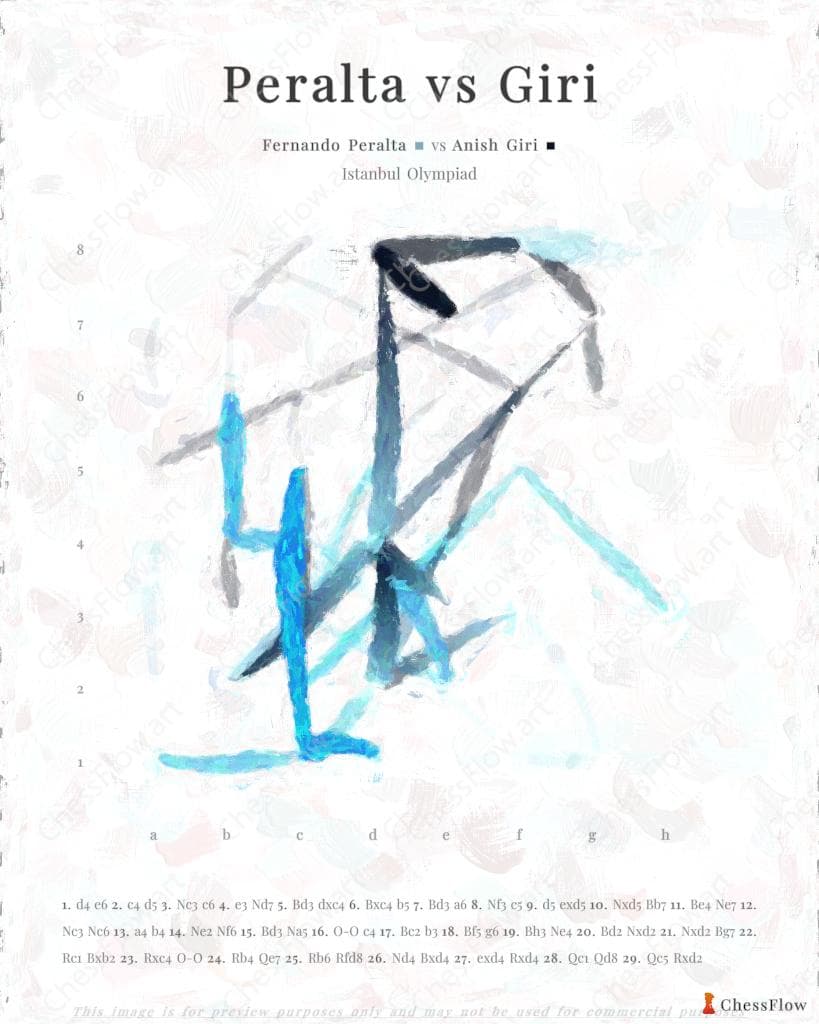
Fernando Peralta vs Anish Giri
Fernando Peralta vs Anish Giri
The Opening Battle Fernando Peralta (2606) faced off against rising Dutch talent Anish Giri (2711) in round 5 of the 2012 Istanbul Olympiad. The game opened with the Queen's Gambit Declined, Semi-Sla...
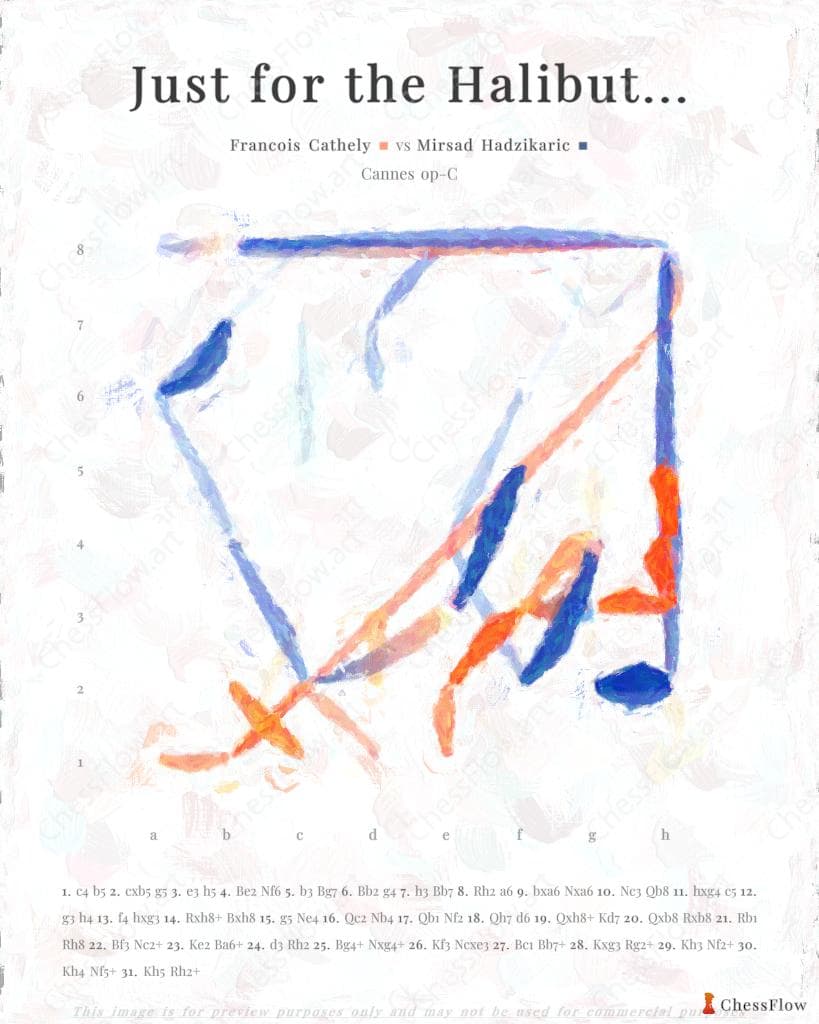
Francois Cathely vs Mirsad Hadzikaric
Francois Cathely vs Mirsad Hadzikaric
The Opening Gambit Francois Cathely and Mirsad Hadzikaric faced off in the 1995 Cannes op-C tournament with an opening that immediately signaled chaos was coming. After 1.c4 b5, Black's Polish Defens...
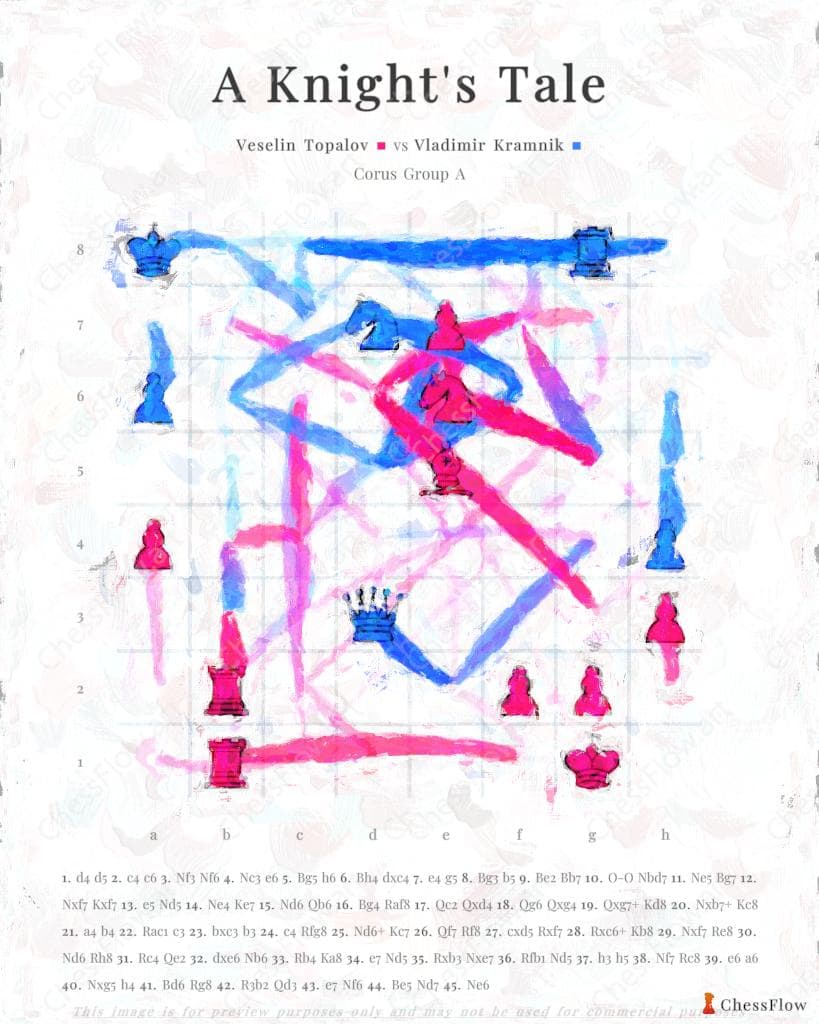
Veselin Topalov vs Vladimir Kramnik
Veselin Topalov vs Vladimir Kramnik
The Knight Sacrifice That Shook Wijk aan Zee Veselin Topalov pulled off one of the most spectacular attacking victories of the 2008 Corus tournament, defeating Vladimir Kramnik with a brilliant knigh...