TePe Sigeman Chess Tournament 2026
Van Foreest and Grandelius Draw in Quiet Italian Game


Forest of Kings
A Peaceful Day in Malmö
Jorden van Foreest and Nils Grandelius signed a draw in round six of the 2026 TePe Sigeman Chess Tournament, a result that suited neither player's tournament ambitions but reflected the nature of the position. After Van Foreest's dramatic win over Magnus Carlsen in round four—the first time anyone had beaten Carlsen in classical chess since Gukesh's famous Norway Chess 2025 victory—and his subsequent loss to Arjun Erigaisi in round five, the Dutch grandmaster was looking to stabilize. Grandelius, playing on home soil in Malmö and still searching for his first win after a brutal start to the event, needed something more than half a point.
They got a textbook Italian Game instead.
The Giuoco Pianissimo Lives Up to Its Name
Van Foreest opened with 1.e4 e5 2.Nf3 Nc6 3.Bc4, inviting the Italian Game rather than the sharper Ruy Lopez. Grandelius responded with the Classical Variation via 3...Nf6, and after 4.d3 the game entered Giuoco Pianissimo territory—Italian for "very quiet game," a name that proved prophetic.
The opening moves flowed quickly, both players clearly in their preparation. 5.O-O d6 6.c3 O-O 7.Re1 is one of the most popular setups in modern chess at all levels, from club players to world championship matches. The position offers White a slight pull but Black has no weaknesses, and the resulting middlegames tend to be maneuvering affairs rather than tactical firefights.
Grandelius retreated his bishop with 7...Bb6, a standard response that keeps the piece active on the a7-g1 diagonal while avoiding any immediate exchanges. Van Foreest responded with 8.Bb3, maintaining the tension and preparing to reroute his knight via d2 to c4.
The Knight Maneuvers
The strategic heart of this game came in moves 8 through 12, as both players repositioned their pieces for the coming middlegame. Grandelius played 8...Ne7 followed by 9...Ng6, a typical regrouping that aims to control the f4 square and prepare a potential kingside expansion with ...h6 and ...Nf4.
Van Foreest countered with 9.Nbd2 and then 10.Nc4, targeting the b6 bishop. This knight journey—d2 to c4—is a thematic idea in the Italian, pressuring Black's dark-squared bishop and preparing d4 under favorable circumstances.
After 10...h6 prevented any Ng5 ideas and 11.Bc2 repositioned the bishop to a more flexible diagonal, Grandelius solidified with 11...c6. The position was roughly equal according to the engines—hovering around +0.20 throughout—but more importantly, it was the kind of position where neither side had obvious targets.
Van Foreest finally executed the exchange with 12.Nxb6 axb6, giving Black the half-open a-file but eliminating any further pressure on the bishop. The resulting pawn structure, with Black's doubled b-pawns, is a common sight in Italian Game structures. In theory, these pawns can be weak; in practice, they rarely matter in the middlegame and often disappear in simplified positions.
The Central Break
With the pieces rearranged, Van Foreest pushed forward with 13.d4, the natural central break that White has been preparing since the opening. This is the moment the Italian Game builds toward—White stakes a claim in the center and hopes to use the space advantage to create threats.
Grandelius responded with 13...b5, gaining space on the queenside and preventing any Nc4 ideas from returning. The move also prepares ...Bb7 if needed, though the bishop on c8 remained passive throughout the game.
The position after 14.h3 and 14...Re8 was dead level. Engines showed +0.24, essentially zero, and the character of the position suggested a long, maneuvering game ahead. Both kings were safe, both pawn structures were solid, and neither side had obvious attacking chances.
When Theory Meets Practice
This is where the gap between engine assessment and human experience becomes relevant. A computer sees +0.24 and shrugs—it's a draw with best play. But for the players sitting at the board in Malmö, the question isn't "what's the evaluation?" but "where do I go from here?"
Van Foreest, rated 2735, had the white pieces and the slight space advantage that comes with controlling d4. But Grandelius, at 2662, had no weaknesses to target. The Swedish grandmaster's position was compact and resilient—the kind of setup that can absorb pressure for hours without cracking.
The game continued past the opening phase, but the trajectory was clear early. Neither player found a way to unbalance the position, and with both needing results for different reasons—Van Foreest to recover from his round five loss, Grandelius to finally get on the scoreboard with a win—the draw was a disappointing but fair outcome.
Grandelius's Difficult Tournament
For Nils Grandelius, this draw at least continued his mini-recovery after a brutal start. The 32-year-old Swedish grandmaster lost to Magnus Carlsen in round two, then fell to Arjun Erigaisi in round three before being outplayed by the 14-year-old Yagiz Kaan Erdogmus in round four. That loss to Erdogmus was particularly painful—Grandelius made only one real mistake with 25...cxd6? (instead of the correct 25...Rxd6!), and the Turkish teenager punished it with the powerful 26.Nd5!, weaving a mating net with his knights.
"Of course it feels quite nice to not have zero points, at least!" Grandelius had said after his round five draw against Abdusattorov, and the same sentiment likely applied here. A draw against Van Foreest isn't a bad result on rating, but at 1/6, Grandelius was playing for pride more than prizes.
The contrast with his round two loss to Carlsen was stark. In that game, Carlsen had praised the encounter as "a fun game, for sure!" after risking the Benoni and navigating complications successfully. Grandelius has worked as one of Carlsen's seconds in the past, and losing to his former employer in his home country stung.
Van Foreest's Rollercoaster Week
Jorden van Foreest's tournament has been a study in extremes. In round four, he became the first player to beat Magnus Carlsen in classical chess since Gukesh at Norway Chess 2025—a headline-grabbing result that announced the Dutch grandmaster's arrival among the world elite. Then in round five, he blundered against Arjun Erigaisi and lost, giving back all the momentum.
Carlsen himself offered an interesting perspective on Van Foreest's playing style: "Obviously I've played against him and I've seen a lot of his games against others, also in training camps. Jorden can look 2800 and 2400 in the span of minutes, both with his moves and his explanations and all of that, and that kind of makes him really interesting."
Unfortunately for Van Foreest, round five witnessed one of his "2400 moments," as Colin McGourty put it in his chess.com coverage. This round six draw was more of a 2650 performance—solid, professional, unremarkable. Sometimes that's exactly what you need after a loss.
The Tournament Picture
Heading into the final round, Arjun Erigaisi and Yagiz Kaan Erdogmus shared the lead on 3½ points. Carlsen sat half a point back after winning what he called an "incredibly shaky" game against Zhu Jiner in round five. The penultimate round featured crucial matchups: Erdogmus had White against Abdusattorov, Woodward faced Carlsen, and Zhu played Erigaisi.
This Van Foreest-Grandelius draw was the quiet game in a tournament that had delivered fireworks elsewhere. Round four alone saw Van Foreest beat Carlsen, Erdogmus defeat Grandelius with those crushing knight maneuvers, and Zhu pounce on an opening mistake to beat Woodward. Round five featured Erigaisi's win over Van Foreest and a 104-move marathon between Erdogmus and Woodward that ended in a draw.
Against that backdrop, a 14-move Italian Game that never caught fire was almost a relief for the commentators. GMs Erwin l'Ami and Stellan Brynell, hosting the live broadcast, had plenty of action elsewhere to discuss.
The Italian Game in 2026
The opening choice itself was notable. Van Foreest has shown a preference for solid, strategic openings in this tournament, and the Italian Game fits that profile perfectly. Unlike the Ruy Lopez, which often leads to complex pawn structures and long-term strategic battles, the Italian tends to produce clearer, more symmetrical positions.
The Giuoco Pianissimo in particular—characterized by the quiet 4.d3 instead of the more aggressive 4.c3 (the Giuoco Piano proper)—has become a favorite of players who want to avoid theoretical battles. Magnus Carlsen himself has used it extensively, and its popularity has trickled down through all levels of chess.
For Grandelius, facing the Italian rather than the Ruy Lopez meant less theoretical preparation was required but also fewer imbalances to play for. The resulting position was objectively equal but practically drawish—exactly the kind of game that leaves both players slightly unsatisfied.
Looking Ahead
The TePe Sigeman Chess Tournament concludes with the final round on May 7. With Erigaisi and Erdogmus leading, Carlsen lurking half a point behind, and several players still mathematically in contention, the final day promises more drama than this particular game delivered.
For Van Foreest, the tournament will be remembered for that Carlsen victory regardless of how he finishes. For Grandelius, playing on home soil in Malmö, the event has been a struggle—but at least he avoided the ignominy of finishing on zero points.
The position after move 14 in this game—symmetrical, balanced, professional—is the kind of quiet moment that gets lost in tournament coverage. We turned it into a print anyway.
Sometimes the forest is quiet. Sometimes the kings just... coexist.
1.e4 e5 2.Nf3 Nc6 3.Bc4 Nf6 4.d3 Bc5 5.O-O d6 6.c3 O-O 7.Re1 Bb6 8.Bb3 Ne7 9.Nbd2 Ng6 10.Nc4 h6 11.Bc2 c6 12.Nxb6 axb6 13.d4 b5 14.h3 Re8 15.a3 Qc7 16.Be3 Be6 17.Nd2 Rad8 18.Qf3 Qe7 19.Rad1 Nh4 20.Qe2 Ng6 21.Nf1 Bc4 22.Qd2 Nh5 23.Ng3 Nxg3 24.fxg3 exd4 25.cxd4 Be6 26.Qf2 Rc8 27.Bf4 Rcd8 28.b4 d5 29.e5 Rf8 30.Qe3 f5 31.exf6 Rxf6 32.Bxg6 Rxg6 33.g4 Re8 34.Rd2 Qd7 35.Be5 Bf7 36.Qg3 Rge6 37.Rf1 Bg6 38.Rdf2 Be4 39.h4 b6 40.h5 Qe7 41.Rf4 c5 42.g5 Qxg5 43.Qxg5 hxg5 44.Rf7 R6e7 45.Rxe7 Rxe7 46.Bd6 Rf7 47.bxc5 bxc5 48.dxc5 Rxf1+ 49.Kxf1 d4 50.Be5 d3 51.Bc3 Kh7 52.Kf2 Kh6 53.g4 g6 54.Ke3 Bc6 55.hxg6 Kxg6 56.Kxd3 Kf7 57.Kd4 1/2-1/2
How would it look as art?


Own a piece of chess history. Transform this legendary game into a unique piece of art for your home or office.
Perfect For
- Unique Gifts for chess enthusiasts and players
- Tournament Prizes that winners will treasure
- Club Decor for chess clubs and gaming spaces
- Office Art showcasing strategic thinking
- Personal Collection of historic games
Turn Your Games Into Art
Whether it's your own game from Chess.com or Lichess, or another historic masterpiece, transform any chess game into a stunning visual artwork.
You might also like
More legendary chess game stories
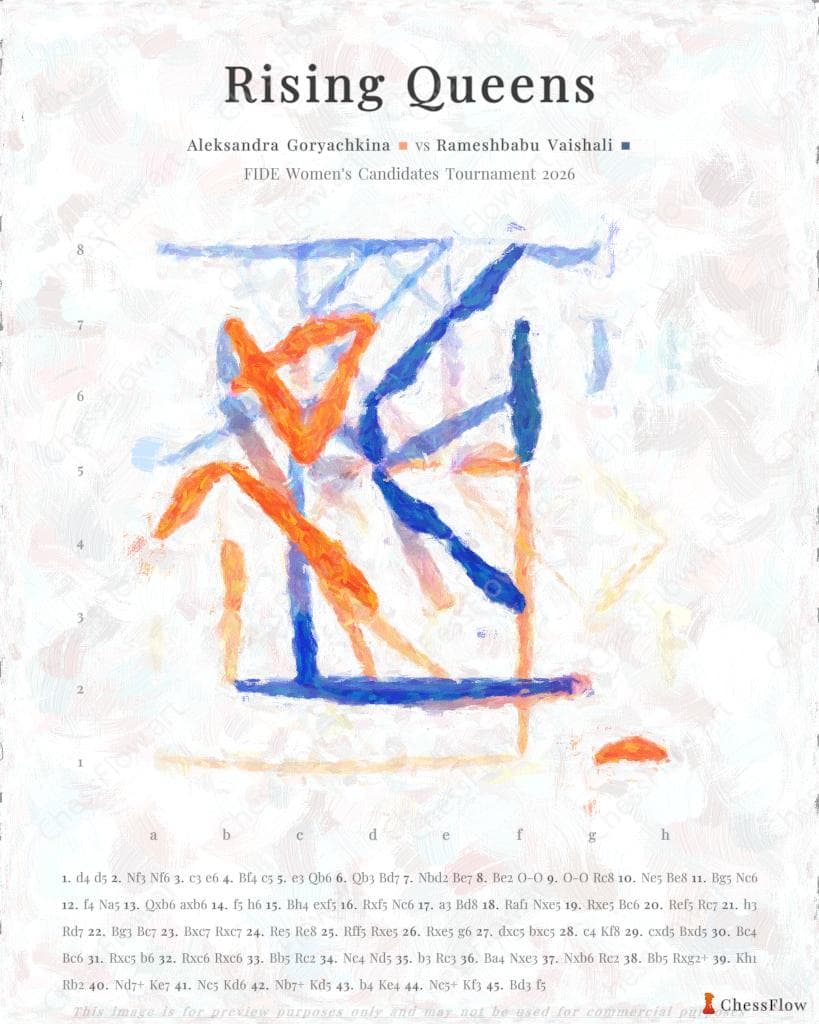
Aleksandra Goryachkina vs Rameshbabu Vaishali
Aleksandra Goryachkina vs Rameshbabu Vaishali
Vaishali Strikes Back in Candidates Thriller Rameshbabu Vaishali scored a crucial victory over Aleksandra Goryachkina in round 11 of the 2026 FIDE Women's Candidates Tournament, dealing a blow to the...
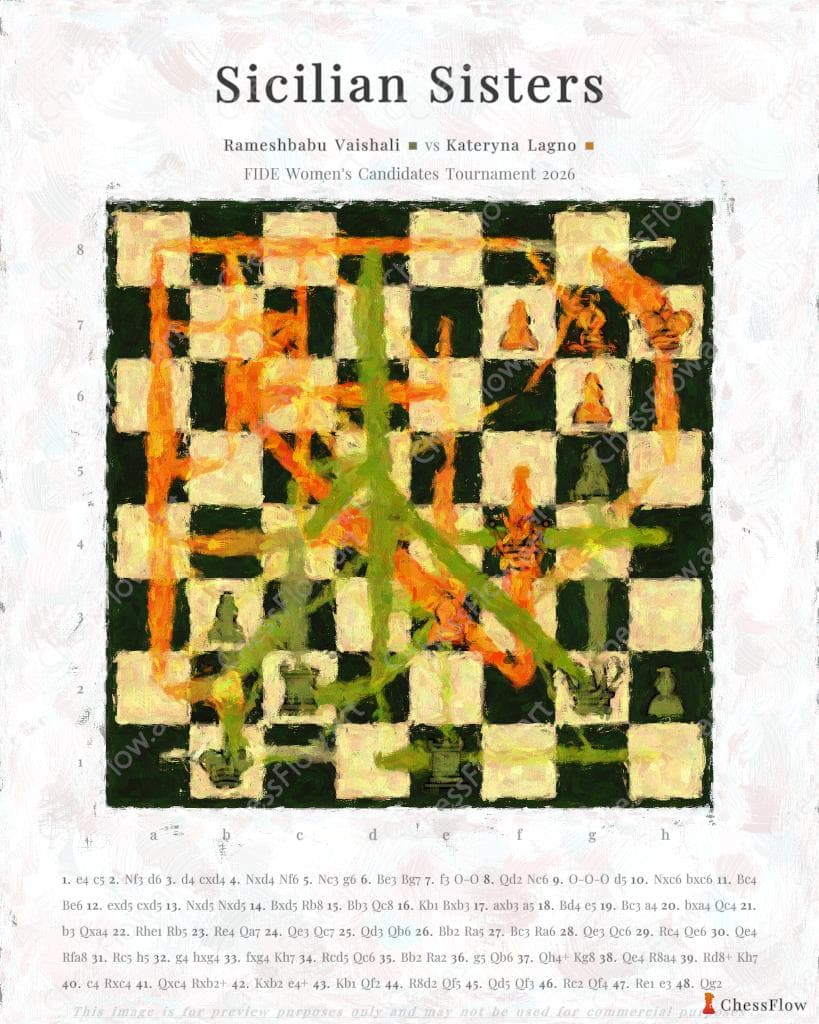
Rameshbabu Vaishali vs Kateryna Lagno
Rameshbabu Vaishali vs Kateryna Lagno
Vaishali Strikes in the Dragon Vaishali Rameshbabu defeated Kateryna Lagno in round 14 of the FIDE Women's Candidates Tournament 2026, playing a sharp Sicilian Dragon that ended in White's favor. The...
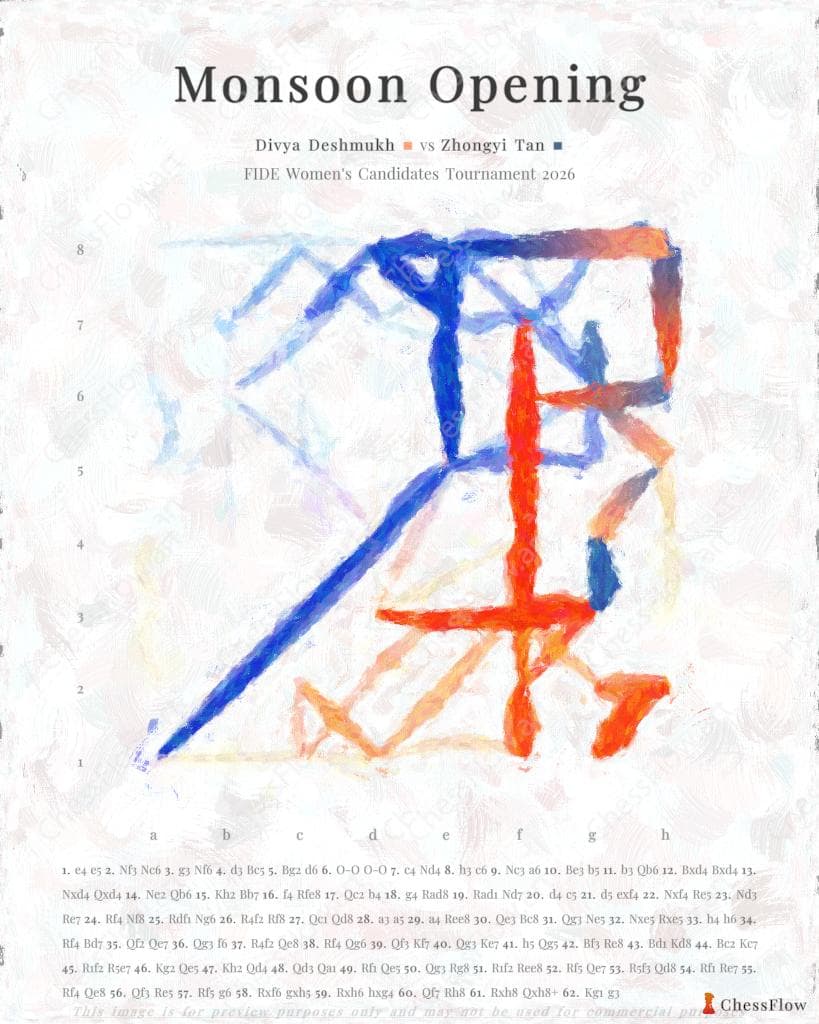
Divya Deshmukh vs Zhongyi Tan
Divya Deshmukh vs Zhongyi Tan
The Opening Choice Divya Deshmukh opened with 1.e4, and Tan Zhongyi responded with the classical 1...e5. The game transposed into the King's Knight Opening: Konstantinopolsky variation (ECO C44), a r...