FIDE Candidates Tournament 2026
Giri and Esipenko Draw in Candidates Round 11 Exchange QGD


Giri's Gamble
A Draw That Satisfied No One
Anish Giri and Andrey Esipenko split the point in round 11 of the 2026 FIDE Candidates Tournament, a result that did nothing to change either player's trajectory in Cyprus. Giri remains in the chasing pack, still needing results to keep pressure on runaway leader Javokhir Sindarov. Esipenko, meanwhile, stayed winless through eleven rounds—a tournament that has offered him plenty of fight but precious little reward.
The game itself was a slow-burn Exchange Queen's Gambit that transformed into a grinding endgame. Neither player found a knockout blow, and after 43 moves of careful maneuvering, the position liquidated into a dead draw. For Giri, who needed wins to stay in contention, this was a missed opportunity to apply pressure before his crucial round 13 clash with Sindarov. For Esipenko, it was another half-point added to a Candidates debut that has been defined more by resilience than results.
The Opening: Giri Goes Solid
Giri opened with 1.d4 d5 2.c4 e6 3.Nc3 Be7, steering the game into the Exchange Variation of the Queen's Gambit Declined. The early 4.cxd5 exd5 established the symmetrical pawn structure that would define the character of the entire game—a structure notorious for its drawish tendencies at the highest level.
This was a deliberate choice from Giri. After his wild Najdorf adventures earlier in the tournament—including that memorable round 4 win over Esipenko where he admitted "I was hoping no opponent will think I'm sick enough to actually go for this"—the Dutchman opted for something more controlled. The Exchange QGD is the kind of opening where White gets a tiny edge, Black equalizes with accurate play, and both players shake hands around move 40. That's essentially what happened here.
Esipenko handled the opening phase smoothly. After 6...O-O and 7...c5, Black achieved the standard freeing break, and the resulting position after 8.dxc5 Bxc5 offered no real imbalance. The queens came off early with 12...Qb6 13.Qb5 a6 14.Qxb6 Bxb6, and the game transitioned into a minor piece endgame where both players had to demonstrate technical precision rather than creative inspiration.
The Middlegame Squeeze
With queens off the board by move 14, this became a game about small advantages and patient maneuvering. Giri tried to create something with his bishop pair and central control, but Esipenko defended accurately.
The key positional battle centered around the c5-square. After 15.Na4 Ba7 16.Bd6 Rfc8, Giri's bishop landed on an active diagonal, temporarily restricting Black's rook. But Esipenko responded with 17...Bxc5 18.Nxc5, and the resulting knight-versus-knight structure offered White nothing tangible. The engines might show +0.3 here, but that's the kind of "advantage" that evaporates with any inaccuracy.
Giri tried to generate kingside pressure with 24.g4 g5 25.h4, attempting to open lines against Esipenko's king. This was the most ambitious moment of the game—Giri was essentially gambling that he could create weaknesses faster than Esipenko could organize counterplay. The pawn tension on the kingside created some visual drama, but Esipenko's 25...Nc4 and subsequent piece coordination neutralized any real danger.
The position after 26.Rh1 Nce5 27.Nxe5 Nxe5 was the kind of thing engines evaluate as dead equal while humans stare at for fifteen minutes trying to find a plan. Both players had active pieces, neither had weaknesses, and the pawn structure offered no leverage points. This is where the Exchange QGD earns its reputation.
The Endgame: Technical Precision, Zero Fireworks
The critical transformation came with 30.Nxe6 fxe6, when Giri captured Black's bishop and opened the f-file. This gave White a momentary initiative—the isolated e6-pawn looked like a potential target, and Black's king position was slightly exposed.
But Esipenko had calculated accurately. After 31.f4 Rag8 32.fxg5 hxg5 33.hxg5, the position simplified further. White's extra g-pawn was meaningless with such limited material, and Black's active knight on e5 provided perfect compensation for any structural deficiencies.
The final phase saw both players trading down into a rook endgame. 35.e4 dxe4 36.Rd4 Rg8 37.Rb4 b5 led to a position where White had a slight pull on paper—an extra pawn, active rook—but the reality was that Black's activity and the reduced material made a draw inevitable.
After 38.Rxe4 Rxg5 39.a4 Nf7 40.axb5 axb5 41.Rd4 Nd6, the position was a textbook fortress. Esipenko's knight covered all the key squares, and Giri had no way to make progress without allowing counterplay. The final moves 42.Kf2 Rc5 43.Ke3 1/2-1/2 saw both players agree to the inevitable.
What This Means for the Standings
This draw maintained the status quo in a tournament that has been dominated by Javokhir Sindarov's remarkable run. The young Uzbek, who Hikaru Nakamura praised by saying "He's played better than every other player combined—no one else has been even close!", remained two points clear at the top heading into the final stretch.
For Giri, this result was frustrating but not catastrophic. He still had the round 13 showdown with Sindarov to come—a game where he needed to win to prevent Sindarov from clinching the tournament with a round to spare. The draw against Esipenko preserved his mathematical chances but did nothing to improve his position.
Esipenko's tournament continued its pattern of near-misses and solid draws. The Russian remained winless through eleven rounds, tied with Matthias Bluebaum at the bottom of the standings. His earlier loss to Giri in round 4—that wild Najdorf where Esipenko admitted "I couldn't remember some things during the game"—remained the defining result of his Candidates debut. This draw showed his defensive capabilities but highlighted the difficulty of breaking through against top-level preparation.
The Human Element: Why This Game Mattered
On pure chess merit, this was a well-played but unspectacular draw. Both players made accurate moves, neither blundered, and the result was fair. But context matters in a Candidates Tournament.
Giri came into this game knowing he needed points. His approach—choosing the Exchange QGD with White—was curious. It's the kind of opening you play when you want a safe draw, not when you need to win. Perhaps he was saving energy for the Sindarov clash, or perhaps he judged that Esipenko's solid style would make any advantage difficult to convert regardless of the opening.
Esipenko, for his part, showed why he belongs at this level even if the results haven't reflected it. His handling of the endgame was precise, and he never gave Giri a genuine chance to press. The position after move 30 might have looked dangerous for Black, but Esipenko's calculation was spot-on.
The endgame structure after move 35—rook and knight versus rook, with pawns on both wings—is strong grandmasters from the rest. Both players navigated it flawlessly, which is exactly why the game ended in a draw. At this level, technical positions get held.
Looking Ahead
The real drama of this Candidates was always going to be about Sindarov's historic run and whether anyone could catch him. This Giri-Esipenko draw was a subplot at best—a game that kept the standings unchanged while the main story continued elsewhere.
Giri would get his chance against Sindarov in round 13. Esipenko would continue fighting for his first win. And the chess world would keep watching to see if the 20-year-old Uzbek could complete one of the most dominant Candidates performances in modern history.
The position after move 25, with both players committed to that kingside pawn storm, is the kind of tense moment that captures the psychological weight of Candidates chess. We turned this one into a print.
Sometimes a draw is just a draw. But in a Candidates Tournament, every half-point carries weight—and this one kept Giri's slim hopes alive while Esipenko's search for a breakthrough continued.
1.d4 d5 2.c4 e6 3.Nc3 Be7 4.cxd5 exd5 5.Bf4 Nf6 6.e3 O-O 7.Nf3 c5 8.dxc5 Bxc5 9.Be2 Nc6 10.O-O Be6 11.Qa4 h6 12.Rfd1 Qb6 13.Qb5 a6 14.Qxb6 Bxb6 15.Na4 Ba7 16.Bd6 Rfc8 17.Bc5 Bxc5 18.Nxc5 Ne5 19.Rac1 Ned7 20.Nd3 Kf8 21.Nd4 Ke7 22.f3 Ne8 23.Kf2 Nd6 24.g4 g5 25.h4 Nc4 26.Rh1 Nce5 27.Nxe5 Nxe5 28.Rcd1 Rh8 29.Kg3 Nc6 30.Nxe6 fxe6 31.f4 Rag8 32.fxg5 hxg5 33.hxg5 Ne5 34.Rxh8 Rxh8 35.e4 dxe4 36.Rd4 Rg8 37.Rb4 b5 38.Rxe4 Rxg5 39.a4 Nf7 40.axb5 axb5 41.Rd4 Nd6 42.Kf2 Rc5 43.Ke3 1/2-1/2
How would it look as art?


Own a piece of chess history. Transform this legendary game into a unique piece of art for your home or office.
Perfect For
- Unique Gifts for chess enthusiasts and players
- Tournament Prizes that winners will treasure
- Club Decor for chess clubs and gaming spaces
- Office Art showcasing strategic thinking
- Personal Collection of historic games
Explore more
Turn Your Games Into Art
Whether it's your own game from Chess.com or Lichess, or another historic masterpiece, transform any chess game into a stunning visual artwork.
You might also like
More legendary chess game stories

Wenjun Ju vs Humpy Koneru
Wenjun Ju vs Humpy Koneru
Koneru Finds Redemption Against the World Champion Humpy Koneru entered round ten of Norway Chess Women 2026 in last place with just three points, having lost three Armageddon games already in Oslo....
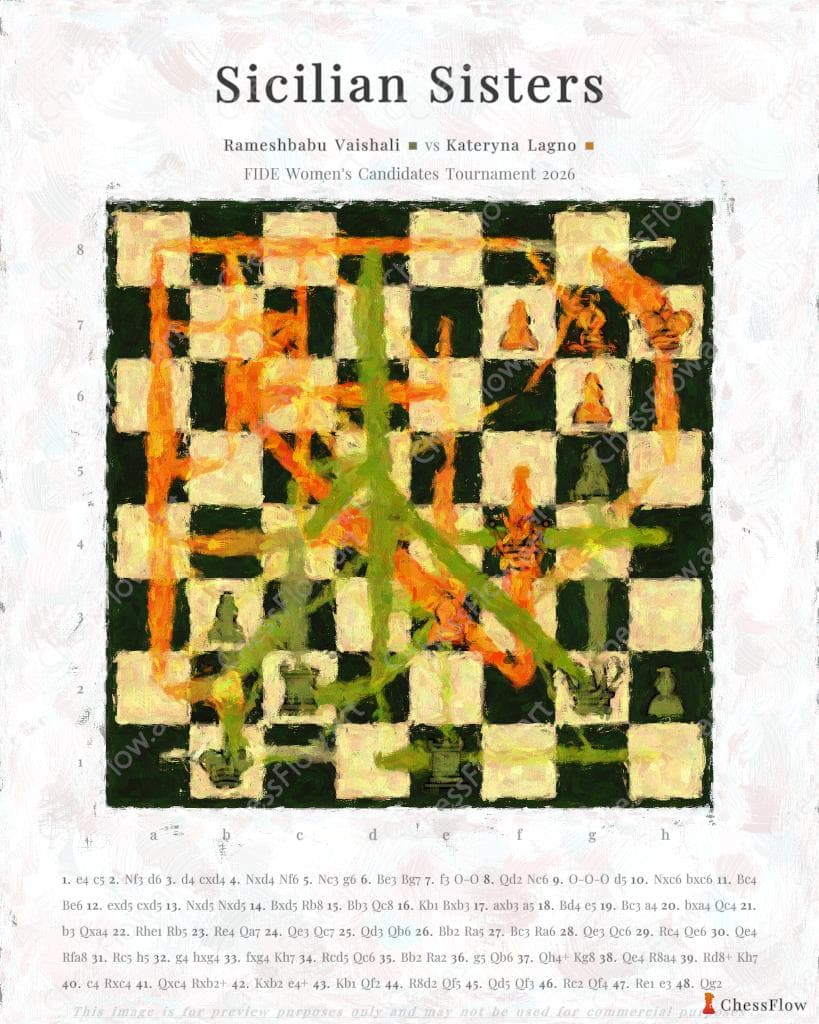
Rameshbabu Vaishali vs Kateryna Lagno
Rameshbabu Vaishali vs Kateryna Lagno
Vaishali Strikes in the Dragon Vaishali Rameshbabu defeated Kateryna Lagno in round 14 of the FIDE Women's Candidates Tournament 2026, playing a sharp Sicilian Dragon that ended in White's favor. The...
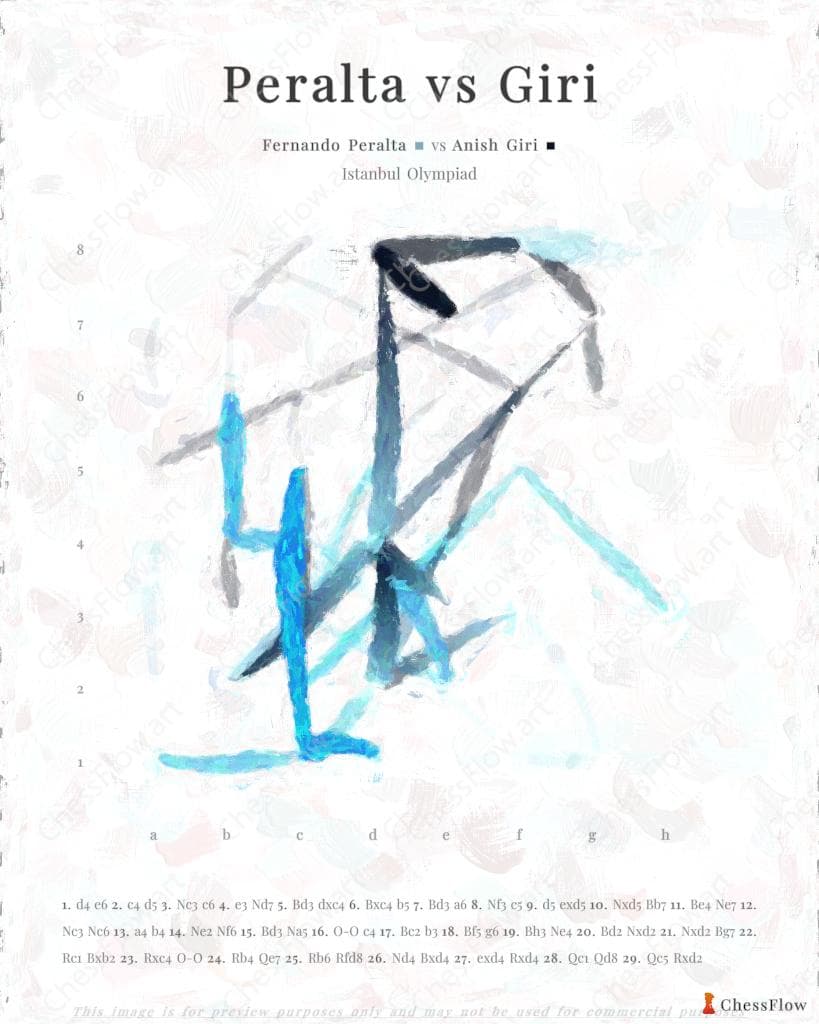
Fernando Peralta vs Anish Giri
Fernando Peralta vs Anish Giri
The Opening Battle Fernando Peralta (2606) faced off against rising Dutch talent Anish Giri (2711) in round 5 of the 2012 Istanbul Olympiad. The game opened with the Queen's Gambit Declined, Semi-Sla...