FIDE Candidates Tournament 2026
Giri Misses Win vs Wei Yi, Sindarov Nears Candidates Victory


Giri, Anish vs Wei, Yi
Giri's Missed Opportunity
Anish Giri had Wei Yi on the ropes for 77 moves in round 12 of the 2026 FIDE Candidates Tournament, pressing with clear winning chances in a technical endgame, only to let the Chinese grandmaster escape with a draw. The result keeps Giri two points behind runaway leader Javokhir Sindarov heading into their crucial round 13 clash—a game where only a win will keep Giri's title hopes mathematically alive.
This was Candidates winners from Candidates contenders. Giri did everything right for most of the 77 moves, building an advantage from a quiet Catalan opening and converting it into an endgame where engines gave him serious winning chances. But "winning chances" at the top level means nothing without conversion, and conversion against Wei Yi—a player who once beat Magnus Carlsen in a blitz game at age 15—requires precision that Giri couldn't quite find when it mattered most.
The Catalan Framework
The game began with 1.c4 e6 2.g3 d5 3.Bg2 Nf6 4.Nf3 Be7 5.O-O O-O 6.d4 dxc4, a standard Catalan structure where White typically recovers the pawn while maintaining long-term pressure with the powerful g2 bishop. Giri recaptured with 7.Qc2, the most popular continuation, keeping options open for how to regain the c4 pawn while eyeing potential queenside expansion.
Wei responded with 7...a6 8.a4 Bd7, a setup designed to prevent White's typical a4-a5 ideas while preparing to return the pawn under favorable circumstances. After 9.Qxc4 c5, Black struck at the center immediately, and the position transformed following 10.dxc5 Bc6 11.Nc3 a5.
This is where the game's character began to emerge. Wei had given up a pawn but secured the a5 square for his pieces and eliminated White's queenside pawn majority. The question was whether Giri could make something of his temporary material advantage before Black's piece activity compensated for the missing pawn.
The Central Transformation
The critical early sequence came with 12.Ne5 Bxg2 13.Kxg2 Nbd7 14.Nd3 Nxc5 15.Nxc5 Qc7. Giri had returned the c5 pawn but now possessed a knight on c5 that exerted pressure across the board. The position was objectively close to equal, but White had a clear plan: trade pieces, simplify, and try to exploit any small inaccuracies in the endgame.
After 16.Be3 Rac8 17.N3e4 Nxe4 18.Qxe4 Bxc5 19.Rac1 b6 20.Rfd1 Qe7, the position had clarified significantly. Both players had developed harmoniously, but Giri's rooks were better placed—one on the open c-file, one on the d-file—while Wei's bishop on c5 was about to become a liability.
The exchange of bishops with 21.Bxc5 Rxc5 22.Rxc5 Qxc5 left a rook endgame where Giri had a small but persistent edge. His rook invaded with 23.Rd7, targeting the seventh rank and putting immediate pressure on Black's position. This is the kind of technical advantage that engines might evaluate as only +0.3 or +0.4, but at the Candidates level, such positions are precisely where the best players grind out wins.
The Rook Endgame Grind
What followed was a 50-move technical battle that demonstrated both Giri's persistence and Wei's defensive resourcefulness. After 23...g6 24.b3 Qc3 25.Qf3 Qxf3+ 26.exf3, the queens came off and Giri had to prove his advantage in a pure rook ending.
The position after move 26 is instructive. White has a rook on the seventh rank, a slightly better pawn structure, and the initiative. Black's rook is passive on c8, and the king needs to mobilize quickly. Engines call this position roughly equal, but no human wants to defend this for 40 moves with the clock ticking.
Giri pressed with 27.Rd6 b5 28.axb5 Rb8 29.b6, creating a dangerous passed pawn on the b-file. Wei's king rushed toward the action with 29...Kf8 30.Rc6 Rb7, but the b6 pawn remained a thorn in Black's position.
The next phase saw Giri try to make progress on the kingside while maintaining the b-pawn. 31.g4 Ke8 32.h4 Kd7 33.Rc5 Rxb6 34.Rxa5 Ke7 saw the b-pawn finally fall, but Giri had won the a5 pawn in return. The position was still objectively holdable for Black, but Wei had to find precise moves with his clock running dangerously low.
Time Trouble and the Escape
According to reports from the venue, Wei reached the time control with merely one second on his clock. In such situations, even objectively drawn positions become minefields. Giri continued pressing with 35.h5 h6 36.f4 Rxb3, and after 37.hxg6 fxg6 38.Ra7+ Kf6 39.Rh7 h5 40.gxh5 gxh5 41.Rxh5, the position had simplified to a rook and pawn ending where White had an extra pawn but Black's activity provided sufficient counterplay.
The final moves 41...Rd3 42.f3 Rd5 led to a position where neither side could make progress. The game eventually ended in a draw, with Wei reportedly calling the arbiter to point out that a triple repetition was about to appear on the board.
GM David Howell's earlier assessment of Giri's defensive skills proved prophetic in reverse: "I trust Giri's defensive skills," he had said during round 7. But in round 12, it was Wei's defensive skills that proved decisive, surviving what ChessBase described as "a complex struggle, with Wei taking considerable risks."
What This Means for the Tournament
The draw leaves Giri in an agonizing position. He remains two points behind Sindarov with only two rounds to play, meaning he must beat the tournament leader with White in round 13 just to have any chance. Even then, Sindarov would only need a draw against Matthias Bluebaum in the final round to clinch the tournament.
Sindarov's path to victory has been remarkable. After scoring a historic 6/7 in the first half—the best opening stretch in Candidates history—he has continued to accumulate points through solid play and the occasional draw. His round 12 game against Hikaru Nakamura lasted just 35 minutes before ending in a peaceful result.
For Wei Yi, this draw represents survival more than success. Standing on 3.5/12 after this game, the Chinese grandmaster is far from the title race, but escaping from a lost position against one of the world's best technical players is no small achievement. His tournament has been a mixed bag: a "stylish attacking win" over Andrey Esipenko in round 7 showed his capabilities, but inconsistency has plagued his results throughout.
The Conversion Problem
This game encapsulates a broader theme of Giri's Candidates career. As one Lichess forum user noted: "The candidates is all about conversion. It's a good idea to never reach losing positions but without converting your winning chances it's not enough."
Giri's quality of play and opening preparation throughout this tournament has been "incredibly good," according to observers. He was "never worse and never had problems with black, spending 5 minutes on some games." But the wins haven't come when needed—missed chances against Fabiano Caruana in round 9, against Hikaru Nakamura in round 11, and now against Wei Yi in round 12.
The position after move 26 in this game—queens off, rook on the seventh, Black's king stranded—is the kind of thing you hang on a wall. We turned this one into a print at ChessFlow.
Tomorrow's round 13 brings Giri vs. Sindarov, the game that will determine whether this Candidates has any remaining drama or whether Sindarov clinches with a round to spare. Giri must win. A draw sends Sindarov to face Gukesh Dommaraju for the world title. Given Sindarov's rock-solid play throughout the tournament—he's lost zero games and drawn only twice—Giri faces perhaps the most difficult assignment in chess: beating a player who simply doesn't lose.
If Sindarov draws his final two games, he will achieve the best score in Candidates history by half a point, surpassing Ian Nepomniachtchi's record. At just 20 years old, he would face Gukesh in what would be the youngest world championship match ever—two 20-year-olds battling for the highest title in chess.
For Giri, round 13 represents one final chance. His preparation has been excellent, his play has been strong, but in the Candidates, being strong isn't enough. You have to convert.
1.c4 e6 2.g3 d5 3.Bg2 Nf6 4.Nf3 Be7 5.O-O O-O 6.d4 dxc4 7.Qc2 a6 8.a4 Bd7 9.Qxc4 c5 10.dxc5 Bc6 11.Nc3 a5 12.Ne5 Bxg2 13.Kxg2 Nbd7 14.Nd3 Nxc5 15.Nxc5 Qc7 16.Be3 Rac8 17.N3e4 Nxe4 18.Qxe4 Bxc5 19.Rac1 b6 20.Rfd1 Qe7 21.Bxc5 Rxc5 22.Rxc5 Qxc5 23.Rd7 g6 24.b3 Qc3 25.Qf3 Qxf3+ 26.exf3 Rc8 27.Rd6 b5 28.axb5 Rb8 29.b6 Kf8 30.Rc6 Rb7 31.g4 Ke8 32.h4 Kd7 33.Rc5 Rxb6 34.Rxa5 Ke7 35.h5 h6 36.f4 Rxb3 37.hxg6 fxg6 38.Ra7+ Kf6 39.Rh7 h5 40.gxh5 gxh5 41.Rxh5 Rd3 42.f3 Rd5 1/2-1/2
How would it look as art?


Own a piece of chess history. Transform this legendary game into a unique piece of art for your home or office.
Perfect For
- Unique Gifts for chess enthusiasts and players
- Tournament Prizes that winners will treasure
- Club Decor for chess clubs and gaming spaces
- Office Art showcasing strategic thinking
- Personal Collection of historic games
Turn Your Games Into Art
Whether it's your own game from Chess.com or Lichess, or another historic masterpiece, transform any chess game into a stunning visual artwork.
You might also like
More legendary chess game stories

Yi Wei vs Andrey Esipenko
Yi Wei vs Andrey Esipenko
Wei's First Strike Wei Yi finally broke through at the 2026 FIDE Candidates Tournament, defeating Andrey Esipenko 1-0 in round 13 with a sharp attacking game that emerged from the normally solid Petr...

Jiner Zhu vs Aleksandra Goryachkina
Jiner Zhu vs Aleksandra Goryachkina
Goryachkina Takes Down Zhu in Round 13 Aleksandra Goryachkina scored a crucial victory over Jiner Zhu in round 13 of the FIDE Women's Candidates Tournament 2026, dealing a blow to the Chinese GM's ch...
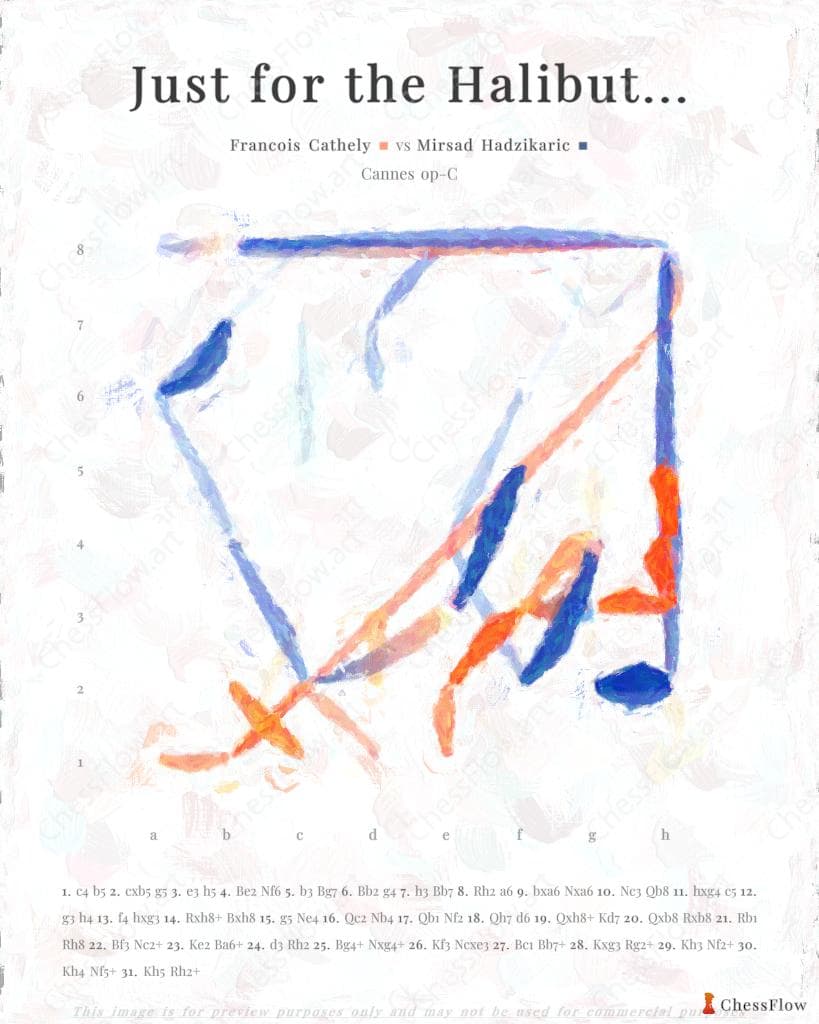
Francois Cathely vs Mirsad Hadzikaric
Francois Cathely vs Mirsad Hadzikaric
The Opening Gambit Francois Cathely and Mirsad Hadzikaric faced off in the 1995 Cannes op-C tournament with an opening that immediately signaled chaos was coming. After 1.c4 b5, Black's Polish Defens...