TePe Sigeman Chess Tournament 2026
Grandelius Holds Abdusattorov in Solid QGD Draw at Sigeman


Nordic Endgame
Grandelius Stops the Bleeding
Nils Grandelius needed this one. After three losses in four rounds—including defeats to Magnus Carlsen, Arjun Erigaisi, and rising star Yagiz Kaan Erdogmus—the Swedish number-one was staring at a disastrous home tournament. Facing world number-four Nodirbek Abdusattorov with the white pieces in round five, Grandelius played it safe, steering the game into a risk-free Queen's Gambit Declined that never seriously threatened to produce a decisive result.
The draw was agreed after just 14 moves of main play, with both players content to split the point. For Grandelius (2662), it's a small mercy after a brutal stretch. For Abdusattorov (2780), who missed winning chances against Arjun Erigaisi in round four, it's another half-point that keeps him in touch with the leaders but doesn't close the gap.
The Exchange Variation Without Teeth
Grandelius opened with 1.d4 Nf6 2.c4 e6 3.Nc3 d5 4.Bg5, inviting a classical Queen's Gambit Declined. Abdusattorov obliged with 4...Be7, and the game quickly took on a symmetrical, low-tension character after 6.Bxf6 Bxf6.
This early bishop exchange is a well-known way to avoid the sharpest theoretical battles. White gives up the bishop pair but gains a solid pawn structure and removes Black's most active minor piece. The resulting positions tend to be technical rather than tactical—exactly what Grandelius needed after his recent troubles.
The opening sequence continued with 7.Nf3 O-O 8.Rc1 a6, where Abdusattorov prepared the typical queenside expansion with ...b5. Grandelius responded with 9.Bd3, developing naturally, and after 9...dxc4 10.Bxc4 Nd7, the position had already lost most of its dynamic potential.
Engine evaluations hovered around 0.00 throughout the opening phase—this wasn't a case of one player outpreparing the other or finding a novelty. Both grandmasters were simply following well-trodden paths, and neither seemed interested in deviating into uncharted territory.
The Knight Maneuver That Went Nowhere
The most interesting moment came with 11.Ne4, when Grandelius centralized his knight with some vague ideas of Nd6 or Nf6 checks. But Abdusattorov calmly retreated with 11...Be7, and suddenly White's knight had no good squares to jump to.
This is a subtle positional point that club players often miss: a knight in the center is only strong if it has targets or can't be easily challenged. Here, Black's solid setup meant the knight on e4 was more of a temporary visitor than a permanent occupant. After 12.O-O b5 13.Bd3 Bb7, Abdusattorov had completed his development and established a comfortable position.
The evaluation remained dead equal. Engines saw no advantage for either side, and more importantly, there was no imbalance to play for. No weak pawns, no exposed kings, no piece activity differential. This was heading toward a draw from the moment the center stabilized.
A Quick Handshake
With 14.a4, Grandelius made his last attempt to create something on the queenside, probing the b5 pawn. Abdusattorov responded with 14...Rc8, and at this point, both players had seen enough.
The position after move 14 tells the whole story: White has a slight space advantage but no targets. Black is solid but passive. The engines call it 0.00, and the humans agreed. There was simply nothing to fight for.
Some might criticize such a short draw, but context matters. Grandelius had been through the wringer—losses to Carlsen's Benoni, Arjun's aggressive play, and Erdogmus's knight dance that produced one of the tournament's most memorable combinations. A quiet day at the office was probably exactly what the Swedish GM needed.
For Abdusattorov, this continues a frustrating pattern. In round four, he had Arjun Erigaisi on the ropes after 18.a5! and 19.Bh4! created serious problems, but he let the advantage slip. Against Grandelius, he never got the chance to press—the position was too sterile from the start.
The Tournament Picture
This draw keeps Abdusattorov in the chasing pack, but the real story of round five was happening elsewhere. With Erdogmus holding the sole lead after his round-four demolition of Grandelius, the 14-year-old Turkish star was the one everyone was watching.
The standings heading into the final rounds show how tight this tournament has become. Carlsen, after his shocking loss to Jorden van Foreest in round four—his first classical defeat since Gukesh beat him at Norway Chess 2025—desperately needed a win against Zhu Jiner to stay in contention. Van Foreest, meanwhile, was riding high after becoming the first player to beat Carlsen in classical chess in nearly a year.
Grandelius sits near the bottom of the table, but at least he stopped the losing streak. Sometimes in chess, especially at a home tournament where expectations run high, a boring draw feels like a victory.
The QGD Exchange: A Practical Choice
It's worth noting why this particular opening choice made sense for Grandelius. The Queen's Gambit Declined with an early Bxf6 is one of the most drawish systems in chess at the top level. By exchanging the dark-squared bishops early, White avoids the complex middlegame battles that arise in the main lines with Bg5 staying on the board.
The resulting pawn structures tend to be symmetrical or nearly so. Black gets the bishop pair but often struggles to activate them. White has a slight initiative but no real winning chances against accurate defense. It's the kind of opening you play when you want to take the game into quiet waters—and that's exactly what Grandelius achieved.
Abdusattorov, for his part, seemed content with the outcome. As world number-four, he could afford to take a half-point with Black against a lower-rated opponent. The real battles would come in later rounds.
What This Means Going Forward
For Grandelius, the tournament has been a disappointment. Playing in front of a home crowd in Malmö, he came in as Sweden's top player and has delivered only this one draw against the elite opposition. The losses to Carlsen and Erdogmus were particularly painful—the former because Carlsen's Benoni was a high-risk choice that Grandelius couldn't punish, the latter because Erdogmus's 26.Nd5! was the kind of tactical blow that stings.
But chess tournaments are marathons, not sprints. Grandelius still has games remaining, and a couple of wins could salvage his result. The key is to rebuild confidence, and a solid draw against a 2780-rated opponent is a reasonable starting point.
For Abdusattorov, the tournament represents a missed opportunity so far. He started strong with a win over Zhu Jiner in round one, taking advantage of her blunder 23.Nd4?? to win material and convert smoothly. But since then, he's drawn every game—including the high-profile encounter against Carlsen in round three and the frustrating near-miss against Arjun in round four.
The Uzbek star remains dangerous, of course. At 2780, he's capable of producing wins against anyone in the field. But with Erdogmus setting the pace, Abdusattorov will need to find more decisive results in the remaining rounds.
The Broader Context
The TePe Sigeman Chess Tournament has produced plenty of drama in 2026—just not in this particular game. Van Foreest's historic win over Carlsen, Erdogmus's emergence as a genuine 2700+ threat, and the struggles of Zhu Jiner and Grandelius at the bottom of the table have all made for interesting viewing.
This Grandelius-Abdusattorov draw was the quiet game on a loud day. Sometimes that's how chess works. Not every encounter can be a tactical firefight or a grinding six-hour endgame. Sometimes two grandmasters shake hands after 14 moves because neither sees a path to an advantage, and both have other battles to fight.
The position after move 14 is the kind of dead-equal setup that makes you appreciate how much work goes into creating winning chances at the top level. We turned this one into a print anyway—even peaceful positions have their own geometry.
As the tournament enters its final stretch, all eyes will be on whether Erdogmus can hold his nerve, whether Carlsen can mount a comeback, and whether Abdusattorov can finally convert one of his promising positions into a full point. This draw won't be remembered as a highlight, but for Grandelius, it might be the game that stopped the bleeding and let him regroup for the rounds ahead.
1.d4 Nf6 2.c4 e6 3.Nc3 d5 4.Bg5 Be7 5.e3 h6 6.Bxf6 Bxf6 7.Nf3 O-O 8.Rc1 a6 9.Bd3 dxc4 10.Bxc4 Nd7 11.Ne4 Be7 12.O-O b5 13.Bd3 Bb7 14.a4 Rc8 15.axb5 axb5 16.Qe2 c5 17.dxc5 Nxc5 18.Nxc5 Rxc5 19.Rxc5 Bxc5 20.Bxb5 Bxf3 21.Qxf3 Qb6 22.Qc6 Rb8 23.Qxb6 Rxb6 24.Bd3 Rxb2 25.Rb1 Rxb1+ 26.Bxb1 Bd6 27.Bc2 Bc5 28.Bb1 Bd6 29.Bc2 Bc5 1/2-1/2
How would it look as art?


Own a piece of chess history. Transform this legendary game into a unique piece of art for your home or office.
Perfect For
- Unique Gifts for chess enthusiasts and players
- Tournament Prizes that winners will treasure
- Club Decor for chess clubs and gaming spaces
- Office Art showcasing strategic thinking
- Personal Collection of historic games
Explore more
Turn Your Games Into Art
Whether it's your own game from Chess.com or Lichess, or another historic masterpiece, transform any chess game into a stunning visual artwork.
You might also like
More legendary chess game stories

Yi Wei vs Andrey Esipenko
Yi Wei vs Andrey Esipenko
Wei's First Strike Wei Yi finally broke through at the 2026 FIDE Candidates Tournament, defeating Andrey Esipenko 1-0 in round 13 with a sharp attacking game that emerged from the normally solid Petr...
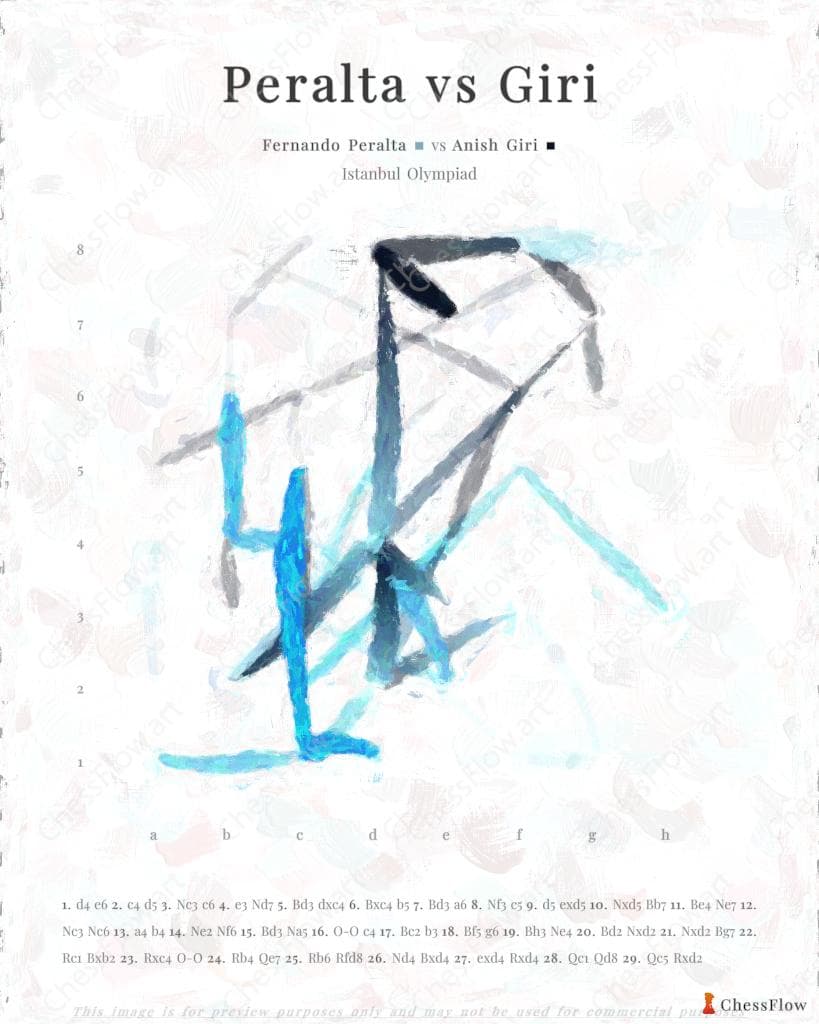
Fernando Peralta vs Anish Giri
Fernando Peralta vs Anish Giri
The Opening Battle Fernando Peralta (2606) faced off against rising Dutch talent Anish Giri (2711) in round 5 of the 2012 Istanbul Olympiad. The game opened with the Queen's Gambit Declined, Semi-Sla...
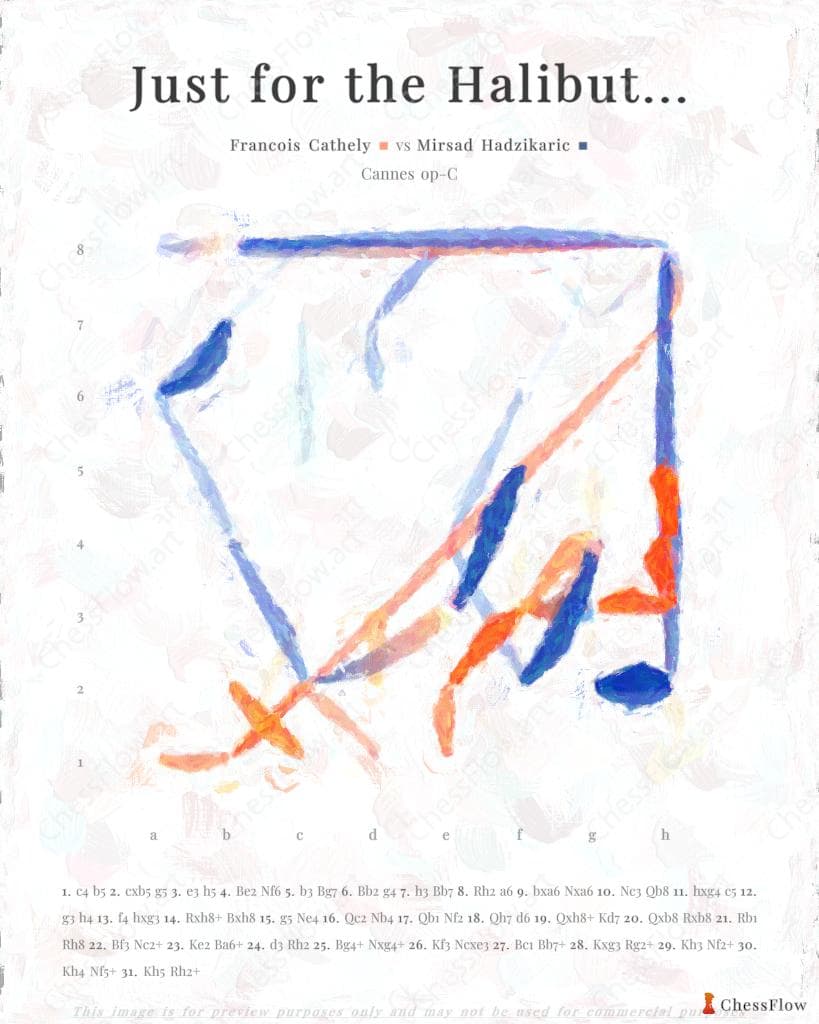
Francois Cathely vs Mirsad Hadzikaric
Francois Cathely vs Mirsad Hadzikaric
The Opening Gambit Francois Cathely and Mirsad Hadzikaric faced off in the 1995 Cannes op-C tournament with an opening that immediately signaled chaos was coming. After 1.c4 b5, Black's Polish Defens...