Championnat de France des Clubs 2026 | Elimination | Groupe A
Gurel and Tabatabaei Draw in French Club Championship


Tabatabaei's Tempest
A Half-Point in the French Club Championship
M. Amin Tabatabaei and Ediz Gurel split the point in Round 7 of the Championnat de France des Clubs 2026, a game that promised fireworks in the English Attack but fizzled into a theoretical draw after just thirteen moves. The Iranian GM, playing for Tremblay-En-France, couldn't find a way to generate winning chances against Gurel's solid preparation for Clichy Echecs 92, and the higher-rated player had to settle for half a loaf.
The result matters more for the team standings than for either player's individual ambitions. With both GMs rated above 2640, this was always going to be a battle where preparation and risk tolerance decided the outcome. Neither player blinked.
The English Attack: White's Aggressive Intent
Gurel opened with 1.e4 c5 2.Nf3 e6 3.d4 cxd4 4.Nxd4 Nc6 5.Nc3 Qc7, entering the Taimanov Variation of the Sicilian Defense. This was no surprise — the Taimanov is one of Black's most flexible Sicilian systems, delaying piece development to keep options open. Tabatabaei, rated 2714 and one of Iran's strongest players, has made a career of navigating these complex structures.
The game took a sharp turn with 6.Be3 followed by 7.g4, the English Attack. This aggressive setup, where White pushes the g-pawn early and often castles queenside, has been a weapon of choice against various Sicilian structures since the 1990s. The idea is straightforward: launch a kingside pawn storm while the king finds safety on the opposite wing.
Tabatabaei responded with 7...h6, a typical prophylactic move that prevents g5 ideas and gives the king a potential escape square. This is standard theory, but the move also carries risk — Black commits a tempo to a pawn move that doesn't develop a piece, and in sharp Sicilian positions, every tempo counts.
Gurel's Rook Lift and the Pressure Builds
After 8.Rg1, Gurel signaled his intentions clearly. The rook lift to g1 prepares the g4-g5 break and puts immediate pressure on Black's kingside. It's the kind of move that looks slow but carries venomous intent — once g5 comes, Black's knight on f6 will be under fire, and the h-file could open for a direct attack on the king.
Tabatabaei continued with 8...Nf6, developing his last minor piece and preparing to castle. But here's where the position gets interesting from a practical standpoint. Black has played ...h6 and ...Nf6, which means castling kingside walks into White's prepared attack. Yet castling queenside isn't obviously better — White has already committed to that wing with his king.
The critical exchange came with 9.Nxc6 bxc6. Gurel traded his centralized knight for Black's c6 knight, giving Tabatabaei doubled pawns but also the open b-file for his rook. This is a classic trade-off in the Sicilian: White gets a structural advantage, but Black gets dynamic compensation through piece activity.
10.Qf3 put the queen on an active square, eyeing both the f6 knight and the c6 pawn. The engine evaluates this position as roughly +0.5 for White — a small but persistent edge. In human terms, this means Gurel had achieved a comfortable position where he could press without significant risk.
The Central Break That Changed Everything
Tabatabaei's response was principled: 10...d5. This central break is the standard antidote to White's flank attack in many Sicilian positions. By striking in the center, Black challenges White's control and opens lines for his pieces. The evaluation barely budged — engines still saw a slight White edge — but the character of the position shifted.
After 11.O-O-O, Gurel completed his development and tucked his king away on the queenside. The position now had clear battle lines: White would push on the kingside while Black would seek counterplay on the queenside and in the center.
11...Rb8 was Tabatabaei's response, activating the rook on the newly opened b-file. This is the kind of move that engines approve of but humans understand differently. The rook isn't attacking anything immediately, but it's on an open file pointing at White's king. In time trouble or in complications, that rook could become a monster.
12.h4 continued Gurel's kingside expansion. The pawn on h4 supports a future g5 break and takes away the g5 square from Black's pieces. The position was heating up — both players had their pieces aimed at the enemy king.
The Knight Retreat and Theoretical Peace
Here's where the game took an unexpected turn toward simplification. Tabatabaei played 12...Nd7, retreating the knight from f6. This move looks strange at first glance — why move a developed piece backward? But the logic is sound. The knight was going to be kicked by g5 anyway, and from d7 it can reroute to c5 or e5, both excellent squares.
Gurel responded with 13.exd5, capturing in the center. This is a critical decision point. By taking on d5, White opens the position but also releases some tension. The evaluation dropped from +0.7 to +0.3 — still a small edge, but the winning chances were diminishing.
After 13...cxd5, the position had transformed. Black's pawn structure was now healthier (no more doubled c-pawns), and the d5 pawn controlled key central squares. The engine assessment of +0.27 tells the story: this is a position where White has a microscopic advantage, but realistically, accurate play from both sides should lead to a draw.
Where Did the Fight Go?
The PGN cuts off after move 13, but the game ended in a draw. Given the position after 13...cxd5, this isn't surprising. The evaluation was essentially equal, and neither player had a clear path to creating winning chances.
What's interesting is the contrast between the opening's aggressive reputation and the game's peaceful conclusion. The English Attack is supposed to be a fighting weapon — White pushes pawns, sacrifices material, and goes for the king. But at the highest levels, Black's defensive resources are well-known, and a well-prepared player like Tabatabaei can neutralize the aggression.
This is the reality of modern top-level chess. Opening preparation has become so deep that even the sharpest lines often lead to theoretical draws. Gurel, who recently won a Bullet Brawl event with a 10-game winning streak and has beaten Magnus Carlsen in bullet, knows how to play for the win. But in classical chess against a 2714-rated opponent, sometimes the position simply doesn't offer enough.
The Bigger Picture
Gurel, the Turkish GM rated 2641, has been on a strong run in 2026. He finished 5th at the European Individual Championship earlier this year with 8 points, and his online exploits have made him a fan favorite. At just 17 years old (born in 2008), he's one of the top-rated juniors in the world, ranked 6th among players born 2006 or later according to the June 2026 FIDE list.
Tabatabaei, at 2714, is the clear favorite in any individual matchup, but team chess operates differently. The half-point helps Tremblay-En-France avoid a loss on this board, and in tight team matches, every half-point matters.
Looking at the other results from Round 7, the tournament saw several decisive games. Rauf Mamedov beat Jules Armas, Raunak Sadhwani won his game, and Pouya Idani — Tabatabaei's compatriot — also scored a victory. The French Club Championship knockout stage is unforgiving, and teams need their top boards to deliver.
A Draw Worth Examining
Not every draw is boring, and not every draw is interesting. This one falls somewhere in between. The opening was theoretically important — the English Attack against the Taimanov is a mainline that both players will face again. The early middlegame showed good technique from both sides. And the position after 13...cxd5, while equal, still required accurate play to hold.
For students of the Sicilian, this game is worth studying. Tabatabaei's handling of the ...d5 break and the knight retreat to d7 are instructive. Gurel's piece coordination and pawn advances showed the English Attack remains a viable weapon even when it doesn't lead to a direct attack.
The position after move 10, with White's queen on f3 and the g4-h4 pawn duo ready to roll, is the kind of tense setup that looks great on a wall. We turned this one into a print.
For Gurel and Tabatabaei, it's on to the next round. In team chess, a draw against a higher-rated opponent is never a disaster. And in a tournament with players like Vasyl Ivanchuk, Lucas van Foreest, Bassem Amin, and Raunak Sadhwani competing, every result counts toward the final standings.
The Championnat de France des Clubs continues, and both players will be back at the board soon. For now, they'll take their half-points and prepare for whatever comes next.
1.e4 c5 2.Nf3 e6 3.d4 cxd4 4.Nxd4 Nc6 5.Nc3 Qc7 6.Be3 a6 7.g4 h6 8.Rg1 Nf6 9.Nxc6 bxc6 10.Qf3 d5 11.O-O-O Rb8 12.h4 Nd7 13.exd5 cxd5 14.Bd4 Bb7 15.Re1 Bc5 16.Qe3 Qb6 17.Bxc5 Qxc5 18.Qg3 d4 19.Nd1 Bd5 20.a3 O-O 21.Bd3 Rfc8 22.g5 h5 23.g6 f6 24.Qf4 Bc4 25.b4 Qb5 26.Kd2 Bxd3 27.cxd3 Qd5 28.Re4 Ne5 29.Rxe5 fxe5 30.Qf7+ Kh8 31.Rg5 Rc2+ 32.Kxc2 Qa2+ 33.Nb2 Rc8+ 34.Kd1 Qb1+ 35.Ke2 Rc2+ 36.Kf3 Qh1+ 1/2-1/2
How would it look as art?


Own a piece of chess history. Transform this legendary game into a unique piece of art for your home or office.
Perfect For
- Unique Gifts for chess enthusiasts and players
- Tournament Prizes that winners will treasure
- Club Decor for chess clubs and gaming spaces
- Office Art showcasing strategic thinking
- Personal Collection of historic games
Turn Your Games Into Art
Whether it's your own game from Chess.com or Lichess, or another historic masterpiece, transform any chess game into a stunning visual artwork.
You might also like
More legendary chess game stories
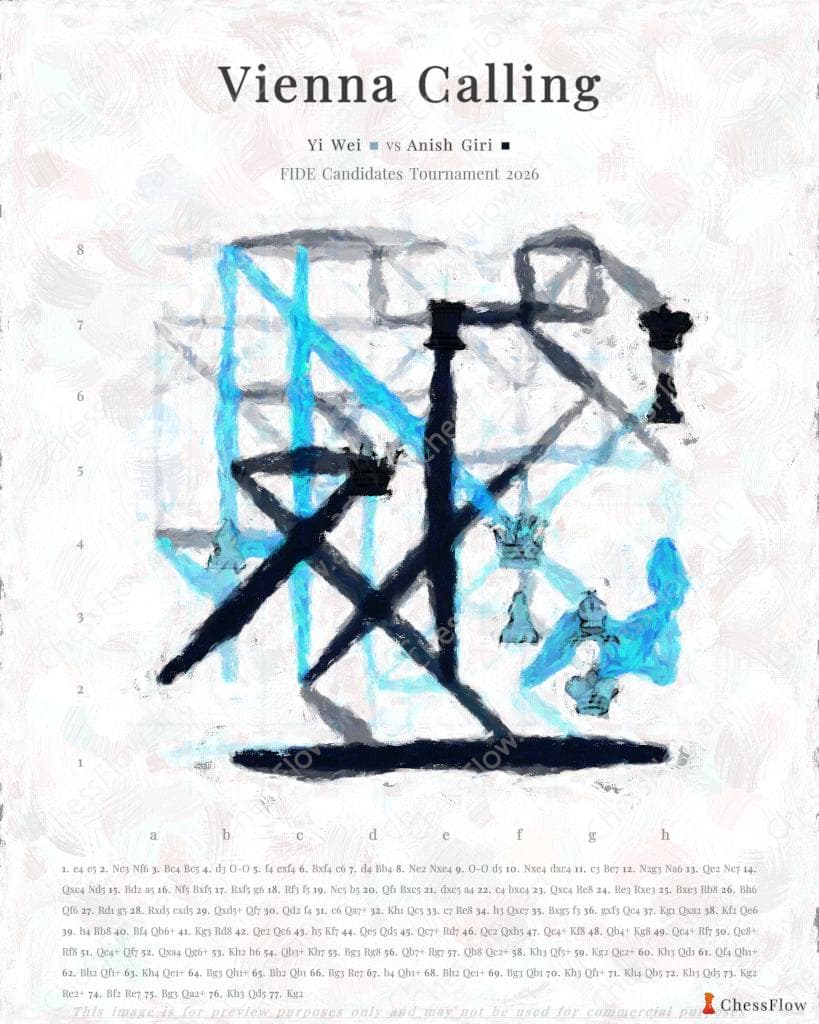
Yi Wei vs Anish Giri
Yi Wei vs Anish Giri
The Vienna Hybrid Experiment Wei Yi's choice of the Vienna Hybrid against Anish Giri in round 12 of the 2026 FIDE Candidates raised eyebrows. The opening sequence 1.e4 e5 2.Nc3 signals White's intent...
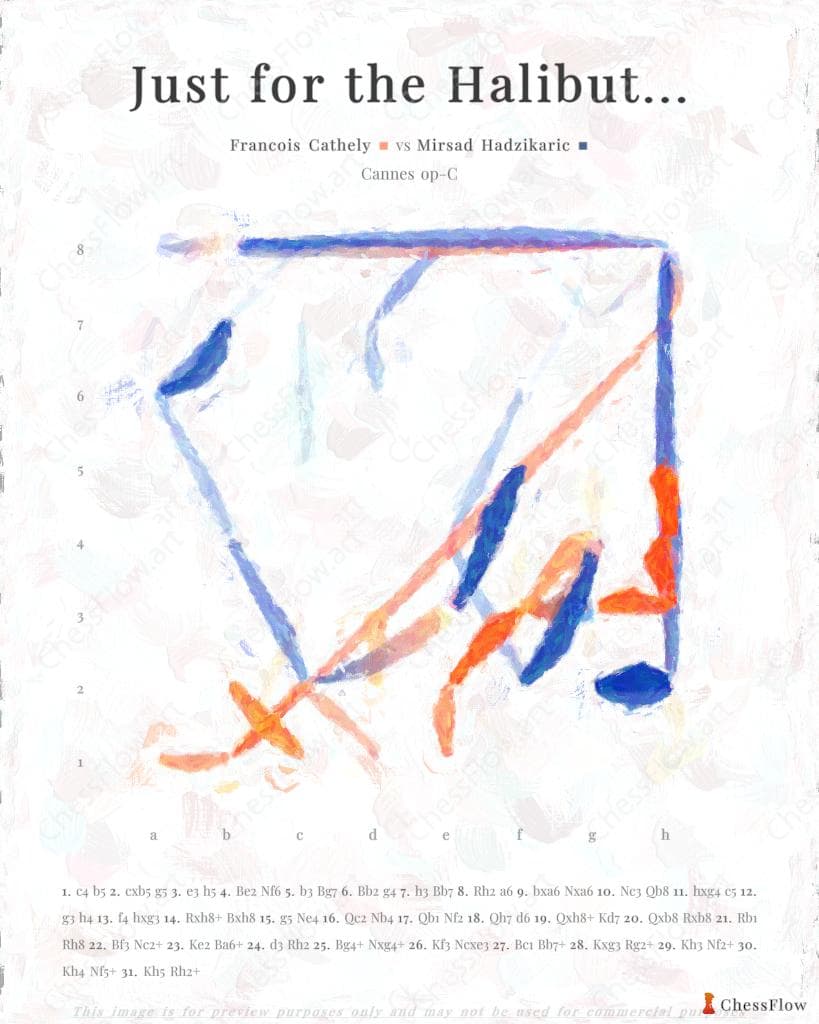
Francois Cathely vs Mirsad Hadzikaric
Francois Cathely vs Mirsad Hadzikaric
The Opening Gambit Francois Cathely and Mirsad Hadzikaric faced off in the 1995 Cannes op-C tournament with an opening that immediately signaled chaos was coming. After 1.c4 b5, Black's Polish Defens...
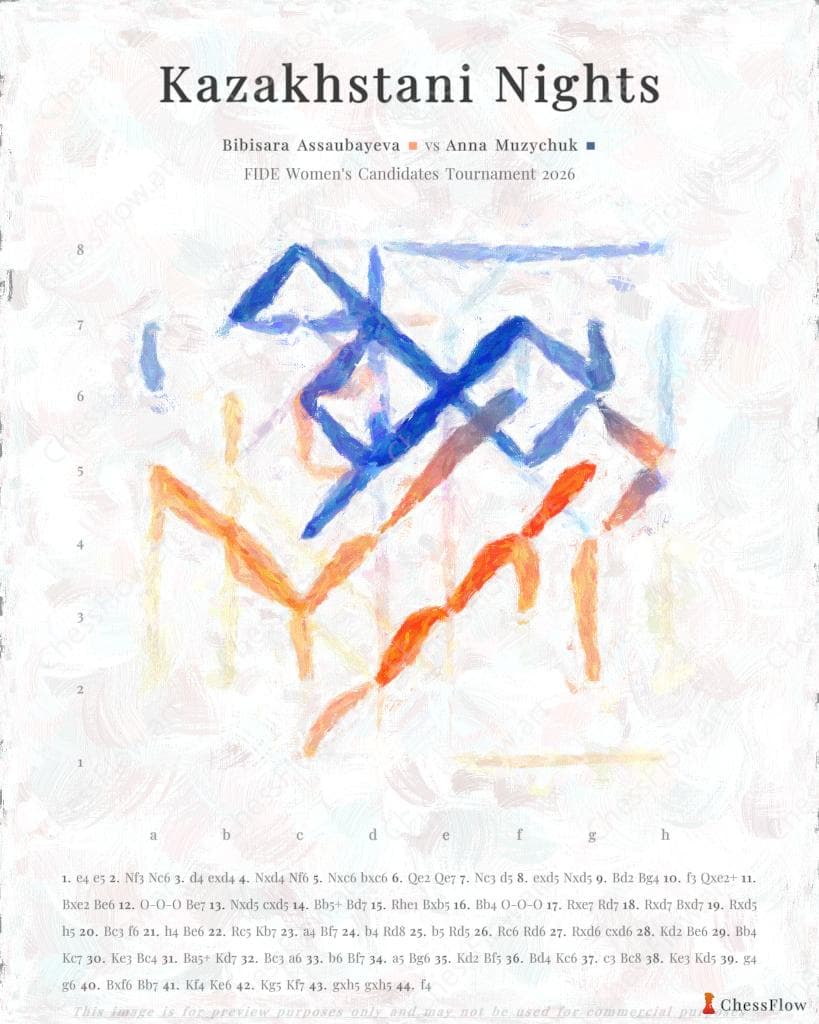
Bibisara Assaubayeva vs Anna Muzychuk
Bibisara Assaubayeva vs Anna Muzychuk
Assaubayeva Strikes Back in Round 13 Bibisara Assaubayeva bounced back from recent struggles to defeat Anna Muzychuk in round 13 of the FIDE Women's Candidates Tournament 2026. The Kazakhstani GM, ra...