FIDE Candidates Tournament 2026
Nakamura's 67-Minute Think Leads to Sindarov Crush at Candidates

Unexpected Castle
Nakamura Sinks After Hour-Long Think
Hikaru Nakamura sat at the board for 67 minutes and 44 seconds on move 13. When he finally moved, he had chosen wrong, and Javokhir Sindarov punished him for it. The 20-year-old Uzbek star scored his fourth win in five rounds at the 2026 FIDE Candidates Tournament, opening up a three-point gap over Nakamura and leaving the American searching for answers in his post-game stream.
"This was 100 percent on the people who were working for me," Nakamura said afterward. "I had a file, it didn't have the move 12…O-O, and honestly castles. I guess it's technically a novelty, but it's such a human move, and as soon as Javokhir played it, I was like thinking to myself, what is this? Actually kind of insane!"
The game began with a Semi-Slav structure that quickly turned sharp after 1.d4 d5 2.c4 e6 3.Nc3 c6 4.e4 dxe4 5.Nxe4 Bb4+ 6.Bd2 Qxd4. Nakamura was already giving up material to chase activity, trading his d-pawn for rapid development. By move 9, Black had grabbed the g2 pawn and White had a bishop pair and a lead in development—the kind of imbalanced position where preparation matters enormously.
Then came 12...O-O, the move that wasn't in Nakamura's files.
The Castle That Broke Nakamura's Preparation
What makes 12...O-O so devastating isn't that it's objectively the best move—it's that it's the most natural move a human would consider, yet somehow slipped through Nakamura's team's preparation. Sindarov simply castled, tucking his king away and connecting his rooks while White still had to figure out how to coordinate.
"He just thought one hour and played the wrong move, and after this I take this advantage and played very well, in my opinion," Sindarov told FM Mike Klein after the game.
The position after castling demanded precision from White. Nakamura needed to find 13.Ne4!, keeping pieces active and maintaining pressure. Instead, after burning more than an hour on the clock, he played 13.h4?!, a move that looks aggressive but accomplishes nothing concrete. The pawn push threatens to harass Black's queen on g5, but Sindarov had already calculated that he could simply take the b4 pawn with his queen and emerge with a winning material advantage.
The problem with 13.h4?! is that it doesn't address White's fundamental issue: Black has two extra pawns and a perfectly safe king. Pushing the h-pawn just weakens White's kingside without creating real threats. Nakamura later acknowledged on stream that without knowing the correct line, finding the right continuation over the board was nearly impossible.
The Collapse
After 13...Qa5+ 14.b4 Nxb4, Sindarov had collected another pawn and White's position was already beyond repair. Nakamura tried to generate counterplay with 15.O-O, finally getting his king to safety, but the material deficit was simply too large.
The next phase showed Sindarov's technical precision. He calmly reorganized with 15...Re8 and 16...c5, consolidating his extra material while keeping his pieces coordinated. When Nakamura tried to complicate matters with 17.Rad1 Nf5 18.Nxf5 exf5, Black emerged with a healthy pawn structure and still maintained his material advantage.
The position around move 20 illustrates the gap between engine evaluation and human reality. Engines might show something like -2 or -3, suggesting White is "only" losing by a few pawns. But in practical terms, with a rook, bishop, and knight all well-placed, Black's conversion is almost automatic at this level. There's no counterplay, no tricks—just slow suffocation.
20...Nd4 was particularly instructive. Rather than rushing to win more material, Sindarov centralized his knight on the dominant d4 square, controlling the board and preparing to exchange pieces into a winning endgame. This is the kind of mature play that has characterized his tournament—pressing when he has an advantage, but never overreaching.
The Exchange and the Endgame
The critical moment of simplification came around move 23. After 22...Be6 23.Bxb7 Ne2, Sindarov offered an exchange of queens with 24...Qxd2 25.Rxd2 Nxg1. This wasn't just trading pieces for the sake of it—the resulting endgame with rook, bishop, and pawns against rook and bishop was completely winning for Black.
26.Bxa8 Rxa8 27.Kxg1 left Nakamura with a rook and bishop against Sindarov's rook and bishop, but Black's extra pawns on the queenside and superior piece coordination made the outcome inevitable. The c4 pawn fell, then the a2 pawn, and White's bishop was reduced to passively defending while Black's pawns marched forward.
The final phase was clinical. Sindarov advanced his a-pawn to a4, created weaknesses on both flanks, and slowly improved his king's position. By move 38, with 38...g5 opening up the kingside, Nakamura's position was collapsing on multiple fronts. The game ended after 41...gxh4+, when Nakamura resigned rather than play out a hopeless position.
What This Means for the Tournament
Sindarov's victory pushes him to 4.5/5, an extraordinary score that puts him three full points ahead of Nakamura and leaves only Fabiano Caruana within striking distance at 3.5/5. At this pace, the 20-year-old is on track to clinch the tournament with rounds to spare.
"I know it will be very hard to win, but I want to try," Sindarov had said before the tournament. "Everyone has a chance to win this tournament. And it's only one tournament; if your chess was going very well, why not?"
His chess has been going very well indeed. The Uzbek number-two (behind Nodirbek Abdusattorov) has shown the kind of fearless, dynamic play that made him a Candidates qualifier in the first place, combined with the practical maturity to convert advantages without taking unnecessary risks.
For Nakamura, rated 2810 and the top seed in Cyprus, this loss is a severe blow to his title hopes. At 37, he's one of the oldest players in the field, and he knows better than anyone how difficult it is to recover from a three-point deficit against a player in Sindarov's form. His post-game comments about preparation failures suggest the frustration runs deep.
"Maybe you can say that over the board I should have some way figured it out," Nakamura admitted, "but I think it's impossible without knowing what the correct line is."
The irony is that 12...O-O isn't some deep computer novelty—it's the most human move imaginable. Sometimes the best preparation in the world can't account for the obvious.
The Psychology of Momentum
Chess commentators and players alike have noted the psychological dimension of Sindarov's run. As one observer put it: "Do not underestimate the boost that confidence plays after a strong start. You trust your instincts more, a positive cycle of intuition and performance. Meanwhile, your opponents doubt themselves against you."
This dynamic was visible in the Nakamura game. While Sindarov played quickly and confidently, Nakamura's 67-minute think on move 13 suggested a player wrestling with uncertainty, trying to calculate his way out of unfamiliar territory rather than relying on intuition.
The position after move 12 is the kind of thing you hang on a wall—a perfectly ordinary-looking position that somehow broke one of the world's best players. We turned this one into a print at ChessFlow.
With nine rounds remaining, Sindarov needs only to maintain his form to secure a World Championship match against Gukesh Dommaraju. His opponents face an increasingly desperate task: they must beat him multiple times while also winning their other games, all against a player who has shown no signs of cracking under pressure.
"Hopefully, next year I want to see some strong players like me, Abdusattorov in my country," Sindarov said before the tournament, expressing his hope to be a role model for Uzbek chess. If he wins the Candidates, he'll have done far more than that—he'll have announced Uzbekistan's arrival at the absolute pinnacle of world chess.
Round six continues tomorrow, with Sindarov facing Matthias Bluebaum and Nakamura looking to rebound against Andrey Esipenko. For the American veteran, the math is simple but brutal: anything less than a win, and his Candidates dream may effectively be over.
1.d4 d5 2.c4 e6 3.Nc3 c6 4.e4 dxe4 5.Nxe4 Bb4+ 6.Bd2 Qxd4 7.Bxb4 Qxe4+ 8.Be2 Na6 9.Bd6 Qxg2 10.Bf3 Qg5 11.Ne2 Ne7 12.Ng3 O-O 13.h4 Qa5+ 14.b4 Nxb4 15.O-O Re8 16.Qd2 c5 17.Rad1 Nf5 18.Nxf5 exf5 19.Qf4 Nc6 20.Kh1 Nd4 21.Rg1 g6 22.Bd5 Be6 23.Bxb7 Ne2 24.Qd2 Qxd2 25.Rxd2 Nxg1 26.Bxa8 Rxa8 27.Kxg1 Rd8 28.Bf4 Rxd2 29.Bxd2 Bxc4 30.Be3 Bxa2 31.Bxc5 a5 32.f4 f6 33.Kf2 Kf7 34.Ba3 Ke6 35.Bf8 a4 36.Ke3 Kf7 37.Bb4 h6 38.Kf2 g5 39.Kg3 Bd5 40.Ba3 Be4 41.Bc1 gxh4+ 0-1
How would it look as art?


Own a piece of chess history. Transform this legendary game into a unique piece of art for your home or office.
Perfect For
- Unique Gifts for chess enthusiasts and players
- Tournament Prizes that winners will treasure
- Club Decor for chess clubs and gaming spaces
- Office Art showcasing strategic thinking
- Personal Collection of historic games
Explore more
Turn Your Games Into Art
Whether it's your own game from Chess.com or Lichess, or another historic masterpiece, transform any chess game into a stunning visual artwork.
You might also like
More legendary chess game stories
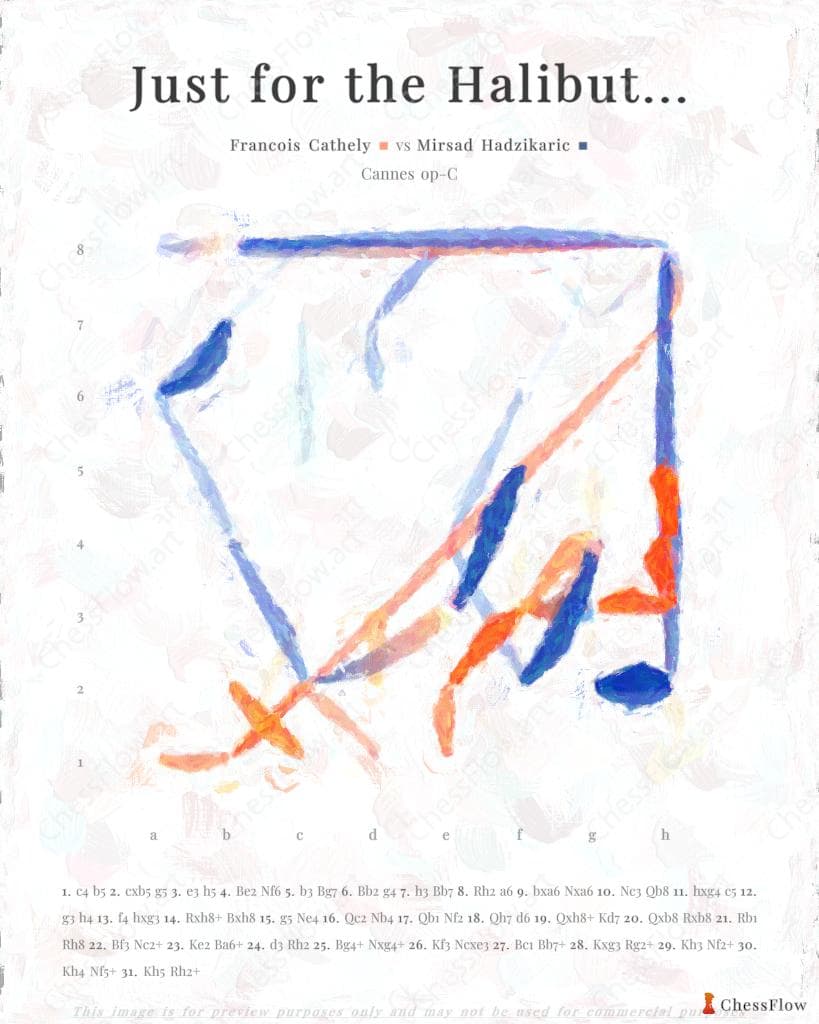
Francois Cathely vs Mirsad Hadzikaric
Francois Cathely vs Mirsad Hadzikaric
The Opening Gambit Francois Cathely and Mirsad Hadzikaric faced off in the 1995 Cannes op-C tournament with an opening that immediately signaled chaos was coming. After 1.c4 b5, Black's Polish Defens...
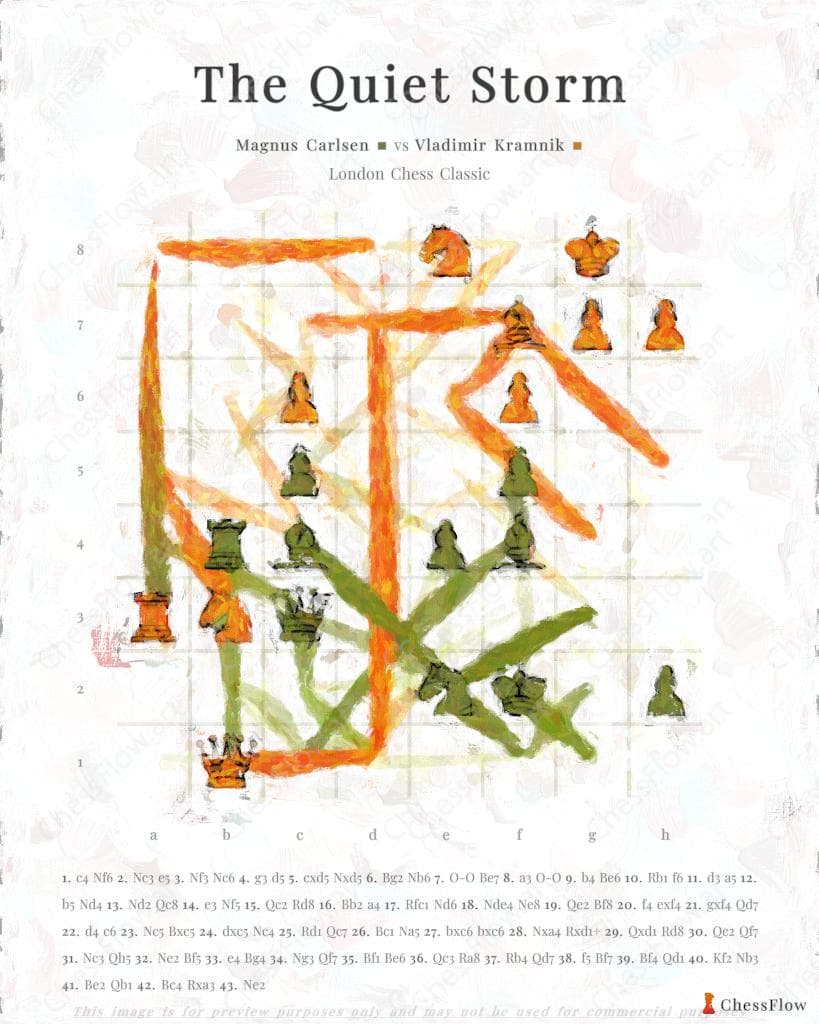
Magnus Carlsen vs Vladimir Kramnik
Magnus Carlsen vs Vladimir Kramnik
The Opening Battle Magnus Carlsen opened with 1.c4 against Vladimir Kramnik in the first round of the 2009 London Chess Classic, steering the game into an English Opening. The Norwegian was 18 years...
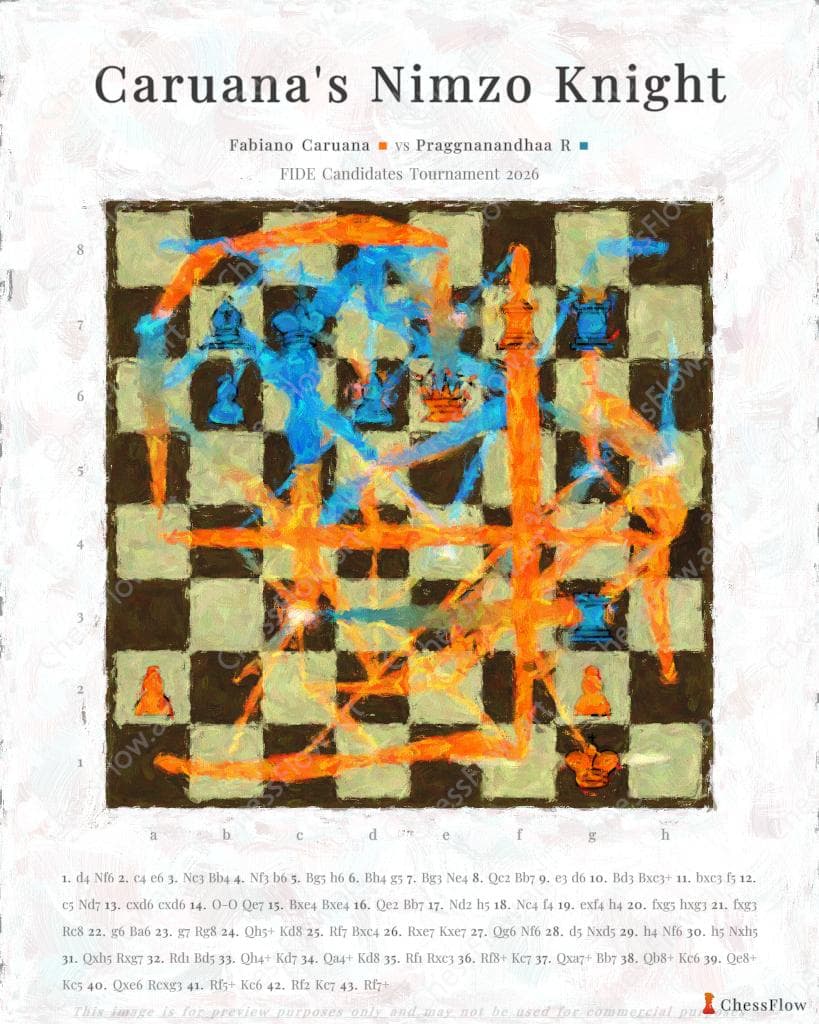
Fabiano Caruana vs Praggnanandhaa R
Fabiano Caruana vs Praggnanandhaa R
The Opening Choice Fabiano Caruana opened with 1.d4 against Praggnanandhaa in round 13 of the 2026 FIDE Candidates Tournament, leading to the Nimzo-Indian Defense after 1.d4 Nf6 2.c4. The American gr...