2026 Dreamhack Atlanta Group A
Sarana Checkmates Hong in DreamHack Atlanta Najdorf Battle


Atlanta Nocturne
Sarana Delivers Checkmate in DreamHack Atlanta Quarterfinal
Alexey Sarana walked into the Georgia World Congress Center on Friday needing a win, and he got one in the most emphatic way possible—checkmate on the board. The Serbian GM defeated Andrew Hong in 41 moves, punishing an early inaccuracy in the Najdorf Sicilian and converting with surgical precision in a rapid game where Hong never fully recovered from a single misstep on move 12.
The result pushes Sarana deeper into the upper bracket of DreamHack Atlanta's double-elimination knockout, keeping his path to the Esports World Cup Last Chance Qualifier alive. For Hong, rated 72 points below his opponent, the loss drops him to the lower bracket where the margin for error disappears entirely.
The Najdorf Gets Complicated Early
Both players entered familiar territory with 1.e4 c5 2.Nf3 d6 3.d4 cxd4 4.Nxd4 Nf6 5.Nc3 a6—the Najdorf Sicilian, one of the most theoretically dense battlegrounds in chess. Hong chose the Adams Attack with 6.h3, a solid but somewhat passive approach that avoids the sharper main lines. Sarana responded with the thematic 6...e5, immediately challenging White's knight and staking out central space.
The opening proceeded logically: Hong retreated 7.Nb3, Sarana developed 7...Be6, and both sides prepared for opposite-side castling. Hong's 8.Qf3 aimed at the kingside, while Sarana countered with 8...Nbd7 and 9...Rc8, eyeing the c-file that would become critical later.
When Hong castled queenside with 10.O-O-O, the stage was set for a race. In these positions, both players typically launch pawn storms against the opposing king. But rapid chess at 10+0 demands quick decisions, and it was here that Hong made the choice that would haunt him.
The Knight Jump That Backfired
After Sarana's 11...Bg7, completing his fianchetto, Hong played 12.Nd5?!—a move that looks aggressive but actually hands Black a comfortable position. The engine immediately flags this as an inaccuracy, preferring Qd3 to maintain tension.
The problem with 12.Nd5 is simple: Sarana gets to trade off the knight on his own terms. After 12...Bxd5 13.exd5, White has gained nothing but a slightly awkward pawn structure. The d5-pawn blocks White's light-squared bishop and creates no real threats. Meanwhile, Black's pieces coordinate beautifully—the bishop on g7 rakes the long diagonal, the rook on c8 pressures the c-file, and the queen can swing to active squares.
Engines call this position only slightly better for Black, around -0.4. But in rapid chess, "slightly better" with clear plans often becomes "winning" when the opponent has to find precise defensive moves under time pressure. Hong had handed Sarana exactly the kind of position the European Champion thrives in: complex enough to outplay a lower-rated opponent, simple enough that the right ideas are clear.
Sarana's Queenside Pressure Mounts
The game continued with Sarana building pressure methodically. His pieces found natural squares—the queen came to c7, the knights coordinated, and the rooks doubled on the c-file. Hong tried to generate kingside counterplay with his pawn majority, but without the knight on d5, his attack lacked punch.
What makes Sarana dangerous in these positions isn't just calculation—it's patience. The 26-year-old, who won the European Individual Championship in 2023 and has 16 Titled Tuesday victories to his name, understands when to press and when to wait. Against Hong, he didn't need to force anything. Each move improved his position slightly while Hong's defensive task grew more difficult.
The c-file became Sarana's highway into White's position. With the rooks stacked and the queen supporting, any weakness around Hong's king would become a target. In rapid chess, this kind of sustained pressure is exhausting to defend against. Every move requires precision, and the clock ticks down relentlessly.
Hong's Position Crumbles
By the middlegame, Hong found himself in the worst kind of rapid chess nightmare: a position that's objectively holdable but practically miserable. Engines might show -0.5 or -0.7, suggesting the game is close to equal, but no human wants to sit on the defensive side of this for another 20 moves with four minutes on the clock.
This is where the gap between engine assessment and human experience matters most. Stockfish doesn't feel the psychological weight of defending a passive position. It doesn't worry about time trouble or the creeping sense that one slip means disaster. Hong had to find accurate moves repeatedly, while Sarana could probe and wait for the inevitable error.
The error came, as it usually does in rapid. Hong's position deteriorated move by move until Sarana's pieces swarmed the White king. The final combination wasn't a spectacular sacrifice or a deep calculation—it was the logical conclusion of 30 moves of steady pressure. When the checkmate pattern emerged, Hong had no escape.
The Final Blow
The game ended in checkmate after 41 moves—a relatively rare occurrence at the GM level, where most players resign well before the mate is delivered. But in rapid chess, with time pressure mounting and pieces flying, sometimes the end comes suddenly. Hong's king, trapped on the queenside where it had castled seeking safety, found no refuge.
For Sarana, this was exactly the kind of clinical conversion he needed. At DreamHack Dallas last year, he finished second behind Oleksandr Bortnyk, losing in the finals after a strong run through the bracket. This time, he's clearly aiming higher. A top-four finish would secure another expense-paid trip to Riyadh for the EWC Last Chance Qualifier—but Sarana wants the title.
What This Means for Both Players
Hong, rated 2592, came into DreamHack Atlanta as a legitimate contender. The American GM has a Titled Tuesday victory to his name and competed at the GRENKE Freestyle Open earlier this year, showing he can hang with stronger opposition. But this loss exposes the challenge of facing someone like Sarana in a must-win rapid game. The rating gap matters, and Sarana made it count.
The double-elimination format means Hong isn't eliminated—he drops to the lower bracket where he'll need to win out to have any chance at the top four. It's a brutal road, but not impossible. Meanwhile, Sarana advances with momentum, his Najdorf preparation looking sharp and his conversion technique as reliable as ever.
DreamHack Atlanta continues through the weekend, with the knockout bracket determining which four players will earn their spots in Riyadh. The $50,000 prize pool—up from last year's event—adds financial stakes to the EWC qualification implications. For players outside the Speed Chess Championship and Champions Chess Tour pathways, this is one of the last chances to punch a ticket to the Esports World Cup.
The Najdorf's Eternal Appeal
There's something fitting about this game being decided in the Najdorf. The opening has been a battleground for decades, producing some of chess's most memorable fights. Fischer played it. Kasparov made it his weapon. And in 2026, at a gaming festival in Atlanta, two GMs went to war in the same theoretical territory.
Hong's choice of the Adams Attack—6.h3—is considered one of the more restrained options against the Najdorf. It avoids the theoretical minefields of the English Attack or the Yugoslav Attack, but it also gives Black an easier path to comfortable play. Sarana navigated the opening confidently, and when Hong's 12.Nd5 gave him a target, he converted the slight edge into a full point.
This game is the kind of thing you hang on a wall—a clean win by a top-50 player, decided by subtle positional understanding rather than flashy tactics.
Looking Ahead
Sarana's victory keeps him in the upper bracket, meaning he's two wins away from securing a top-four finish and the EWC qualifier spot that comes with it. His next opponent will come from the other quarterfinal matches, and if his Najdorf preparation is any indication, he's ready for whatever comes.
For chess fans following DreamHack Atlanta, this game offered a reminder of why rapid chess at the GM level is so interesting to watch. The opening theory, the middlegame maneuvering, the time pressure, and the decisive result—it's a complete package. And when it ends in checkmate rather than resignation, you know someone got completely outplayed.
The tournament continues, but Sarana has already made his statement. The European Champion is here to win.
1.e4 c5 2.Nf3 d6 3.d4 cxd4 4.Nxd4 Nf6 5.Nc3 a6 6.h3 e5 7.Nb3 Be6 8.Qf3 Nbd7 9.Bd2 Rc8 10.O-O-O g6 11.g4 Bg7 12.Nd5 Bxd5 13.exd5 Qc7 14.Bd3 O-O 15.g5 e4 16.Bxe4 Nxe4 17.Qxe4 Rfe8 18.Qd3 Ne5 19.Qc3 Qd7 20.Qg3 Rxc2+ 21.Kb1 Nc4 22.Bc3 Ree2 23.Nd4 Rxb2+ 24.Bxb2 Rxb2+ 25.Kc1 Qa4 26.Rhe1 Qxa2 27.Re8+ Bf8 28.Ne6 Qa1# 0-1
How would it look as art?


Own a piece of chess history. Transform this legendary game into a unique piece of art for your home or office.
Perfect For
- Unique Gifts for chess enthusiasts and players
- Tournament Prizes that winners will treasure
- Club Decor for chess clubs and gaming spaces
- Office Art showcasing strategic thinking
- Personal Collection of historic games
Turn Your Games Into Art
Whether it's your own game from Chess.com or Lichess, or another historic masterpiece, transform any chess game into a stunning visual artwork.
You might also like
More legendary chess game stories
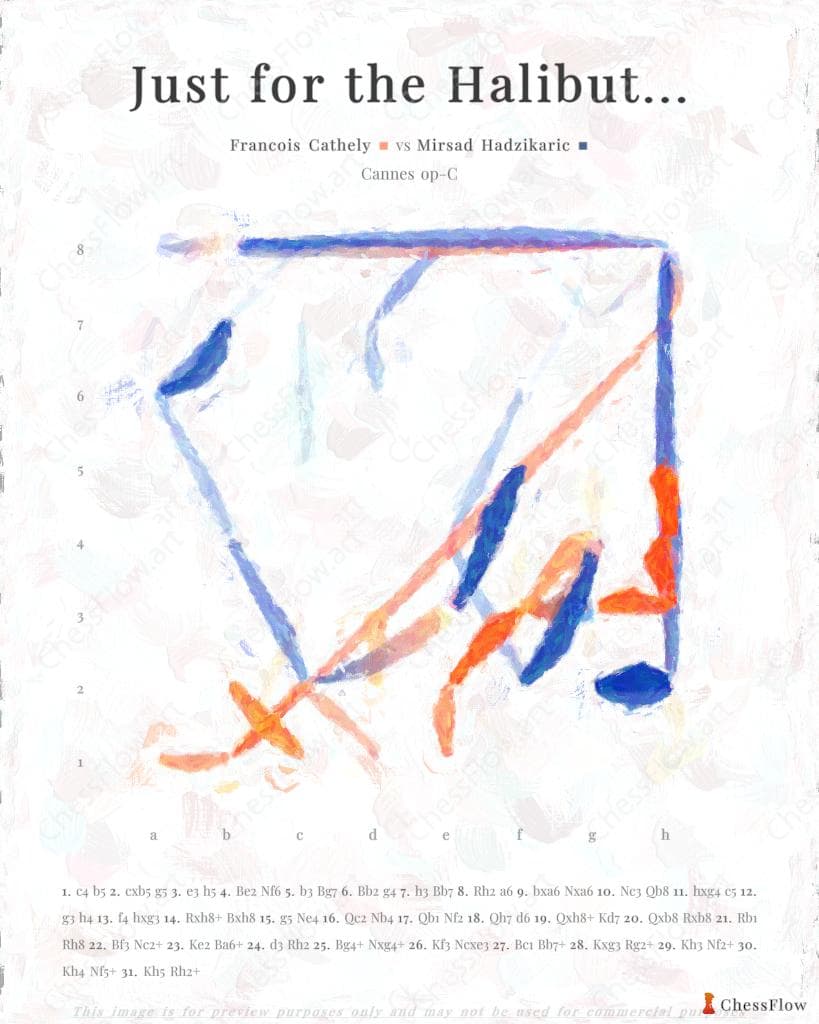
Francois Cathely vs Mirsad Hadzikaric
Francois Cathely vs Mirsad Hadzikaric
The Opening Gambit Francois Cathely and Mirsad Hadzikaric faced off in the 1995 Cannes op-C tournament with an opening that immediately signaled chaos was coming. After 1.c4 b5, Black's Polish Defens...
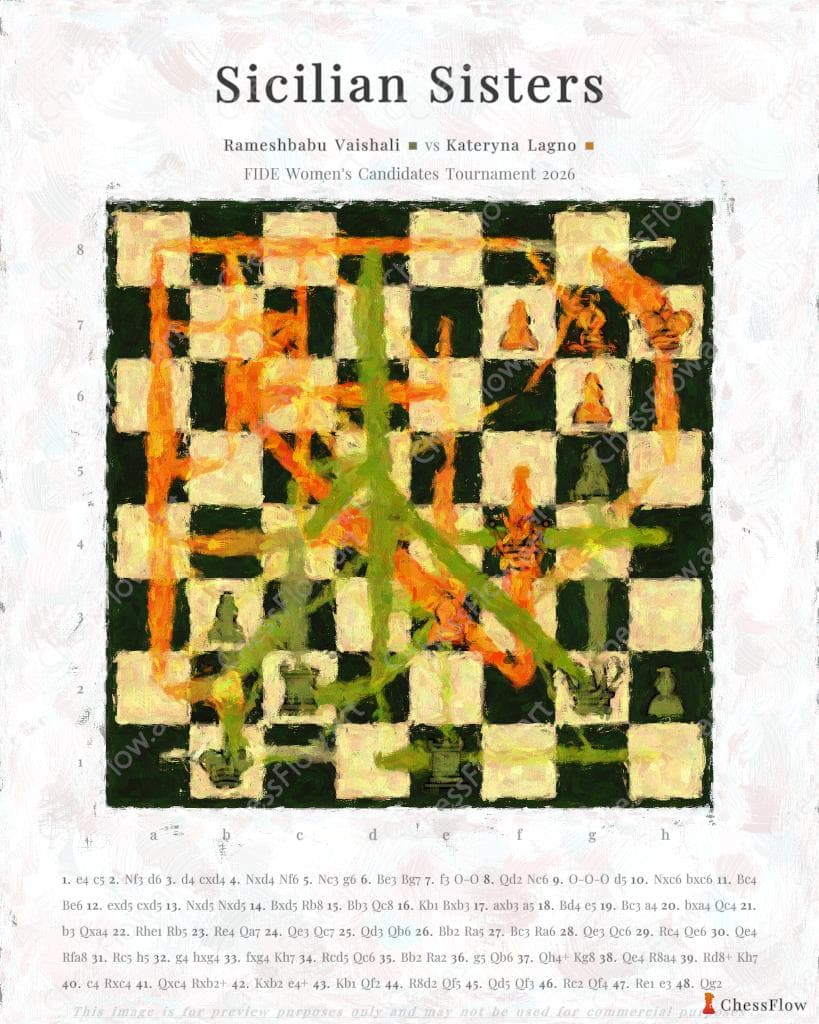
Rameshbabu Vaishali vs Kateryna Lagno
Rameshbabu Vaishali vs Kateryna Lagno
Vaishali Strikes in the Dragon Vaishali Rameshbabu defeated Kateryna Lagno in round 14 of the FIDE Women's Candidates Tournament 2026, playing a sharp Sicilian Dragon that ended in White's favor. The...
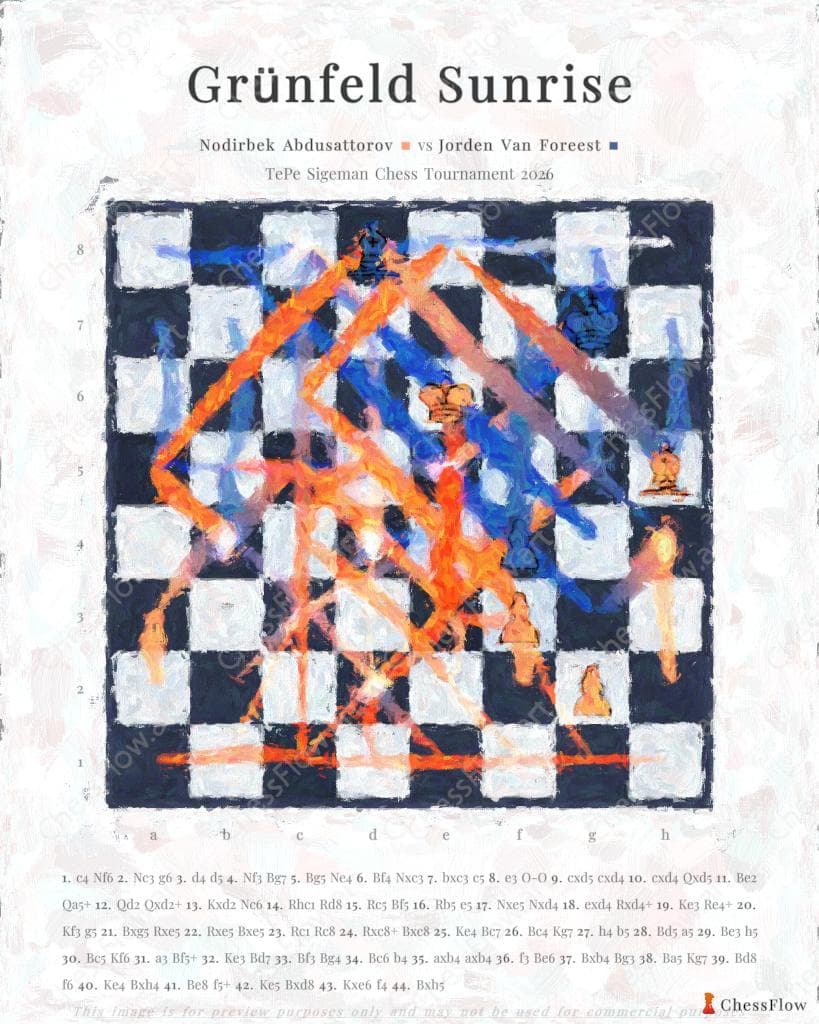
Nodirbek Abdusattorov vs Jorden Van Foreest
Nodirbek Abdusattorov vs Jorden Van Foreest
A Quiet Day in Malmö Nodirbek Abdusattorov and Jorden van Foreest split the point in round 7 of the TePe Sigeman Chess Tournament 2026, a game that never really caught fire. The Grünfeld Defense led...