Asian Individual Chess Championship 2026 | Open
Iniyan and Xu Draw Sharp Grünfeld at Asian Championship
Dragon's Dawn
A Bishop Sacrifice That Led Nowhere
Pa Iniyan and Xu Xiangyu agreed to a draw in Round 8 of the 2026 Asian Individual Chess Championship in Ulaanbaatar, but not before the Indian grandmaster threw a bishop into the fire on f7. The sacrifice, a standard idea in the Grünfeld Exchange, netted White a pawn but left him without the firepower to crack Black's solid structure. For Xu, fresh off winning the Chinese National Championship last month, the half-point keeps his tournament on track. For Iniyan, rated 50 points below his opponent, holding with the white pieces against a player in form is no small thing.
The game followed the Seville Variation of the Grünfeld Exchange — one of the sharpest theoretical battlegrounds in modern chess. Both players blitzed through the opening moves with plenty of time on their clocks, suggesting deep preparation on both sides. The real question wasn't whether someone had a novelty, but whether either player wanted to deviate from well-trodden paths.
The Grünfeld's Central Tension
The opening sequence 1.d4 Nf6 2.c4 g6 3.Nc3 d5 4.cxd5 Nxd5 5.e4 Nxc3 6.bxc3 Bg7 7.Bc4 is one of the most analyzed in all of chess. White gets a big pawn center; Black gets piece activity and long-term pressure against those central pawns. It's the kind of position where both sides can feel they're playing for a win, which is exactly why top players keep returning to it.
Xu chose the main line with 7...c5, immediately striking at White's center. After 8.Ne2 O-O 9.O-O Nc6 10.Be3, the position had reached a critical juncture. Black's knight on c6 eyes the d4 pawn, but it also blocks the c-file and limits the scope of the g7 bishop. The question for Black is always: where does that knight belong?
Xu answered with 10...Bg4, pinning the f3-pawn idea and preparing to reroute the knight. This is a well-known plan in the Seville Variation — Black develops the bishop actively before deciding on the knight's final destination. Iniyan responded with 11.f3, breaking the pin at the cost of slightly weakening his kingside structure.
Then came 11...Na5, the move that defines this particular line. The knight heads for c4 via a5, where it can pressure White's queenside or exchange itself for the dark-squared bishop. It's a positional decision with long-term implications: Black gives up the knight's central influence in exchange for structural concessions from White.
The Sacrifice on f7
Iniyan didn't hesitate. 12.Bxf7+! is the main theoretical continuation here, and he played it instantly. The idea is straightforward: White wins a pawn and eliminates Black's rook from the f-file, but gives up his light-squared bishop in the process. After 12...Rxf7 13.fxg4 Rxf1+ 14.Kxf1, White has an extra pawn but Black has the bishop pair and a solid structure.
The evaluation here hovers around +0.3 to +0.4 — technically a small White edge, but the kind of position where engines and humans see things very differently. Engines don't mind defending slightly worse positions for 50 moves. Humans do. The question is whether White can create enough pressure to make Black's defense uncomfortable, or whether Black's bishops and piece activity will neutralize the extra pawn.
Xu's response was calm and logical. 14...Qd6 develops the queen to an active square, eyeing both the d4 pawn and the kingside. After 15.Kg1 Qe6, Black has completed his development and is ready to contest the center. The engine still likes White slightly, but the practical chances are roughly equal.
The Middlegame Grind
What followed was a careful maneuvering phase where neither player found a way to make progress. Iniyan had his extra pawn, but it was doubled on the g-file — hardly a prize asset. Xu had the bishop pair, but with the position relatively closed, those bishops needed open lines to prove their worth.
This is where the gap between computer assessment and human reality becomes most apparent. The engine might say White is +0.4, but what does that mean in practice? It means White has a tiny structural advantage that requires perfect play over 40-50 moves to convert. Against a player at this level — a newly crowned Chinese champion who just won the Rilton Cup earlier this year — that's not a realistic expectation.
The position after move 15 is the kind that makes grandmasters reach for the draw offer. Both sides have completed development. The pawn structure is stable. Neither player has a clear plan to improve their position without taking significant risks. In a nine-round Swiss tournament where every half-point matters, discretion often wins out over valor.
Xu's Recent Form
Xu Xiangyu arrived in Ulaanbaatar as one of the favorites, and his recent results justify that status. He won the 2026 Chinese National Championship in Xinghua just three weeks ago, scoring 8.5/11 to claim his first national title and secure a spot on China's team for the upcoming Chess Olympiad. Before that, he dominated the Rilton Cup in Stockholm, finishing a full point ahead of the field with 8/9.
At 2623 FIDE (2611 in the tournament's starting list), Xu is one of the highest-rated players in the field, trailing only top seed Yu Yangyi. His style tends toward solid, positional chess — exactly the kind of approach that makes him dangerous in long tournaments where consistency matters more than brilliance.
Iniyan, rated 2573 (2587 in the starting list), is one of India's rising talents. The 23-year-old has been a grandmaster since 2019 and has steadily climbed the rating list over the past few years. Getting a draw with White against a higher-rated opponent in good form is a respectable result, even if the game itself didn't produce fireworks.
The Tournament Picture
With this draw, both players remain in the chasing pack behind the leaders. Yu Yangyi, the top seed from China, has been the player to beat through the first eight rounds. The tournament features a strong field of 13 grandmasters rated above 2550, including several FIDE-registered players competing under the FID flag.
The Asian Individual Championship is one of the continent's most prestigious events, with the winner earning qualification rights for various FIDE events. Past champions include some of Asia's strongest players, and the 2026 edition in Ulaanbaatar has attracted a particularly deep field.
For Xu, a draw here keeps his title hopes alive without taking unnecessary risks. For Iniyan, it's a solid result that maintains his standing in the tournament. Neither player will look back on this game as a missed opportunity — it was simply two well-prepared grandmasters reaching a theoretical position where neither side had a realistic winning chance.
The Opening's Enduring Appeal
The Grünfeld Exchange remains one of the most popular choices at the elite level precisely because it produces positions like this one. White gets concrete material (the center, sometimes an extra pawn), while Black gets dynamic compensation (piece activity, the bishop pair, pressure against White's structure). The resulting positions require deep understanding from both sides, and the theory runs incredibly deep.
Iniyan's choice of 12.Bxf7+ is the main line for good reason — it's objectively White's best try for an advantage. But "best try" doesn't mean "winning." Against accurate defense, the position tends toward equality, and Xu defended accurately.
The position after the bishop sacrifice would make a striking image — White's doubled g-pawns, Black's bishops ready to spring to life, the queens jockeying for position. We turned this one into a print over at ChessFlow.
Three rounds remain in Ulaanbaatar, and the race for the Asian title is far from decided. Xu will be looking to push for wins with Black in the remaining games, while Iniyan needs decisive results to climb into contention. This draw was a brief respite in what promises to be a tense finish to the championship.
Looking Ahead
The Grünfeld will almost certainly appear again before the tournament ends — it's too popular among elite players to avoid. When it does, we might see one of the many sidelines that avoid the Seville Variation's forcing nature. Or we might see another theoretical duel that ends in a handshake before move 30.
That's the reality of modern chess at the highest level. Preparation runs so deep that many games are essentially decided in the opening — not by who plays better, but by who has analyzed further. Iniyan and Xu both knew this position inside and out, and neither found a way to surprise the other.
For chess fans hoping for blood, this game didn't deliver. But for those who appreciate the depth of opening preparation and the practical realities of tournament chess, it was a fascinating glimpse into how grandmasters navigate well-known theoretical terrain. Sometimes the best move is the one that ensures you don't lose.
1.d4 Nf6 2.c4 g6 3.Nc3 d5 4.cxd5 Nxd5 5.e4 Nxc3 6.bxc3 Bg7 7.Bc4 c5 8.Ne2 O-O 9.O-O Nc6 10.Be3 Bg4 11.f3 Na5 12.Bxf7+ Rxf7 13.fxg4 Rxf1+ 14.Kxf1 Qd6 15.Kg1 Qe6 16.Qd3 Qc4 17.Qd2 Qe6 18.Qd3 Qc4 19.Qd2 Qe6 20.Qd3 1/2-1/2
How would it look as art?


Own a piece of chess history. Transform this legendary game into a unique piece of art for your home or office.
Perfect For
- Unique Gifts for chess enthusiasts and players
- Tournament Prizes that winners will treasure
- Club Decor for chess clubs and gaming spaces
- Office Art showcasing strategic thinking
- Personal Collection of historic games
Turn Your Games Into Art
Whether it's your own game from Chess.com or Lichess, or another historic masterpiece, transform any chess game into a stunning visual artwork.
You might also like
More legendary chess game stories

Jose Eduardo Martinez Alcantara vs Narayanan S L
Jose Eduardo Martinez Alcantara vs Narayanan S L
Martinez Alcantara Takes Down Narayanan in Round 9 Clash Jose Eduardo Martinez Alcantara defeated S.L. Narayanan 1-0 in Round 9 of the Bucharest Grand Prix 2026, extending his remarkable unbeaten str...
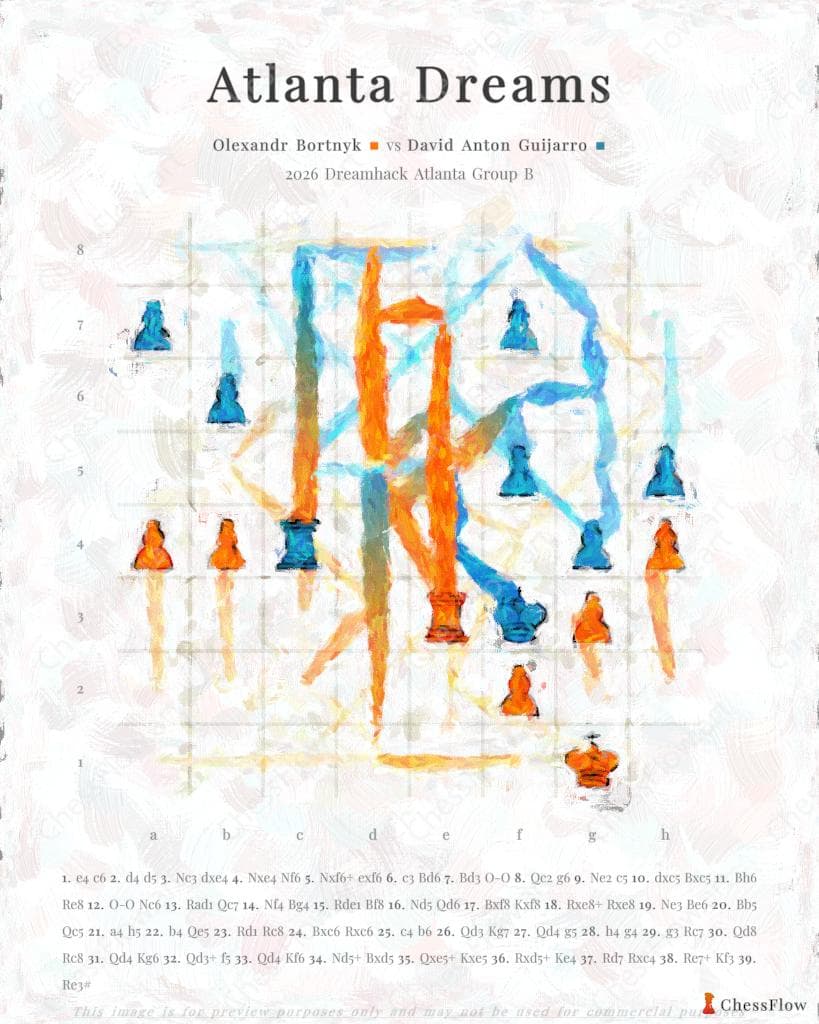
Olexandr Bortnyk vs David Anton Guijarro
Olexandr Bortnyk vs David Anton Guijarro
Checkmate in the Quarterfinals Olexandr Bortnyk ended David Anton Guijarro's DreamHack Atlanta run with actual checkmate on the board — not a resignation, not a time scramble, but the king cornered a...
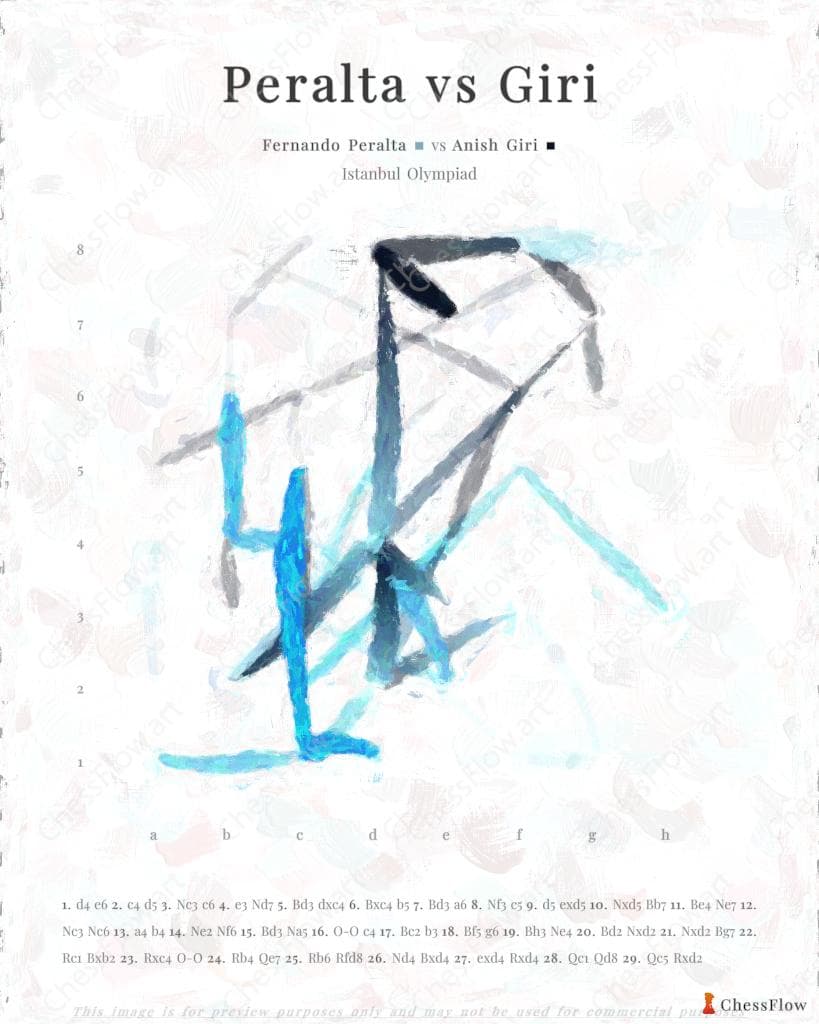
Fernando Peralta vs Anish Giri
Fernando Peralta vs Anish Giri
The Opening Battle Fernando Peralta (2606) faced off against rising Dutch talent Anish Giri (2711) in round 5 of the 2012 Istanbul Olympiad. The game opened with the Queen's Gambit Declined, Semi-Sla...