35th Annual Chicago Open
Jacobson and Sarana Draw Tense Sicilian at Chicago Open

Windy City Sicilian
A Strategic Stalemate on Lake Michigan
Brandon Jacobson and Alexey Sarana couldn't separate themselves in Round 8 of the 35th Annual Chicago Open, agreeing to a draw after a methodical Sicilian Defense that never quite caught fire. The half-point keeps both grandmasters in contention as the tournament enters its final stages, though neither will look back on this game as a missed opportunity—the position simply didn't offer either side a clear path to an advantage.
Jacobson, the American GM rated 2594 and fresh off an impressive second-place finish at the GRENKE Chess Open earlier this year (where he scored 8/9, losing only on tiebreaks to Indian IM Aswath S), had the white pieces and chose a restrained approach against Sarana's Sicilian. The Russian-born grandmaster, now representing Serbia and rated 2664, has been a fixture in the world's top 60 for years—he was part of the select group that went undefeated alongside Magnus Carlsen and Leinier Dominguez at the GRENKE Freestyle event.
This wasn't a game that would make highlight reels, but it offered a window into how two well-prepared professionals navigate a theoretical battleground where neither wants to overextend.
The Anti-Najdorf Approach
Rather than entering the sharp main lines of the Sicilian, Jacobson opted for a quieter setup with 1.e4 c5 2.Nf3 d6 3.Nc3 Nf6 4.Be2. This move order, classified under ECO B50 (Sicilian Defense: Modern Variations), sidesteps the heavily analyzed Najdorf and Dragon systems in favor of a slower positional struggle.
Sarana responded with 4...e5, immediately staking out central territory and signaling he wasn't interested in passive defense. This pawn advance transforms the character of the game—Black accepts a backward d6 pawn but gains space and piece activity in return. It's a common practical choice against White's anti-Sicilian setups, essentially daring White to prove the d6 weakness matters.
The early phase saw both players develop sensibly: 5.Bc4 from Jacobson, targeting the f7 square and preparing to castle, while Sarana completed his kingside development with 5...Be7 6...Nc6 and 7...O-O. The evaluation hovered around dead equal—engines saw nothing for either side, and the players' moves reflected that assessment.
Knight Dance on d4 and d5
The game's most interesting strategic moment came in the knight maneuvering phase between moves 8-12. After Sarana played 8...Nd7, retreating his knight from f6 to reroute it, Jacobson immediately occupied the outpost with 9.Nd5. This is the kind of move that looks impressive on the board—a knight on d5 in the Sicilian is usually a dominant piece—but Sarana had seen it coming.
9...Nb6 challenged the knight directly, and here Jacobson faced a decision. He could exchange on e7, giving up his centralized piece, or retreat. He chose 10.Ne3, a pragmatic move that keeps the knight in play but surrenders the d5 square. The evaluation ticked slightly in White's favor (+0.31 according to the engine), but this is the kind of edge that evaporates with accurate play.
Sarana immediately seized the vacated square with 10...Nd4, planting his own knight on the premium central outpost. Now both players had achieved something—Jacobson's knight on e3 eyes f5 and g4, while Sarana's knight on d4 pressures White's position. The symmetry of the knight struggle reflected the broader equilibrium of the game.
11.c3 forced the issue, and after 11...Nxf3+ 12.Qxf3, the position had simplified considerably. Sarana had traded his well-placed knight, but in return he'd eliminated White's most active minor piece and opened the f-file for potential counterplay.
The Quiet Middle Game
What followed was a textbook example of grandmaster chess at its most technical—and, frankly, its least dramatic. Both players maneuvered their pieces to optimal squares without creating any real imbalances.
12...Bg5 from Sarana was a nice touch, pinning the knight on e3 to the queen and preparing to trade off White's remaining active piece. Jacobson responded with 13.Bb3, preserving his bishop pair, and 13...a5 from Sarana fixed the queenside pawns, preventing any a4-a5 expansion ideas.
The position after 14.Qd1 Qe7 15.Bd2 Be6 16.Bxe6 Qxe6 was the kind of structure where engines see equality and humans see... equality. There were no weaknesses to attack, no open files to exploit, no piece imbalances to leverage. Both players had developed harmoniously, and the resulting position offered neither side a realistic winning plan without cooperation from the opponent.
This is where the gap between engine assessment and human experience actually works in reverse from the usual narrative. Normally we talk about positions that engines call equal but are torture to defend. This was the opposite—a position that's genuinely equal, where pushing for a win would only create weaknesses in your own camp.
Why the Draw Made Sense
At the grandmaster level, recognizing when a position has run out of potential is as important as finding tactical shots. Jacobson had invested significant clock time in the opening phase—he was down to 36 minutes after 16 moves compared to Sarana's hour—and the position simply didn't justify the risk of playing on with a time disadvantage.
For Sarana, the draw with Black against a well-prepared opponent was a perfectly acceptable result. He'd neutralized any opening ambitions Jacobson might have had and emerged with a solid position. Pressing for more would have meant creating imbalances that could easily backfire.
The final position, with the queens and minor pieces still on the board but no clear plan for either side, was a natural stopping point. Neither player had made any serious inaccuracies—the engine evaluation never exceeded +0.5 in either direction—and the game ended as a fair reflection of the play.
Tournament Context
The 35th Annual Chicago Open, one of the premier open tournaments in the United States, attracted a strong field including several titled players. Jacobson entered the event having already proven his form in 2026 with strong performances on the FIDE Circuit, including results at the Brazil Floripa Open and Uzbekistan Tashkent Open.
Sarana, meanwhile, has been building an impressive resume since relocating from Russia to Serbia. His undefeated performance at the GRENKE Freestyle Chess event—finishing alongside Carlsen and Dominguez in the group on 7/9—showed he's capable of competing with the world's best when the format suits him.
This draw, while not the most memorable game either player will contest, represents the kind of solid chess that accumulates points over a long tournament. Neither player lost rating points, neither gave the other a free half-point, and both preserved their energy for the remaining rounds.
The Broader Picture
Games like this one rarely make headlines, but they're the backbone of professional chess. For every tactical fireworks display, there are dozens of well-played draws where both competitors simply did their jobs. Jacobson's preparation neutralized any advantage Sarana might have sought with the Sicilian, and Sarana's accurate response ensured the game never tilted in White's favor.
The opening choice itself—avoiding the main lines in favor of a quieter system—reflects a modern trend among top players. Rather than memorizing 30 moves of theory in the Najdorf, players increasingly opt for flexible setups where understanding trumps memorization. Jacobson's 4.Be2 and subsequent Bc4 achieved exactly what such systems aim for: a playable middlegame without early complications.
For chess fans following the Chicago Open, this game serves as a reminder that draws aren't failures—they're often the correct result when two well-prepared players meet. The real drama at the 35th Annual Chicago Open will come from the games where someone overextends, miscalculates, or simply runs out of time. This wasn't one of those games.
The position after move 16, with its balanced pawn structure and piece harmony, is actually the kind of clean geometry that looks striking when visualized—something we turned into a print at ChessFlow. Sometimes the quietest games produce the most elegant positions.
Both Jacobson and Sarana will return to the board hoping for more dynamic encounters in the tournament's final rounds. For now, the half-point keeps them both in the hunt, which is exactly what both players needed from a game that never offered more than equality.
1.e4 c5 2.Nf3 d6 3.Nc3 Nf6 4.Be2 e5 5.Bc4 Be7 6.d3 Nc6 7.a4 O-O 8.O-O Nd7 9.Nd5 Nb6 10.Ne3 Nd4 11.c3 Nxf3+ 12.Qxf3 Bg5 13.Bb3 a5 14.Qd1 Qe7 15.Bd2 Be6 16.Bxe6 Qxe6 17.g3 Bxe3 18.Bxe3 Nd7 19.f4 exf4 20.Bxf4 d5 21.Qb3 dxe4 22.Qxb7 exd3 23.Rae1 Qg4 24.Qd5 Rad8 25.Qxd3 Ne5 26.Qe2 Qxe2 27.Rxe2 Nd3 28.Bc7 Ra8 29.Rd2 c4 30.Rf5 Ra7 31.Bb6 Rb7 32.Bxa5 Ra8 33.Rd5 f6 34.Rd8+ Rxd8 35.Bxd8 Rb8 36.Bc7 Rb7 37.Bd8 Rb8 1/2-1/2
How would it look as art?


Own a piece of chess history. Transform this legendary game into a unique piece of art for your home or office.
Perfect For
- Unique Gifts for chess enthusiasts and players
- Tournament Prizes that winners will treasure
- Club Decor for chess clubs and gaming spaces
- Office Art showcasing strategic thinking
- Personal Collection of historic games
Explore more
Turn Your Games Into Art
Whether it's your own game from Chess.com or Lichess, or another historic masterpiece, transform any chess game into a stunning visual artwork.
You might also like
More legendary chess game stories

Vincent Keymer vs Alireza Firouzja
Vincent Keymer vs Alireza Firouzja
Firouzja Strikes Back in Oslo Alireza Firouzja needed this one. After suffering back-to-back classical losses to Praggnanandhaa Rameshbabu in rounds 7 and 8, the French number-one found himself slipp...
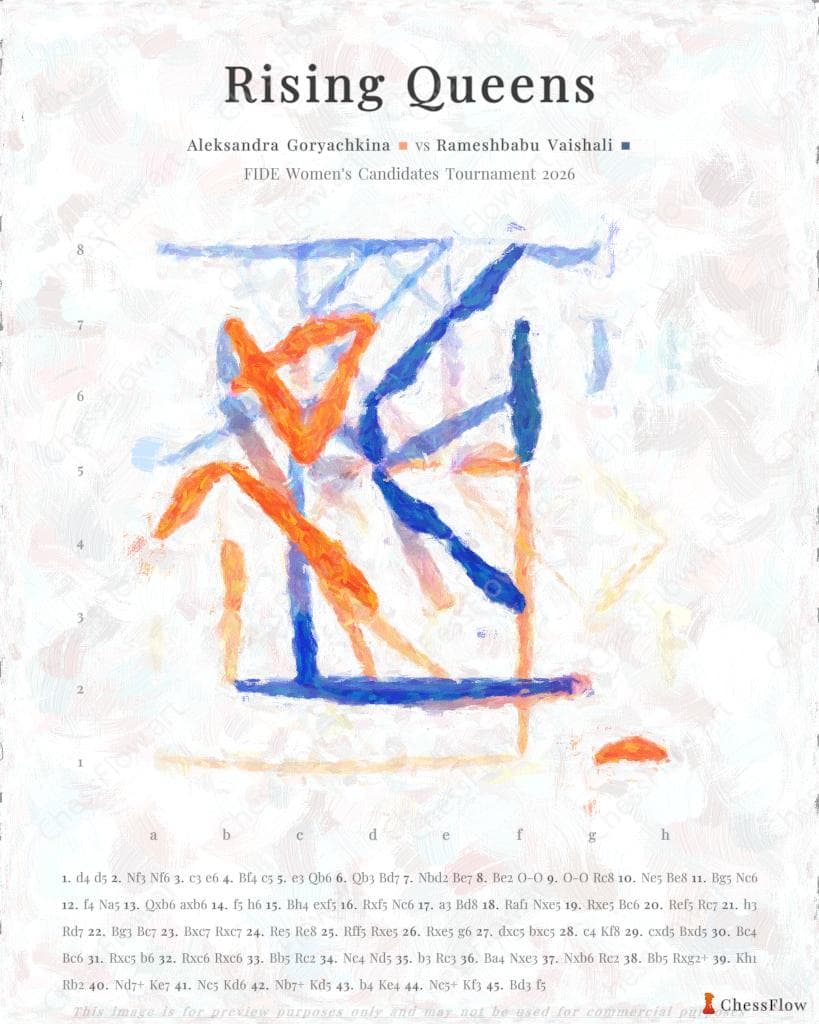
Aleksandra Goryachkina vs Rameshbabu Vaishali
Aleksandra Goryachkina vs Rameshbabu Vaishali
Vaishali Strikes Back in Candidates Thriller Rameshbabu Vaishali scored a crucial victory over Aleksandra Goryachkina in round 11 of the 2026 FIDE Women's Candidates Tournament, dealing a blow to the...
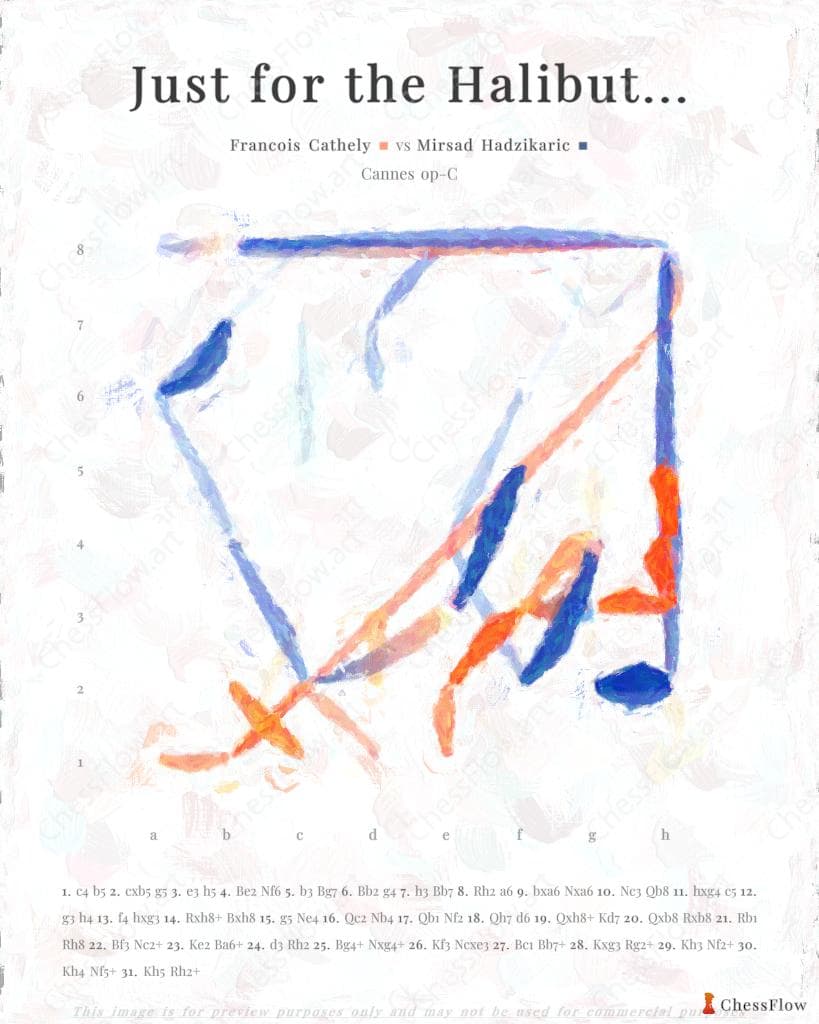
Francois Cathely vs Mirsad Hadzikaric
Francois Cathely vs Mirsad Hadzikaric
The Opening Gambit Francois Cathely and Mirsad Hadzikaric faced off in the 1995 Cannes op-C tournament with an opening that immediately signaled chaos was coming. After 1.c4 b5, Black's Polish Defens...