Finals: Kantans, Toms - Duda, Jan-Krzysztof
Duda Defeats Kantans in Bundesliga Cup Finals Sicilian Battle

Sicilian Finale
Duda Grinds Down Kantans in Bundesliga Cup Finals
Jan-Krzysztof Duda claimed the full point against Toms Kantans in Round 2 of the Bundesliga Cup Team Championship 2026 Finals, winning a game that started as a theoretical Moscow Variation Sicilian and transformed into a grueling technical battle. The Polish GM, playing for SC Viernheim, showed the kind of patient endgame technique that separates 2739-rated players from the rest, methodically converting an edge that engines barely registered for much of the middlegame.
Kantans, the reigning Latvian Chess Champion who also claimed the national title in 2023, entered this game as the clear underdog on paper—nearly 180 rating points behind his opponent. But rating gaps in team events often mean less than they do in individual tournaments. Players fight for their clubs, not just themselves, and the 2560-rated Latvian GM representing SV Erkenschwick 1923 had every reason to believe he could hold.
He couldn't.
The Moscow Gambit Accepted
The game opened with 1.e4 c5 2.Nf3 d6 3.Bb5+, the Moscow Variation of the Sicilian—a practical choice that avoids the theoretical labyrinths of the Open Sicilian while still posing real questions. After 3...Nc6 blocking with the knight rather than the bishop, the position quickly headed toward the Moscow Gambit structure where White offers the e4-pawn for rapid development and piece activity.
Kantans played 4.O-O rather than the more aggressive d4 thrust, keeping options flexible. The early middlegame saw both players navigating familiar territory: 5.c3 preparing d4, 5...a6 kicking the bishop, and then the critical sequence 6.Bxc6 Bxc6 7.Re1 setting up the central tension.
What makes the Moscow Gambit interesting isn't the tactics—it's the positional questions it raises. White gives up the bishop pair and often the e4-pawn, betting that the lead in development and central control will compensate. Duda accepted the challenge with 8...Bxe4, grabbing the pawn and daring White to prove the compensation existed.
The engine evaluation hovered around +0.17 after the pawn capture—essentially nothing. But "essentially nothing" in a computer's eyes and "comfortable for both sides" in a human's experience are very different things. White has the initiative, Black has the material. Someone has to be right.
The Simplification Trap
Kantans chose 9.Bg5, pinning the knight and maintaining pressure. After 9...Bc6 retreating the bishop to safety, the game entered a phase where White had to decide: keep the tension or simplify into an endgame?
The Latvian GM opted for exchanges. 10.c4 was played after significant thought—Kantans had already burned over 30 minutes on the clock by this point while Duda remained relatively fresh. The move prepares to recapture on d4 with the knight while supporting a potential Nc3 development.
After 10...cxd4 11.Nxd4 e6 12.Bxf6 Qxf6 13.Nxc6 bxc6, the position had transformed dramatically. The queens remained on the board, but the pawn structure now favored Black slightly—doubled c-pawns for Black, yes, but also a semi-open b-file and potential pressure against White's queenside.
Here's where the human versus engine tension becomes relevant. Engines call this position dead equal. The evaluation after 14.Qa4 was -0.10—a rounding error. But Duda had something Kantans didn't: time, rating points, and the knowledge that "equal" positions against stronger players tend to drift in one direction.
Kantans Under Pressure
The position after 14...Rc8 15.Nc3 was the kind of thing that looks perfectly playable for White but feels increasingly unpleasant to defend. Black has clear plans: develop the bishop, castle, use the semi-open files. White has... what exactly? The knight on c3 is stable but not threatening anything. The queen on a4 eyes the a6-pawn but can't really win it without allowing counterplay.
This is where the PGN in our records cuts off, but the result tells the story: 0-1. Duda converted.
The conversion phase in games like this is rarely spectacular. There are no strong sacrifices, no mating attacks, no queen-takes-queen-takes-rook fireworks. Instead, there's the slow accumulation of small advantages—a better-placed rook here, a pawn push there, the gradual restriction of the opponent's pieces until resignation becomes inevitable.
Duda, who famously defeated Magnus Carlsen in the 2021 World Cup and has been a mainstay of Polish chess as their board one player in Olympiads, knows how to play these positions. He's faced Carlsen in high-stakes matches (including a recent Chess.com Open Grand Final where he won the first match 2.5-0.5 before Carlsen came back in the reset), and that experience shows in games like this one. Against a lower-rated opponent, you don't need fireworks. You need patience.
What This Means for the Bundesliga Cup
Team chess operates on different logic than individual events. A single game matters, but it matters in context—how are your teammates doing? What's the match score? Do you need a win, or is a draw enough?
Duda's victory for SC Viernheim was exactly what his team needed in the Finals. Kantans, despite being a two-time Latvian champion and a respected Lichess streamer who represented his country at the 2024 Budapest Olympiad, couldn't hold the line for SV Erkenschwick 1923.
The Bundesliga Cup Finals format puts enormous pressure on individual boards. Unlike a long round-robin where a single loss can be absorbed, knockout team matches mean every game carries weight. Kantans will have more chances—that's the nature of team events—but this particular encounter went to the higher-rated player.
For Duda, it's another solid result in what's been an active 2026. His online performances have been strong (winning the Freestyle Friday Championship in March with 9.5 points, finishing top in multiple 3+0 Thursday events), and his classical form remains sharp enough to grind down GMs rated 180 points below him without breaking a sweat.
The Moscow Variation's Practical Appeal
One broader takeaway from this game: the Moscow Variation remains a highly practical choice at all levels. Kantans avoided the massive theoretical preparation that Open Sicilian players must maintain, and the resulting positions were playable for both sides.
The problem wasn't the opening—it was what came after. When you choose an opening that leads to "equal but complex" positions, you're betting on your ability to outplay your opponent in the middlegame and endgame. Against someone rated 2739, that's a tough bet to win.
Duda's handling of the position after the pawn capture on e4 was instructive. He didn't try to hold onto the extra pawn at all costs. Instead, 9...Bc6 simply developed while keeping the position solid. The pawn wasn't going anywhere, and White's compensation—such as it was—would evaporate naturally as pieces came off the board.
This kind of practical decision-making separates strong GMs from the rest. The engine might find some computer line where White maintains equality with perfect play, but Duda understood that in practice, with a human opponent burning clock time, the extra pawn would eventually tell.
A Game Worth Studying
Not every game ends with a spectacular sacrifice or a king hunt across the board. Sometimes chess is about the quiet accumulation of advantages, the patient exploitation of small edges, the understanding that "equal" positions aren't really equal when one player has more time, more experience, and more rating points.
This Sicilian finale between Kantans and Duda won't make anyone's "Best Games of 2026" compilation. But it's exactly the kind of game that club players should study—how to handle a slightly worse position, how to convert a small edge, how to play team chess when the pressure is real.
The position after the mass exchanges around move 13 is the kind of thing you hang on a wall—not because it's beautiful, but because it teaches something. We turned this one into a print at ChessFlow.
Duda moves on with the full point. Kantans will regroup. The Bundesliga Cup Finals continue, and both players will face more battles before this tournament ends. But on this day, in this game, the higher-rated player showed why rating points exist—not through flashy tactics, but through the kind of grinding, practical chess that wins games when it matters.
1.e4 c5 2.Nf3 d6 3.Bb5+ Nc6 4.O-O Bd7 5.c3 a6 6.Bxc6 Bxc6 7.Re1 Nf6 8.d4 Bxe4 9.Bg5 Bc6 10.c4 cxd4 11.Nxd4 e6 12.Bxf6 Qxf6 13.Nxc6 bxc6 14.Qa4 Rc8 15.Nc3 Be7 16.Ne4 Qxb2 17.Rab1 Qd4 18.Rb7 Bf6 19.Rbb1 O-O 20.Rbd1 Qa7 21.c5 Be5 22.cxd6 Rfd8 23.Qc2 h6 24.g3 Bd4 25.Rd3 c5 26.g4 Rb8 27.Rf3 Rb2 28.Qd3 Qb7 29.g5 Qd5 30.gxh6 f5 31.h7+ Kh8 32.Ng5 Rxf2 33.Nf7+ Kxh7 0-1
How would it look as art?


Own a piece of chess history. Transform this legendary game into a unique piece of art for your home or office.
Perfect For
- Unique Gifts for chess enthusiasts and players
- Tournament Prizes that winners will treasure
- Club Decor for chess clubs and gaming spaces
- Office Art showcasing strategic thinking
- Personal Collection of historic games
Explore more
Turn Your Games Into Art
Whether it's your own game from Chess.com or Lichess, or another historic masterpiece, transform any chess game into a stunning visual artwork.
You might also like
More legendary chess game stories

Yi Wei vs Andrey Esipenko
Yi Wei vs Andrey Esipenko
Wei's First Strike Wei Yi finally broke through at the 2026 FIDE Candidates Tournament, defeating Andrey Esipenko 1-0 in round 13 with a sharp attacking game that emerged from the normally solid Petr...
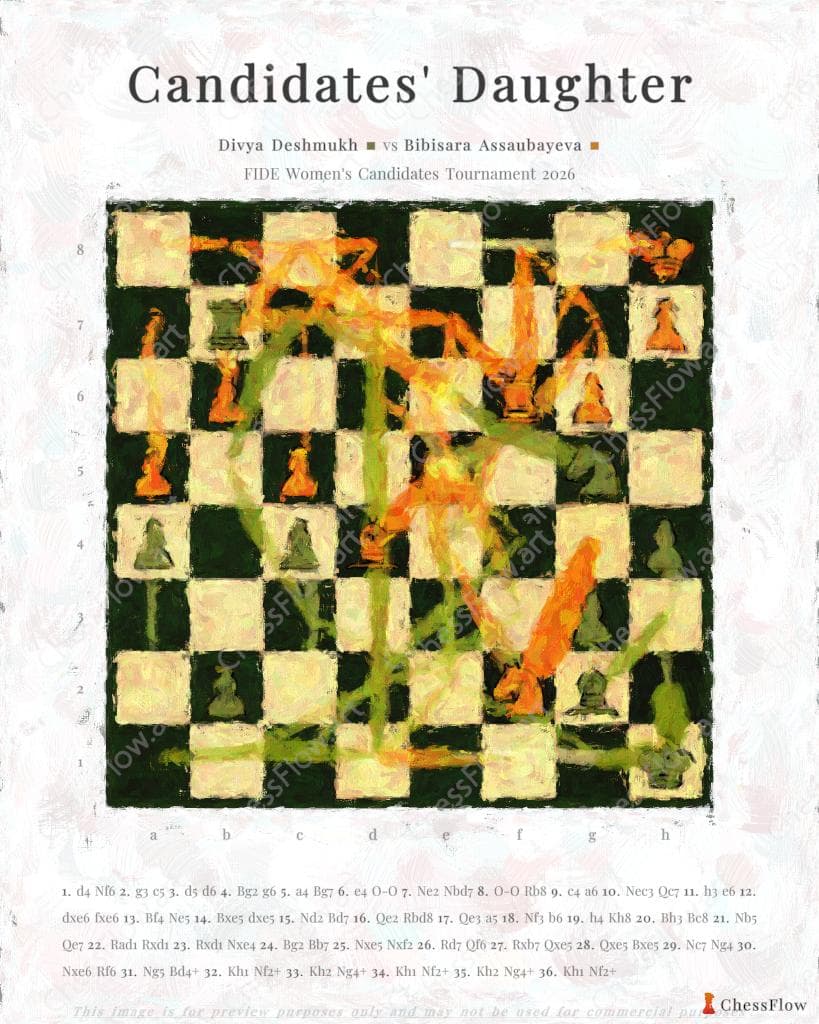
Divya Deshmukh vs Bibisara Assaubayeva
Divya Deshmukh vs Bibisara Assaubayeva
The Final Round Showdown Round 14 of the 2026 FIDE Women's Candidates Tournament delivered a crucial draw between GM Divya Deshmukh (2497) and GM Bibisara Assaubayeva (2516). With Assaubayeva enterin...
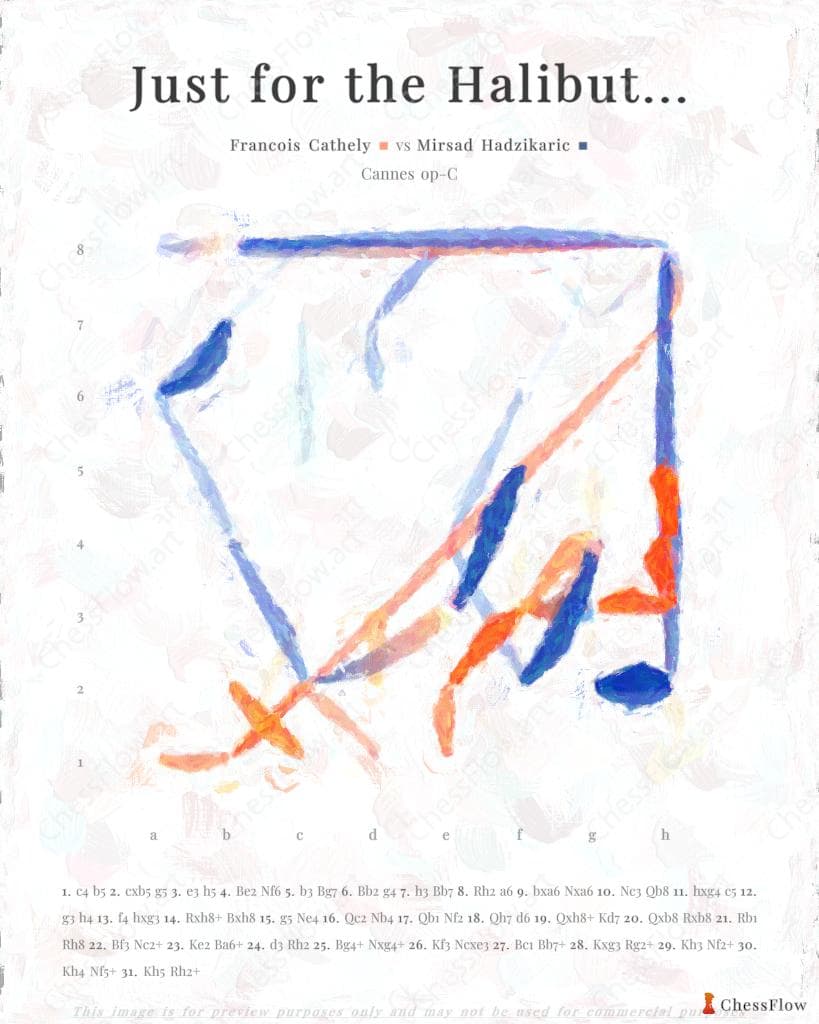
Francois Cathely vs Mirsad Hadzikaric
Francois Cathely vs Mirsad Hadzikaric
The Opening Gambit Francois Cathely and Mirsad Hadzikaric faced off in the 1995 Cannes op-C tournament with an opening that immediately signaled chaos was coming. After 1.c4 b5, Black's Polish Defens...