2026 Norway Chess Open
Carlsen Holds Keymer in Semi-Tarrasch Armageddon Draw


Nordic Duel
Carlsen's Draw Odds Save the Day in Oslo
Magnus Carlsen walked away with half a point against Vincent Keymer in their Round 14 Armageddon clash at Norway Chess 2026, but not without sweating through a position that briefly turned against him. The world number one, playing Black with draw odds and seven minutes on his clock against Keymer's ten, survived a critical moment where an inaccuracy handed White a significant advantage—only for the position to stabilize before Keymer could convert.
The result continues a turbulent tournament for Carlsen, whose classical score in Oslo has been unusually inconsistent. He entered this round having collected two wins and three losses in classical play, with only one draw—a far cry from the dominant performances Norwegian fans have come to expect at his home super-tournament.
For Keymer, it was another near-miss in what has been a frustrating event. The German prodigy had already lost five consecutive Armageddon games before finally breaking through with a classical win over World Champion Gukesh Dommaraju in Round 6. This draw against Carlsen, while not a loss, represented another missed opportunity to claim a scalp against the world's top-rated player.
The Semi-Tarrasch Setup
The game opened with 1.d4 Nf6 2.c4 e6 3.Nf3 d5 4.Nc3 c5, steering into the Queen's Gambit Declined: Semi-Tarrasch Defense. This opening has long been a reliable weapon for Black at the highest levels, offering dynamic counterplay against White's central structure while avoiding the heavily theoretical mainlines of the Orthodox QGD.
Carlsen's choice of 4...c5 signaled his intent to fight for central control immediately rather than adopt a passive setup. The Semi-Tarrasch leads to positions where Black accepts an isolated queen's pawn in exchange for piece activity and open lines—a trade-off that suits Carlsen's style of grinding out positions where small advantages can be accumulated over time.
Keymer responded with the solid 5.e3, preparing to develop his light-squared bishop while maintaining flexibility. This is the most popular continuation at the elite level, though it allows Black to equalize with accurate play. The game continued with 5...a6, a useful prophylactic move preventing any Nb5 ideas and preparing to expand on the queenside.
After 6.cxd5 exd5 7.Be2 Nc6 8.O-O, the position had reached a standard Semi-Tarrasch tabiya. Black has the isolated d5 pawn, but compensation comes in the form of active piece play and the open c-file. Carlsen continued logically with 8...cxd4 9.Nxd4 Bd6, developing with tempo against the knight while eyeing the kingside.
Keymer's Queenside Pressure
The middlegame took shape after 10.b3 O-O 11.Bb2 Re8 12.Rc1. Keymer was playing a model game against the isolani, placing his pieces on ideal squares to target Black's structural weakness. The bishop on b2 eyes the long diagonal, the rook on c1 controls the open file, and White's centralized pieces coordinate smoothly.
Carlsen exchanged knights with 12...Nxd4 13.Qxd4, and after 13...Bf5 14.Rfd1 Be5 15.Qd2, the position remained balanced but required precision from both sides. The engines showed White with only a tiny edge—around +0.24—but the practical challenges for Black were mounting. Defending an isolated pawn while White piles up on the open files is never comfortable, even when the computer says "equal."
This is where the gap between engine assessment and human experience becomes relevant. Engines might call such positions level, but no one wants to defend this for 40 moves with the clock ticking down. Every piece trade brings Black closer to an endgame where the d5 pawn becomes a permanent liability.
The Critical Inaccuracy
The game's decisive moment came after 15...Rc8. This move, while natural-looking, allowed White to build a significant advantage. The engine evaluation jumped from roughly +0.24 to +0.68—still holdable, but a clear indication that Black had drifted.
Keymer found 16.Bf3, putting pressure on the d5 pawn and preparing to increase the squeeze. The bishop on f3 is ideally placed, attacking the central weakness while supporting potential breaks.
Then came the critical error. Carlsen played 16...Ne4?!, an aggressive-looking move that centralized the knight but proved to be an inaccuracy. The engine evaluation spiked to +1.45, indicating a serious problem for Black. The intended 16...Be6 would have been more prudent, keeping the position solid and maintaining the defensive structure.
The move Ne4 looks active and thematic—centralizing a piece with tempo against White's queen—but it actually allows White to exploit the looseness in Black's position. After the queen moves, White can challenge the knight and potentially win material or create lasting positional pressure.
The Armageddon Factor
In a classical game with normal time controls, Keymer would have had every opportunity to nurse this advantage toward a win. But this was Armageddon, where Black has draw odds. Carlsen didn't need to win—he just needed to survive.
The Norway Chess format has produced exactly these kinds of swings throughout the tournament. As Keymer himself noted after an earlier round: "I had five draws, but I could have won four and lost three or something like that, so it was not really as calm as the result suggests." The same volatility applied here.
With draw odds in his pocket, Carlsen could afford to take risks that would be unwise in a classical encounter. Even if the position turned against him, he only needed to hold—and holding is what the five-time World Champion does better than almost anyone.
The game eventually petered out to a draw, with Carlsen using his draw odds to secure the half-point despite the earlier inaccuracy. For Keymer, it was another case of coming close but not quite converting—a theme that has defined his Norway Chess campaign.
Tournament Context
This result fit into a broader pattern for both players. Carlsen's tournament has been marked by unusual inconsistency—he lost to Firouzja in the opening round, fell to Praggnanandhaa in a wild time scramble in Round 3, but also scored classical wins over Gukesh and Firouzja. His event has lacked the steady accumulation of points that typically characterizes his super-tournament performances.
For Keymer, the draw maintained his position in the middle of the pack. His breakthrough classical win over Gukesh in Round 6 showed what he's capable of when everything clicks, but the Armageddon format has been unkind to him. Five consecutive Armageddon losses before that win meant he was constantly giving back points that other players were accumulating.
The standings heading into the final rounds showed Wesley So leading the pack after a dominant stretch that included consecutive classical wins over Praggnanandhaa. Firouzja, who had led since beating Carlsen in Round 1, sat in second after Carlsen's revenge victory. Keymer occupied third place, with Carlsen in fourth—a position that would have seemed unlikely for the world number one before the tournament began.
The Semi-Tarrasch's Enduring Appeal
The opening choice itself deserves some attention. The Semi-Tarrasch has been a trusted weapon for elite players seeking dynamic play against 1.d4 without entering the most heavily analyzed theoretical battlegrounds. Players from Kasparov to Kramnik have employed it in critical games, and Carlsen's use of it here shows its continued relevance at the highest level.
The structure arising from the Semi-Tarrasch—with Black's isolated d-pawn balanced against active pieces—creates the kind of tension that both players seemed to embrace. Keymer's handling of the position, building pressure methodically before Carlsen's inaccuracy, demonstrated solid understanding of the strategic themes.
The position after move 16 is the kind of thing you hang on a wall—the tension between Black's active pieces and White's structural pressure captured in a single moment.
Looking Ahead
With the tournament entering its final stretch, every half-point carries weight. For Carlsen, the draw kept him in contention but didn't close the gap to the leaders. For Keymer, it represented another near-miss in a tournament full of them.
The Norway Chess format continues to produce drama precisely because it punishes draws with Armageddon and rewards classical wins so heavily. Three points for a classical victory versus 1.5 for an Armageddon win creates massive incentives to push for decisive results—and massive swings when those pushes fail.
Carlsen's ability to survive this Armageddon encounter, despite the inaccuracy that gave Keymer a winning position, speaks to the practical difficulty of converting advantages under time pressure. The engines may have said +1.45, but converting that against Magnus Carlsen with the clock ticking is another matter entirely.
The tournament continues with both players seeking to improve their positions in the final rounds. For Carlsen, the goal remains climbing back toward the top of the standings in his home event. For Keymer, each game represents an opportunity to prove he belongs among the world's elite—and to finally string together the consistent results that have eluded him in Oslo.
Norway Chess 2026 has delivered on its promise of fighting chess, with the unique format ensuring that every round produces decisive results one way or another. This Carlsen-Keymer encounter, while ending in a draw, provided another reminder of how small margins separate success from failure at the highest level—and how draw odds can turn a losing position into half a point.
1.d4 Nf6 2.c4 e6 3.Nf3 d5 4.Nc3 c5 5.e3 a6 6.cxd5 exd5 7.Be2 Nc6 8.O-O cxd4 9.Nxd4 Bd6 10.b3 O-O 11.Bb2 Re8 12.Rc1 Nxd4 13.Qxd4 Bf5 14.Rfd1 Be5 15.Qd2 Rc8 16.Bf3 Ne4 17.Nxe4 dxe4 18.Qxd8 Rcxd8 19.Rxd8 Rxd8 20.Bxe5 exf3 21.gxf3 Bh3 22.a4 Rd2 23.Bc3 Ra2 24.a5 f6 25.e4 Kf7 26.b4 g5 27.Bd4 Re2 28.Be3 Kg6 29.Kh1 h6 30.Rg1 Kf7 31.Rd1 Kg6 32.Kg1 Kf7 33.Bd2 Kg6 34.Bc3 g4 35.fxg4 Rxe4 36.Rd3 1/2-1/2
How would it look as art?


Own a piece of chess history. Transform this legendary game into a unique piece of art for your home or office.
Perfect For
- Unique Gifts for chess enthusiasts and players
- Tournament Prizes that winners will treasure
- Club Decor for chess clubs and gaming spaces
- Office Art showcasing strategic thinking
- Personal Collection of historic games
Explore more
Turn Your Games Into Art
Whether it's your own game from Chess.com or Lichess, or another historic masterpiece, transform any chess game into a stunning visual artwork.
You might also like
More legendary chess game stories
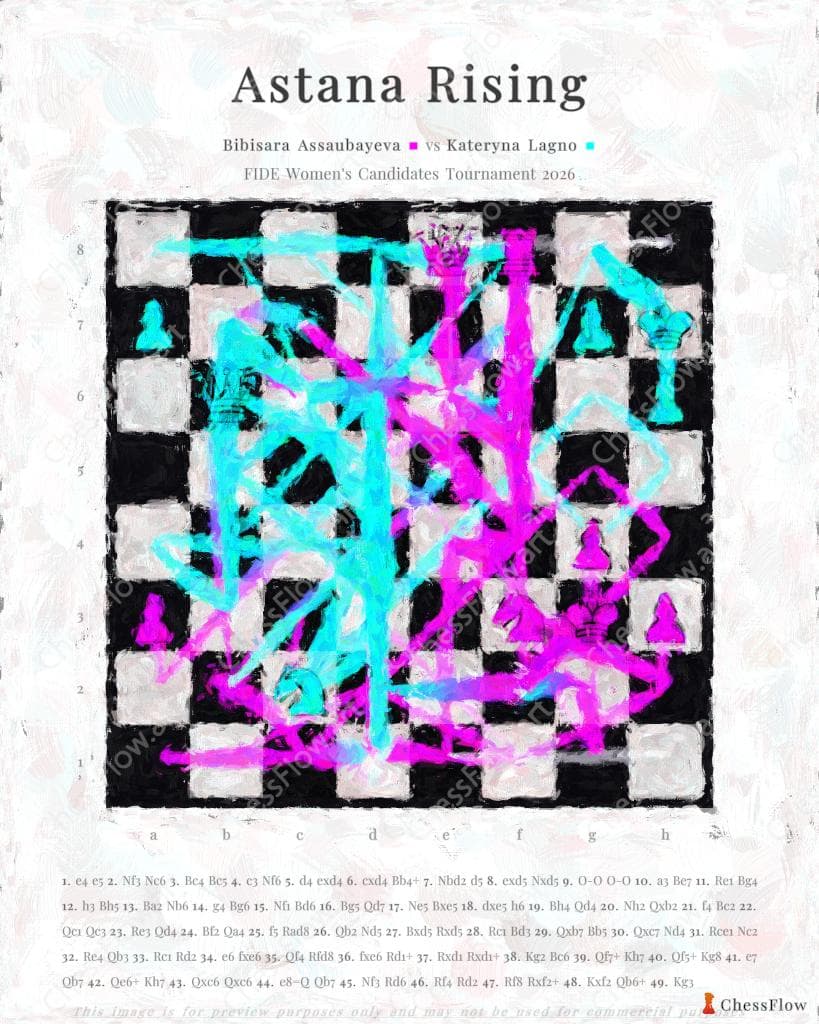
Bibisara Assaubayeva vs Kateryna Lagno
Bibisara Assaubayeva vs Kateryna Lagno
Assaubayeva Strikes Back in Round 12 Bibisara Assaubayeva bounced back from recent struggles with a decisive win over Kateryna Lagno in round 12 of the FIDE Women's Candidates Tournament. The Kazakh...

Jose Eduardo Martinez Alcantara vs Narayanan S L
Jose Eduardo Martinez Alcantara vs Narayanan S L
Martinez Alcantara Takes Down Narayanan in Round 9 Clash Jose Eduardo Martinez Alcantara defeated S.L. Narayanan 1-0 in Round 9 of the Bucharest Grand Prix 2026, extending his remarkable unbeaten str...
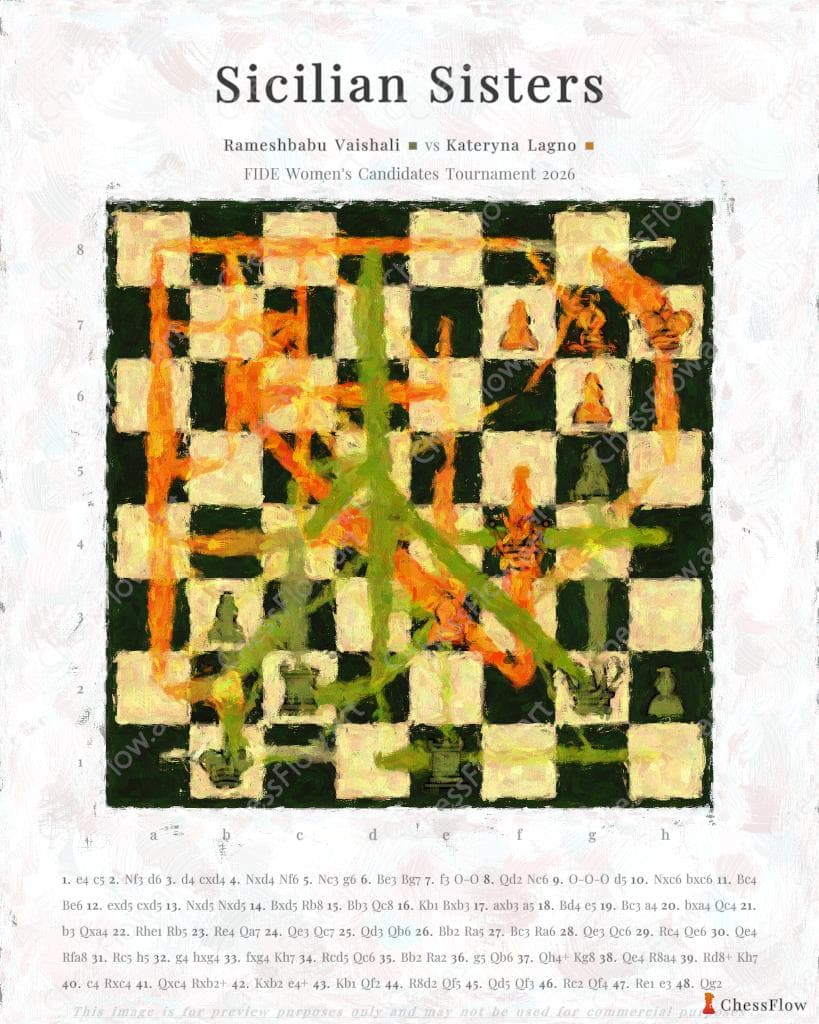
Rameshbabu Vaishali vs Kateryna Lagno
Rameshbabu Vaishali vs Kateryna Lagno
Vaishali Strikes in the Dragon Vaishali Rameshbabu defeated Kateryna Lagno in round 14 of the FIDE Women's Candidates Tournament 2026, playing a sharp Sicilian Dragon that ended in White's favor. The...