2026 Norway Chess Open
Firouzja Beats Keymer to Stay in Norway Chess Hunt


Nordic Fire
Firouzja Strikes Back in Oslo
Alireza Firouzja needed this one. After suffering back-to-back classical losses to Praggnanandhaa Rameshbabu in rounds 7 and 8, the French number-one found himself slipping in the Norway Chess 2026 standings. Against Vincent Keymer in round 18, playing Black in a King's Indian Attack, Firouzja ground out a victory that keeps him within striking distance of tournament leader Wesley So.
The game itself was a slow-burning affair—the kind where engines hover around equality for thirty moves while both players maneuver for microscopic advantages. But in Norway Chess format, where classical wins are worth three points, even a technical victory carries enormous weight. Firouzja now sits on 13 points, just one behind So with the final rounds approaching.
The Double Fianchetto Dance
Keymer opened with 1.Nf3 d5 2.g3 g6 3.Bg2 Bg7, steering into a King's Indian Attack with double fianchetto structures. This is quiet territory—the kind of opening where both sides castle quickly and spend the next twenty moves figuring out where to put their pieces.
Firouzja responded symmetrically with his own fianchetto, and the position after 4...e5 gave Black a solid central presence. The evaluation hovered between +0.07 and +0.20 through the opening phase—essentially dead equal by any human standard.
The first real decision point came after 7.e4, when Keymer invited the central tension. Firouzja took immediately with 7...dxe4, and after 8.dxe4 we had an open center with both players' bishops staring down the long diagonals. The position screamed "draw" to anyone watching, but Firouzja clearly had other ideas.
Keymer's Bishop Odyssey
What made this game interesting wasn't a single tactical blow but rather Keymer's curious handling of his dark-squared bishop. After 9.Be3, the bishop embarked on a journey that would consume several tempi without achieving much.
10.Bc5 attacked the b6 square and prevented immediate castling, but after 10...b6, the bishop had to retreat. 11.Ba3 was the logical follow-up, eyeing the a3-f8 diagonal, but with Black's king still in the center, this pressure was more theoretical than practical.
Meanwhile, Firouzja found the active 11...Nd4, planting a knight on the ideal outpost. This is the kind of move that doesn't change the evaluation dramatically—engines still showed roughly equal—but it forces White to make decisions while Black's pieces flow naturally to good squares.
The trade sequence 12.Qd3 Bxf3 13.Bxf3 c5 highlighted the strategic battle. Firouzja was willing to give up the bishop pair in exchange for a rock-solid knight on d4 and complete control of the dark squares. After 14.Bg2, Keymer had essentially admitted that his bishop maneuvers hadn't achieved anything concrete.
The Knight Trade and Its Aftermath
The critical moment came around move 15-16. Keymer played 15.Ne2, seemingly preparing to challenge the dominant knight on d4. But this allowed Firouzja to complete his development with 15...Rd8, putting the rook on the open file and increasing the pressure.
When Keymer finally pulled the trigger with 16.Nxd4 Rxd4, the position transformed. Black now had a rook actively placed on the fourth rank, and White's queen had to find a new home. 17.Qe2 was the choice, but the evaluation had already begun drifting in Black's favor—nothing dramatic, just -0.24, but in a position where White had been trying to prove something, this represented a failure.
The engine might call this position "equal" or "slightly better for Black," but there's a human element the silicon doesn't capture. Keymer had spent considerable time in the opening trying to generate something with his bishop maneuvers, and now he was left with a slightly passive position and no clear plan. Firouzja, by contrast, had a simple approach: improve his pieces, probe for weaknesses, and wait for an opportunity.
The Long Grind
What followed was the kind of technical phase that separates good players from great ones. The PGN shows the evaluation gradually shifting in Black's favor, not through any single error but through the accumulation of small advantages.
Engines call positions like this "holdable," and they're right—with perfect play, White can probably draw. But no human plays perfectly for forty moves, especially not against someone as tenacious as Firouzja. The French grandmaster has shown throughout this tournament that he's willing to play on in positions others might accept as drawn, and his patience was rewarded here.
Keymer, who earlier in the tournament had spoken about his struggles in armageddon games ("It's nice to finally win a game after so many failed chances," he said after beating Gukesh in round 6), found himself on the wrong end of a similar grind. The German number-one has shown he can compete with the world's best, but converting advantages and defending difficult positions remain areas where experience matters.
What This Means for the Standings
With this victory, Firouzja moves to 13 points, keeping the pressure on Wesley So at 14. The American has been the most consistent performer throughout Norway Chess 2026, but with Firouzja and Praggnanandhaa both within striking distance, nothing is decided.
The tournament format—three points for a classical win, 1.5 for an armageddon win, and 1 for an armageddon loss after a classical draw—means that a single classical victory can completely reshape the standings. Firouzja knows this better than anyone; he opened the tournament with back-to-back classical wins before his recent stumble.
For Keymer, this loss drops him further behind the leaders. Sitting on 10 points, he's now four points off the pace with limited rounds remaining. His earlier victory over World Champion Gukesh Dommaraju showed what he's capable of ("I don't think I was ever worse," he said after that game), but consistency against the very top players remains the challenge.
The Broader Picture
Norway Chess 2026 has been a tournament of momentum swings. Firouzja dominated early, Magnus Carlsen has struggled with four classical losses, and So has quietly accumulated points while others traded blows. The defending champion has had an uncharacteristically difficult event, and even said after one round, "It's less bad than yesterday"—not exactly the confidence you expect from the world number-one.
This game between Keymer and Firouzja won't be remembered as a classic. There was no sacrificial attack, no dramatic blunder, no time scramble chaos. But it was exactly the kind of game Firouzja needed—a controlled, professional victory that stops the bleeding and keeps his title hopes alive.
The double fianchetto structure after move 4 is the kind of position we turned into a print. Sometimes the quietest games have the most elegant geometry.
Looking Ahead
With the tournament entering its final stretch, every point matters. So leads, but he still has to face Carlsen—and while the Norwegian has struggled, he's still Magnus Carlsen. Firouzja needs classical wins to close the gap, and Pragg remains dangerous after his back-to-back victories over Carlsen and Firouzja himself.
Keymer's tournament has been a mixed bag. His first win came in round 6 against Gukesh, but he's lost all his armageddon games and now this classical encounter. At 2759, he's rated among the world's elite, but Norway Chess 2026 has shown the gap between "elite" and "tournament winner" can be measured in these grinding technical games where the smallest inaccuracy costs everything.
For Firouzja, this victory is a reminder of what he's capable of when he's not pressing too hard. The 22-year-old French star has the talent to win any tournament he enters, but his results have been inconsistent since his breakthrough years. A strong finish in Oslo would be a statement that he's ready to challenge for the very top again.
The final rounds promise more drama. In Norway Chess format, no lead is safe, and no deficit is insurmountable. One classical win changes everything—and both Firouzja and So know it.
1.Nf3 d5 2.g3 g6 3.Bg2 Bg7 4.O-O e5 5.d3 Nc6 6.Nc3 Nf6 7.e4 dxe4 8.dxe4 Bg4 9.Be3 Qc8 10.Bc5 b6 11.Ba3 Nd4 12.Qd3 Bxf3 13.Bxf3 c5 14.Bg2 O-O 15.Ne2 Rd8 16.Nxd4 Rxd4 17.Qe2 Qd7 18.b3 Rd2 19.Qc4 b5 20.Qxc5 Bf8 21.Qxe5 Ng4 22.Qg5 Bxa3 23.e5 h6 24.Qf4 Rd8 25.Rae1 Rd4 26.e6 fxe6 27.Re4 e5 28.Qf3 Rf8 29.Qe2 Rxe4 30.Qxe4 Kg7 31.h3 Nf6 32.Qxe5 Re8 33.Qc3 Rc8 34.Qa5 Bc5 35.c3 Bb6 36.Qb4 a5 37.Qf4 Rxc3 38.Kh2 Qc7 39.Qd2 Rc2 40.Qd3 Rxf2 41.Re1 Qb7 42.Rg1 Rxa2 0-1
How would it look as art?


Own a piece of chess history. Transform this legendary game into a unique piece of art for your home or office.
Perfect For
- Unique Gifts for chess enthusiasts and players
- Tournament Prizes that winners will treasure
- Club Decor for chess clubs and gaming spaces
- Office Art showcasing strategic thinking
- Personal Collection of historic games
Turn Your Games Into Art
Whether it's your own game from Chess.com or Lichess, or another historic masterpiece, transform any chess game into a stunning visual artwork.
You might also like
More legendary chess game stories
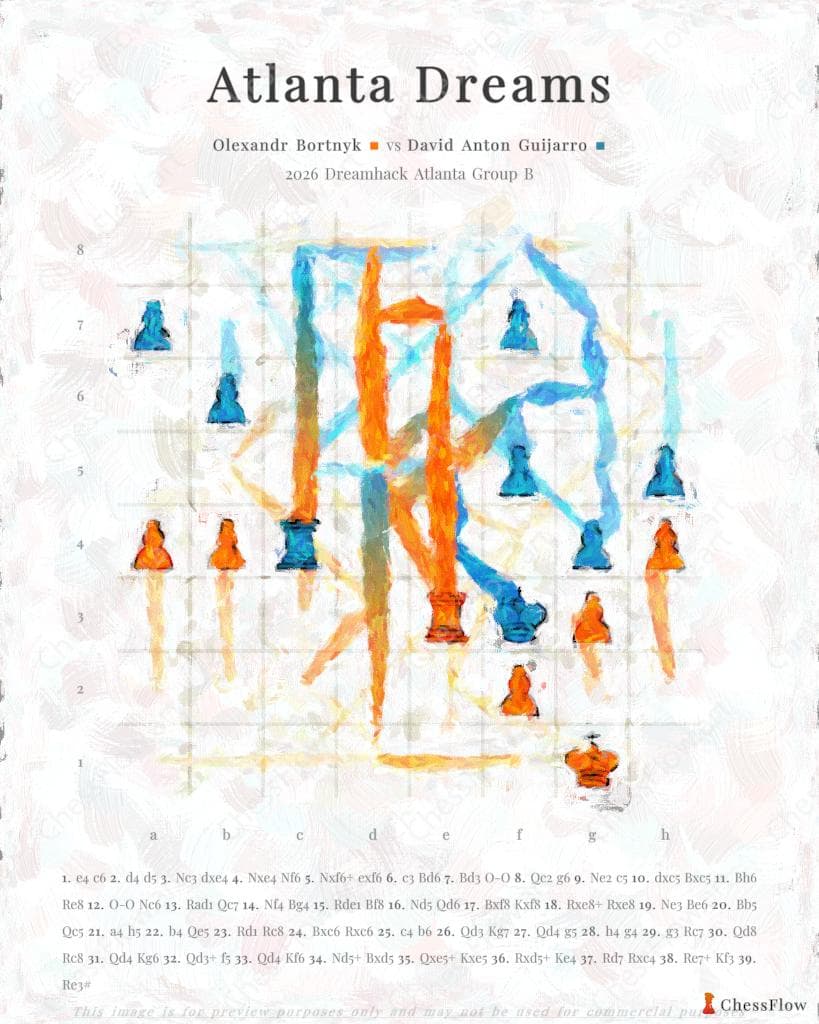
Olexandr Bortnyk vs David Anton Guijarro
Olexandr Bortnyk vs David Anton Guijarro
Checkmate in the Quarterfinals Olexandr Bortnyk ended David Anton Guijarro's DreamHack Atlanta run with actual checkmate on the board — not a resignation, not a time scramble, but the king cornered a...
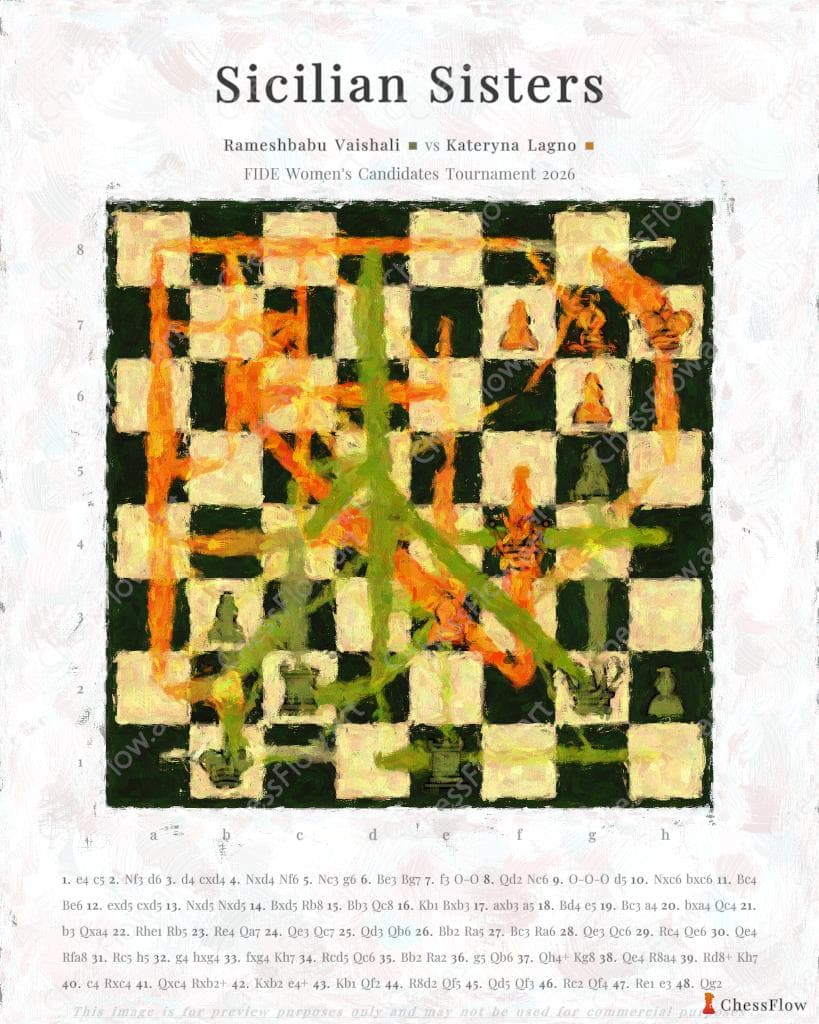
Rameshbabu Vaishali vs Kateryna Lagno
Rameshbabu Vaishali vs Kateryna Lagno
Vaishali Strikes in the Dragon Vaishali Rameshbabu defeated Kateryna Lagno in round 14 of the FIDE Women's Candidates Tournament 2026, playing a sharp Sicilian Dragon that ended in White's favor. The...
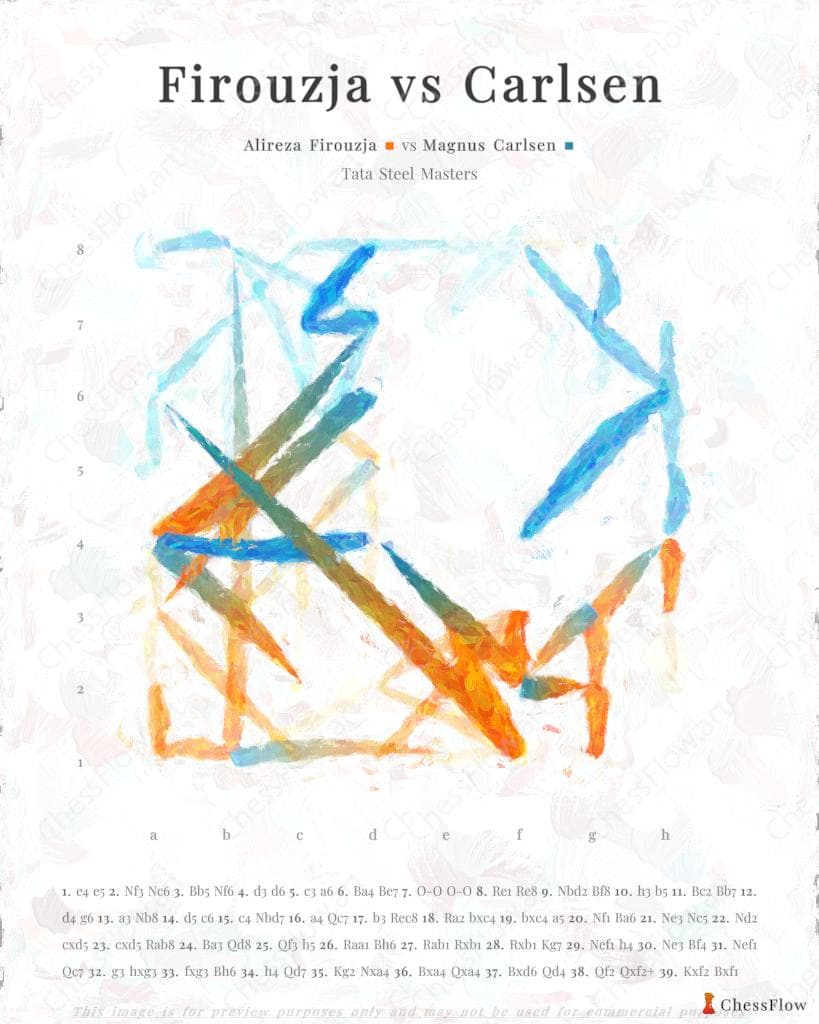
Alireza Firouzja vs Magnus Carlsen
Alireza Firouzja vs Magnus Carlsen
The Matchup Magnus Carlsen faced Alireza Firouzja in round 9 of the 2020 Tata Steel Masters, a highly anticipated clash between the world champion and the tournament's youngest participant. Carlsen,...