2026 Norway Chess Women
Ju Wenjun Beats Koneru in Armageddon at Norway Chess 2026


Midnight in Bergen
Ju Wenjun Takes Down Koneru in Late-Night Armageddon Thriller
Ju Wenjun won with Black in Armageddon to claim 1½ points against Humpy Koneru in Round 18 of the 2026 Norway Chess Women tournament. The classical game had been a tense, largely balanced affair through a Zukertort Opening, but when the clocks reset for the tiebreaker, the reigning World Champion found her rhythm in the final minutes—continuing her remarkable run in the rapid format that has defined her tournament.
This result matters for the standings. Koneru, who entered the event struggling at the bottom of the table, had been slowly clawing her way back. A win here would have pulled her level with Ju in the standings. Instead, the World Champion extended her cushion, leaving the Indian GM still needing points with the tournament winding down.
A Quiet Opening Turns Sharp
The classical portion began with Koneru choosing 1.Nf3 d5 2.e3 Nf6 3.b3, steering into the flexible waters of the Zukertort Opening. This was a deliberate choice—avoiding the theoretical battlegrounds where Ju's preparation might be deeper, opting instead for a position where understanding trumps memorization.
Ju responded with a King's Indian setup, fianchettoing her dark-squared bishop with 3...g6 and 4...Bg7. The position that emerged after 5.d4 O-O 6.Bd3 c5 was the kind of structure both players have navigated hundreds of times: White with the bishop pair and central presence, Black with the long diagonal and counterplay against d4.
The first real tension point came on move 11. After a series of natural developing moves, Koneru played 11.c4?, a move that looks logical—challenging Black's central pawn structure—but the engine immediately flags it as a mistake, dropping the evaluation to -1.68. The problem is that after 11...e5!, Black would have seized the initiative in the center, and White's queen on e2 becomes awkwardly placed.
But here's where the human element intervenes. Ju played 11...e6? instead, a solid but passive choice that lets White off the hook entirely. The evaluation snaps back to 0.00. Two mistakes in succession, canceling each other out—the kind of thing that happens in classical chess when both players are feeling their way through an unfamiliar position rather than executing prepared analysis.
The Middlegame Grind
What followed was a technical middlegame where neither player could find a way to create meaningful imbalances. After 14.cxd5 exd5, the position simplified into an isolated queen pawn structure for Black, but with the bishops traded off, White had no real way to pressure it.
Koneru tried 15.Ba6, trading off the light-squared bishops. This is a common strategic idea—eliminating Black's "good" bishop that defends the IQP—but with so many pieces already off the board, the resulting position was simply too dry to generate winning chances.
The position after 16.Qxa6 Qe6 shows the problem White faced: Black's pieces are well-coordinated, the d5 pawn is adequately defended, and there's no obvious plan to make progress. Engines call positions like this "equal," but what that really means is "neither side can force anything." For the players at the board, this translates to a long, grinding draw where the first person to push too hard loses.
Armageddon: Where Ju Thrives
When the classical game ended in a draw (the PGN shows the game reaching a position where neither side could make progress), everything came down to Armageddon—and this is where the tournament context becomes crucial.
Ju Wenjun has been a force in the Armageddon tiebreakers throughout Norway Chess 2026. According to the tournament reports, she had won five out of six Armageddon games heading into this round, despite not winning a single classical game. This is a remarkable statistic that speaks to her ability to handle the pressure of the rapid format, where Black needs only a draw to claim the point.
For Koneru, the Armageddon format has been less kind. She entered the tournament losing to Bibisara Assaubayeva in the very first round—a classical loss that put her immediately on the back foot. Since then, she's been fighting to recover, winning her Armageddon game against Ju in Round 5 to pick up 1½ points. But consistency in the tiebreakers has eluded her.
In this Armageddon, Ju had Black and needed only a draw. The time control in Norway Chess Armageddon gives White more time but Black the draw odds—a format that rewards solid defense and punishes overextension. Ju's experience in these situations proved decisive.
The Tournament Picture
This result keeps Ju Wenjun in the hunt for a top-three finish, while Koneru remains near the bottom of the standings. The tournament has been dominated by Divya Deshmukh and Bibisara Assaubayeva at the top, with Anna Muzychuk also in contention. Ju's path forward depends on continuing to convert in Armageddon while hoping for a breakthrough in classical play.
For Koneru, the math is getting difficult. She needs results in the remaining rounds just to avoid finishing last—a disappointing outcome for a player at this level. At 2535, she's one of the highest-rated players in the field, but rating points don't translate directly to tournament points, especially in a format that rewards Armageddon specialists.
The Norway Chess scoring system—3 points for a classical win, 1½ for an Armageddon win, 1 for an Armageddon loss, and 0 for a classical loss—creates situations where a player can accumulate points through tiebreaker consistency without ever winning a "real" game. Ju has exploited this perfectly, grinding out draws in classical and then converting in the rapid follow-up.
What This Game Reveals
The classical portion of Koneru-Ju was not a game that will appear in opening manuals or tactical anthologies. It was a professional chess game between two elite players who understood each other's preparation and chose to navigate around it rather than through it.
The mutual mistakes on move 11 are instructive. Koneru's 11.c4? was the kind of move that looks natural at the board—developing, gaining space, challenging the center—but contains a tactical flaw that only reveals itself if Black responds precisely. Ju's 11...e6? shows that even World Champions miss opportunities when they're not in "calculation mode" but rather in "development mode."
This is the gap between engine assessment and human experience. The computer sees the position after 11.c4? as significantly better for Black, but only if Black finds the precise continuation. In practice, against the clock, in a position that doesn't scream "tactics here," the opportunity slips by.
The position after move 16 is the kind of thing you hang on a wall—a frozen moment where two elite players have reached perfect equilibrium, neither able to find a crack in the other's position.
Looking Ahead
With the tournament entering its final rounds, the standings remain fluid. Deshmukh leads, but Assaubayeva and Muzychuk are within striking distance. Ju's Armageddon prowess has kept her relevant despite the lack of classical wins, while Koneru's tournament has been a struggle from the opening round.
The format rewards adaptability. Some players thrive in classical and struggle in rapid; others, like Ju, have found a way to extract points from the tiebreaker system even when the main games don't go their way. Norway Chess 2026 has been a laboratory for this hybrid format, and the results suggest that being "good at Armageddon" is a distinct skill worth cultivating.
For Koneru, the remaining rounds offer a chance at redemption. For Ju, they offer a chance to climb higher in the standings while continuing to do what she does best—survive in classical, strike in Armageddon.
The World Champion's tournament continues. The crown may not be on the line in Norway, but her ability to grind out results under pressure suggests it remains in capable hands.
1.Nf3 d5 2.e3 Nf6 3.b3 g6 4.Bb2 Bg7 5.d4 O-O 6.Bd3 c5 7.O-O b6 8.Qe2 Bb7 9.dxc5 bxc5 10.Rd1 Nbd7 11.c4 e6 12.Nc3 Qe7 13.Rac1 Rfd8 14.cxd5 exd5 15.Ba6 Bxa6 16.Qxa6 Qe6 17.Qxe6 fxe6 18.Ng5 Re8 19.Nb5 h6 20.Nxe6 Rxe6 21.Nc7 Ree8 22.Nxa8 Rxa8 23.Bxf6 Nxf6 24.Rxc5 a5 25.Rdc1 Kh7 26.Rc8 Rxc8 27.Rxc8 Ne4 28.Ra8 Bc3 29.f3 Nf6 30.Ra7+ Kg8 31.Kf1 Kf8 32.Ke2 Ke8 33.Kd3 Be1 34.Kd4 Bd2 35.a3 g5 36.g4 h5 37.gxh5 Nxh5 38.Kxd5 Bxe3 39.Rxa5 Kf7 40.b4 Nf6+ 41.Kc6 Ke6 42.Ra8 Nd5 43.Re8+ Ne7+ 44.Kc7 Bf4+ 45.Kb7 Kd7 46.Rxe7+ Kxe7 47.a4 Bd2 48.b5 Kd7 49.b6 Bc3 50.h3 Bd2 51.Ka6 Kc8 52.a5 Be3 53.Kb5 Kb7 54.a6+ Kb8 55.Kc6 Bf4 56.a7+ Ka8 57.Kb5 Kb7 58.Kc5 Be3+ 59.Kb5 Bf4 60.Ka5 Bd2+ 61.Kb5 Be3 0-1
How would it look as art?


Own a piece of chess history. Transform this legendary game into a unique piece of art for your home or office.
Perfect For
- Unique Gifts for chess enthusiasts and players
- Tournament Prizes that winners will treasure
- Club Decor for chess clubs and gaming spaces
- Office Art showcasing strategic thinking
- Personal Collection of historic games
Turn Your Games Into Art
Whether it's your own game from Chess.com or Lichess, or another historic masterpiece, transform any chess game into a stunning visual artwork.
You might also like
More legendary chess game stories

Jiner Zhu vs Aleksandra Goryachkina
Jiner Zhu vs Aleksandra Goryachkina
Goryachkina Takes Down Zhu in Round 13 Aleksandra Goryachkina scored a crucial victory over Jiner Zhu in round 13 of the FIDE Women's Candidates Tournament 2026, dealing a blow to the Chinese GM's ch...
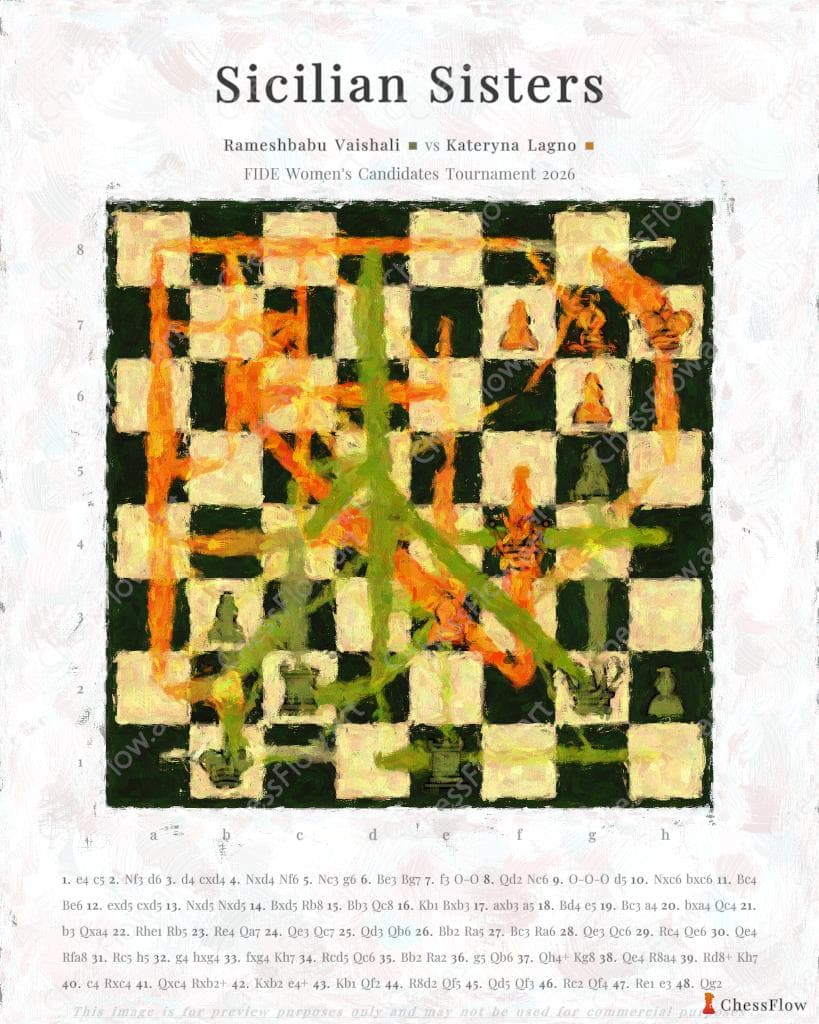
Rameshbabu Vaishali vs Kateryna Lagno
Rameshbabu Vaishali vs Kateryna Lagno
Vaishali Strikes in the Dragon Vaishali Rameshbabu defeated Kateryna Lagno in round 14 of the FIDE Women's Candidates Tournament 2026, playing a sharp Sicilian Dragon that ended in White's favor. The...
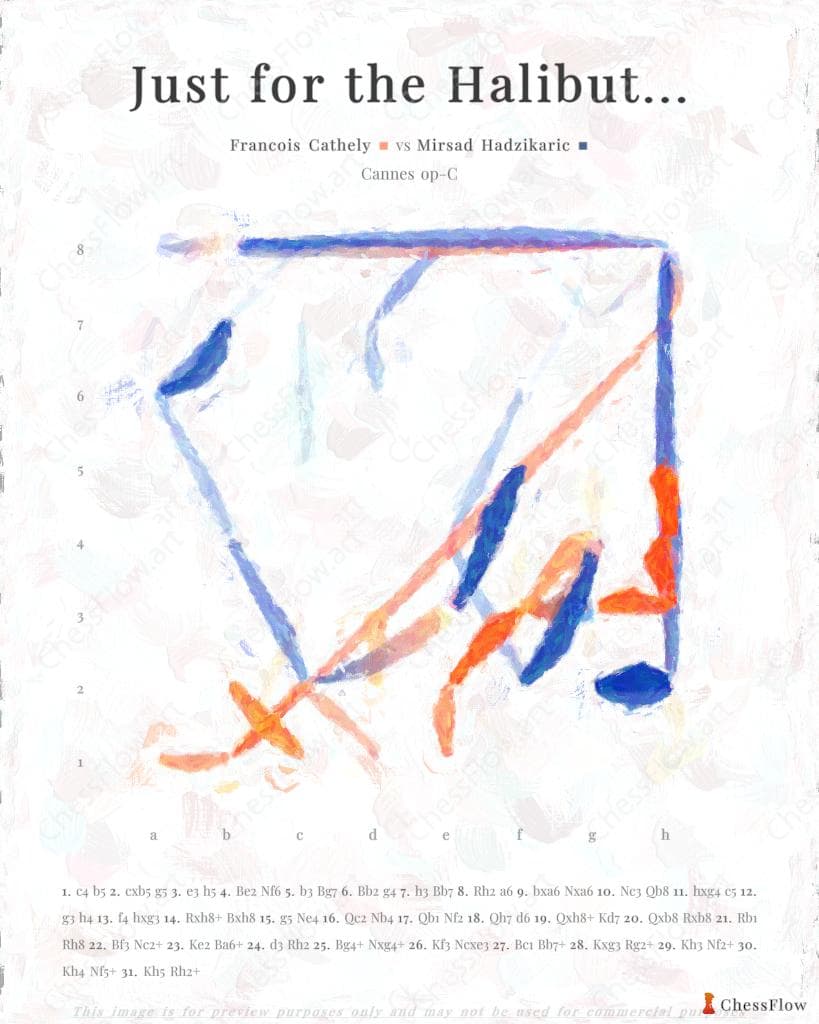
Francois Cathely vs Mirsad Hadzikaric
Francois Cathely vs Mirsad Hadzikaric
The Opening Gambit Francois Cathely and Mirsad Hadzikaric faced off in the 1995 Cannes op-C tournament with an opening that immediately signaled chaos was coming. After 1.c4 b5, Black's Polish Defens...