2026 Norway Chess Women
Zhu Defeats Koneru in Norway Chess Women Round 8


Zhu's Gambit
Zhu Jiner Takes Down Koneru in Round 8 Armageddon
Jiner Zhu claimed another crucial 1.5 points at Norway Chess Women 2026, defeating Humpy Koneru in their Round 8 Armageddon tiebreaker after their classical game ended in a draw. The result keeps Zhu in contention in a tightly packed field where Bibisara Assaubayeva still leads, but the margins are razor-thin with two rounds remaining.
The classical encounter between the two GMs was a curious affair — a Zukertort Opening that stayed quiet until it suddenly wasn't. Koneru, playing White, chose an unusual setup with 8.Rg1?, a move that immediately raised eyebrows. Engines flagged it as a mistake, preferring the natural Nc3 to continue development. Instead, Koneru's rook lift signaled aggressive intentions on the kingside, but the execution left something to be desired.
Zhu responded calmly with 8...c5, seizing central space while White's rook sat awkwardly on g1, committed to an attack that hadn't materialized. The position after 1.Nf3 d5 2.e3 Nf6 3.c4 e6 4.b3 Be7 5.Bb2 O-O 6.Be2 b6 7.Qc2 Bb7 8.Rg1 already felt like White had overcommitted to a plan without the pieces to support it.
The Kingside Gamble That Never Paid Off
Koneru's concept was clear: push g4-g5 and launch a kingside assault. The problem? Her development was incomplete, and Zhu's setup with the fianchettoed bishop on b7 and central pawns on d5 and e6 was rock solid. When 9.g4 came, followed by 10.g5, Black had already developed naturally with 9...Nc6 and was ready to exploit White's overextension.
The critical moment came after 10...Ne4?! — an inaccuracy according to engines, which preferred the more patient Ne8, retreating the knight to safety while maintaining the tension. Zhu's choice was more aggressive, centralizing the knight on e4 where it became a thorn in White's position. Koneru responded with 11.Nc3?!, another imprecision when a3 was more accurate, and suddenly Black had 11...Nb4, threatening to invade on d3 or c2.
The position was messy. Koneru retreated her queen with 12.Qb1, a sad necessity to avoid losing material, while Zhu pushed 12...f5, locking down the kingside and ensuring White's g5 pawn would never become a battering ram. The attack Koneru had invested so much in was going nowhere.
A Blunder Erases Black's Advantage
Then came the moment that changed everything. After 13.a3, threatening the knight on b4, Zhu played 13...Nc6?? — a horrible blunder that threw away her entire advantage. The engine evaluation swung from -1.72 to nearly equal in a single move. The correct continuation was 13...d4!, opening the center and exploiting White's poorly coordinated pieces. Instead, by retreating the knight, Zhu allowed Koneru back into the game.
What followed was a sequence of exchanges: 14.cxd5 Nxc3 15.Bxc3 exd5. The position simplified considerably, and whatever edge Black had enjoyed was gone. The game had transformed from a potential rout into a balanced struggle where both players had chances.
This is the kind of moment that separates engine analysis from human chess. Engines will tell you the position after 13...Nc6?? is roughly equal, but the psychological shift is enormous. Zhu had been pressing for twenty moves with a clear advantage; suddenly she was scrambling to hold. Koneru, who had been defending an uncomfortable position, could finally breathe.
The Armageddon Decider
The classical game eventually petered out to a draw, which meant everything came down to Armageddon — the format Norway Chess uses to ensure every round produces a winner. In Armageddon, White gets 10 minutes to Black's 7, but a draw counts as a win for Black. It's a format that rewards nerve as much as calculation.
Koneru has struggled in Armageddon throughout this event. Earlier in the tournament, she admitted she was "just trying to play some unusual tries" with offbeat openings, but they haven't worked out. Her record in the tiebreakers has been poor, and against Zhu, the pattern continued.
Zhu, on the other hand, has shown herself to be remarkably composed in the rapid tiebreakers. In Round 1, she beat defending champion Anna Muzychuk in Armageddon, "confidently steering the game toward the draw she needed, even to the extent of taking a draw in a winning position." That kind of cold-blooded pragmatism is exactly what Armageddon demands.
The tiebreaker wasn't pretty — these games rarely are when the clocks are ticking down and both players are operating on fumes — but Zhu got the job done. Another 1.5 points in the bank, another step closer to challenging Assaubayeva at the top.
Where This Leaves the Standings
With two rounds remaining in the double round-robin, the standings are compressed enough that almost anyone can still win. Assaubayeva leads, but her margin has been shrinking. Divya Deshmukh, who called playing Armageddon "very heavy on the brain and also on the body," has been picking up points steadily despite saying "I don't want to play any more armageddons!" after her Round 3 win.
Zhu's victory over Koneru keeps her in the mix. The Chinese GM has been one of the more consistent performers, escaping a lost position against World Champion Ju Wenjun in Round 3 in what was described as "nothing short of miraculous." She's proven she can grind out results even when the chess isn't perfect.
Koneru, meanwhile, remains at the bottom of the standings with just 1 point from her first three matches. The Indian GM, who won her second World Rapid title in 2024, has been refreshingly honest about her current form: "I have lost a lot of classical rating last year. I didn't do well in many tournaments... I want to get out of that and improve my classical rating." At 38, she's no longer chasing the same goals as the younger players in the field: "It's important for me that I enjoy the game more than the results."
That philosophy is admirable, but the results in Norway have been brutal. Losses to Assaubayeva, Muzychuk, Divya, and now Zhu have left Koneru with a lot of ground to make up — ground that may be impossible to recover with only two rounds left.
The Tournament Picture
Norway Chess 2026 features six of the world's strongest women players in a double round-robin format with Armageddon tiebreakers. The prize fund is equal to the open event for the first time, with 700,000 Norwegian kroner (roughly €65,000) going to the winner.
The format means every match produces a result: 3 points for a classical win, 1.5 points for an Armageddon win, 1 point for an Armageddon loss (after drawing the classical), and 0 points for losing in classical. It's a system designed to reward decisive play, and it's created a dynamic where even a single classical win can vault a player up the standings.
Assaubayeva remains the only player to have won a classical game in the entire women's event, which explains her lead. But with Divya, Zhu, and Muzychuk all within striking distance, the final two rounds promise drama.
The position after Koneru's 8.Rg1? — that awkward moment where White's rook sits on g1 with no clear purpose while Black's position is already superior — is the kind of thing that captures a game's turning point perfectly. We turned this one into a print.
Round 9 continues Thursday, with Zhu looking to build on her momentum and Koneru hoping to salvage something from a difficult tournament. In a field this strong, every point matters, and the race to catch Assaubayeva is far from over.
1.Nf3 d5 2.e3 Nf6 3.c4 e6 4.b3 Be7 5.Bb2 O-O 6.Be2 b6 7.Qc2 Bb7 8.Rg1 c5 9.g4 Nc6 10.g5 Ne4 11.Nc3 Nb4 12.Qb1 f5 13.a3 Nc6 14.cxd5 Nxc3 15.Bxc3 exd5 16.Qb2 g6 17.h4 Rf7 18.b4 d4 19.exd4 cxd4 20.Nxd4 Nxd4 21.Bxd4 Bf8 22.O-O-O a5 23.b5 Bxa3 24.Qxa3 Qxd4 25.Rg3 Rc8+ 26.Rc3 Rfc7 27.Kb2 Bd5 28.Qd6 Rxc3 0-1
How would it look as art?


Own a piece of chess history. Transform this legendary game into a unique piece of art for your home or office.
Perfect For
- Unique Gifts for chess enthusiasts and players
- Tournament Prizes that winners will treasure
- Club Decor for chess clubs and gaming spaces
- Office Art showcasing strategic thinking
- Personal Collection of historic games
Turn Your Games Into Art
Whether it's your own game from Chess.com or Lichess, or another historic masterpiece, transform any chess game into a stunning visual artwork.
You might also like
More legendary chess game stories
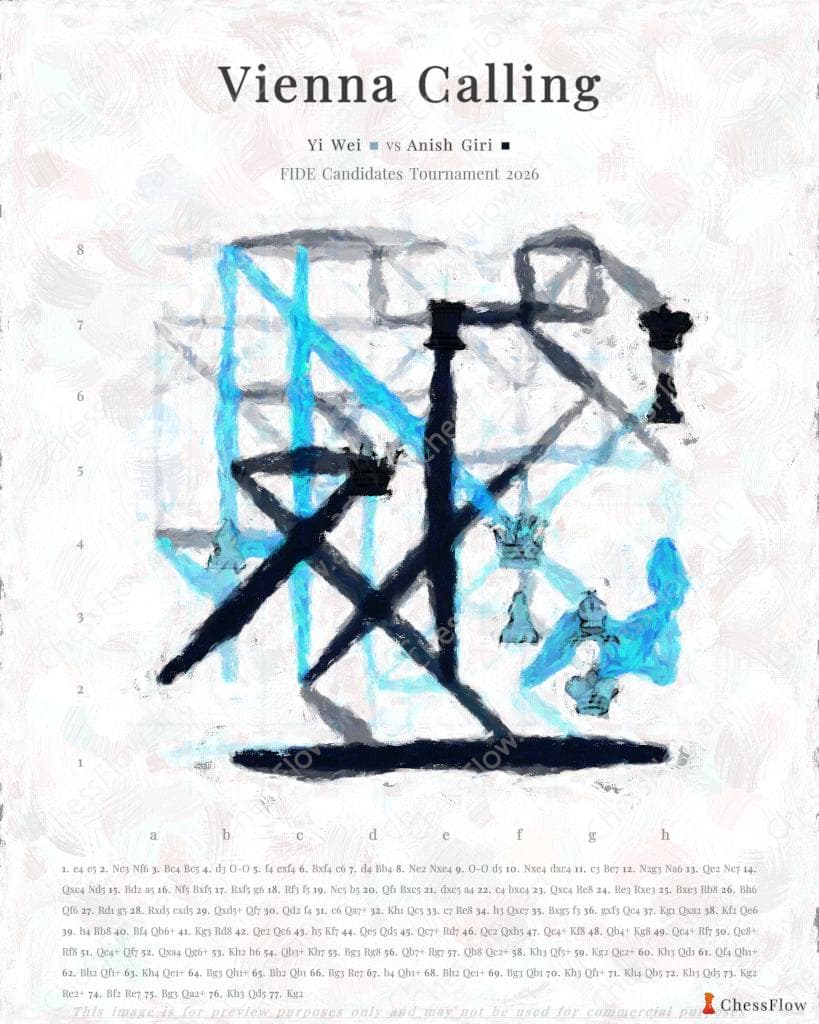
Yi Wei vs Anish Giri
Yi Wei vs Anish Giri
The Vienna Hybrid Experiment Wei Yi's choice of the Vienna Hybrid against Anish Giri in round 12 of the 2026 FIDE Candidates raised eyebrows. The opening sequence 1.e4 e5 2.Nc3 signals White's intent...
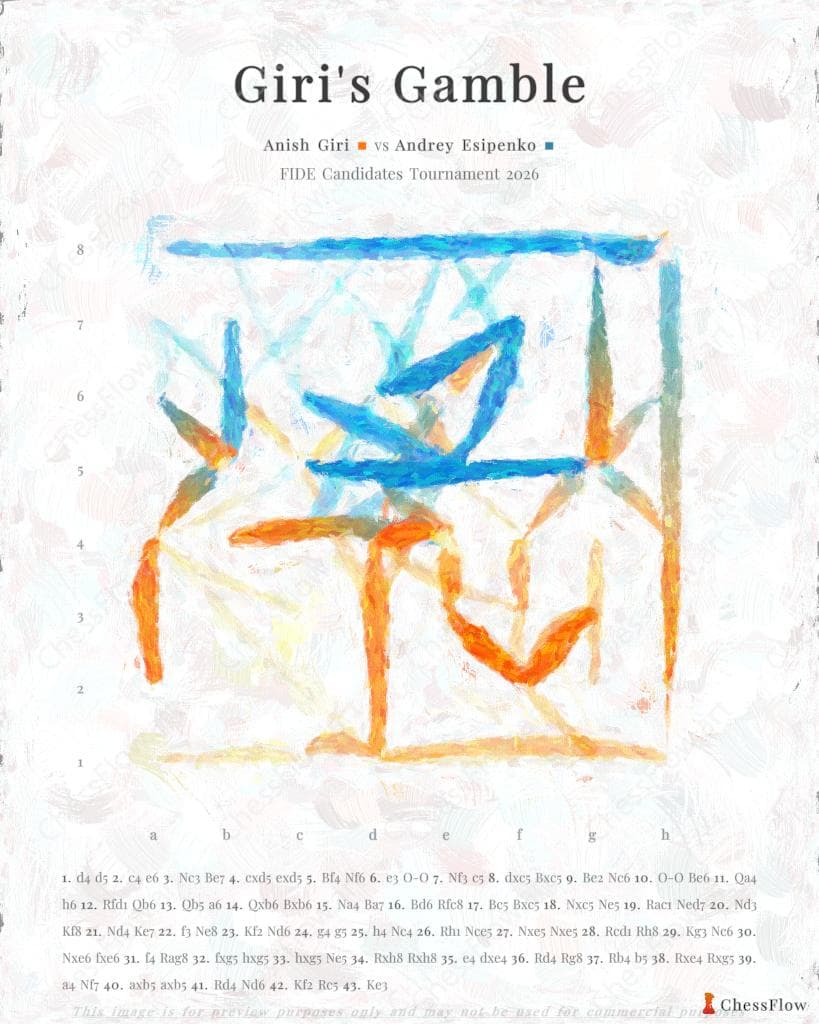
Anish Giri vs Andrey Esipenko
Anish Giri vs Andrey Esipenko
A Draw That Satisfied No One Anish Giri and Andrey Esipenko split the point in round 11 of the 2026 FIDE Candidates Tournament, a result that did nothing to change either player's trajectory in Cypru...
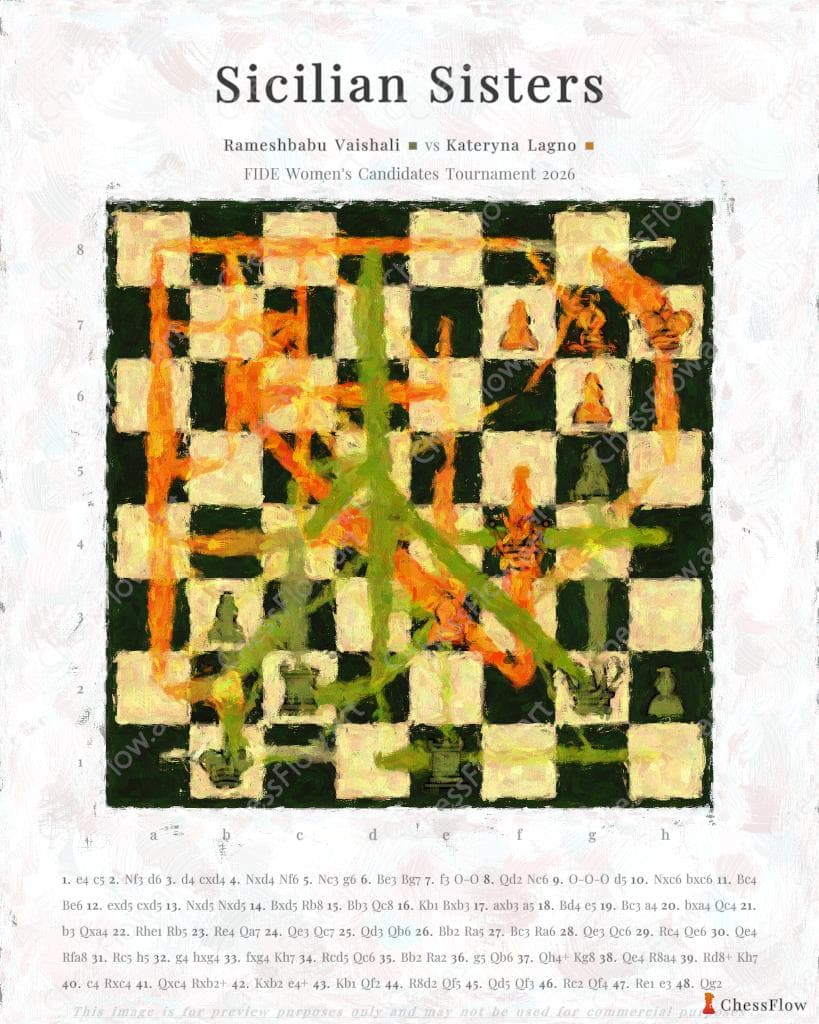
Rameshbabu Vaishali vs Kateryna Lagno
Rameshbabu Vaishali vs Kateryna Lagno
Vaishali Strikes in the Dragon Vaishali Rameshbabu defeated Kateryna Lagno in round 14 of the FIDE Women's Candidates Tournament 2026, playing a sharp Sicilian Dragon that ended in White's favor. The...