FIDE Women’s Candidates Tournament 2026
Lagno vs Muzychuk Draw in Women's Candidates 2026


Sister Act
Lagno and Muzychuk Split the Point as Vaishali Claims the Title
Kateryna Lagno needed a win. Anna Muzychuk needed a win. Neither got one. In round 11 of the 2026 FIDE Women's Candidates Tournament, the two veterans ground out 49 moves of Queen's Indian theory before agreeing to a draw by repetition, a result that kept both players mathematically alive but ultimately meant nothing once Vaishali Rameshbabu clinched the tournament three rounds later.
The game itself was a study in controlled tension—two experienced players probing for weaknesses that never materialized, trading pieces at careful intervals, and eventually reaching an endgame where neither side could make progress. It's the kind of chess that engines evaluate as dead equal from move 20 onward, but that doesn't capture what it feels like to sit across the board from a rival when the tournament standings demand you take risks.
The Queen's Indian: A Safe Harbor
Lagno opened with 1.d4 Nf6 2.c4 e6 3.Nf3 b6, inviting a Queen's Indian Defense. Muzychuk obliged with the Capablanca Variation, a solid setup that has been a reliable weapon at the highest levels for a century. The early moves followed well-trodden paths: 4.g3 Bb4+ 5.Bd2 Bxd2+ 6.Qxd2, exchanging the dark-squared bishops immediately and signaling that neither player was looking for sharp complications in the opening.
This exchange is a typical feature of the Capablanca line—Black gives up the bishop pair but simplifies the position and avoids the structural headaches that can arise in other Queen's Indian variations. After 6...Bb7 7.Bg2 O-O 8.Nc3 d5, Muzychuk had achieved a comfortable setup with her bishop on the long diagonal and central pawns ready to contest the center.
The position after 9.Ne5 Nbd7 10.O-O Qe7 was the kind of symmetrical structure where both players have reasonable piece activity but no obvious targets. Lagno's knight on e5 looked imposing, but without supporting pieces to create threats, it was more of a placeholder than a battering ram.
The Middlegame: Probing Without Punching
The game entered its critical phase around move 15. Lagno had centralized her pieces effectively, but Muzychuk's position was rock-solid. The sequence 11.Qc2 Rfd8 12.Rad1 c5 illustrated the problem White faced: every time Lagno tried to create tension, Muzychuk had a natural response that neutralized the pressure.
When Lagno played 13.cxd5 exd5, she opened the position slightly but also gave Black a clear plan—use the open e-file and the central pawn majority. The exchange 14.Nxd7 Rxd7 removed White's best-placed piece and left the position even more symmetrical.
Here's where the human element diverges from engine assessment. Stockfish will tell you this position is 0.00, completely equal, nothing to see. But in a Candidates tournament, with both players needing wins to stay in contention, "equal" doesn't mean "comfortable." Lagno had to find a way to create imbalances; Muzychuk had to decide whether to play for a win or simply hold the draw.
The next several moves—15.Rfe1 Re8 16.e3 h6 17.b3 Red8—showed both players maneuvering carefully, improving piece placement without committing to anything concrete. Lagno's 18.Bh3 was an attempt to activate the bishop, which had been somewhat passive on g2, but Muzychuk responded with 18...Rc7, preparing to double rooks on the c-file.
The Knight Dance on b5
The most interesting moment of the middlegame came with 19.Nb5, a move that forced Muzychuk to make a decision. The knight threatened to land on d6 or c7, and Black had to react. Muzychuk chose 19...Bc8, retreating the bishop to defend but also clearing the b7 square for potential rook activity.
After 20.Bg2 Rc6 21.Qb2, Lagno had achieved something—her knight on b5 was annoying, and her queen was eyeing the long diagonal. But Muzychuk's 21...Bg4 was a clever response, developing the bishop to an active square and preparing to exchange it for White's knight or rook.
The sequence 22.Rc1 a6 23.Nc3 cxd4 24.exd4 finally resolved the central tension, but the resulting position was still dead level. Both players had isolated d-pawns, but neither could exploit the other's weakness.
Simplification and the Draw
From move 25 onward, the game was heading toward an inevitable conclusion. 25.Ne2 Bxe2 26.Rxc6 Qxc6 exchanged the knights and one pair of rooks, leaving a position where White had a slight initiative but no real winning chances.
Muzychuk's 27...Re8 activated her last rook, and after 28.Qd2 Rxe1+ 29.Qxe1, the queens came off the board soon after. The position with 29...Qc2 saw Muzychuk's queen penetrating to the second rank, but there was nothing to attack—White's pawns were all defended, and the king was safe.
The final phase was pure technique. Lagno played 30.h3 a5 31.Qe5, trying to keep some activity, but Muzychuk's 31...Qc1+ 32.Bf1 Qc6 forced more simplification. By move 35, both players were shuffling pieces, looking for any weakness that didn't exist.
The Endgame: Knights and Bishops
The position after 36.Kg2 Qxe5 37.dxe5 was a pure minor piece endgame—Muzychuk's knight against Lagno's bishop, with pawns on both flanks. In theory, this type of position can be played for a long time, but neither side had any realistic winning chances.
Muzychuk tried 37...Nd7 38.Bxd5 Nxe5, winning back the pawn and reaching a position where both sides had three pawns each. The knight versus bishop battle continued with 39.f4 Nd3 40.a3 Ne1+ 41.Kf2 Nc2, but the position was a fortress.
The final moves showed this endgame was drawn. Lagno's bishop on c4 controlled key squares, but Muzychuk's knight could hop around without being trapped. After 42.a4 f5 43.Ke2 Nb4 44.Bc4 Kf6 45.Ke3 Ke7 46.Kd4 Nc6+ 47.Kd5 Nb4+ 48.Kd4 Nc6+ 49.Kd5 Nb4+, the players agreed to a draw by repetition.
The knight's perpetual check on c6 and b4 was unstoppable—White couldn't escape without allowing Black to win a pawn or reach a trivially drawn position. Both players recognized the futility of continuing.
What This Result Meant
At the time this game was played, the draw kept both Lagno and Muzychuk in the hunt, but the real story was unfolding on other boards. Vaishali Rameshbabu was building her lead, and by round 14, she would clinch the tournament with a win over Lagno herself.
For Lagno, this draw was a missed opportunity. She had the white pieces against a player she needed to beat, and the Queen's Indian wasn't the opening to generate winning chances. Her tournament would end in disappointment—a loss to Assaubayeva in round 12 and then the decisive defeat to Vaishali in round 14.
Muzychuk, meanwhile, finished in the middle of the pack. She remained unbeaten through round 5 alongside Goryachkina, but couldn't find the wins she needed to challenge for first place. The draw against Lagno was characteristic of her tournament—solid, professional, but not quite enough.
The final standings saw Vaishali claim the right to face Ju Wenjun for the world championship, with Assaubayeva finishing second after a wild final-round draw against Divya Deshmukh. Lagno, Goryachkina, and Muzychuk all finished behind, their hopes extinguished by the 24-year-old Indian star's consistent play.
The Bigger Picture
This game between Lagno and Muzychuk represents a particular type of elite chess—two experienced players who know each other's preparation, who have faced each other dozens of times, and who understand that sometimes the best result is the one you can guarantee. The Queen's Indian is a respectable opening, but it's not designed to create the kind of imbalances that lead to decisive results.
Engines will tell you the game was drawn from the opening, and they're right. But what the evaluation bar doesn't capture is the tournament context, the pressure of needing a win, and the difficulty of creating chances against a well-prepared opponent. Both players made reasonable decisions, and the result was fair.
The position after move 25, with the queens still on but the position completely level, is the kind of thing that tells a story about elite chess. We turned this one into a print—sometimes the most instructive games are the ones where nothing goes wrong.
For chess fans following the Women's Candidates, this game was a footnote in a tournament that would be defined by Vaishali's breakthrough performance. But for students of the Queen's Indian Defense, it's a useful example of how Black can equalize comfortably and how White struggles to create winning chances without taking risks that might backfire.
The 2026 Women's Candidates will be remembered for Vaishali's triumph, but games like Lagno-Muzychuk remind us that even at the highest level, not every game produces fireworks. Sometimes two strong players sit down, play good chess, and shake hands after 49 moves with neither having made a serious mistake. That's the reality of elite competition—and it's why the games that do produce decisive results feel so special.
1.d4 Nf6 2.c4 e6 3.Nf3 b6 4.g3 Bb4+ 5.Bd2 Bxd2+ 6.Qxd2 Bb7 7.Bg2 O-O 8.Nc3 d5 9.Ne5 Nbd7 10.O-O Qe7 11.Qc2 Rfd8 12.Rad1 c5 13.cxd5 exd5 14.Nxd7 Rxd7 15.Rfe1 Re8 16.e3 h6 17.b3 Red8 18.Bh3 Rc7 19.Nb5 Bc8 20.Bg2 Rc6 21.Qb2 Bg4 22.Rc1 a6 23.Nc3 cxd4 24.exd4 Qc7 25.Ne2 Bxe2 26.Rxc6 Qxc6 27.Qxe2 Re8 28.Qd2 Rxe1+ 29.Qxe1 Qc2 30.h3 a5 31.Qe5 Qc1+ 32.Bf1 Qc6 33.Bd3 g6 34.Be2 Qe6 35.Bf3 Kg7 36.Kg2 Qxe5 37.dxe5 Nd7 38.Bxd5 Nxe5 39.f4 Nd3 40.a3 Ne1+ 41.Kf2 Nc2 42.a4 f5 43.Ke2 Nb4 44.Bc4 Kf6 45.Ke3 Ke7 46.Kd4 Nc6+ 47.Kd5 Nb4+ 48.Kd4 Nc6+ 49.Kd5 Nb4+ 1/2-1/2
How would it look as art?


Own a piece of chess history. Transform this legendary game into a unique piece of art for your home or office.
Perfect For
- Unique Gifts for chess enthusiasts and players
- Tournament Prizes that winners will treasure
- Club Decor for chess clubs and gaming spaces
- Office Art showcasing strategic thinking
- Personal Collection of historic games
Explore more
Turn Your Games Into Art
Whether it's your own game from Chess.com or Lichess, or another historic masterpiece, transform any chess game into a stunning visual artwork.
You might also like
More legendary chess game stories

Jiner Zhu vs Aleksandra Goryachkina
Jiner Zhu vs Aleksandra Goryachkina
Goryachkina Takes Down Zhu in Round 13 Aleksandra Goryachkina scored a crucial victory over Jiner Zhu in round 13 of the FIDE Women's Candidates Tournament 2026, dealing a blow to the Chinese GM's ch...
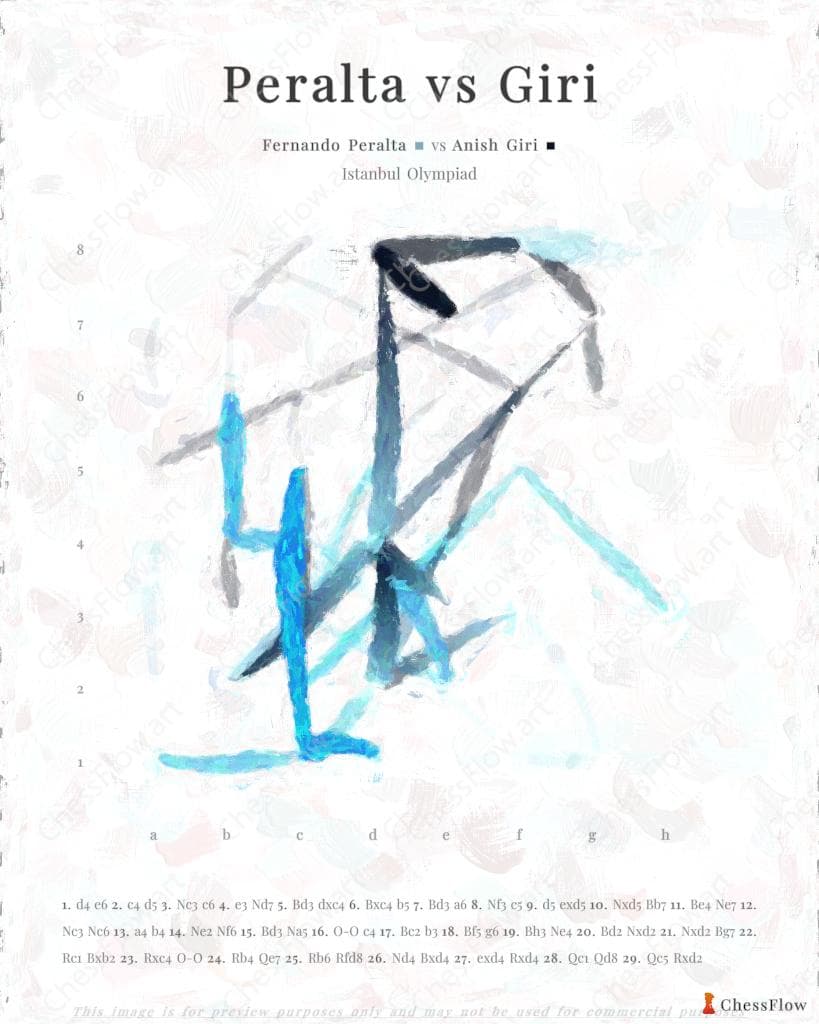
Fernando Peralta vs Anish Giri
Fernando Peralta vs Anish Giri
The Opening Battle Fernando Peralta (2606) faced off against rising Dutch talent Anish Giri (2711) in round 5 of the 2012 Istanbul Olympiad. The game opened with the Queen's Gambit Declined, Semi-Sla...
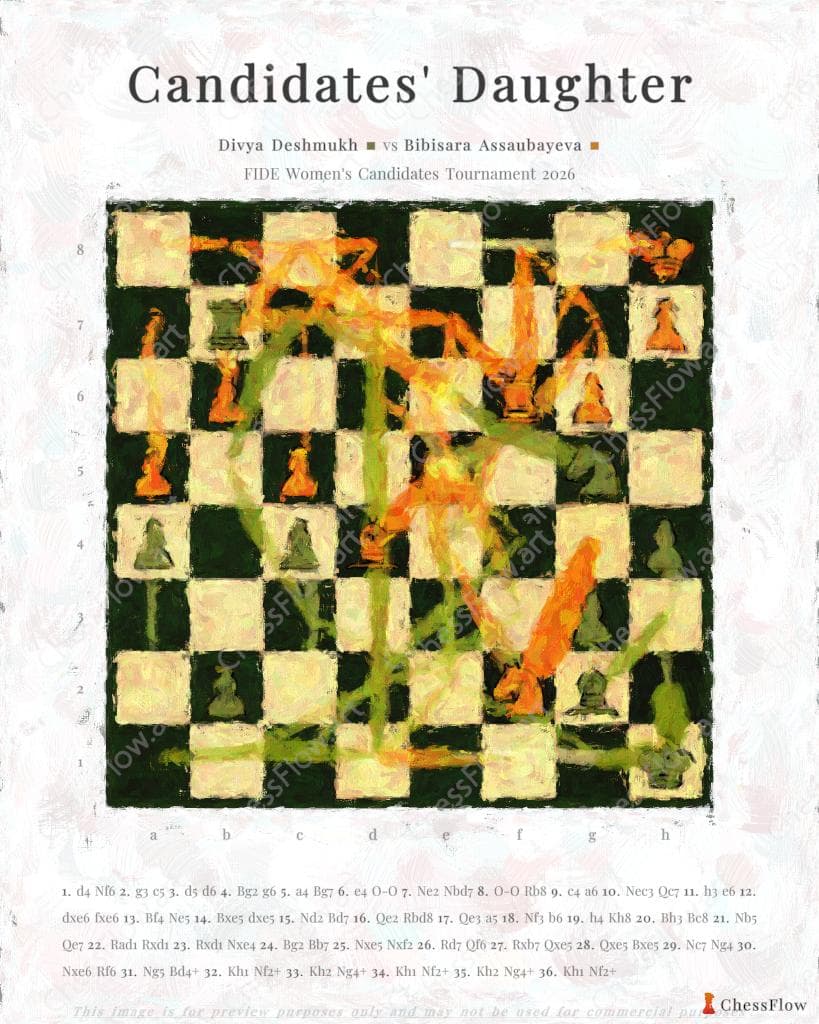
Divya Deshmukh vs Bibisara Assaubayeva
Divya Deshmukh vs Bibisara Assaubayeva
The Final Round Showdown Round 14 of the 2026 FIDE Women's Candidates Tournament delivered a crucial draw between GM Divya Deshmukh (2497) and GM Bibisara Assaubayeva (2516). With Assaubayeva enterin...