2026å¹´å ¨å½å½é 象æ£é¦æ èµï¼ä¸ªäººï¼
Li and Bai Draw in Tarrasch Duel at Chinese Championship
Bamboo Warriors
A Draw That Satisfied Neither Side
Di Li and Bai Jinshi split the point in round 10 of the 2026 Chinese Individual Chess Championship, a game that saw White emerge with a material advantage only to watch it evaporate into a dead-drawn queen ending. The result kept Li tied for third place on 7 points—level with tournament leaders Yu Yangyi and Wei Yi—while Bai remained stuck on 4½ points, his championship hopes effectively over.
The Tarrasch Defense (1.d4 Nf6 2.c4 e6 3.Nf3 d5 4.Nc3 c5 5.cxd5 exd5 6.g3) led to an asymmetrical pawn structure where Black accepted an isolated d-pawn in exchange for piece activity. What followed was a sharp middlegame where both players traded blows, culminating in a position where Li had won a pawn but couldn't convert. The threefold repetition on move 30 felt inevitable—neither player had any realistic winning chances left.
The Opening: Tarrasch Territory
Li chose a quiet approach against Bai's Tarrasch Defense, opting for the fianchetto system rather than the sharper main lines. After 5.cxd5 exd5 6.g3 Nc6 7.Bg2 cxd4 8.Nxd4 Bc5, Black had achieved a comfortable position with active pieces aimed at White's king.
The critical early decision came on move 10. After 9.Nb3 Bb6 10.O-O d4, Bai pushed his isolated pawn forward, transforming it from a weakness into a space-gaining asset. This is the kind of double-edged decision that defines the Tarrasch—Black's d-pawn can become either a target or a battering ram, and Bai was betting on the latter.
Li responded with 11.Na4, immediately targeting the bishop on b6. Rather than retreat passively, this knight maneuver signaled White's intent to simplify and exploit the advanced d-pawn's lack of support.
The Middlegame Liquidation
The game's character changed dramatically between moves 12 and 17. Li began a systematic exchange sequence that stripped the board of minor pieces while picking up Black's central pawn.
12.Bg5 h6 was a necessary concession—Black couldn't allow Bxf6 followed by Bxc6 without first weakening his kingside structure. After 13.Nxb6 axb6 14.Bxf6 Qxf6, White had traded his knight for Black's dark-squared bishop and forced the queen to an awkward square.
The key moment arrived with 15.Bxc6 bxc6 16.Qxd4. Li had achieved his strategic goal: he'd won the d-pawn and damaged Black's pawn structure, leaving Bai with doubled c-pawns and isolated b-pawns. On paper, White should be pressing for a win.
But chess isn't played on paper. After 16...Rd8 17.Qxb6 Ba6, Bai had developed his final piece with tempo, threatening the e2 pawn. The position was materially favorable for White—up a pawn with a better structure—but Black's piece activity provided full compensation.
The Rook Ending That Wasn't
The game's most interesting phase occurred between moves 18 and 25, where both players navigated a series of tactical complications.
18.Rfe1 Qxb2 saw Bai grab the b2 pawn, creating threats against White's first rank. Li couldn't simply defend passively—19.Qxc6 Bxe2 picked up the e-pawn, and suddenly Black had counterplay despite being down material.
The position after 20.Rab1 Qe5 required careful calculation. White had won the c6 pawn but Black's bishop on e2 was awkwardly placed between White's rooks. Li found 21.Nd4, attacking the bishop while centralizing his knight.
What followed was a forced sequence: 21...Rxa2 22.Rxe2 Rxe2 23.Nxe2 Qxe2. The smoke cleared to reveal a queen and rook versus queen and rook ending where Black had equalized completely. The extra pawn White had nursed through the middlegame had vanished.
24.Ra1 Rd1+ 25.Rxd1 Qxd1+ 26.Kg2 left a pure queen ending with equal material. Engines will tell you this is a theoretical draw, and both players knew it too.
The Perpetual
Li made one final attempt to create winning chances with 27.Qe8+ Kg7 28.Qe5+, checking the king and probing for weaknesses. But Bai's king found a safe shuttle between g7 and g8, and after 28...Kg8 29.Qe8+ Kg7 30.Qe5+ Kg8, the threefold repetition was agreed.
Neither player could be satisfied with this outcome. Li, rated 2561 and sitting in a tie for first, needed wins to have any chance at the title. Bai, at 2618 but languishing in 11th place, had been outplayed in the opening and middlegame but escaped with half a point thanks to accurate defensive technique.
The draw meant Li finished the tournament on 7 points—tied with Yu Yangyi and Wei Yi at the top of the standings. However, tiebreaks would ultimately determine the final placings, and Li's third-place finish represented a strong performance for a player rated nearly 150 points below the tournament favorites.
Tournament Context
The 2026 Chinese Individual Chess Championship, held in Xinghua, brought together China's elite players in an 11-round competition. With Olympiad spots on the line, every game carried weight beyond the tournament itself.
Bai Jinshi, 27 years old and rated 2618, entered as one of the higher-rated players but struggled throughout the event. His 4½ points left him in 11th place, a disappointing result for a player who had shown strong form in team events, including decisive wins against Shamsiddin Vokhidov and Alexei Shirov in recent international competitions.
Li Di, meanwhile, punched above his rating. Finishing tied for first on points—alongside top-10 world players Yu Yangyi (2709) and Wei Yi (2732)—demonstrated that the 2561-rated player belonged at the highest level of Chinese chess. His performance earned him consideration for future national team selections.
The tournament was ultimately won by Xu Xiangyu, who entered the final round tied with Kong Xiangrui and secured the title with a crucial result. Both Xu and women's champion Yan Tianqi earned spots on China's team for the 2026 Chess Olympiad.
A Game of Missed Opportunities
This wasn't a game that will appear in opening manuals or tactical puzzle books. It was a practical struggle where White achieved a theoretical advantage but couldn't convert against accurate defense. The Tarrasch Defense lived up to its reputation—Black accepted structural weaknesses in exchange for piece activity, and that activity proved sufficient to hold.
For Bai, the draw represented damage control. For Li, it was a missed opportunity to separate himself from the pack. The position after move 17, with White a pawn up and Black's structure in ruins, was exactly the kind of technical grind that should favor the higher-rated player. That it ended in a repetition says something about the resilience of Black's position—or perhaps about the difficulty of converting small advantages against strong opposition.
The final position, with queens circling each other in perpetual check, is the kind of chess geometry that looks almost artistic when rendered visually. We made this one into a print.
For those following the Chinese championship, this game illustrated why the Tarrasch remains a viable weapon at the highest levels. Black may accept long-term weaknesses, but the resulting piece activity often provides enough counterplay to neutralize White's structural advantages. Li learned that lesson the hard way, watching his extra pawn disappear into a drawn ending where neither side could make progress.
1.d4 Nf6 2.c4 e6 3.Nf3 d5 4.Nc3 c5 5.cxd5 exd5 6.g3 Nc6 7.Bg2 cxd4 8.Nxd4 Bc5 9.Nb3 Bb6 10.O-O d4 11.Na4 O-O 12.Bg5 h6 13.Nxb6 axb6 14.Bxf6 Qxf6 15.Bxc6 bxc6 16.Qxd4 Rd8 17.Qxb6 Ba6 18.Rfe1 Qxb2 19.Qxc6 Bxe2 20.Rab1 Qe5 21.Nd4 Rxa2 22.Rxe2 Rxe2 23.Nxe2 Qxe2 24.Ra1 Rd1+ 25.Rxd1 Qxd1+ 26.Kg2 g6 27.Qe8+ Kg7 28.Qe5+ Kg8 29.Qe8+ Kg7 30.Qe5+ Kg8 1/2-1/2
How would it look as art?


Own a piece of chess history. Transform this legendary game into a unique piece of art for your home or office.
Perfect For
- Unique Gifts for chess enthusiasts and players
- Tournament Prizes that winners will treasure
- Club Decor for chess clubs and gaming spaces
- Office Art showcasing strategic thinking
- Personal Collection of historic games
Turn Your Games Into Art
Whether it's your own game from Chess.com or Lichess, or another historic masterpiece, transform any chess game into a stunning visual artwork.
You might also like
More legendary chess game stories
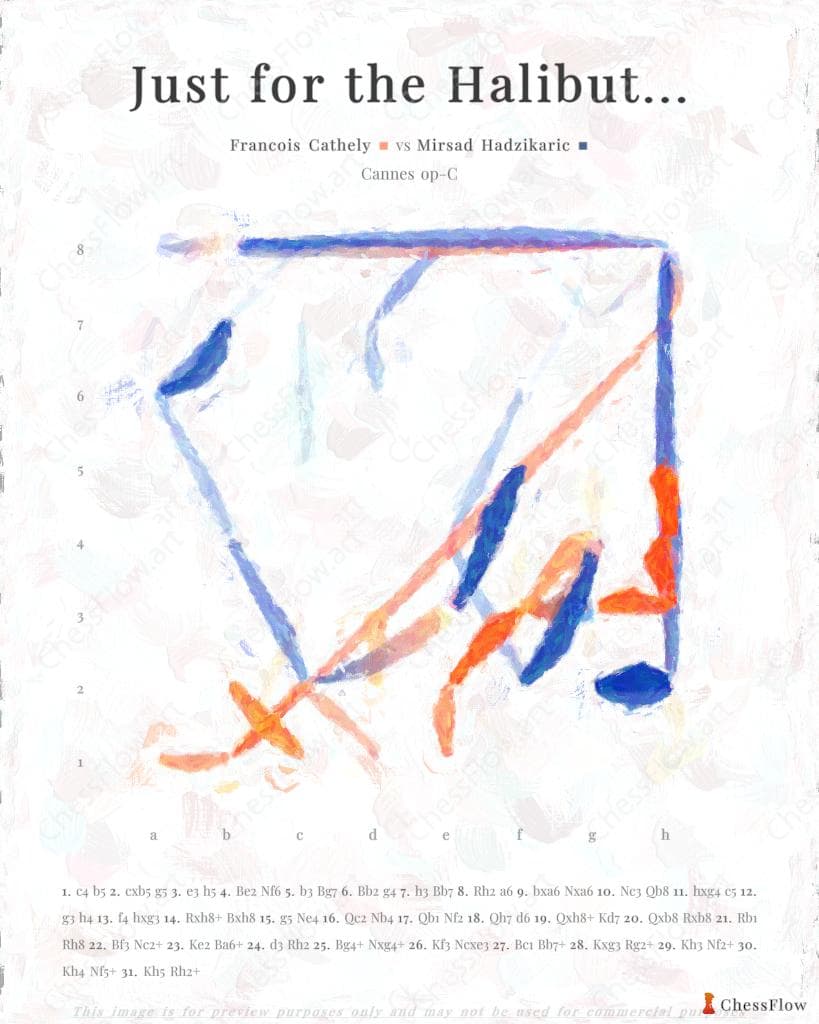
Francois Cathely vs Mirsad Hadzikaric
Francois Cathely vs Mirsad Hadzikaric
The Opening Gambit Francois Cathely and Mirsad Hadzikaric faced off in the 1995 Cannes op-C tournament with an opening that immediately signaled chaos was coming. After 1.c4 b5, Black's Polish Defens...
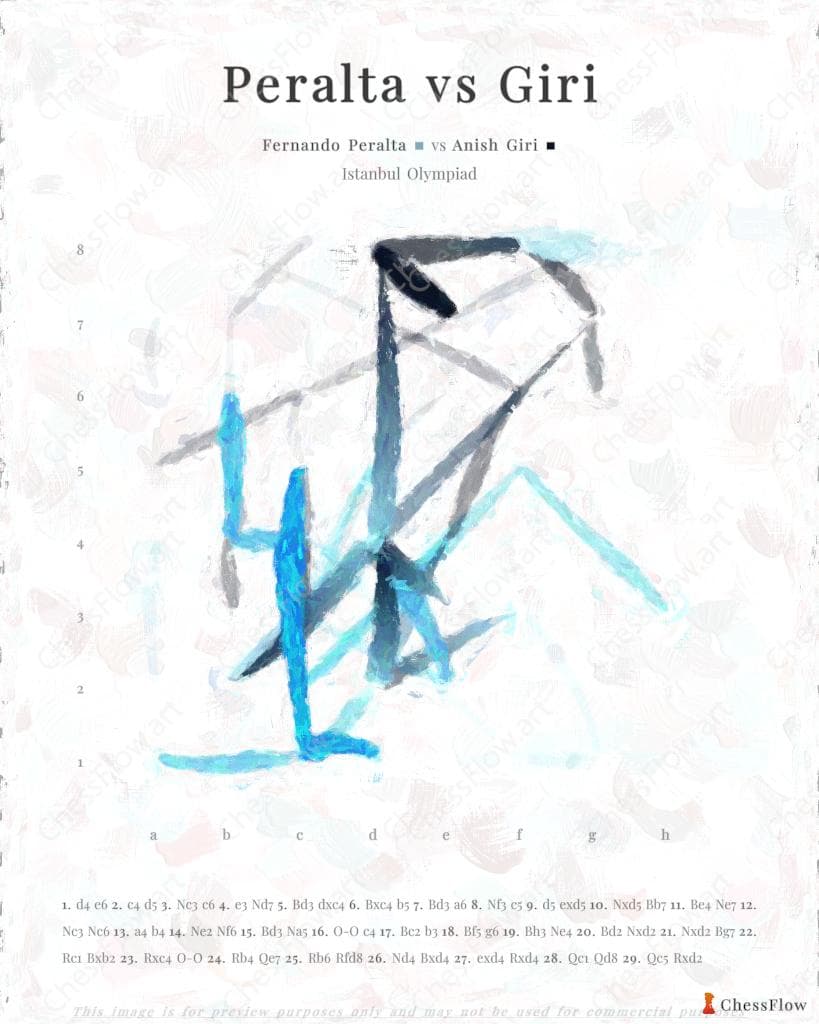
Fernando Peralta vs Anish Giri
Fernando Peralta vs Anish Giri
The Opening Battle Fernando Peralta (2606) faced off against rising Dutch talent Anish Giri (2711) in round 5 of the 2012 Istanbul Olympiad. The game opened with the Queen's Gambit Declined, Semi-Sla...
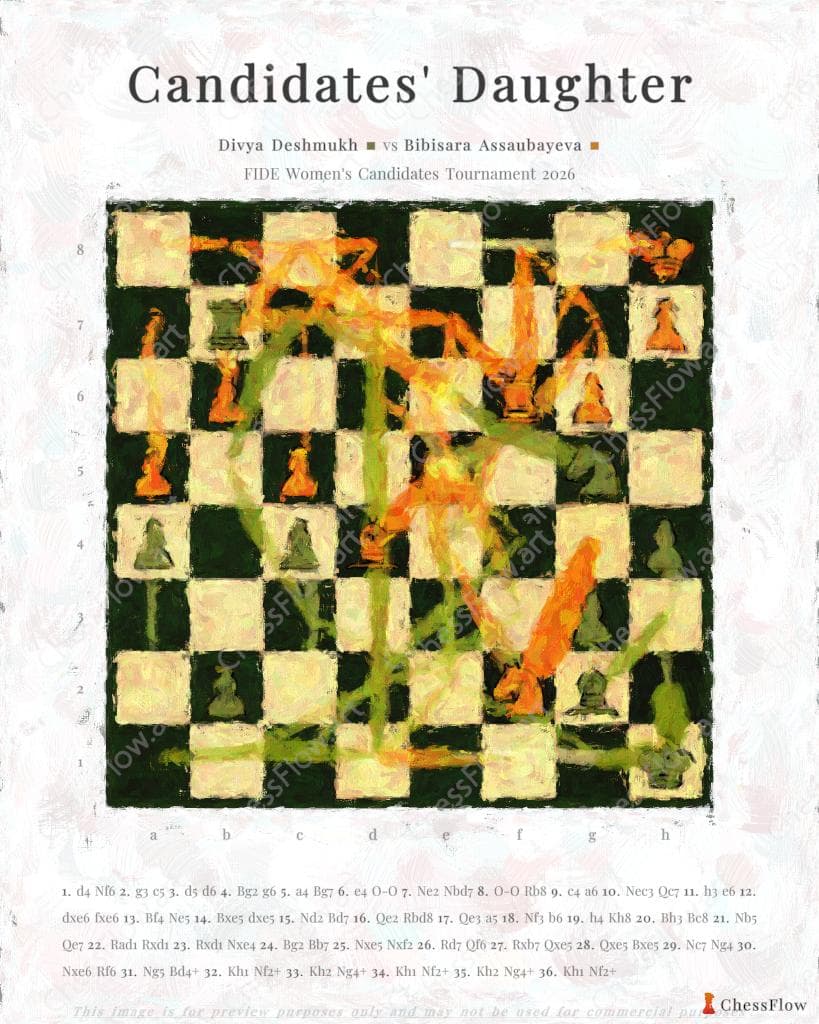
Divya Deshmukh vs Bibisara Assaubayeva
Divya Deshmukh vs Bibisara Assaubayeva
The Final Round Showdown Round 14 of the 2026 FIDE Women's Candidates Tournament delivered a crucial draw between GM Divya Deshmukh (2497) and GM Bibisara Assaubayeva (2516). With Assaubayeva enterin...