35th Annual Chicago Open
Liang, Jacobson Draw in Chicago Open Final Round Berlin

Windy City Gambit
Liang and Jacobson Split the Point in Final Round Showdown
Awonder Liang and Brandon Jacobson, both entering the final round of the 35th Annual Chicago Open with 6.0/8, agreed to a draw in a Berlin Defense that never caught fire. The result left both players at 6.5/9, with Jacobson finishing on 5.5 points in the final standings alongside GM Jianchao Zhou and IM Tianqi Wang, while Liang ended on 5.0 points after taking two half-point byes earlier in the event.
Neither player could afford a loss. Both needed a result. What they got was a theoretical Berlin that traded into an equal endgame before move 20, the kind of game where the handshake feels inevitable long before it happens.
The Anti-Berlin: A Quiet Choice for a Tense Moment
Liang opened with 1.e4 e5 2.Nf3 Nc6 3.Bb5 Nf6 4.d3, steering into the Anti-Berlin rather than allowing the notoriously drawish Berlin Wall endgame. The choice made sense—Liang, rated 110 points higher at 2704 to Jacobson's 2594, presumably wanted to keep pieces on the board and create winning chances. But Jacobson had clearly prepared for this.
After 5.Bxc6 dxc6, Liang surrendered the bishop pair early, a strategic concession that left him with a slight structural edge (the doubled c-pawns) but no clear path to an advantage. The evaluation sat at +0.06—essentially dead equal.
Jacobson responded with 6...Be6, developing naturally and preparing to contest the center. The game followed a logical pattern: 7.O-O Qd6 8.Nb3 Bb6 9.Bd2 Nd7. By move 10, both players had castled, developed their pieces, and the position was as balanced as the engine suggested.
Liang Probes, Jacobson Holds
The first real attempt to create imbalance came with 10.Ng5, Liang looking to provoke a weakness or trade off the bishop. Jacobson responded with 10...Bxb3, willingly giving up the bishop pair but eliminating White's well-placed knight and damaging White's pawn structure after 11.axb3.
This was the critical decision point. Jacobson chose solidity over dynamism, accepting that his position might be slightly worse but eminently holdable. The engine agreed—dead zero.
After 11...f6 12.Nf3 O-O, the knight retreated and Black completed development. Liang tried 13.Nh4, eyeing the f5 square and keeping some pressure, but Jacobson countered with 13...Nc5, targeting the weakened b3 pawn and preparing to simplify.
The queen trade came quickly: 14.Qg4 Qd7 15.Qxd7 Nxd7. With queens off the board and the evaluation hovering around +0.40, Liang had a microscopic edge—the kind that exists in the engine's assessment but means nothing in practical play. Both players had over 50 minutes on their clocks. Neither was under pressure.
The Rating Gap That Didn't Matter
On paper, this should have been Liang's game to win. He's the higher-rated player by a significant margin, fresh off sweeping the 2026 Charlotte Open with 5.5/6 and coming off a competitive 12-game classical match against Hans Niemann in Paris (where he trailed 2-0 after eight games but showed his fighting spirit). Jacobson, meanwhile, had just delivered a strong 8/9 performance at the Grenke Chess Festival to tie for first in the classical A-Open.
But ratings don't play chess—positions do. And this position, after the queen trade, offered Liang nothing to work with. The doubled b-pawns were ugly but not weak. Black's knight could dance between c5 and d7. The bishops were of opposite colors, which in an endgame typically favors the defender.
16.g3 Rfd8 was the last move recorded before the draw was agreed. The position was sterile. Engines called it +0.46—technically a slight White edge, but the kind of edge that requires Black to make multiple mistakes to convert. Jacobson wasn't going to make mistakes in a position this simple.
The Human Calculation
Here's the thing about final-round games in open tournaments: the math matters more than the chess. Both players entered with 6.0/8. A draw guaranteed them solid prize money and a respectable finish. A loss would have been catastrophic—dropping from contention entirely while the winner took home a much larger share.
Liang, in particular, had an unusual tournament. The standings show him with two unplayed games (marked as "U---"), suggesting he took byes in rounds 5 and 7. Whether this was planned or circumstantial, it meant he entered the final round having played fewer games than his competitors. A draw against a 2594-rated GM was a reasonable result.
Jacobson, for his part, had fought through a loss in round 4 (to board 2, likely the tournament leader) and recovered with wins in rounds 5 and 7. He wasn't going to risk that comeback on a speculative attack against a 2700+ player who had shown no weaknesses.
Berlin Defense: The Great Equalizer
The Berlin has a reputation for a reason. Since Kramnik used it to neutralize Kasparov's 1.e4 in their 2000 World Championship match, it's become the go-to choice for players seeking a solid, low-risk response to the Ruy Lopez. The Anti-Berlin (4.d3) was supposed to avoid the most drawish lines, but as this game showed, Black can still achieve equality with accurate play.
The key moment was probably 5.Bxc6 dxc6—Liang's decision to trade the bishop immediately. This avoided the main lines but also gave up any pretense of fighting for an advantage. Jacobson's structure was doubled but solid, and his pieces found natural squares.
Compare this to the wild games that can arise from the Italian or the Scotch, and you see why elite players keep returning to the Berlin. It's not exciting, but it's effective.
What This Means for Both Players
Jacobson's 5.5/9 finish, tied for third through sixth place, continues his strong 2026 form. After his Grenke success, he's establishing himself as one of the most consistent American GMs in the 2550-2600 range—the kind of player who rarely beats the super-GMs but almost never loses to players below him.
Liang's 5.0/9 is a more modest result, but context matters. He entered as the top seed (or close to it) and was likely targeted by opponents eager to take down a 2700. His two byes suggest the tournament wasn't his primary focus, and a draw against Jacobson in the final round is hardly a disappointment.
The Chicago Open itself continues to attract strong American talent. With multiple GMs finishing on 5.5 points and the top finishers pushing toward 6.0, the event maintains its reputation as one of the premier open tournaments in the Midwest.
A Game of Mutual Respect
Not every chess game produces fireworks. Sometimes two strong players sit down, recognize that neither can outplay the other in the given position, and agree to split the point. That's what happened here.
Liang tried to create something with the Anti-Berlin. Jacobson neutralized it with accurate play. The queen trade simplified into an endgame where neither side had winning chances. The draw was agreed.
This one won't make highlight reels, but the symmetry of the final position—both players with their pieces developed, neither with a weakness to target—has a certain aesthetic appeal. We turned this one into a print anyway.
For those following American chess, the takeaway is simple: Jacobson is playing well, Liang remains a force in open tournaments, and the Chicago Open delivered another competitive final round. Sometimes that's enough.
The 35th Annual Chicago Open concluded with the expected mix of decisive games and strategic draws. Follow along with ChessFlow for more coverage of American tournament chess.
1.e4 e5 2.Nf3 Nc6 3.Bb5 Nf6 4.d3 Bc5 5.Bxc6 dxc6 6.Nbd2 Be6 7.O-O Qd6 8.Nb3 Bb6 9.Bd2 Nd7 10.Ng5 Bxb3 11.axb3 f6 12.Nf3 O-O 13.Nh4 Nc5 14.Qg4 Qd7 15.Qxd7 Nxd7 16.g3 Rfd8 17.Kg2 Nc5 18.Bc3 Ne6 19.Nf5 g6 20.Ne3 h5 21.Nc4 g5 22.Rh1 h4 23.Bd2 Nd4 24.Rhc1 Ne2 25.Rf1 Nd4 26.Ne3 Kf7 27.Bc3 Rh8 28.Bxd4 Bxd4 29.Ra2 Bxe3 1/2-1/2
How would it look as art?


Own a piece of chess history. Transform this legendary game into a unique piece of art for your home or office.
Perfect For
- Unique Gifts for chess enthusiasts and players
- Tournament Prizes that winners will treasure
- Club Decor for chess clubs and gaming spaces
- Office Art showcasing strategic thinking
- Personal Collection of historic games
Turn Your Games Into Art
Whether it's your own game from Chess.com or Lichess, or another historic masterpiece, transform any chess game into a stunning visual artwork.
You might also like
More legendary chess game stories

Yi Wei vs Andrey Esipenko
Yi Wei vs Andrey Esipenko
Wei's First Strike Wei Yi finally broke through at the 2026 FIDE Candidates Tournament, defeating Andrey Esipenko 1-0 in round 13 with a sharp attacking game that emerged from the normally solid Petr...
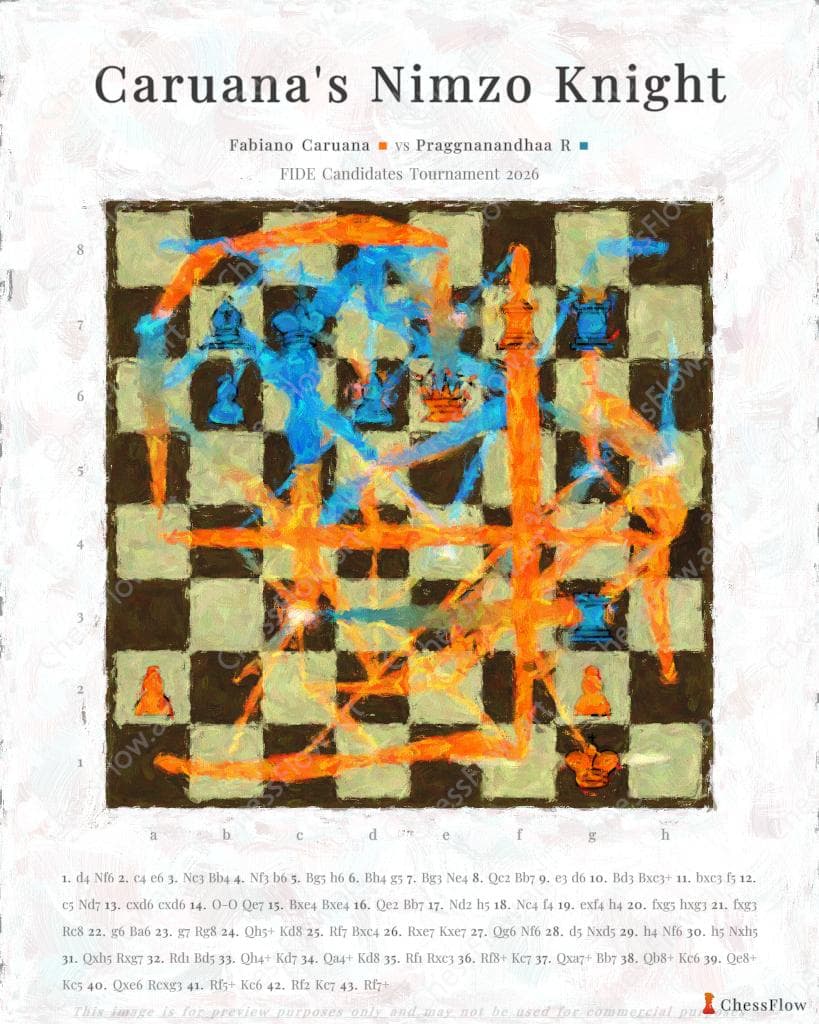
Fabiano Caruana vs Praggnanandhaa R
Fabiano Caruana vs Praggnanandhaa R
The Opening Choice Fabiano Caruana opened with 1.d4 against Praggnanandhaa in round 13 of the 2026 FIDE Candidates Tournament, leading to the Nimzo-Indian Defense after 1.d4 Nf6 2.c4. The American gr...
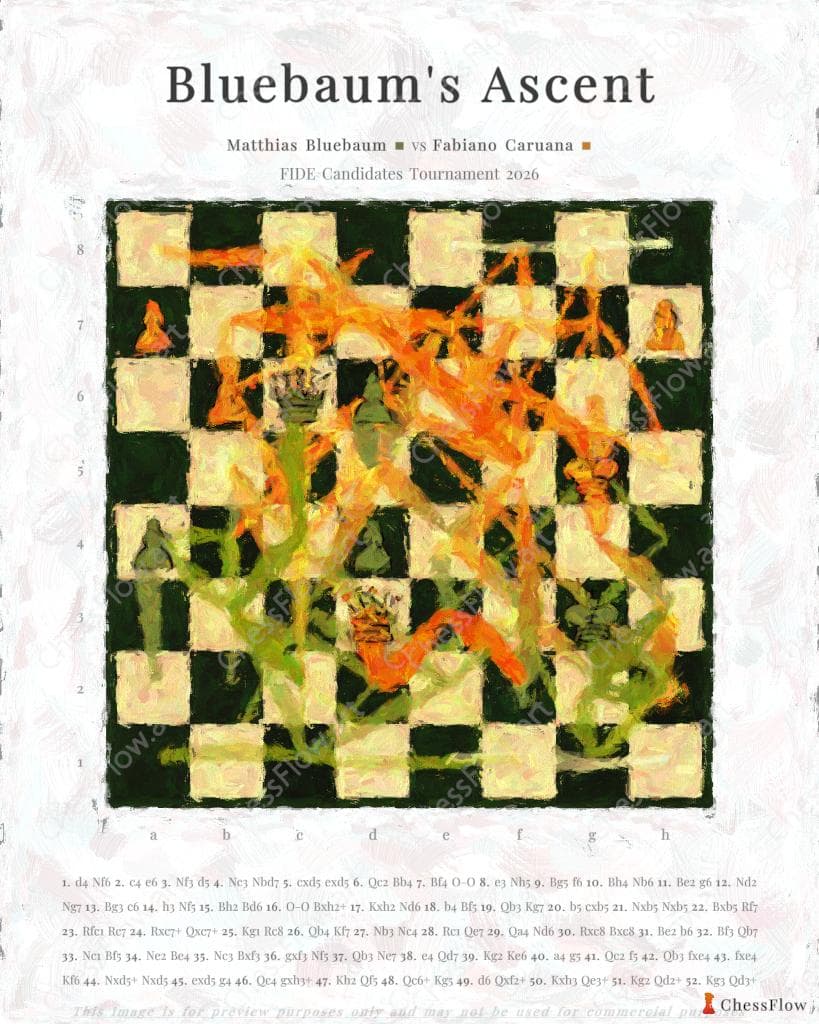
Matthias Bluebaum vs Fabiano Caruana
Matthias Bluebaum vs Fabiano Caruana
A Solid Draw in the Queen's Gambit Matthias Bluebaum held his ground against Fabiano Caruana in round 12 of the 2026 FIDE Candidates Tournament, earning a draw with the white pieces in a Queen's Gamb...