1er Open International de Lecci
Martirosyan Draws Cornette After Wild Exchange Sacrifice in Lecci


Sicilian Corsica
Martirosyan Survives Cornette's Exchange Sacrifice in Wild Corsican Draw
Haik Martirosyan walked away with half a point he probably didn't expect to keep. In round seven of the 1er Open International de Lecci, the Armenian grandmaster found himself under serious pressure after French GM Matthieu Cornette uncorked an exchange sacrifice that generated perpetual check threats Martirosyan couldn't escape. The game ended in a draw by repetition on move 27, but not before White's king was chased across the board like a tourist who'd wandered into the wrong neighborhood.
The result leaves both players in the hunt at this 50-player open in Corsica, though neither will look back on this game as their finest work. Martirosyan, rated 2651 and the highest-rated Armenian player as of June 2026, came into the round as the clear favorite. Cornette, fresh off a strong showing at the Reykjavik Open where he scored 7/9 for a 2617 performance rating, had other ideas.
The Sicilian Gets Personal
The opening carried a certain poetic justice. Playing the Sicilian Defense in Corsica — the island that gives the "Sicilian Corsica" variation its name — Cornette opted for 1.e4 c5 2.Nf3 Nc6 3.Bb5, a Rossolimo-style approach that White sometimes uses to avoid the theoretical labyrinths of the Open Sicilian. Martirosyan's 3...e5 was a principled response, grabbing central space and preparing to develop actively.
The early middlegame saw both players maneuvering for advantage. After 7.Bxc6 dxc6, Black accepted doubled pawns in exchange for the bishop pair and open lines. The position remained balanced through the early teens, with Cornette building pressure on the kingside while Martirosyan tried to consolidate his structural advantage.
Then came the moment that transformed the game.
Cornette's Exchange Sacrifice
On move 17, with the position still looking manageable for White, Cornette played 17...Rxf3, giving up the exchange — a rook for a knight — in exchange for a vicious attack against Martirosyan's exposed king. The calculation was straightforward in concept but terrifying in practice: Black's queen and remaining pieces would generate enough threats to either win material back or force a draw.
Martirosyan had to respond with 18.gxf3, opening the g-file and creating the very weaknesses Cornette was counting on. The follow-up 18...Qh4 immediately targeted both the f3-pawn and the g2-square, setting up what would become an inescapable pattern.
After 19.fxg4 Qxg4+ 20.Kf1 Qh3+, the Armenian grandmaster's king began its uncomfortable journey. The problem wasn't that Martirosyan was losing — engines would likely assess the position as roughly equal with best play — but that "best play" in positions like this means finding a series of only-moves while your opponent gets to throw punches.
The King Hunt That Ended in Stalemate
What followed was a textbook example of the gap between engine evaluation and human experience. Computers might call the position holdable, but no one wants to defend a position where their king is getting checked every other move with the clock ticking.
21.Ke1 was forced, stepping toward the center to escape the checks. But after 21...Rd8 22.Qc2 Qg4, Cornette's queen continued to dominate the light squares. The French grandmaster had traded material for activity, and now Martirosyan had to find a way to either stabilize or accept the perpetual.
The critical sequence came with 23.Kf1 Qf3 24.Kg1 Qg4+ 25.Kf1 Qf3 26.Kg1 Qg4+ 27.Kf1 Qf3. The repetition was agreed, with neither player able to deviate without risking everything. Martirosyan couldn't find a way to escape the checks without allowing a devastating follow-up, and Cornette couldn't find a way to increase the pressure without overextending.
The final position is almost absurd: White has an extra exchange, but his king is permanently stuck in a checking pattern. The rook on e2 can't help, the queen on c2 is tied to defense, and any attempt to break the pattern would likely lead to worse.
A Draw That Felt Like a Win for Black
From Cornette's perspective, this was a successful gamble. Facing a player nearly 100 rating points higher, he found a way to generate complications that neutralized White's advantage. The exchange sacrifice on move 17 wasn't objectively winning, but it was practically dangerous — exactly the kind of decision that makes open tournaments unpredictable.
For Martirosyan, the half-point keeps him in contention at 6/7, tied for seventh place in the event. The Armenian GM had been on a strong run, including wins over Sohan Belkaid, Eytan Rozen, and Sebastien Maze in earlier rounds. But this game was a reminder that even top-100 players can find themselves in uncomfortable positions when an opponent is willing to sacrifice material for activity.
Cornette's tournament has been more uneven — he sits at 5/7 after this round — but games like this one show why he remains a dangerous opponent. His peak rating of 2620 and his French U18 and U20 Championship titles weren't accidents; he knows how to create problems.
The Opening Question
One interesting aspect of this game is the opening choice. The Sicilian Rossolimo with 3.Bb5 is supposed to give White a safe, positional game — the kind of chess where the higher-rated player can grind out an advantage without taking excessive risks. But Cornette's aggressive handling of the Black pieces turned that script on its head.
The sequence 1.e4 c5 2.Nf3 Nc6 3.Bb5 e5 4.O-O Bd6 5.d3 Nf6 6.Be3 a6 7.Bxc6 dxc6 is well-known theory, but the middlegame that followed showed how quickly things can go wrong for White if Black is willing to sacrifice material. Martirosyan's 8.a4 and 9.a5 were standard prophylactic moves, but they didn't address the fundamental problem: Black's pieces were more active, and the f5-break was coming.
After 10...f5 11.exf5 Bxf5, Cornette had achieved the kind of dynamic position he was looking for. The bishop on f5 was well-placed, the f-file was open, and White's extra pawn wasn't worth much against Black's piece activity.
What This Means Going Forward
The 1er Open International de Lecci runs through May 17, with two rounds remaining after this one. Martirosyan's draw keeps him in the top group, but he'll need to win at least one of his remaining games to have a realistic shot at first place. The current leader, Rinat Jumabayev of Kazakhstan, sits at 6.5/7 after a dominant performance that included wins over Leon Luke Mendonca and Nico Chasin.
For Cornette, the draw is a confidence boost heading into the final rounds. Holding a 2651-rated opponent with the Black pieces — and doing so in style — is exactly the kind of result that can spark a strong finish.
The tournament has drawn a strong field for a regional open, with several 2600+ players competing alongside local talent. Marc'Andria Maurizzi, the young French star, is also on 6/7, setting up potential drama in the final rounds.
The position after move 17 — with the exchange sacrifice hanging in the air — is the kind of thing you hang on a wall. ChessFlow turned this one into a print.
A Game Worth Remembering
This wasn't a perfect game from either player. Martirosyan's handling of the middlegame allowed Cornette to generate more activity than White should have permitted, and Cornette's decision to take the perpetual rather than press for more suggests he wasn't entirely confident in his attack's objective strength.
But imperfect games are often the most interesting ones. The exchange sacrifice, the king hunt, the repetition — these are the moments that make chess memorable. Not every game ends with a checkmate or a resignation. Sometimes the most dramatic result is a draw where both players walk away feeling like they escaped with their lives.
The Lecci Open continues, and both Martirosyan and Cornette will be looking to build on this result. For now, though, this game stands as a reminder that rating points don't always tell the whole story. Sometimes the lower-rated player finds a way to make the position uncomfortable, and sometimes a draw is the best either side can hope for.
1.e4 c5 2.Nf3 Nc6 3.Bb5 e5 4.O-O Bd6 5.d3 Nf6 6.Be3 a6 7.Bxc6 dxc6 8.a4 O-O 9.a5 Ng4 10.Bd2 f5 11.exf5 Bxf5 12.Nc3 c4 13.Ne4 cxd3 14.cxd3 Kh8 15.Re1 Bxe4 16.dxe4 Bc5 17.Re2 Rxf3 18.gxf3 Qh4 19.fxg4 Qxg4+ 20.Kf1 Qh3+ 21.Ke1 Rd8 22.Qc2 Qg4 23.Kf1 Qf3 24.Kg1 Qg4+ 25.Kf1 Qf3 26.Kg1 Qg4+ 27.Kf1 Qf3 1/2-1/2
How would it look as art?


Own a piece of chess history. Transform this legendary game into a unique piece of art for your home or office.
Perfect For
- Unique Gifts for chess enthusiasts and players
- Tournament Prizes that winners will treasure
- Club Decor for chess clubs and gaming spaces
- Office Art showcasing strategic thinking
- Personal Collection of historic games
Explore more
Turn Your Games Into Art
Whether it's your own game from Chess.com or Lichess, or another historic masterpiece, transform any chess game into a stunning visual artwork.
You might also like
More legendary chess game stories
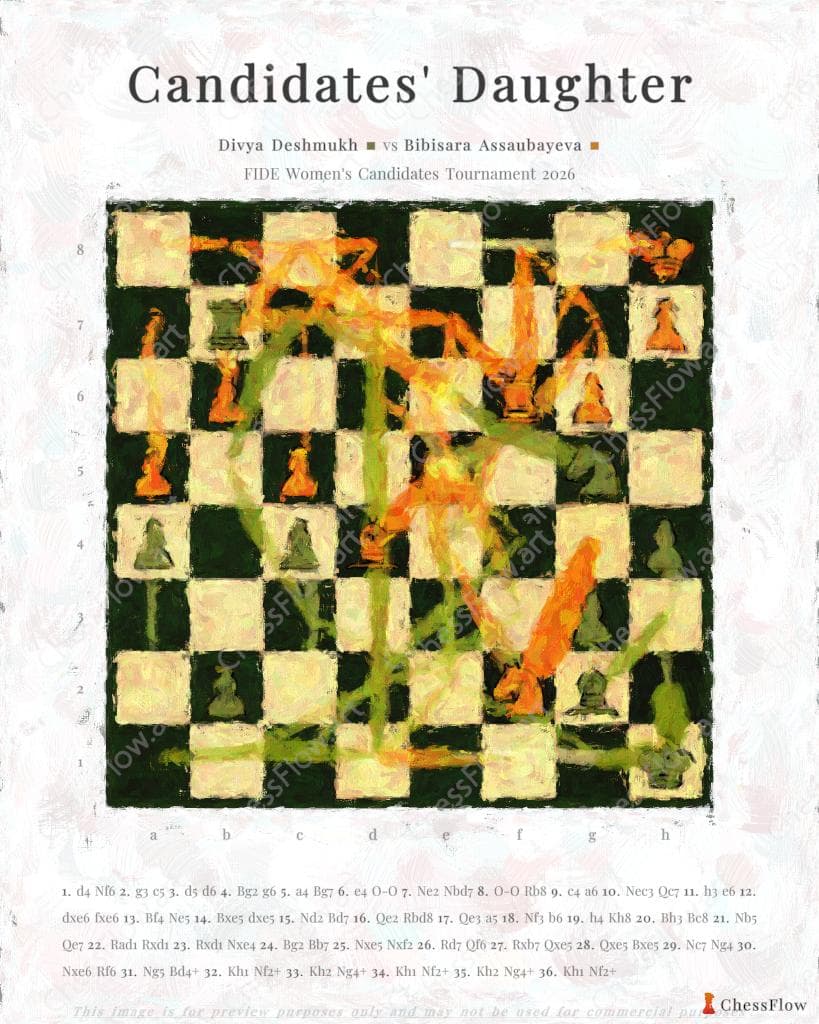
Divya Deshmukh vs Bibisara Assaubayeva
Divya Deshmukh vs Bibisara Assaubayeva
The Final Round Showdown Round 14 of the 2026 FIDE Women's Candidates Tournament delivered a crucial draw between GM Divya Deshmukh (2497) and GM Bibisara Assaubayeva (2516). With Assaubayeva enterin...
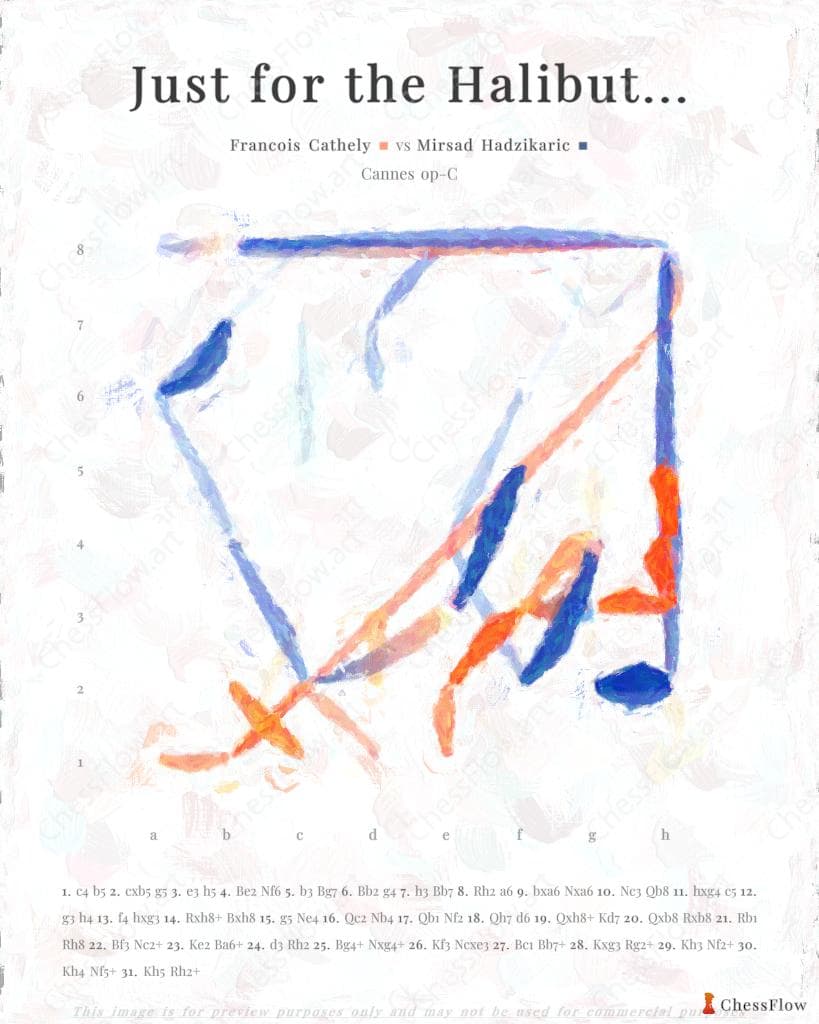
Francois Cathely vs Mirsad Hadzikaric
Francois Cathely vs Mirsad Hadzikaric
The Opening Gambit Francois Cathely and Mirsad Hadzikaric faced off in the 1995 Cannes op-C tournament with an opening that immediately signaled chaos was coming. After 1.c4 b5, Black's Polish Defens...
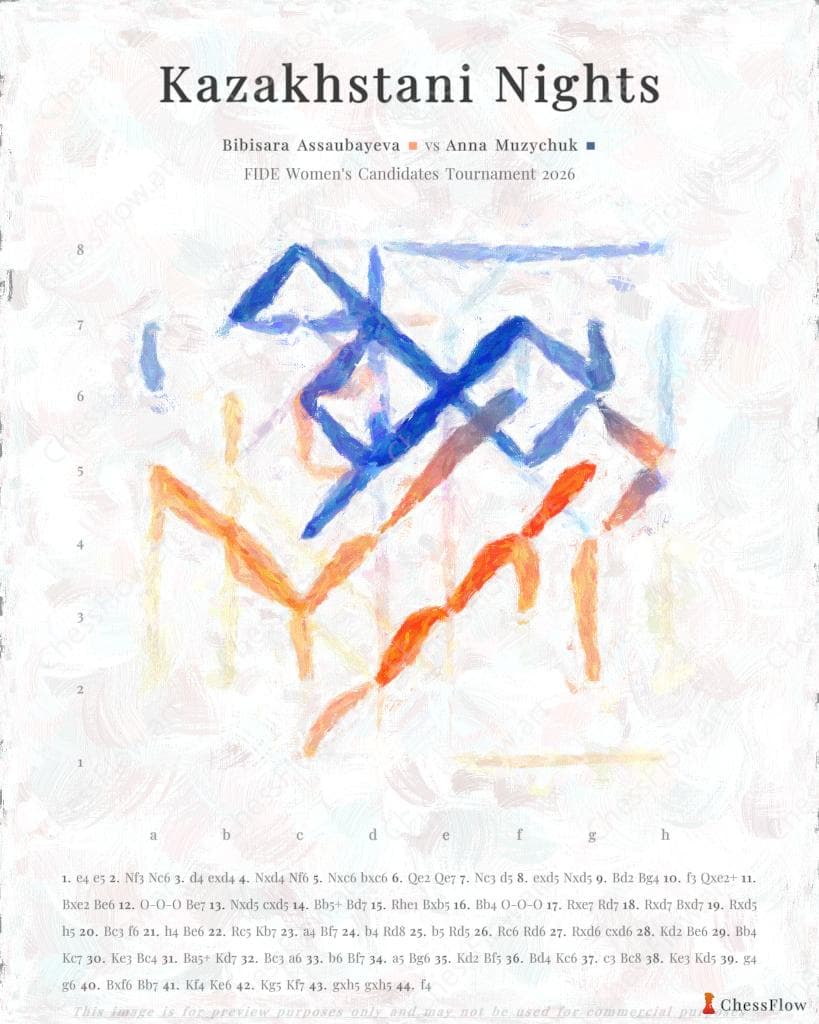
Bibisara Assaubayeva vs Anna Muzychuk
Bibisara Assaubayeva vs Anna Muzychuk
Assaubayeva Strikes Back in Round 13 Bibisara Assaubayeva bounced back from recent struggles to defeat Anna Muzychuk in round 13 of the FIDE Women's Candidates Tournament 2026. The Kazakhstani GM, ra...