Championnat de France des Clubs 2026 | Elimination | Groupe B
Martirosyan and Eljanov Draw in 13 Moves at French Clubs 2026


Martirosyan's Lament
A Draw That Felt Like a Question Mark
Haik Martirosyan and Pavel Eljanov shook hands after just 13 moves in Round 6 of the French Club Championship elimination stage, splitting the point in what can only be described as a game that never really started. The Armenian grandmaster, playing white for Asnieres - le Grand Echiquier, steered the game into the Semi-Tarrasch endgame variation, and after a symmetrical exchange of central pawns and an early queen trade, both players decided they'd seen enough.
The result leaves both teams with a quiet board on this particular pairing, though neither player can be thrilled with the outcome. At 2651 and 2664 Elo respectively, Martirosyan and Eljanov are both seasoned competitors who've been through enough club matches to know when a draw serves the team's interests. But there's a difference between a hard-fought draw and one that ends before any real tension develops.
The Semi-Tarrasch: Theory's Shortest Path to Peace
The game opened with the standard Queen's Gambit move order: 1.d4 Nf6 2.c4 e6 3.Nf3 d5 4.Nc3 c5, reaching the Semi-Tarrasch Defense. This opening has a reputation for leading to dynamic, unbalanced positions—or, if both players choose, to sterile equality almost immediately.
Martirosyan went for the latter. After 5.cxd5, he captured on d5, and Eljanov responded with 5...cxd4, the move that signals willingness to enter the simplified endgame variation. The sequence continued: 6.Qxd4 exd5 7.e4, and now the critical moment arrived. Black played 7...dxe4, accepting the pawn trade that opens the position but also accelerates the exchange of queens.
8.Qxd8+ Kxd8 arrived on move eight, and suddenly we're in an endgame where Black's king has lost the right to castle but stands reasonably safe in the center. The engine evaluation throughout this sequence hovers between +0.10 and +0.20—essentially zero. Both players knew exactly what they were getting into.
The Brief Middle Phase
With queens off the board, Martirosyan tried to generate some activity with 9.Ng5, attacking the e4 pawn and probing Black's setup. This is the standard try in this position—White hopes to create some awkwardness around Black's king or win back the pawn with interest.
Eljanov responded calmly with 9...Be6, defending the pawn and developing simultaneously. The bishop on e6 is a solid piece in these structures, and it immediately challenges White's knight on g5.
Martirosyan continued with 10.Bb5, pinning nothing but preparing to retreat the bishop to a4 if challenged. After 10...a6 11.Ba4 Nbd7, Black has completed his development on the queenside. The knight on d7 supports the eventual ...Nc5, which would attack the bishop on a4 and give Black a comfortable position.
12.O-O castled White's king to safety, and after 12...Nc5, Eljanov's knight arrives on its ideal square. The position is completely level. Both players have developed harmoniously, there are no weaknesses to attack, and the pawn structure is symmetrical.
13.Rd1+ Ke7 was the final move of the game. White checks, Black's king steps to e7, and... that's it. The players agreed to a draw.
What Martirosyan Might Have Tried
The title of this game—"Martirosyan's Lament"—suggests some frustration, and it's easy to see why. With the white pieces against a slightly lower-rated opponent (though only 13 points separate them), Martirosyan might have hoped for more.
But what more was there? The position after move 13 offers White no real prospects. The engine gives it as exactly 0.00. Black's king on e7 is perfectly safe—there are no open files leading to it, no weaknesses in the pawn structure, and Black's pieces are well-coordinated.
The Semi-Tarrasch endgame variation is known precisely for this quality: if Black knows the theory and plays accurately, White struggles to create any imbalance. Martirosyan chose this line, presumably hoping Eljanov would deviate or make an inaccuracy. When neither happened, the game simply... ended.
In club team competitions, this kind of draw isn't unusual. The team match context matters enormously. If Asnieres - le Grand Echiquier had other boards where they were pressing for wins, a quick draw on board one might make strategic sense. If Aix-En-Provence needed a draw to secure a match result, Eljanov's solid play accomplished exactly that.
The Players' Recent Form
Martirosyan, born in 2000, has had an interesting trajectory. He peaked at 2708 in November 2023, making him Armenia's top-rated player at the time. Since then, his rating has fluctuated—he was down to 2626 in March 2026 before climbing back to 2651 by June. The 2026 European Championship saw him finish with 8/11, a strong result that placed him 13th overall with a performance rating of 2667.
Eljanov, the Ukrainian veteran born in 1983, has been on a remarkable run in 2026. According to ChessBase's April rating report, he gained 23 points in a single rating period, one of the biggest jumps among top-100 players. He climbed from around 2659 to 2682 before settling at 2664 in the June list. At 42 years old, Eljanov remains a formidable opponent who has seen every opening and knows exactly when to fight and when to take a safe half-point.
The two players had faced each other in Round 5 as well, though on different boards for their respective teams. That round saw Martirosyan score a win while Eljanov drew. Coming into Round 6, perhaps Eljanov was content with equality, and Martirosyan couldn't find a way to disturb it.
The Opening Choice Reconsidered
If Martirosyan wanted a real fight, the Semi-Tarrasch endgame variation was perhaps not the ideal vehicle. The line has been analyzed to exhaustion, and players at this level know every nuance. The queen trade on move 8 is essentially forced once you enter this variation, and after that, White's winning chances are minimal against accurate defense.
Alternative approaches exist. White can delay cxd5, play Bg5 systems, or choose entirely different setups against the Semi-Tarrasch. The fact that Martirosyan went straight into the endgame variation suggests he was either testing Eljanov's preparation or was himself content with a draw.
The engine evaluations throughout the game tell the story: never above +0.22, and that was on move 9 after Ng5. By the time the draw was agreed, it was dead level. No inaccuracies from either side, no moments where one player had a real chance to press. Just 13 moves of theory, followed by a handshake.
What This Draw Means
In the context of the French Club Championship elimination stage, a single draw on one board rarely decides anything. Team matches are won and lost across multiple boards, and the real drama often happens on the lower boards where rating differences are larger and preparation less thorough.
For Martirosyan, this game adds nothing to his rating or his reputation. He played solid, theoretical chess and got a solid, theoretical result. For Eljanov, it's the same—a professional draw against a strong opponent, nothing more.
The game itself, despite its brevity, does have a certain aesthetic quality. The symmetry of the pawn structure, the clean development, the way both players navigated the opening with precision—there's something almost meditative about it. We turned this one into a print, actually. Sometimes the quiet games have their own beauty.
Looking Ahead
Both Martirosyan and Eljanov will continue competing in the club championship, and both will likely face more critical games as the elimination rounds progress. Martirosyan, at 25, is still building toward what could be his peak years. His 2023 breakthrough to 2700+ showed his potential; whether he can return to those heights remains to be seen.
Eljanov, meanwhile, continues to defy the notion that chess is a young person's game. His recent rating gains prove that experience and deep preparation can still compete with youthful energy and calculation speed. At the highest levels, knowing when to fight and when to draw is itself a skill.
This particular game won't be remembered as a classic. It won't appear in opening manuals except perhaps as a footnote confirming that the Semi-Tarrasch endgame variation leads to equality with best play. But in the larger story of both players' careers and the French Club Championship as a whole, it's simply one more data point—a quiet draw in a long season of chess.
1.d4 Nf6 2.c4 e6 3.Nf3 d5 4.Nc3 c5 5.cxd5 cxd4 6.Qxd4 exd5 7.e4 dxe4 8.Qxd8+ Kxd8 9.Ng5 Be6 10.Bb5 a6 11.Ba4 Nbd7 12.O-O Nc5 13.Rd1+ Ke7 14.Bc2 Rc8 15.Be3 h6 16.Bxc5+ Rxc5 17.Ngxe4 Nxe4 18.Bxe4 b6 19.Nd5+ Bxd5 20.Bxd5 g5 21.Rd3 Bg7 22.Re1+ Kf8 23.b4 Rc3 24.Rdd1 Rc7 25.Rc1 Rxc1 26.Rxc1 Ke7 27.Rc7+ Kd6 28.Rxf7 Re8 29.Bc4 b5 30.Bf1 Re7 31.Rf3 Bd4 32.g3 Rc7 33.Ra3 Rc6 34.Kg2 Ke5 35.Be2 Rc2 36.Kf1 Rc1+ 37.Kg2 Rc2 38.Kf1 Rc1+ 1/2-1/2
How would it look as art?


Own a piece of chess history. Transform this legendary game into a unique piece of art for your home or office.
Perfect For
- Unique Gifts for chess enthusiasts and players
- Tournament Prizes that winners will treasure
- Club Decor for chess clubs and gaming spaces
- Office Art showcasing strategic thinking
- Personal Collection of historic games
Explore more
Turn Your Games Into Art
Whether it's your own game from Chess.com or Lichess, or another historic masterpiece, transform any chess game into a stunning visual artwork.
You might also like
More legendary chess game stories
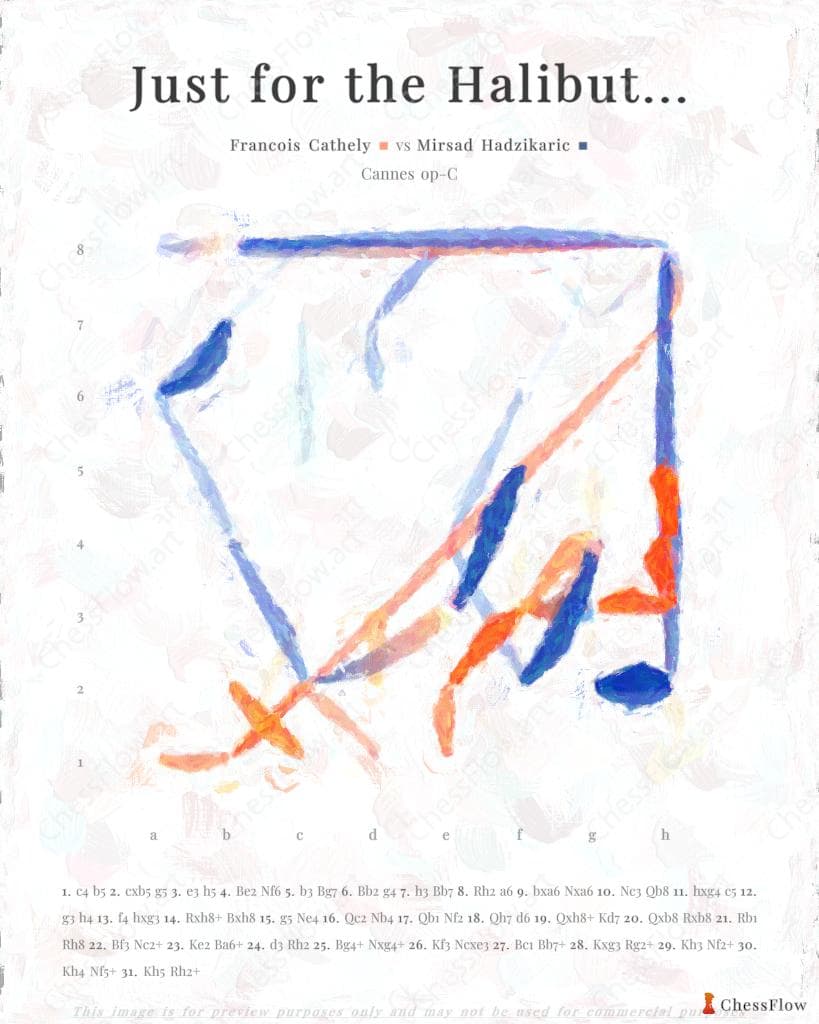
Francois Cathely vs Mirsad Hadzikaric
Francois Cathely vs Mirsad Hadzikaric
The Opening Gambit Francois Cathely and Mirsad Hadzikaric faced off in the 1995 Cannes op-C tournament with an opening that immediately signaled chaos was coming. After 1.c4 b5, Black's Polish Defens...
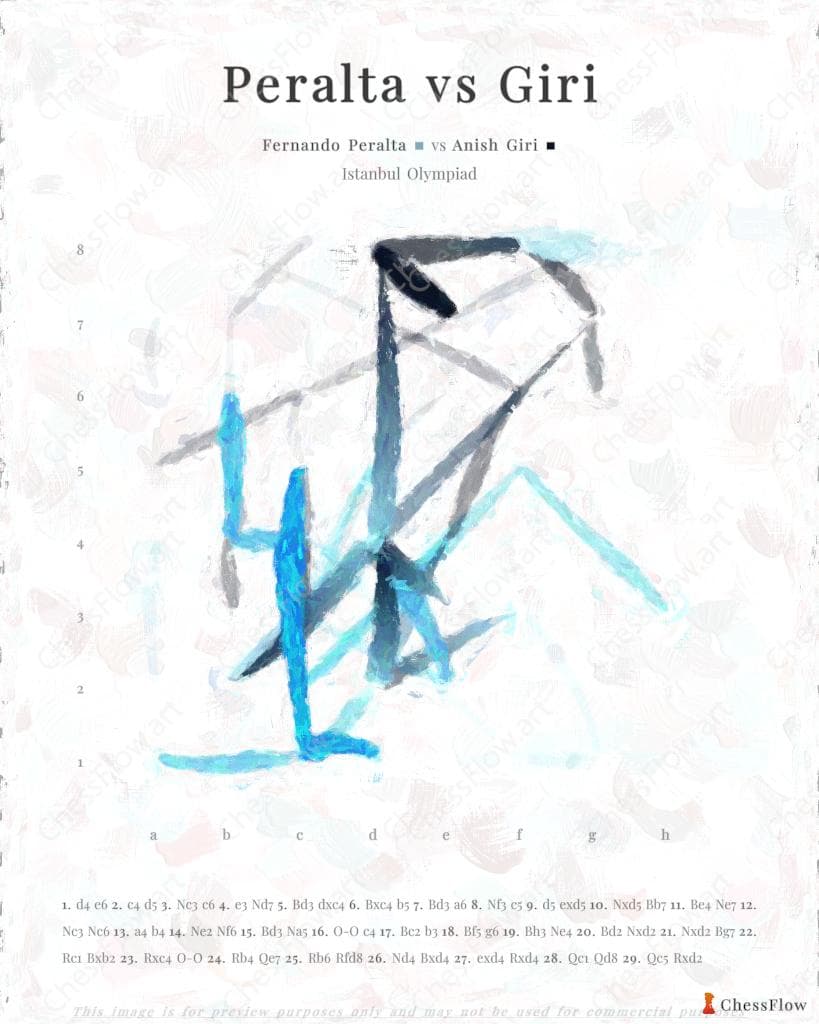
Fernando Peralta vs Anish Giri
Fernando Peralta vs Anish Giri
The Opening Battle Fernando Peralta (2606) faced off against rising Dutch talent Anish Giri (2711) in round 5 of the 2012 Istanbul Olympiad. The game opened with the Queen's Gambit Declined, Semi-Sla...
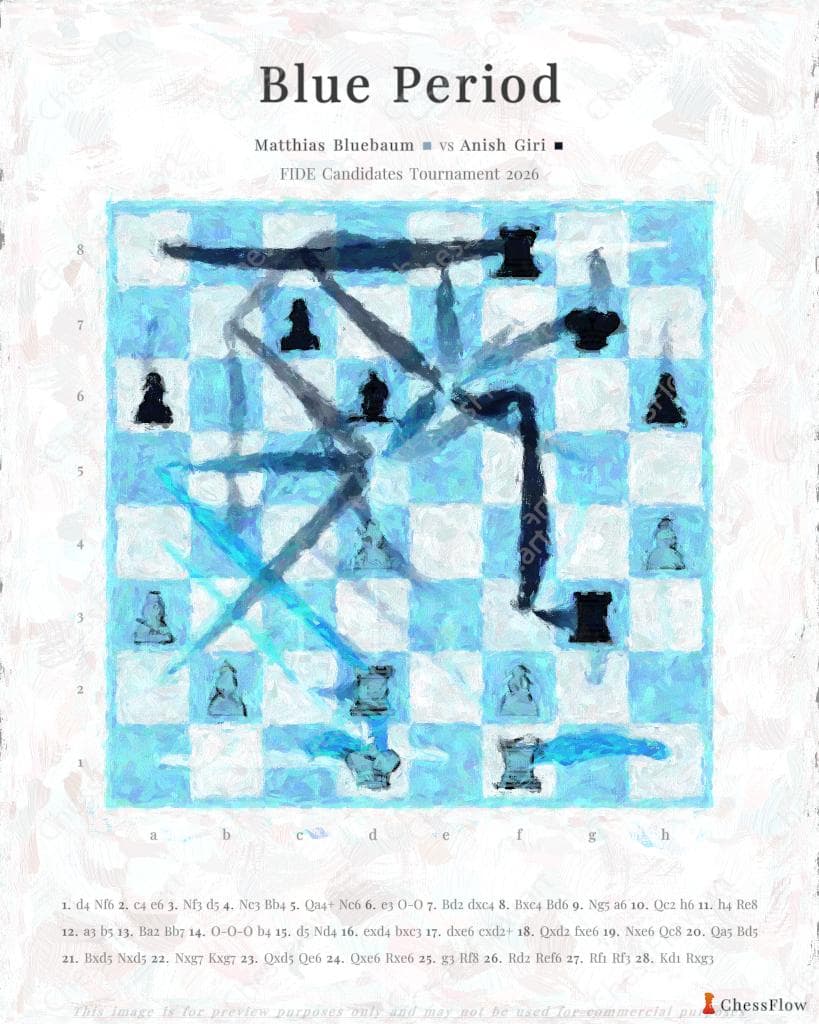
Matthias Bluebaum vs Anish Giri
Matthias Bluebaum vs Anish Giri
Giri Defeats Bluebaum in Round 14 of Candidates 2026 Anish Giri secured a crucial victory against Matthias Bluebaum in round 14 of the FIDE Candidates Tournament 2026, winning with the black pieces i...