TIPOS šachová Extraliga 2025/2026
Ivanchuk Holds Mihok in Wild Sicilian Najdorf Draw


Sicilian Storm
A Kingside Storm Ends in Stalemate
Vasyl Ivanchuk, still competing at the elite level at 57 years old, held off a dangerous kingside attack from Hungarian GM Oliver Mihok to secure a draw in Round 9 of the TIPOS šachová Extraliga. The game featured mutual aggression in one of the sharpest Sicilian Najdorf lines, with pawns flying up the board on both flanks before the players agreed to split the point after 15 moves of theory and tension.
For Mihok, rated 2501 and playing for ŠK Čebovce, this was a chance to claim a scalp against a living legend. For Ivanchuk, representing ŠK K CERO INVEST Nitra at 2621, it was another day at the office in a career that has spanned four decades and includes victories over virtually every world champion from Kasparov to Carlsen.
The draw keeps both teams in contention as the Slovak Extraliga approaches its final rounds.
The Najdorf: Where Legends Go to Fight
Ivanchuk has never been one to avoid complications, and his choice of the Sicilian Najdorf with Black signaled his intentions from the start. The opening sequence 1.e4 c5 2.Nf3 d6 3.d4 cxd4 4.Nxd4 Nf6 5.Nc3 a6 is one of the most theoretically dense in all of chess, and both players clearly came prepared.
Mihok opted for 6.Bd3, a flexible move that delays committing to a specific attacking setup. This isn't the most aggressive approach—the English Attack with Be3 and f3 is more common at the top level—but it keeps options open. Ivanchuk responded with 6...Nbd7, a solid choice that prepares to challenge the center while keeping the position flexible.
The critical decision came on move 9 when Mihok launched his kingside ambitions with 9.g4. This pawn thrust signals White's intentions clearly: push the pawns forward, open lines against the Black king, and create attacking chances before Black can complete development. It's a bold choice against someone with Ivanchuk's experience in sharp positions.
Ivanchuk's response, 9...h6, was practical rather than provocative. He needed to address the threat of g5 at some point, and doing so immediately gave him time to think about his central break.
The Pawn Storm Collides
The position after 10.h4 was exactly the type of double-edged chaos that makes the Najdorf so popular at every level of chess. White's pawns on g4 and h4 threaten to crash through on the kingside, but Black has counterplay in the center and on the queenside.
Ivanchuk found the right moment to strike back with 10...Ne5, centralizing his knight on a powerful outpost and preparing the thematic central break. The knight on e5 is a monster—it attacks d3, eyes f3, and supports the coming d5 push.
When Mihok continued his attack with 11.Rg1, preparing to open the g-file, Ivanchuk unleashed 11...d5!, the move that defines Black's counterplay in so many Sicilian structures. This central break challenges White to justify his kingside aggression before it becomes overwhelming.
The evaluation at this point hovered around equal, but the position was anything but quiet. Both players had committed to their respective plans, and neither could easily back down.
When Pawns Start Falling
The game's most violent sequence began with 12.g5, Mihok pressing forward despite the central tension. The engine actually shows this as slightly inaccurate—the evaluation dips to around -0.1 for the first time—but it's exactly the kind of move that's difficult to criticize over the board. White has been building toward this break, and retreating now would feel like an admission of failure.
Ivanchuk captured with 12...hxg5, and after 13.hxg5 dxe4, the position had transformed completely. The center was open, the h-file was clear, and both kings were suddenly feeling exposed. This is the Najdorf at its most chaotic—a position where calculation matters more than general principles.
The sequence continued with 14.gxf6 exd3 15.Nf3, and here we reach the game's critical juncture. White has won a piece (the knight on f6), but Black has a passed pawn on d3 and White's knight has retreated from its dominant post on d4. The compensation is real, but evaluating it correctly requires precise calculation.
After 15...gxf6, the position was objectively balanced but practically complex. Both players had weakened pawn structures, open files pointing at their kings, and limited time to calculate the consequences of every move. Engines call this roughly equal, but no human wants to be on either side of this position with the clock ticking.
The Art of the Practical Draw
What makes this game instructive isn't the final result—it's how both players navigated the complications to reach a position where neither could realistically play for more.
Mihok, the lower-rated player, had achieved exactly what he wanted from the opening: a sharp, double-edged position where his preparation could neutralize Ivanchuk's superior experience. The Hungarian GM showed good judgment in choosing the aggressive g4-h4 setup, and his willingness to sacrifice material for attacking chances was admirable.
Ivanchuk, for his part, showed he remains dangerous even in his late fifties. His timing on the central break was precise, and his handling of the complications showed the deep understanding that comes from decades of playing the Najdorf against the world's best.
The draw was a fair result. Neither player made a serious error in the critical phase, and the final position offered no realistic winning chances for either side.
Ivanchuk's Enduring Presence
At 57, Ivanchuk continues to compete at a level that would be remarkable for any player, let alone one who first made his mark in the late Soviet era. His FIDE rating of 2621 places him among the world's top 200 players, and his recent results—including a strong showing at the 2026 European Individual Championship where he scored 7.5/11—suggest he's far from finished.
What sets Ivanchuk apart has never been just his calculating ability or his opening preparation. It's his willingness to fight, to take risks, to play for complications when a quieter approach might be safer. Even in a team event like the Slovak Extraliga, he chose the Najdorf—an opening that demands precision and punishes passivity.
Mihok, meanwhile, continues to build his reputation as a dangerous attacker. The 2501-rated Hungarian has shown he can compete with players well above his rating when the position suits his style, and his aggressive approach in this game earned him a respectable result against a legendary opponent.
What This Means for the Extraliga
The draw keeps both teams in the mix as the Slovak Extraliga heads toward its conclusion. ŠK K CERO INVEST Nitra, Ivanchuk's team, needed the half-point to maintain their position in the standings, while ŠK Čebovce will be satisfied with Mihok's result against such a highly-rated opponent.
Team chess often produces these pragmatic outcomes—a draw against a stronger player is a good result, and both sides recognized when the position no longer offered realistic winning chances. The position after the pawn exchanges is the kind of thing you hang on a wall—pure chaos frozen in time. We turned this one into a print at ChessFlow.
For Ivanchuk, the Slovak Extraliga represents another opportunity to compete at the highest level of team chess in Central Europe. His presence elevates any tournament he enters, and opponents like Mihok get the rare chance to test themselves against a player who has beaten world champions and challenged for the title himself.
The Najdorf remains one of chess's most reliable sources of fighting games, and this encounter was no exception. Both players came prepared, both played ambitiously, and both earned their half-point through accurate calculation in a position that could easily have gone wrong for either side.
The Broader Picture
Ivanchuk's 2026 has been characteristically active. Beyond the Extraliga, he competed in the Tata Steel Challengers and the European Individual Championship, maintaining a schedule that would exhaust players half his age. His recent games show a preference for 1.d4 and 1.c4 with White, but he remains comfortable on either side of the Sicilian.
For those following the Slovak Extraliga, Round 9 delivered exactly what team chess promises: competitive matches across multiple boards, with the outcome often decided by the accumulation of half-points rather than individual brilliance. Ivanchuk's draw contributed to his team's effort, and Mihok's solid preparation earned respect from the chess community watching online.
The game ended after just 15 moves of the main phase, but those 15 moves contained enough tension and calculation to fill a much longer encounter. Sometimes the best games are the ones where both players find the right moves under pressure, and this was one of those games.
1.e4 c5 2.Nf3 d6 3.d4 cxd4 4.Nxd4 Nf6 5.Nc3 a6 6.Bd3 Nbd7 7.Be3 e6 8.a4 b6 9.g4 h6 10.h4 Ne5 11.Rg1 d5 12.g5 hxg5 13.hxg5 dxe4 14.gxf6 exd3 15.Nf3 gxf6 16.Nxe5 fxe5 17.Qf3 Ra7 18.O-O-O Rd7 19.Rxd3 Bb7 20.Ne4 Bxe4 21.Qxe4 Rxd3 22.cxd3 Qd5 23.Bxb6 Kd7 24.Qc4 Bd6 25.Kb1 Qb7 26.a5 Rc8 27.Qa4+ Qc6 28.Qxc6+ Kxc6 29.Rc1+ Kb7 30.Rxc8 Kxc8 31.Kc2 Kb7 32.Kc3 Kc6 33.Kc4 Be7 34.b4 Bd6 35.f3 Be7 36.Bf2 Bf8 37.Bg3 Bg7 38.Be1 Bf8 39.Bg3 Bg7 40.Bh4 Bf8 41.Bg3 1/2-1/2
How would it look as art?


Own a piece of chess history. Transform this legendary game into a unique piece of art for your home or office.
Perfect For
- Unique Gifts for chess enthusiasts and players
- Tournament Prizes that winners will treasure
- Club Decor for chess clubs and gaming spaces
- Office Art showcasing strategic thinking
- Personal Collection of historic games
Turn Your Games Into Art
Whether it's your own game from Chess.com or Lichess, or another historic masterpiece, transform any chess game into a stunning visual artwork.
You might also like
More legendary chess game stories
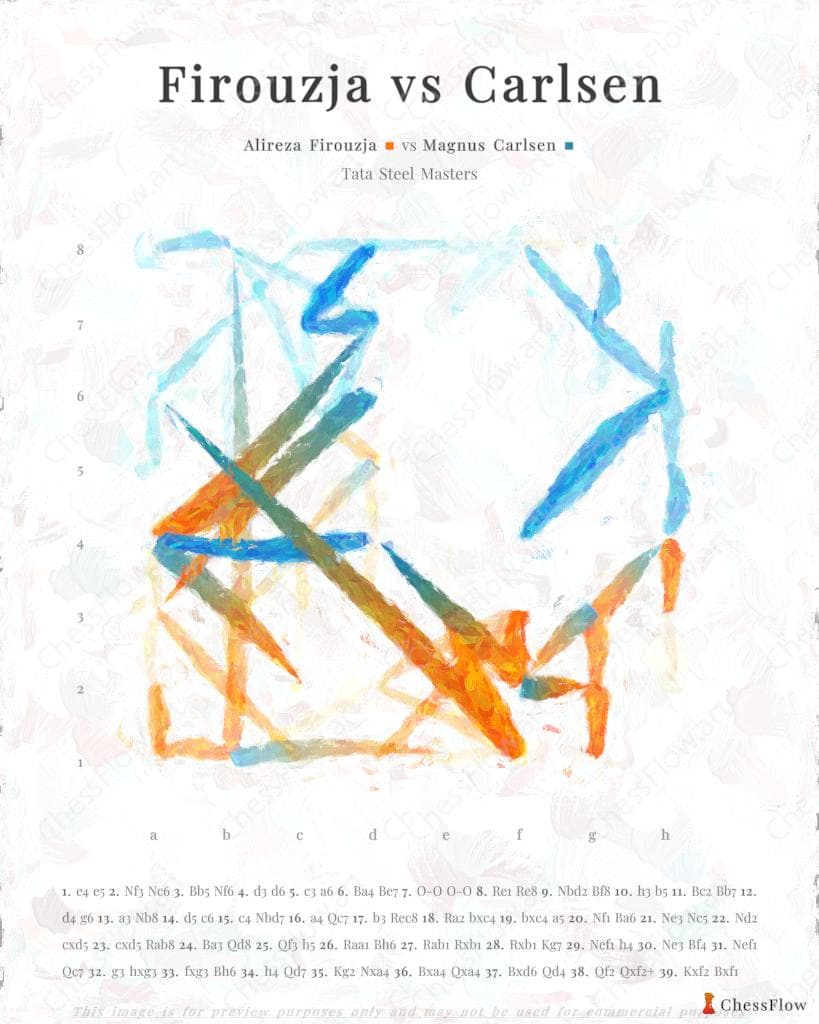
Alireza Firouzja vs Magnus Carlsen
Alireza Firouzja vs Magnus Carlsen
The Matchup Magnus Carlsen faced Alireza Firouzja in round 9 of the 2020 Tata Steel Masters, a highly anticipated clash between the world champion and the tournament's youngest participant. Carlsen,...
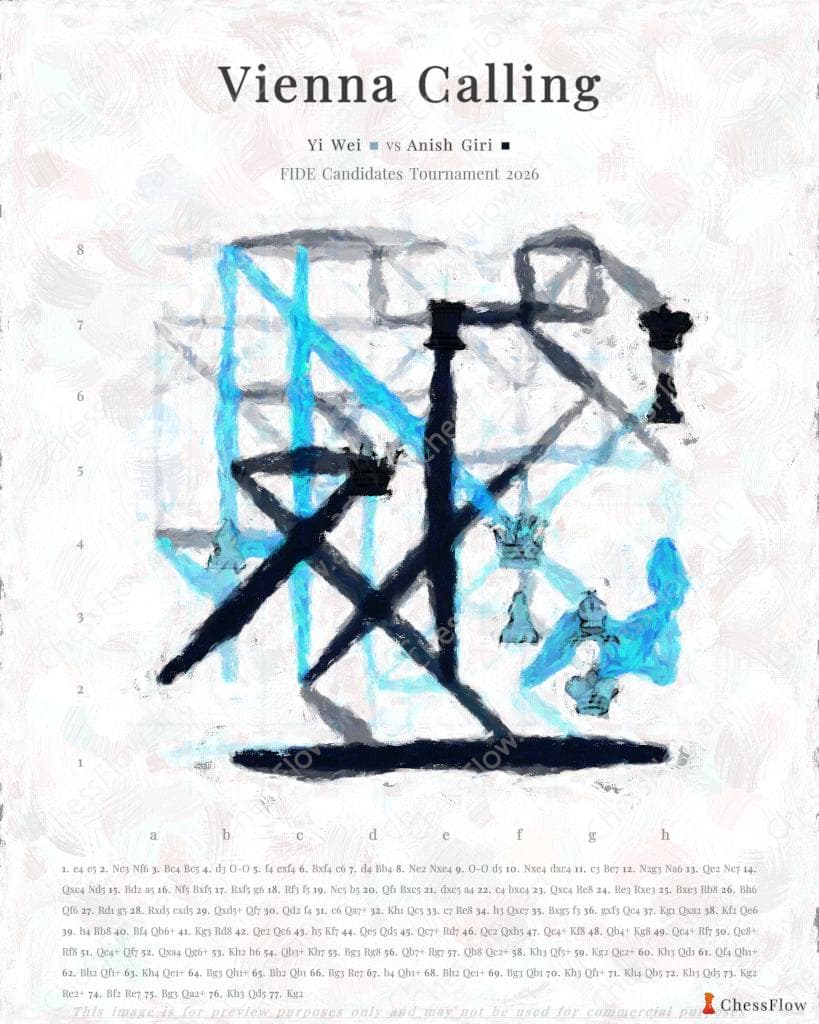
Yi Wei vs Anish Giri
Yi Wei vs Anish Giri
The Vienna Hybrid Experiment Wei Yi's choice of the Vienna Hybrid against Anish Giri in round 12 of the 2026 FIDE Candidates raised eyebrows. The opening sequence 1.e4 e5 2.Nc3 signals White's intent...
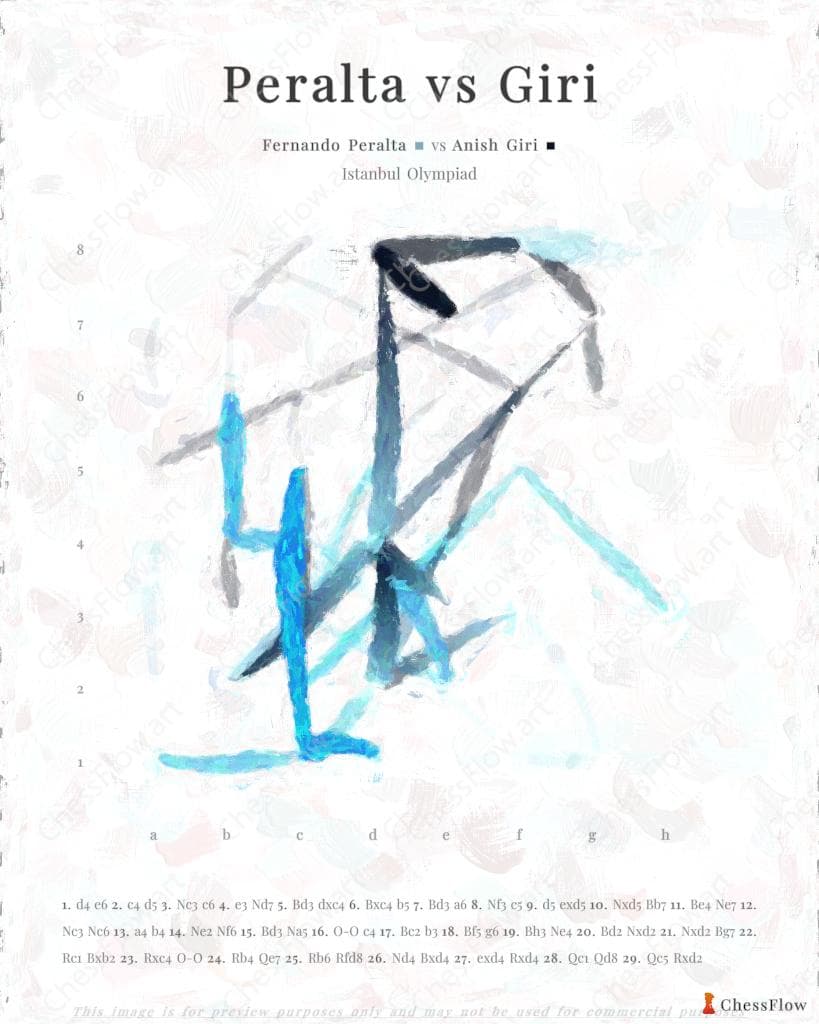
Fernando Peralta vs Anish Giri
Fernando Peralta vs Anish Giri
The Opening Battle Fernando Peralta (2606) faced off against rising Dutch talent Anish Giri (2711) in round 5 of the 2012 Istanbul Olympiad. The game opened with the Queen's Gambit Declined, Semi-Sla...