Finals: Moroni, Luca Jr - Sarana, Alexey
Moroni and Sarana Draw in Italian Team Championship Finals

Moroni's Nimzo Hour
A Quiet Draw with High Stakes
GM Luca Moroni Jr. and GM Alexey Sarana split the point in Round 3.1 of the Italian Team Championship 2026 Playoffs finals, a 14-move draw that settled nothing and everything at once. Playing for ASD Pedone Isolano against SS Lazio Scacchi Master, Moroni steered a Nimzo-Indian into well-trodden theoretical waters, and neither player found reason to deviate from the script. The game ended with pieces still developing and the position dead level.
This wasn't a fighting draw gone wrong or a missed opportunity squandered. It was two grandmasters, both familiar with each other's online and over-the-board tendencies, recognizing that the position offered nothing worth risking in a team match context.
The Nimzo-Indian Setup
Moroni opened with 1.c4 Nf6 2.d4 e6 3.Nc3 Bb4, inviting the Nimzo-Indian Defense. Sarana, rated 107 points higher at 2658, accepted the invitation. The Nimzo has been a reliable weapon at the elite level for a century precisely because it gives Black immediate structural targets while avoiding the theoretical labyrinths of 1.e4 openings.
4.e3 signaled Moroni's intention to play the Rubinstein Variation, one of the most solid approaches White can choose. Rather than the aggressive 4.Qc2 or the sharp 4.f3, Moroni opted for a setup that prioritizes piece development over immediate central confrontation. This choice tells you something about his approach to the game—he wasn't looking to create chaos against a higher-rated opponent.
Sarana responded with the standard 4...O-O followed by 5...d5, establishing the classical Nimzo-Indian structure. The position after 5.Bd3 d5 6.Nf3 dxc4 7.Bxc4 c5 is one of the most analyzed in all of opening theory. Both players were essentially reading from the same textbook.
The Gligoric System Takes Shape
The game transitioned into the Gligoric System, Exchange Variation after 8.O-O a6 9.dxc5 Bxc5. This line has been played thousands of times at the grandmaster level. The position is symmetrical in pawn structure, with both sides having isolated d-pawns that have been traded off, leaving a balanced central configuration.
10.Qe2 is the main move here, preparing to develop the bishop and connect the rooks. Sarana responded with 10...b5, a typical queenside expansion that gains space and prepares to fianchetto the light-squared bishop. The evaluation stayed glued to 0.00 throughout—engines see nothing for either side.
11.Bd3 retreated the bishop to a safer square, and 11...Nbd7 brought the final minor piece into play. Both players were moving quickly through this phase, spending minimal clock time on moves they had clearly seen before. Moroni had used only about six minutes through move 11, while Sarana had burned through about 16 minutes, largely on the 10...b5 decision.
The Critical Non-Moment
If there was a point where the game could have taken a different direction, it came around moves 12-14. After 12.a3, Moroni prevented any future ...Bb4 ideas and prepared b4 to challenge Black's queenside space. 12...Bb7 developed the bishop to its natural diagonal, and 13.b4 Bd6 forced the bishop to retreat.
Here's where the human element diverges from the engine assessment. The computer sees the position as roughly equal (around -0.17 to -0.24), a tiny edge for Black that means nothing in practical terms. But what does that number actually represent? It means both players have completed their development, neither has any structural weaknesses, and the position offers no clear plan of attack for either side.
14.Bb2 Rc8 was the final move recorded before the draw was agreed. Black's rook occupies the open c-file, White's bishop eyes the long diagonal, and the position is symmetrical enough that any winning attempt would require one side to overextend.
Why This Draw Makes Sense
In a team championship context, draws on the lower boards often serve the team's interests. If your top boards are generating winning chances, a solid draw from a lower-rated player against a stronger opponent is a positive result. Moroni, at 2551, was the underdog against Sarana's 2658. Holding the draw with White isn't glamorous, but it's not a failure either.
These two have history in online rapid events. In May 2024 Titled Tuesday, Sarana beat Moroni in their direct encounter, with Sarana finishing second overall and Moroni 11th. In January 2025, both competed in the same Titled Tuesday event, with Sarana finishing 7th and Moroni 8th. They know each other's tendencies, and that familiarity likely contributed to the quick, non-confrontational nature of this game.
The Nimzo-Indian has always been a double-edged choice—it can lead to rich strategic battles or to sterile equality, depending on how both players approach it. When neither side wants to deviate from well-known theory, you get games like this one: technically correct, practically uneventful.
The Team Championship Context
The Italian Team Championship playoffs represent the pinnacle of Italian club chess. ASD Pedone Isolano and SS Lazio Scacchi Master both fielded strong lineups, and the outcome of individual games matters less than the aggregate team result. A draw on board one doesn't decide the match—it just means the pressure shifts to the other boards.
For Sarana, who has been a consistent performer in online events (winning 3+0 Thursday tournaments in 2026 and regularly finishing in the top 20 of Titled Tuesday), this was a routine outing. His career includes a quarterfinal run in the 2019 Junior Speed Chess Championship, where he beat Andrey Esipenko 15-12 before falling to Parham Maghsoodloo 11-15. He's comfortable in high-pressure team situations.
Moroni's career arc has been solid if less spectacular. Born in 2000, he was ranked 7th in the world among juniors in 2018, alongside future stars like Firouzja, Abdusattorov, and Sevian. His 20-7 loss to Maghsoodloo in the 2019 Junior Speed Chess Championship was described as "the most lopsided match in the round of 16," but he's developed into a reliable 2550-level grandmaster who can hold his own against stronger opposition.
The Art of the Short Draw
There's a tendency in chess coverage to dismiss short draws as uninteresting, but they reveal something important about professional chess. Not every game is meant to be a fight to the death. Sometimes the position dictates peace, and both players recognize it simultaneously.
The 14-move draw is a form of communication between professionals. It says: "I see what you're doing, you see what I'm doing, and neither of us has an advantage worth pursuing." In a world where engine preparation can extend 25 moves deep, reaching a known equal position quickly isn't laziness—it's acknowledgment that the real battle might happen in a different game, on a different day.
This particular position after 14...Rc8 is the kind of thing that looks almost painterly in its symmetry—both sides developed, both kings safe, pieces mirroring each other across the board. We turned this one into a print at ChessFlow, if that's your thing.
What This Means Going Forward
The draw keeps both teams' hopes alive in the playoff finals. Neither Moroni nor Sarana gained or lost rating points in any significant way, and neither established psychological dominance for future encounters. It was, in the most literal sense, a non-result.
But non-results matter in team chess. A draw against a higher-rated opponent is often the expected outcome, and meeting expectations is its own form of success. Moroni did his job for ASD Pedone Isolano. Sarana didn't lose ground for SS Lazio Scacchi Master. The championship would be decided elsewhere.
For spectators hoping for fireworks, this game offered none. The Nimzo-Indian can produce spectacular struggles—Kasparov's wins with it, Carlsen's grinding victories—but it can also produce this: two well-prepared players shaking hands before anything interesting happens. That's professional chess at the team level. Not every game is a story. Sometimes a game is just a game.
The Italian Team Championship 2026 Playoffs continue, with both teams still in contention. The finals format means every half-point matters, and both Moroni and Sarana will likely face each other again before the championship is decided. Perhaps next time, one of them will find a reason to deviate from the script.
1.c4 Nf6 2.d4 e6 3.Nc3 Bb4 4.e3 O-O 5.Bd3 d5 6.Nf3 dxc4 7.Bxc4 c5 8.O-O a6 9.dxc5 Bxc5 10.Qe2 b5 11.Bd3 Nbd7 12.a3 Bb7 13.b4 Bd6 14.Bb2 Rc8 15.Rfd1 Qe7 16.Rac1 Nb6 17.Nd2 Rfd8 18.h3 h6 19.Nce4 Nxe4 20.Nxe4 Bxe4 21.Bxe4 Nc4 22.Bd3 Nxb2 1/2-1/2
How would it look as art?


Own a piece of chess history. Transform this legendary game into a unique piece of art for your home or office.
Perfect For
- Unique Gifts for chess enthusiasts and players
- Tournament Prizes that winners will treasure
- Club Decor for chess clubs and gaming spaces
- Office Art showcasing strategic thinking
- Personal Collection of historic games
Explore more
Turn Your Games Into Art
Whether it's your own game from Chess.com or Lichess, or another historic masterpiece, transform any chess game into a stunning visual artwork.
You might also like
More legendary chess game stories
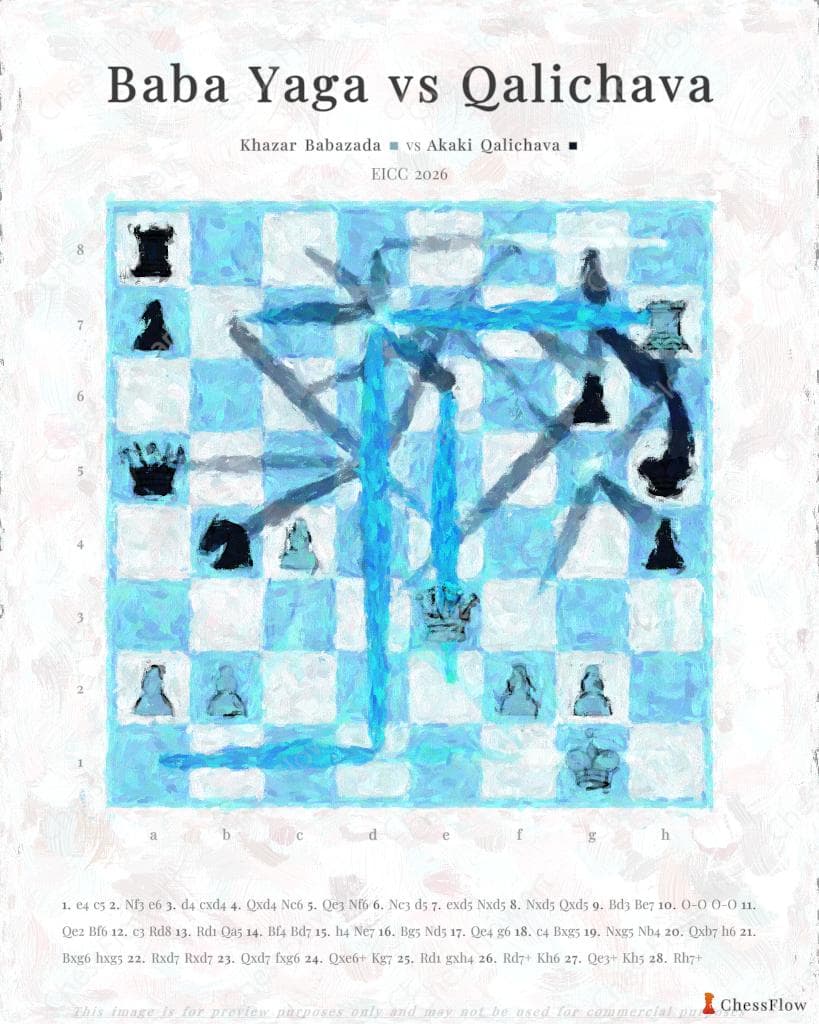
Khazar Babazada vs Akaki Qalichava
Khazar Babazada vs Akaki Qalichava
Babazada Converts After Qalichava's Blunder International Master Khazar Babazada (2480) defeated FIDE Master Akaki Qalichava (2322) in round two of the European Individual Chess Championship 2026. Wh...
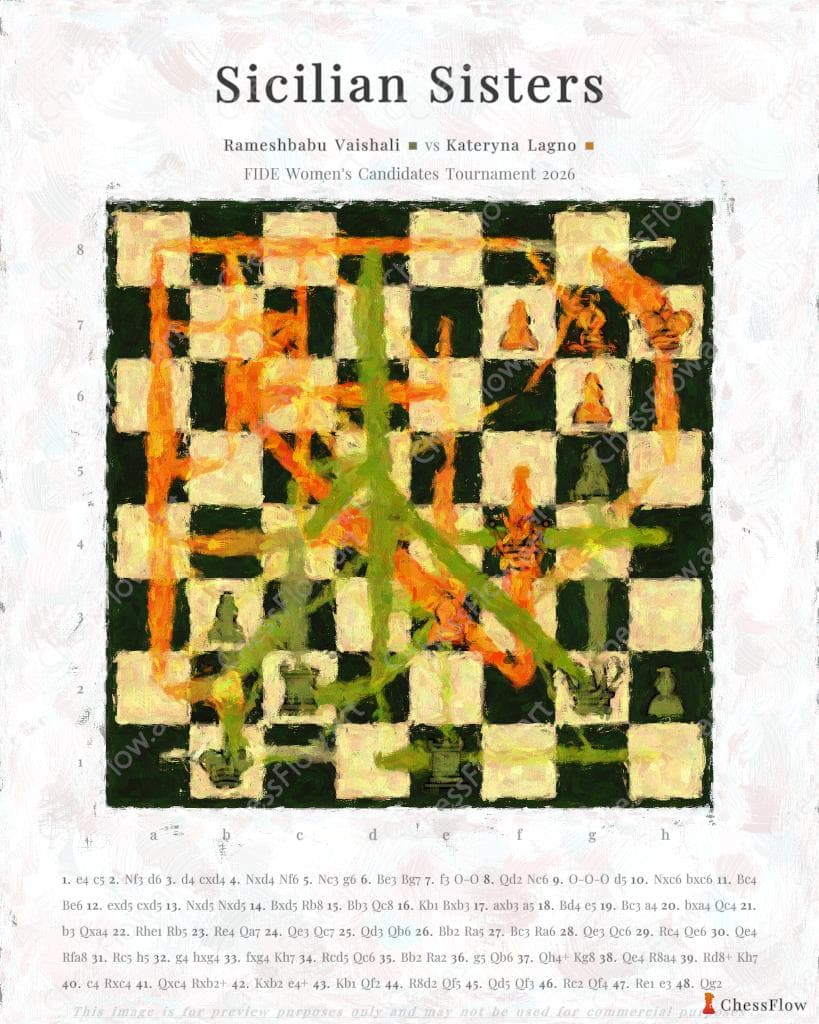
Rameshbabu Vaishali vs Kateryna Lagno
Rameshbabu Vaishali vs Kateryna Lagno
Vaishali Strikes in the Dragon Vaishali Rameshbabu defeated Kateryna Lagno in round 14 of the FIDE Women's Candidates Tournament 2026, playing a sharp Sicilian Dragon that ended in White's favor. The...
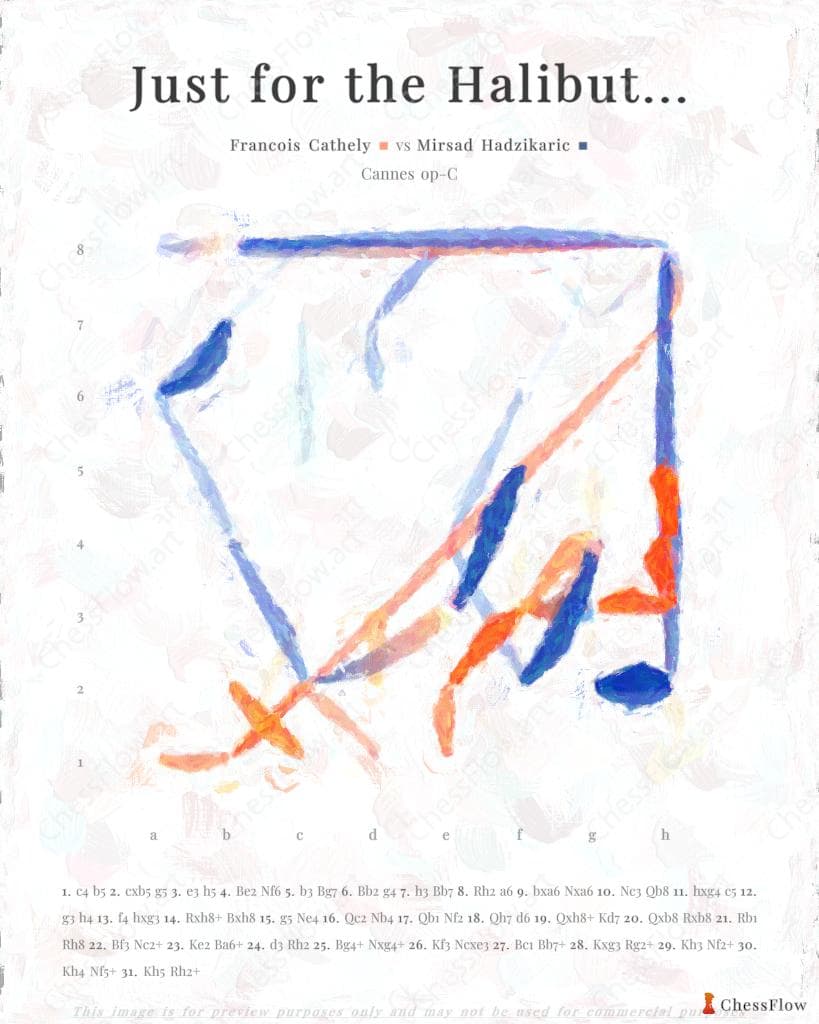
Francois Cathely vs Mirsad Hadzikaric
Francois Cathely vs Mirsad Hadzikaric
The Opening Gambit Francois Cathely and Mirsad Hadzikaric faced off in the 1995 Cannes op-C tournament with an opening that immediately signaled chaos was coming. After 1.c4 b5, Black's Polish Defens...