Paris (1858)
Paul Morphy vs Duke Karl / Count Isouard

A Night at the Opera
Paris, late 1858. In a private box at the Théâtre-Italien, America’s meteoric prodigy Paul Morphy sat opposite two titled patrons of the game—Karl II, Duke of Brunswick, and Count Isouard de Vauvenargues—who consulted on the black pieces while the music swelled from the stage below. The exact opera is still debated (some accounts name The Barber of Seville, others Norma), and even the precise date is a matter of scholarly back-and-forth; a widely cited modern note places it on November 2, 1858, while historians caution that “late October or early November” is as far as we can be sure (ChessBase 2017; Winter, chesshistory.com; Wikipedia 2025). ([ChessBase][1])
What is not in doubt is the game’s place in chess culture. In just 17 moves, Morphy delivered a clinic on development, initiative, and the art of mating attack—an illustration so clean that generations of coaches have used it as a first love letter to attacking chess (Chess.com Terms; Wikipedia 2025). ([Chess.com][2])
The Players
Paul Morphy (1837–1884) had just conquered Europe: he dominated the 1857 American Chess Congress, then routed leading masters in London and Paris in 1858. His style—rapid mobilization, opening of lines, and precise calculation—felt like a glimpse of modernity arriving early (ChessBase 2017). ([ChessBase][1])
Duke Karl II of Brunswick and Count Isouard were serious aristocratic enthusiasts. Though the Duke is often remembered for this disaster, contemporary sources reveal he played much more respectably in other games; here, however, the pair slipped into every classical pitfall Morphy had spent the year teaching opponents to avoid (ChessBase 2017). ([ChessBase][1])
The Game
Opening: Philidor Defence (ECO C41) Moves: 1.e4 e5 2.Nf3 d6 3.d4 Bg4 4.dxe5 Bxf3 5.Qxf3 dxe5 6.Bc4 Nf6 7.Qb3 Qe7 8.Nc3 c6 9.Bg5 b5 10.Nxb5! cxb5 11.Bxb5+ Nbd7 12.0–0–0 Rd8 13.Rxd7 Rxd7 14.Rd1 Qe6 15.Bxd7+ Nxd7 16.Qb8+! Nxb8 17.Rd8# (Wikipedia 2025; Chess.com Terms). ([Wikipedia][3])
From move three, the story writes itself.
- 3…Bg4?! A period move that neglects central tension; Philidor’s structure thrives on …exd4 or …Nf6 instead. Already Morphy seizes a tempo with 4.dxe5 and will lead development by several moves (Wikipedia 2025). ([Wikipedia][3])
- 6.Bc4 and 7.Qb3 hit f7 and b7 at once: the quintessential Morphy fork of themes—development creating direct threats. Black’s necessary 7…Qe7 self-pins and obstructs kingside development (Wikipedia 2025). ([Wikipedia][3])
- After the consolidating 8…c6, Black errs fatally with 9…b5?, chasing a well-posted bishop while underdeveloped. Morphy’s instant refutation 10.Nxb5! rips open queenside lines; 11.Bxb5+ keeps the king in the center (Wikipedia 2025). ([Wikipedia][3])
- The positional heart of the miniature is the double pin Morphy engineers after 12.0–0–0 Rd8 13.Rxd7 Rxd7 14.Rd1: the d7-rook is glued to the king along the file, and its defender is pinned to the queen. This is Morphy’s grammar—every capture improves coordination, every tempo opens a road (Wikipedia 2025). ([Wikipedia][3])
- The finale—16.Qb8+! Nxb8 17.Rd8#—is a celebrated queen sacrifice leading to the so-called “opera mate”: rook mates on the back rank, supported by a bishop cutting the king’s flight (Wikipedia 2025). ([Wikipedia][3])
Turning Points
- 9…b5? — trying to gain time against an already active piece while undeveloped. In open games, time invested in development outweighs minor gains on the flank (Wikipedia 2025). ([Wikipedia][3])
- 12…Rd8?? (forced by the bind) — walks into the crushing pin motif. After 13.Rxd7 Rxd7 14.Rd1, Black is strategically lost: the d7-rook is immobile, the king stranded in the center, and White’s pieces flow onto open files (Wikipedia 2025). ([Wikipedia][3])
- 16.Qb8+! — Morphy’s precise clearance to force …Nxb8 and the model mate on d8. It’s not “showy for showiness’ sake”; it’s the shortest, cleanest finish to a position already won by superior mobilization (ChessBase 2017; Wikipedia 2025). ([ChessBase][1])
Aftermath and Legacy
Within chess instruction, A Night at the Opera became the archetype for four evergreen lessons:
- Develop first, attack later: Every white move before the sacrifices increases pressure or improves harmony; every black move before move 10 either trades the wrong bishop or wastes time (Chess.com Terms; Wikipedia 2025). ([Chess.com][2])
- Open lines against an uncastled king: 10.Nxb5! and 11.Bxb5+ are not “tactics out of nowhere” but principled reactions to a centralized monarch (Wikipedia 2025). ([Wikipedia][3])
- The power of pins: Morphy wins not by brute force but by paralyzing coordination—file pin (king–rook), line pin (queen–knight), and tempo-gaining threats that leave Black unable to untangle (Wikipedia 2025). ([Wikipedia][3])
- Aesthetic economy: the concluding setup is frequently cited as opera mate, an “economical” mate where every remaining white unit contributes (Wikipedia 2025). ([Wikipedia][3])
Historically, the setting of the game has itself become a miniature mystery. David Lawson’s biography popularized November 2 and Barber of Seville, while later archival sleuthing (notably by Edward Winter and Fabrizio Zavatarelli) emphasized the uncertainty and proposed either Barber or Norma as most plausible, sometime in late Oct–early Nov 1858 (ChessBase 2017; Winter, chesshistory.com; Wikipedia 2025). ([ChessBase][1])
More than a curiosity in a gilded theater, the Opera Game remains a compact chapter of chess literacy: the moment 19th-century romantic verve met 20th-century principles—sac, sac… but only after the pieces are in their best places.
Sources
- ChessBase — “50 games you should know: Morphy vs. Duke of Brunswick, Count Isouard,” Oct 18, 2017. (ChessBase 2017). ([ChessBase][1])
- Edward Winter — “Morphy v the Duke and Count,” Chess Notes (ongoing dossier on date/opera attribution). (Winter, chesshistory.com). ([chesshistory.com][4])
- Wikipedia — “Opera Game,” last updated April 29, 2025; includes full score and contemporary references. (Wikipedia 2025). ([Wikipedia][3])
- Chess.com — “Opera Game | Paul Morphy vs. Duke Karl (1858),” concise explainer of the game’s instructive value. (Chess.com Terms). ([Chess.com][2])
1.e4 e5 2.Nf3 d6 3.d4 Bg4 4.dxe5 Bxf3 5.Qxf3 dxe5 6.Bc4 Nf6 7.Qb3 Qe7 8.Nc3 c6 9.Bg5 b5 10.Nxb5 cxb5 11.Bxb5+ Nbd7 12.O-O-O Rd8 13.Rxd7 Rxd7 14.Rd1 Qe6 15.Bxd7+ Nxd7 16.Qb8+ Nxb8 17.Rd8# 1-0
How would it look as art?


Own a piece of chess history. Transform this legendary game into a unique piece of art for your home or office.
Perfect For
- Unique Gifts for chess enthusiasts and players
- Tournament Prizes that winners will treasure
- Club Decor for chess clubs and gaming spaces
- Office Art showcasing strategic thinking
- Personal Collection of historic games
Explore more
Turn Your Games Into Art
Whether it's your own game from Chess.com or Lichess, or another historic masterpiece, transform any chess game into a stunning visual artwork.
You might also like
More legendary chess game stories
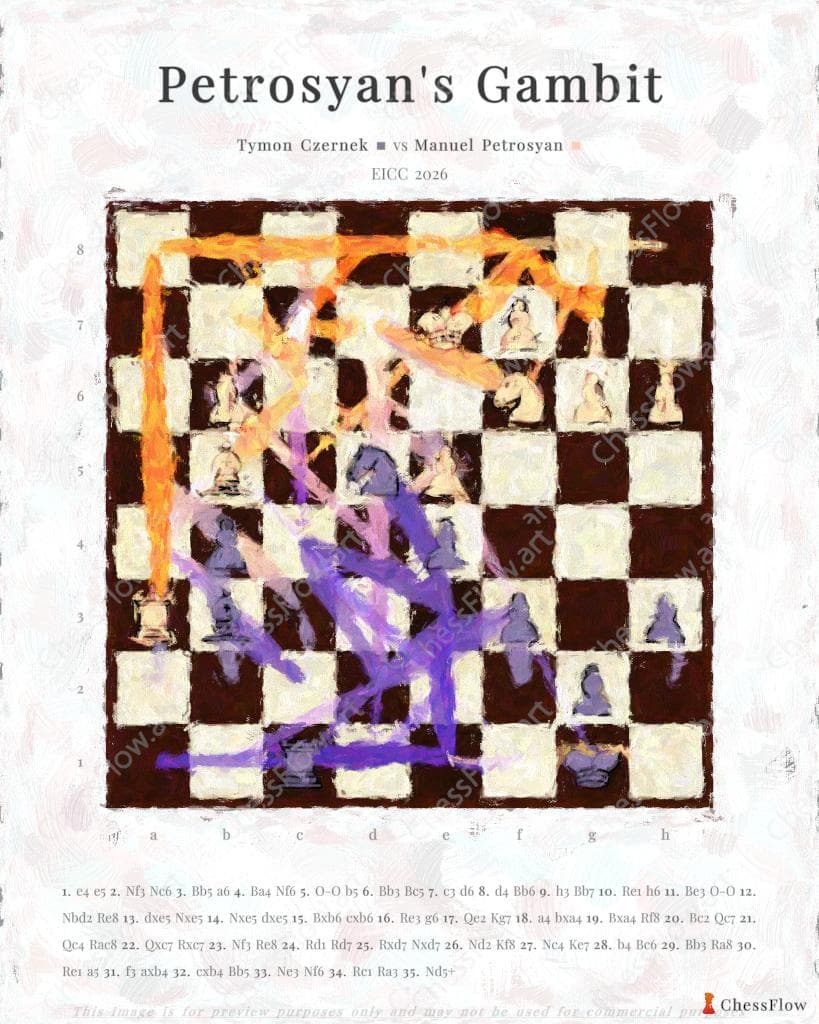
Tymon Czernek vs Manuel Petrosyan
Tymon Czernek vs Manuel Petrosyan
The Matchup GM Manuel Petrosyan (2584) faced off against FM Tymon Czernek (2401) in round 2 of the European Individual Chess Championship 2026. The Armenian grandmaster, fresh off his second national...
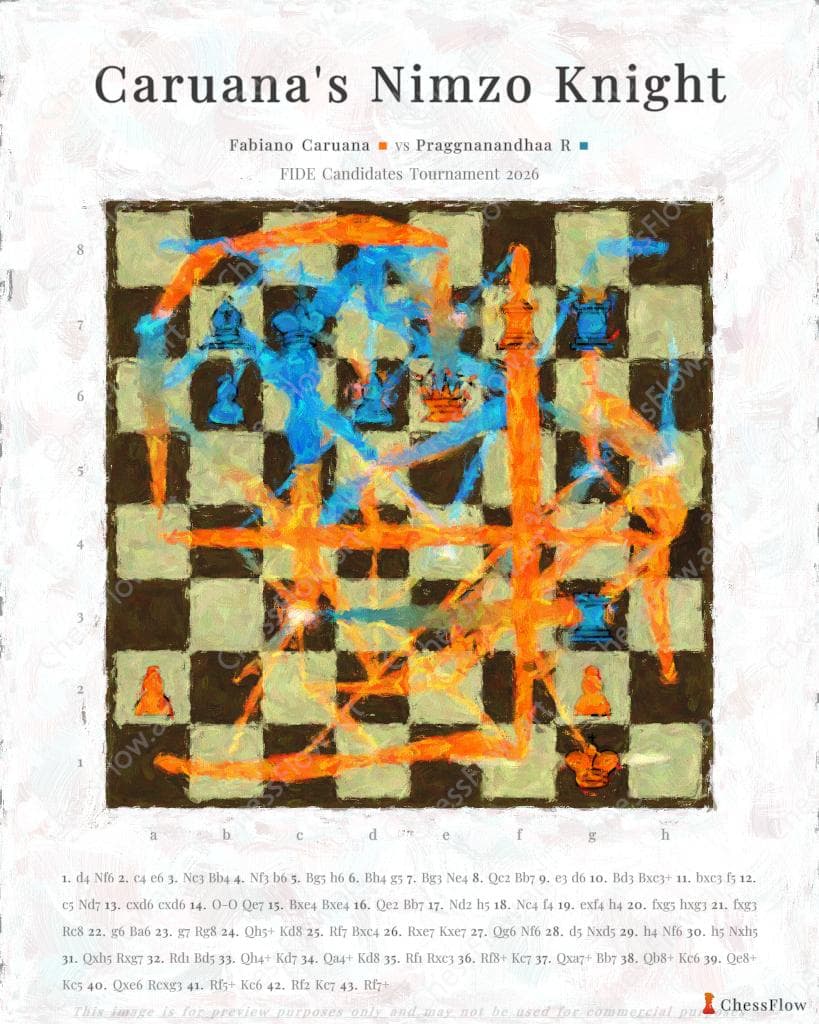
Fabiano Caruana vs Praggnanandhaa R
Fabiano Caruana vs Praggnanandhaa R
The Opening Choice Fabiano Caruana opened with 1.d4 against Praggnanandhaa in round 13 of the 2026 FIDE Candidates Tournament, leading to the Nimzo-Indian Defense after 1.d4 Nf6 2.c4. The American gr...
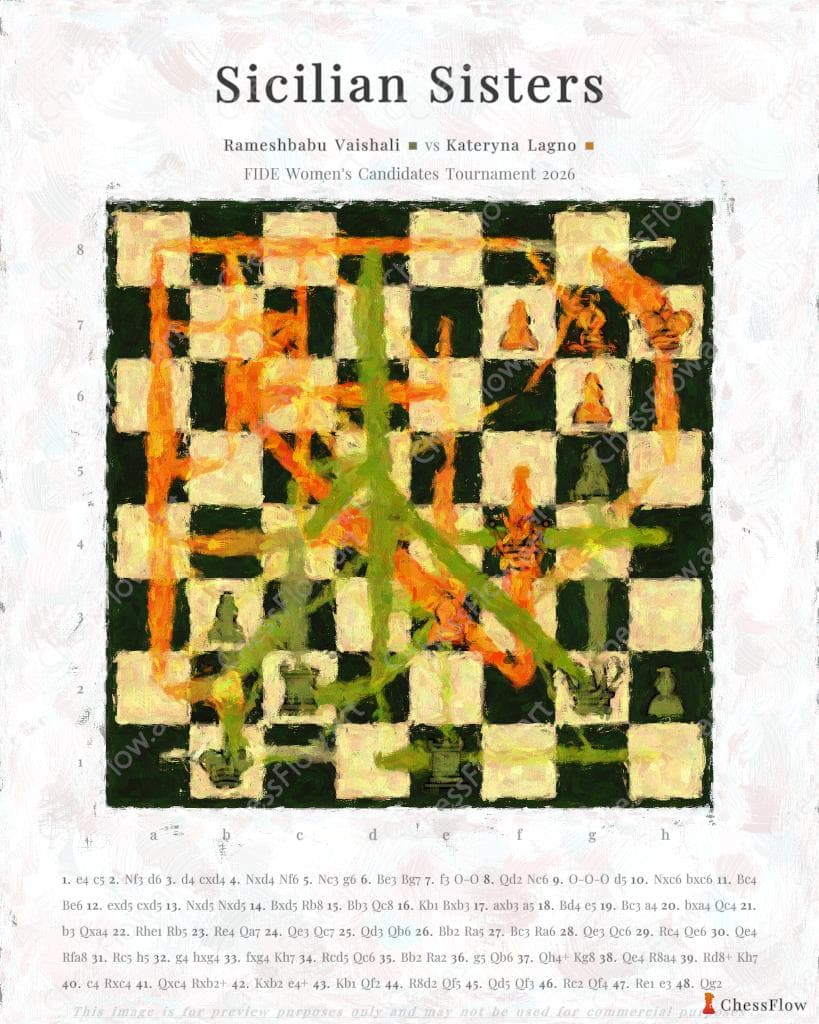
Rameshbabu Vaishali vs Kateryna Lagno
Rameshbabu Vaishali vs Kateryna Lagno
Vaishali Strikes in the Dragon Vaishali Rameshbabu defeated Kateryna Lagno in round 14 of the FIDE Women's Candidates Tournament 2026, playing a sharp Sicilian Dragon that ended in White's favor. The...