2026 Dreamhack Atlanta Group A
Murzin Beats Hong on Time at DreamHack Atlanta 2026


Dreamhack Reverie
Murzin Wins on Time in a Game That Barely Got Started
Volodar Murzin took down Andrew Hong in the lower bracket semifinals at DreamHack Atlanta 2026, but the scoreboard tells a cleaner story than the board did. The game ended on move 20 when Hong's clock ran out in a position where material was roughly equal and the real fight was just beginning.
The result keeps Murzin alive in Group A's lower bracket and pushes him closer to the top four finish that would secure a spot at the Esports World Cup. Hong, meanwhile, exits a tournament where he'd been performing well, undone not by a tactical oversight but by the unforgiving math of 10+0 rapid time controls.
The Italian Goes Quiet
Both players opted for well-trodden territory with the Italian Game, specifically the Giuoco Pianissimo variation that has become a favorite at elite levels when players want to avoid the sharpest theoretical battles. The opening moves followed a familiar script: 1.e4 e5 2.Nf3 Nc6 3.Bc4 Nf6 4.d3 Bc5 5.O-O d6 6.c3.
This is the kind of setup where both sides know the plans, know the typical piece placements, and the game often comes down to who executes their middlegame ideas more precisely. Hong chose the solid 6...a6, preparing queenside expansion, followed by 7...Ba7 — a standard retreat that keeps the bishop on a safe diagonal while maintaining pressure on f2.
The early middlegame saw both players maneuvering without committing to anything drastic. Murzin rerouted his knight with 11.Nbd2 and then 12.Nf1, a typical Italian Game maneuver aiming to bring the knight to g3 and eventually f5, where it can exert pressure on Black's kingside. Hong responded with 11...b5, signaling his intention to create counterplay on the queenside.
What's notable here is the clock situation. By move 11, both players had used only about a minute of their ten-minute allocation. The position was balanced, the moves were largely automatic, and neither side had been forced into deep calculation yet.
The Knight Lands on f5
The position started to sharpen after 14.Nf5, a move that looks aggressive but is actually a standard Italian Game idea. The knight on f5 is annoying for Black — it eyes g7 and d6, and removing it often requires concessions. Hong responded with 14...Qc7, keeping the queen flexible and avoiding any immediate tactics.
Murzin followed up with 15.Bg5, pinning the knight on f6 (or rather, threatening to create problems if the knight moves). Hong's 15...Nd7 unpins and prepares to challenge the center or swing the knight to c5 via b6. This is all sensible stuff — neither player has made a mistake, and the position remains roughly balanced.
Then came 16.h4, a move that signals Murzin's intentions clearly. He's not interested in a quiet maneuvering battle; he wants to push h5, open the h-file, and create threats against Hong's king. It's the kind of move that says "I'm playing for the attack, and you need to find a way to deal with it."
Hong's response was 16...c4, a committal decision that opens the center. The idea is to create counterplay by undermining White's pawn structure and potentially winning the bishop on b3. After 17.dxc4 bxc4, the tension in the position increased significantly.
The Queen Trade That Changed Everything
The critical sequence began with 18.Qxd6, where Murzin offered a queen trade. This is a double-edged decision in rapid chess. On one hand, trading queens often simplifies the position and reduces the chances for tactical fireworks. On the other hand, Murzin's knight on f5 and bishop on g5 remain active pieces, and the resulting endgame-ish position still has plenty of venom.
Hong accepted with 18...Qxd6 19.Nxd6, and now the position required careful evaluation. Black has won the bishop pair and is about to grab the bishop on b3 with 19...cxb3. But White's knight on d6 is a monster — it attacks the bishop on b7 and sits deep in Black's position.
The game concluded with 20.Nxb7, and here Hong's clock ran out.
This is where the game becomes frustrating to analyze, because we never got to see how the position would resolve. After 20.Nxb7, Black has several reasonable options. The bishop on a7 is still on the board, the rook on a8 is attacked, and there are tactical considerations involving the passed b3-pawn. Engines evaluate this as roughly equal, maybe slightly better for White, but it's the kind of position where human assessment matters more than computer evaluation.
The position after move 20 is actually quite interesting from a structural standpoint — White has won back material but Black has that dangerous passed pawn on b3, and the bishop pair could become relevant in an endgame. We'll never know how it would have played out.
The Clock Tells the Real Story
Looking at the time stamps, you can see where this game was decided. Both players managed their time reasonably well through the opening, but Hong started burning clock around move 16-17 when the position became more concrete. By move 18, when Murzin played Qxd6, Hong had dropped to about 5 minutes while Murzin still had over 6:30.
The gap widened in the critical sequence. Hong spent nearly a minute and a half on moves 18-19, and by the time he played 19...cxb3, he was down to about 5 minutes. When Murzin played 20.Nxb7, Hong's flag fell.
In 10+0 rapid, this is simply how games end sometimes. There's no increment to save you, no extra seconds to find the right move. Hong needed time to calculate the complications after Nxb7, and he didn't have it.
What This Means for Both Players
For Murzin, rated 2650 and currently fourth on the FIDE Junior rankings, this win keeps his DreamHack Atlanta campaign alive. The 19-year-old Russian (competing under the FIDE flag) has been having a strong 2026 — he recently faced Vincent Keymer at the GRENKE Freestyle Open, where he held equality for an extended phase before eventually losing in time pressure. The pattern is familiar: Murzin is clearly capable of hanging with top players in the middlegame, but clock management in rapid formats remains a factor.
Hong, rated 2592, had been performing well at GRENKE earlier this year, finishing with 7.5/9 in the Freestyle Open. The American GM is known for his solid positional understanding, and nothing in this game suggested he was outplayed — he simply ran out of time in a position that required calculation.
The DreamHack Atlanta format is unforgiving. The top four finishers earn spots at the Esports World Cup, making every game in the knockout stages high-stakes. Murzin advances; Hong goes home.
A Game Cut Short
There's something unsatisfying about analyzing a game that ended on move 20 due to time. The Italian Game setup was solid from both sides. The middlegame tension was building appropriately. The queen trade on move 18 led to a genuinely interesting position where both sides had chances.
But rapid chess doesn't care about interesting positions. It cares about who has time on the clock when the critical moment arrives.
Murzin played well enough to maintain a slight time advantage throughout, and when the position demanded calculation, he was the one with seconds to spare. That's not a criticism of Hong — it's simply the reality of 10+0 chess.
The position after 20.Nxb7 has a certain visual appeal, actually — the knight deep in enemy territory, the passed pawn on b3, the scattered pieces across the board. We turned this one into a print for the ChessFlow collection.
Murzin moves on to the next round, where he'll need to maintain both his positional composure and his clock discipline. Hong will have to wait for another tournament to make his run at an Esports World Cup qualification spot. The game itself? A fragment of what might have been, decided not by checkmate or resignation, but by the simple, brutal arithmetic of time.
1.e4 e5 2.Nf3 Nc6 3.Bc4 Nf6 4.d3 Bc5 5.O-O d6 6.c3 a6 7.h3 Ba7 8.a4 O-O 9.Re1 Ne7 10.Bb3 Ng6 11.Nbd2 b5 12.Nf1 Bb7 13.Ng3 c5 14.Nf5 Qc7 15.Bg5 Nd7 16.h4 c4 17.dxc4 bxc4 18.Qxd6 Qxd6 19.Nxd6 cxb3 20.Nxb7 f6 21.Be3 Bxe3 22.Rxe3 Rab8 23.Na5 Nc5 24.g3 Ne7 25.Kf1 f5 26.Nxe5 fxe4 27.Re2 Nf5 28.Kg2 Rbd8 29.Nac4 Rd5 30.Nc6 Rf6 31.Nb4 Rd8 32.a5 e3 33.Rf1 Rg6 34.h5 Rg5 35.Nxe3 Re8 36.Rd1 Nxe3+ 37.Rxe3 Rxe3 38.fxe3 Na4 39.Rd8+ Kf7 40.Nd3 Rxa5 41.Rd4 Nxb2 42.Nxb2 Ra2 43.Rd2 a5 44.Nc4 Rc2 45.Kf3 a4 46.Rd7+ Kf8 47.Rb7 Rxc3 48.Rb4 Rxc4 49.Rxc4 b2 50.Rf4+ Kg8 51.Rb4 a3 52.Rb3 a2 53.Rb8+ Kf7 54.Rb7+ Ke6 55.Rb6+ Kd5 56.Rxb2 a1=Q 57.Rb5+ Kc6 58.Rf5 Qf1+ 59.Kg4 Qe2+ 60.Rf3 Kd5 61.Kf4 Ke6 62.e4 Qd2+ 63.Re3 Qd6+ 64.Kf3 Qf8+ 65.Ke2 Qe7 66.Rf3 Qb4 67.Re3 Qb5+ 68.Kf3 Ke5 69.Kf2 Qb2+ 70.Kf3 1-0
How would it look as art?


Own a piece of chess history. Transform this legendary game into a unique piece of art for your home or office.
Perfect For
- Unique Gifts for chess enthusiasts and players
- Tournament Prizes that winners will treasure
- Club Decor for chess clubs and gaming spaces
- Office Art showcasing strategic thinking
- Personal Collection of historic games
Turn Your Games Into Art
Whether it's your own game from Chess.com or Lichess, or another historic masterpiece, transform any chess game into a stunning visual artwork.
You might also like
More legendary chess game stories
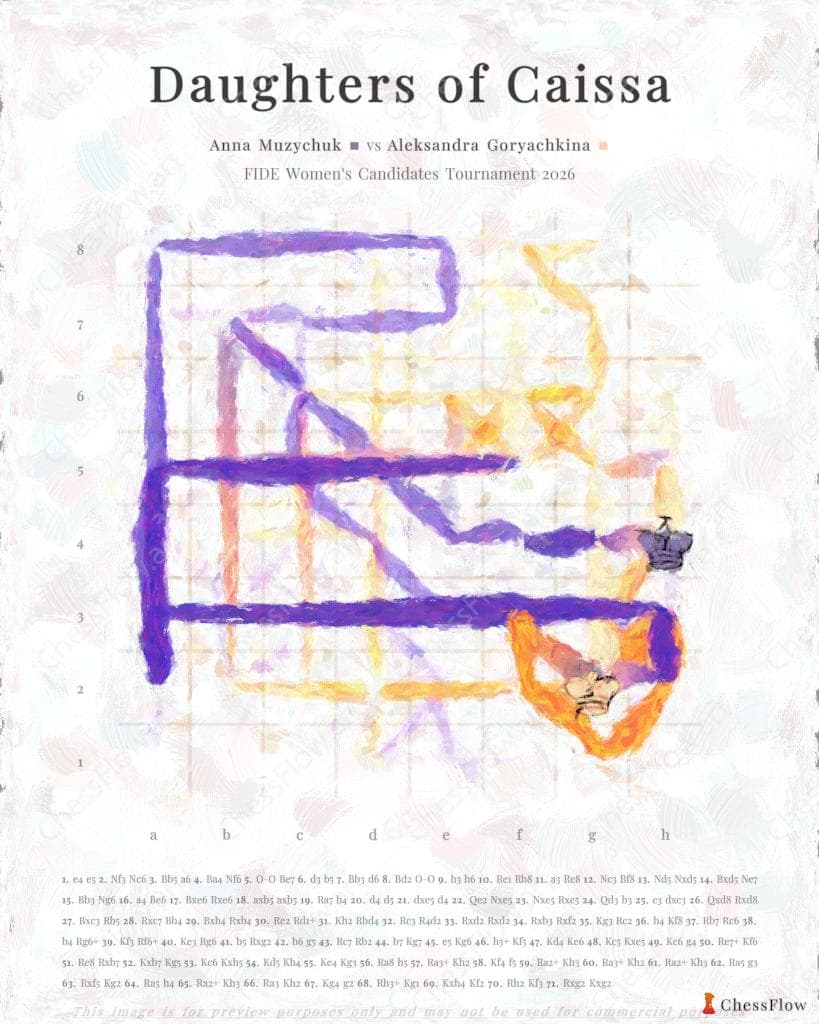
Anna Muzychuk vs Aleksandra Goryachkina
Anna Muzychuk vs Aleksandra Goryachkina
A Quiet Draw in the Ruy Lopez Anna Muzychuk and Aleksandra Goryachkina split the point in round 12 of the 2026 FIDE Women's Candidates Tournament, playing to a draw in the Ruy Lopez: Closed, Martinez...
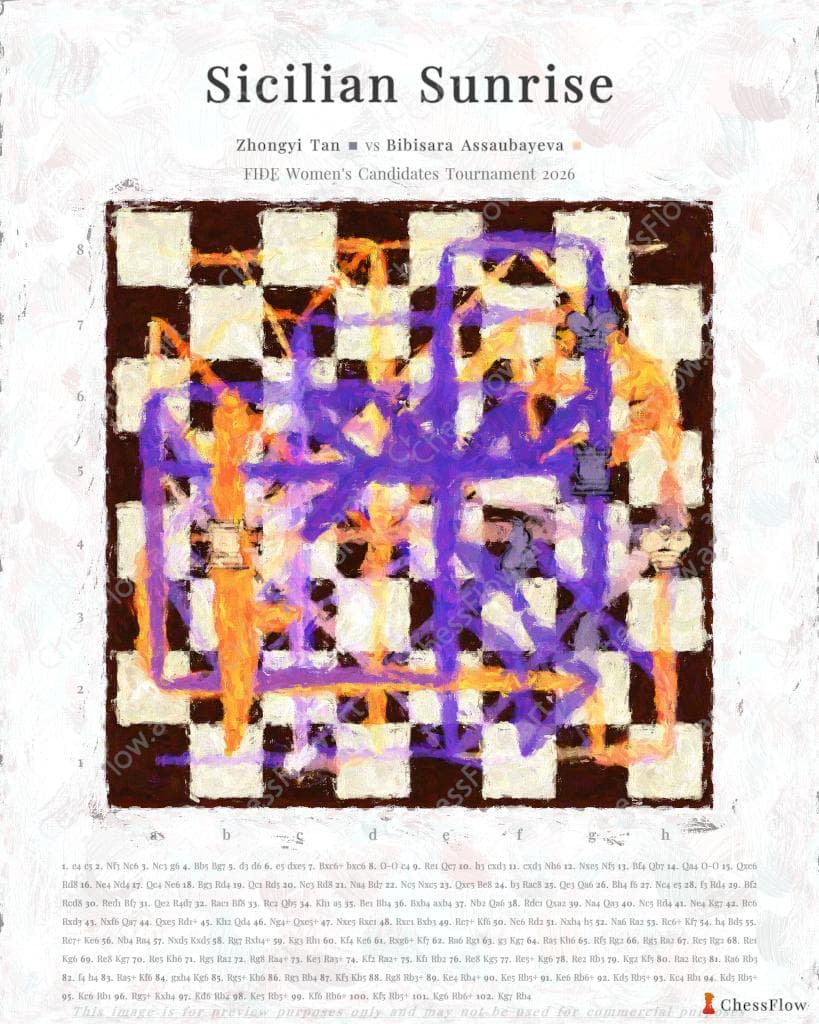
Zhongyi Tan vs Bibisara Assaubayeva
Zhongyi Tan vs Bibisara Assaubayeva
The Sicilian Defense in the Candidates Tan Zhongyi and Bibisara Assaubayeva opened their round 11 encounter at the FIDE Women's Candidates Tournament 2026 with the Sicilian Defense: Old Sicilian afte...
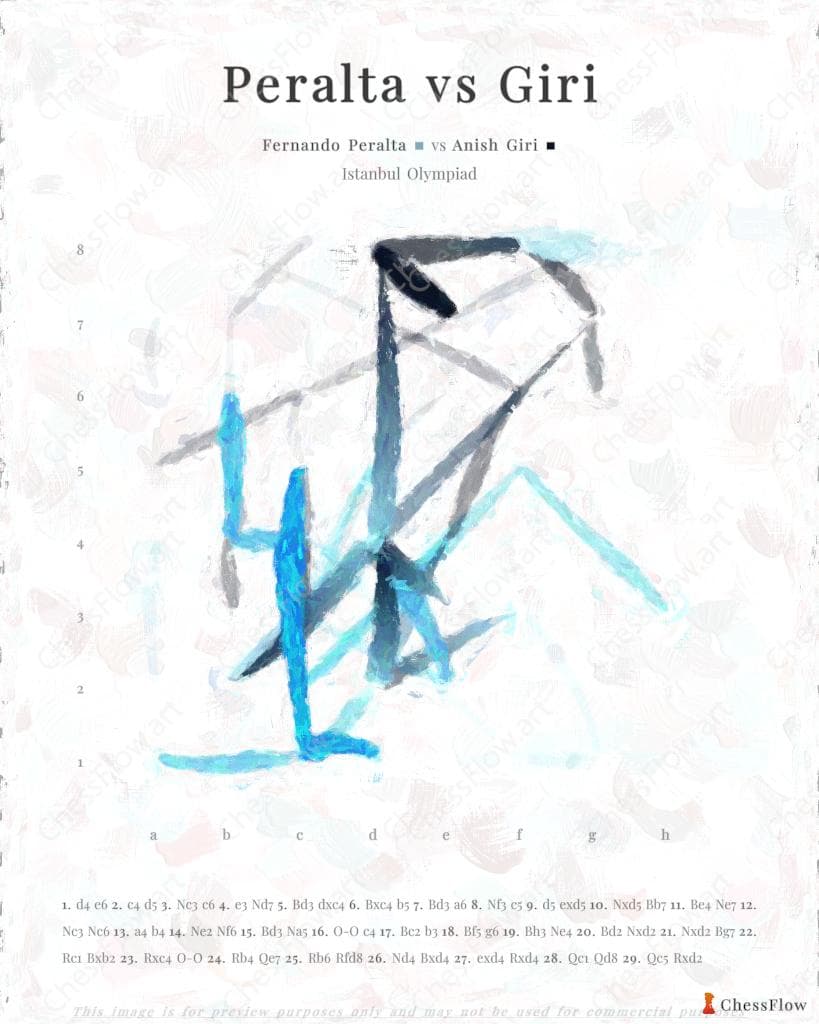
Fernando Peralta vs Anish Giri
Fernando Peralta vs Anish Giri
The Opening Battle Fernando Peralta (2606) faced off against rising Dutch talent Anish Giri (2711) in round 5 of the 2012 Istanbul Olympiad. The game opened with the Queen's Gambit Declined, Semi-Sla...