TIPOS šachová Extraliga 2025/2026
Navara Beats Mihok in Queenless King's Indian Grind


Extraliga Nocturne
Navara Grinds Down Mihok in Queensless King's Indian
David Navara took down Oliver Mihok in Round 10 of the TIPOS šachová Extraliga, converting a queenless middlegame into a smooth technical victory. The Czech GM, rated 2643, used an early queen trade to defuse Black's King's Indian ambitions, then methodically exploited small advantages until Mihok's position collapsed.
This wasn't a game of fireworks. It was a game of slow suffocation—the kind where engines shrug at +0.5 for thirty moves while the human defender slowly runs out of good squares.
The Orthodox Variation Gets Unorthodox
Mihok rolled out the King's Indian Defense with the standard setup: 1.d4 Nf6 2.c4 g6 3.Nc3 Bg7 4.e4 d6 5.Nf3 O-O 6.Be2 e5. This is the Orthodox Variation (E94), one of Black's most reliable ways to fight for counterplay against 1.d4. The idea is simple: Black accepts a space disadvantage in exchange for dynamic piece play and kingside attacking chances.
But Navara had no interest in letting Mihok build up a typical King's Indian attack. After 7.O-O h6 and 8.Re1 a5, White chose the somewhat rare 9.dxe5, immediately opening the center. This isn't the most common approach—White usually maintains the tension with d5 or plays for Be3 and Qd2—but it has a clear logic: if Black can't generate kingside play, the King's Indian's structural weaknesses become more relevant.
9...dxe5 recaptured, and then came the key decision: 10.Qxd8 Rxd8. Queens off the board on move 10. For King's Indian purists, this is almost an insult. The whole point of the opening is to throw everything at the white king, and now there's no king to attack.
But Navara understood something important: in queenless positions, small advantages compound. White has better central control, a slightly more harmonious piece setup, and Black's h6 pawn is now a potential target rather than a useful waiting move.
Pawn Grabbing and the Price of Activity
The position after the queen trade was objectively close to equal—engines gave White around +0.5—but the character of the struggle favored the more experienced player. Navara continued with 11.Nxe5, temporarily winning a pawn, and after 11...Nxe4 12.Nxe4 Bxe5, both sides had grabbed material.
Here came the first real decision point. Navara played 13.Bxh6, snatching the h-pawn that Black had pushed earlier. This is the kind of move that looks slightly risky—White's bishop is now on h6 with no immediate retreat square, and Black can try 13...Bxb2 to grab a pawn himself.
Mihok took the bait: 13...Bxb2 14.Rab1 Bg7. The pawn count was now level, but the position had shifted. White's pieces were more active: the bishop on h6 was annoying, the rook on b1 pressured the b-file, and Black's bishop had retreated to g7 where it wasn't doing much.
15.Bg5 repositioned the bishop to a more stable square, hitting the d8 rook. After 15...Re8, the position looked roughly equal to a computer, but the human experience was different. Mihok had to be precise for the next 20-30 moves just to hold, while Navara could probe without much risk.
The Grind Begins
What followed was a textbook example of the gap between engine evaluation and practical difficulty. From moves 15 to 35, the evaluation hovered between +0.4 and +0.7—technically holdable for Black, but requiring constant accuracy.
Navara's approach was patient. He didn't overpress or try to force matters. Instead, he improved his pieces incrementally, waited for Mihok to make small concessions, and kept the pressure constant. This is the kind of chess that doesn't make highlight reels but wins games at the GM level.
The key to White's advantage was structural: Black's pawns on a5 and c7 were slightly weak, and the knight on e4 was a powerful piece that could jump to various squares. Meanwhile, Black's bishop on g7 was passive, blocked by his own pawns.
Engines might say "equal," but no human wants to defend this for 40 moves with the clock ticking. Every move requires calculation, every piece placement needs to be justified, and one slip means the position goes from "unpleasant but holdable" to "lost."
The Breaking Point
The game continued past the time control, and eventually Mihok's position cracked. The exact moment of collapse isn't always dramatic in these technical games—it's often a single inaccuracy that turns a difficult position into a lost one.
Navara's conversion was clean. Once he achieved a winning position, he didn't give Black any counterplay chances. The final result: 1-0 for the Czech grandmaster.
What This Means for the Extraliga
This win was important for Navara's team, Šachy Reinter Humenné. In team competitions like the Slovak Extraliga, every board matters, and having a 2643-rated GM deliver a full point on board one is exactly what teams need from their top players.
For Mihok, playing for ŠK Čebovce, this was a tough loss but not a surprising one. Facing Navara with the black pieces is never easy, and the Hungarian GM was outrated by over 140 points. The early queen trade took away Black's best chances for counterplay, and from there it was an uphill battle.
Looking at the broader tournament picture, Navara has been a reliable performer in the Extraliga. Earlier in the season, he beat GM Lubomir Ftacnik in Round 5 and drew with IM Vaclav Finek in Round 6. His consistent results have been valuable for his team's standing.
The Quiet Art of Queensless Chess
Games like this one don't generate the same excitement as tactical shootouts, but they reveal something important about high-level chess: the ability to win "equal" positions is what separates strong GMs from the rest.
Navara's approach was almost clinical. He chose an opening that minimized Black's counterplay, traded queens early, grabbed a pawn, gave it back for activity, and then outplayed his opponent in a long technical battle. There were no sacrifices, no strong combinations, no moments where the crowd gasps. Just good chess.
The position after move 15 is the kind of thing that looks deceptively simple. Both sides have similar material, similar pawn structures, similar piece activity. But the details matter: White's pieces coordinate slightly better, Black's pawns are slightly weaker, and over 30 moves those small differences add up.
This is the kind of game ChessFlow was made for—not because it's flashy, but because the structure tells a story. The way the pieces flow from the opening into that queenless middlegame, the slow accumulation of pressure, the eventual collapse. We turned this one into a print.
Looking Ahead
Round 11 of the TIPOS šachová Extraliga is scheduled to continue the season, with teams jockeying for position in the 12-team round-robin format. Navara will likely continue to be a key contributor for Šachy Reinter Humenné, while Mihok and ŠK Čebovce will look to bounce back.
For chess fans following the Slovak and Czech club scene, games like this one are a reminder that even "quiet" wins require deep understanding and precise execution. Navara's handling of the queenless King's Indian was a lesson in practical chess—the kind of game that doesn't make the front page but wins matches.
1.d4 Nf6 2.c4 g6 3.Nc3 Bg7 4.e4 d6 5.Nf3 O-O 6.Be2 e5 7.O-O h6 8.Re1 a5 9.dxe5 dxe5 10.Qxd8 Rxd8 11.Nxe5 Nxe4 12.Nxe4 Bxe5 13.Bxh6 Bxb2 14.Rab1 Bg7 15.Bg5 Re8 16.Bg4 Nd7 17.Nd6 Rxe1+ 18.Rxe1 Ne5 19.Nxc8 Nxg4 20.Ne7+ Kf8 21.Nd5 Re8 22.Be7+ Kg8 23.Nxc7 Rc8 24.Bd6 Bd4 25.Re4 Bxf2+ 26.Kf1 Nf6 27.Re7 Bb6 28.Ke2 Ne4 29.Rxe4 Bxc7 30.Bxc7 Rxc7 31.Kd3 Kf8 32.Re5 b6 33.Rb5 Rc6 34.c5 bxc5 35.Rxa5 Rd6+ 36.Kc3 Re6 37.Rb5 Re3+ 38.Kc4 Re2 39.a4 Rxg2 40.Kxc5 Rxh2 41.a5 Ke7 42.a6 f5 43.a7 Ra2 44.Kb6 Rxa7 45.Kxa7 f4 46.Kb6 Kd6 47.Ka5 f3 48.Rb3 Ke5 49.Rxf3 g5 50.Kb4 g4 51.Rf8 Ke4 52.Kc3 Ke3 53.Rg8 1-0
How would it look as art?


Own a piece of chess history. Transform this legendary game into a unique piece of art for your home or office.
Perfect For
- Unique Gifts for chess enthusiasts and players
- Tournament Prizes that winners will treasure
- Club Decor for chess clubs and gaming spaces
- Office Art showcasing strategic thinking
- Personal Collection of historic games
Turn Your Games Into Art
Whether it's your own game from Chess.com or Lichess, or another historic masterpiece, transform any chess game into a stunning visual artwork.
You might also like
More legendary chess game stories
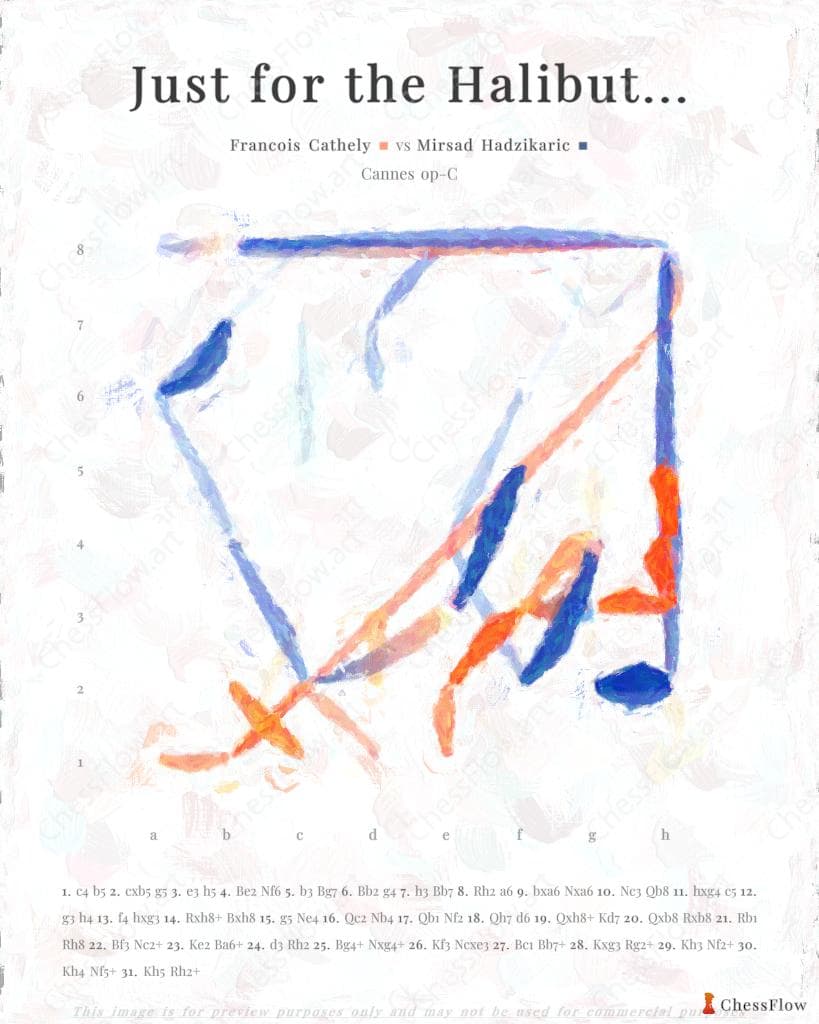
Francois Cathely vs Mirsad Hadzikaric
Francois Cathely vs Mirsad Hadzikaric
The Opening Gambit Francois Cathely and Mirsad Hadzikaric faced off in the 1995 Cannes op-C tournament with an opening that immediately signaled chaos was coming. After 1.c4 b5, Black's Polish Defens...
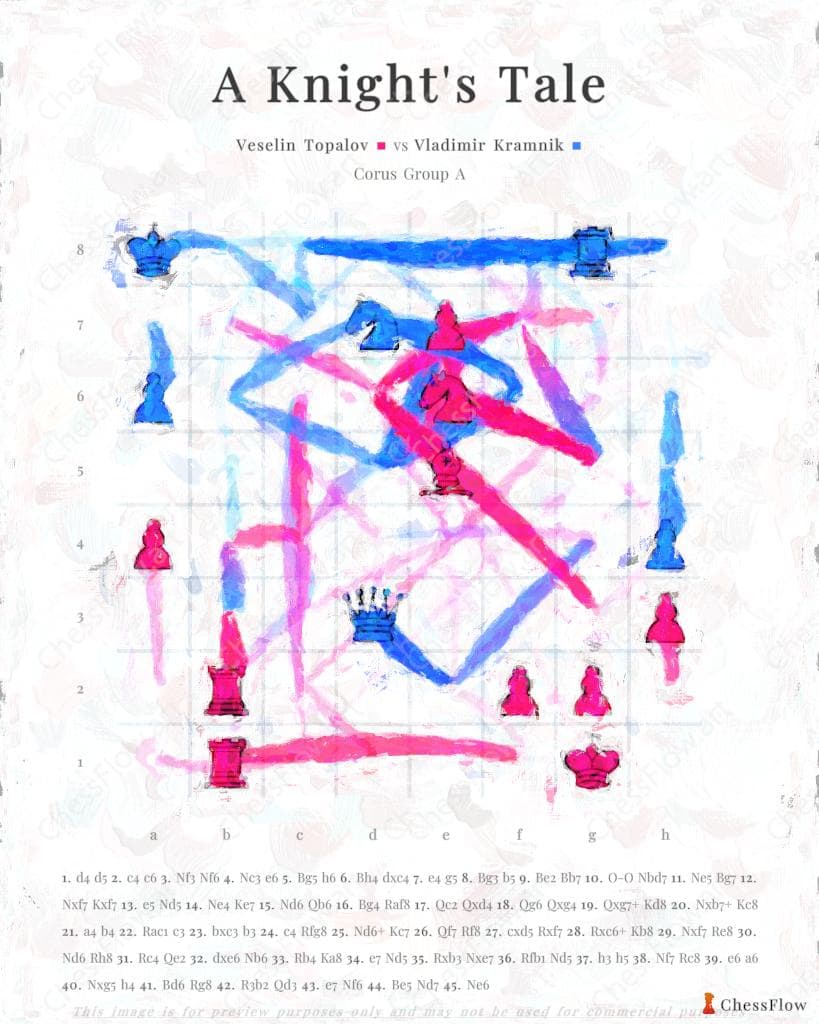
Veselin Topalov vs Vladimir Kramnik
Veselin Topalov vs Vladimir Kramnik
The Knight Sacrifice That Shook Wijk aan Zee Veselin Topalov pulled off one of the most spectacular attacking victories of the 2008 Corus tournament, defeating Vladimir Kramnik with a brilliant knigh...
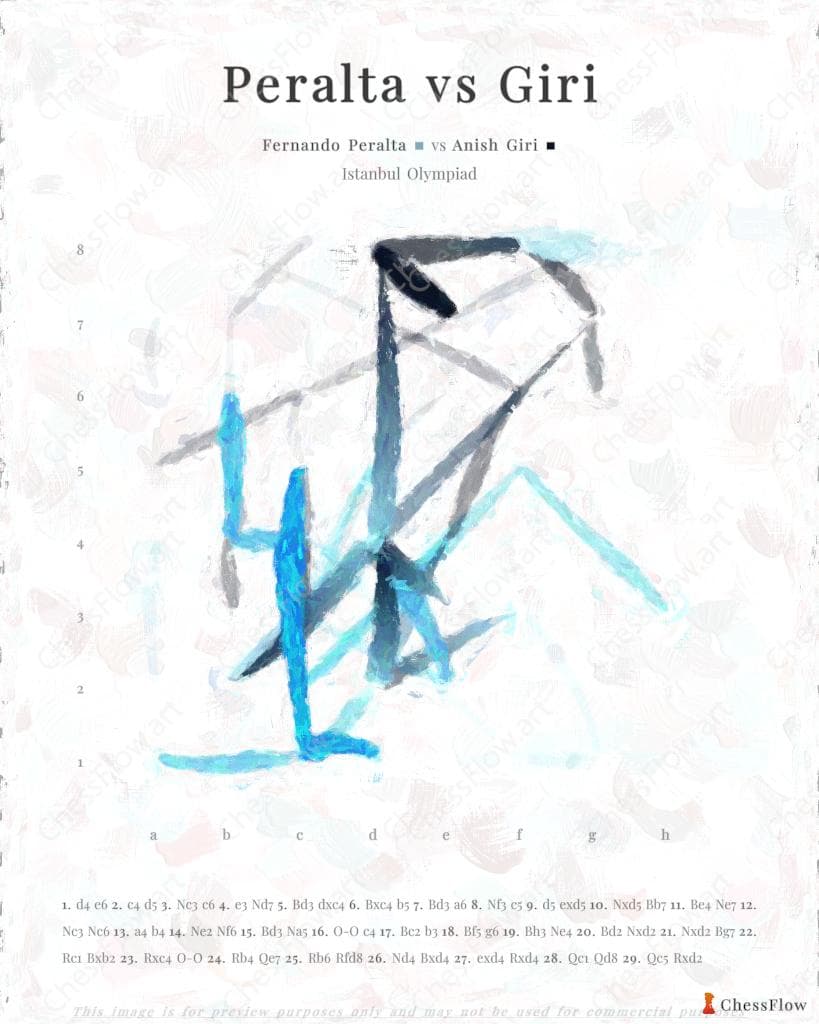
Fernando Peralta vs Anish Giri
Fernando Peralta vs Anish Giri
The Opening Battle Fernando Peralta (2606) faced off against rising Dutch talent Anish Giri (2711) in round 5 of the 2012 Istanbul Olympiad. The game opened with the Queen's Gambit Declined, Semi-Sla...