Finals: Petrov, Nikita - Sonis, Francesco
Petrov vs Sonis Draw in Italian Team Championship Finals


Petrov's Paradox
A 26-Move Handshake in the Italian Team Championship Finals
Nikita Petrov and Francesco Sonis shook hands after just 26 moves in the finals of the Italian Team Championship 2026, splitting the point in a Queen's Indian that never caught fire. The draw, agreed on April 30th with both players' clocks still showing over an hour, felt like a mutual acknowledgment that neither side had found anything worth fighting for in this particular theoretical line.
Petrov, representing Palermo Scacchi Master, came into the game rated 2554 — four points below Sonis, who was playing for Arzachess Costa Smeralda. The gap is negligible at this level, and the game reflected that parity. Both grandmasters navigated the opening with the kind of precision that suggests deep preparation but produces little drama.
The Kramnik Variation and Its Reputation
The game opened with 1.d4 Nf6 2.c4 e6 3.Nf3 b6 4.g3 Bb7 5.Bg2 Be7 6.O-O O-O 7.Re1, entering the Fianchetto Variation of the Queen's Indian with the Kramnik Variation. This is a system known for its solidity rather than its fireworks. White aims for a slight space advantage; Black aims to neutralize it. When both players know the theory well, the result is often exactly what we saw here.
Petrov's 7.Re1 is the modern choice, preparing to support the e4 advance while keeping options open. Sonis responded with 7...Re8, mirroring the rook placement and signaling he wasn't interested in sharp play either. The symmetry of the rooks on e1 and e8 in the early middlegame often foreshadows a technical battle where the smallest advantages matter — or a quick draw when neither side can manufacture them.
The Bishop Dance on Move 8-11
The first hint of tension came when Sonis played 8...Bb4, pinning the knight on c3 against the queen. This is a thematic idea in Queen's Indian structures — Black trades the dark-squared bishop (which often struggles for activity in these positions) for White's knight, potentially weakening White's control of the d5 square.
Petrov responded calmly with 9.Bd2, offering to trade bishops instead of knights. After 9...d6 10.Qc2, Sonis went through with 10...Bxc3, giving up the bishop pair but simplifying the position. The evaluation barely flickered — engines showed +0.39 to +0.41 throughout this sequence, the kind of microscopic edge that means nothing in practical play.
What followed was a curious bishop shuffle. After 11.Bxc3 Be4, Sonis's light-squared bishop lunged forward, temporarily blocking White's e-pawn and eyeing the long diagonal. Petrov responded with 12.Qa4, sidestepping any discovered attack ideas while putting pressure on a7. Then came 12...Nbd7 13.Bh3, and Sonis retreated with 13...Bb7, the bishop returning to its original square after a four-move journey.
This kind of maneuvering looks strange on paper — why move a piece just to bring it back? But in high-level chess, these probing moves serve a purpose. Sonis was testing whether Petrov would overcommit, whether the bishop on h3 might become misplaced, whether any tactical opportunities would emerge from the shuffling. None did.
The Central Break That Wasn't
The game's only real moment of strategic interest came with 14...e5, Sonis's central pawn break. This is the standard way for Black to fight for equality in Queen's Indian structures — challenge White's control of the center and activate the pieces.
The PGN cuts off at this point, but the game continued for only 12 more moves before the draw was agreed. The evaluation after 14...e5 showed +0.36 for White — essentially nothing. Both players likely saw that the resulting positions would be symmetrical, with neither side having any realistic winning chances without a significant error from the opponent.
In team championships, context matters. A draw with Black against a player of similar strength is often a perfectly acceptable result, especially in a finals match where the overall team score determines everything. Sonis, playing for Arzachess Costa Smeralda, may have been content to hold the draw and let his teammates fight for the decisive results. Petrov, for his part, couldn't find a way to generate problems.
Two Players With History
This wasn't the first time these two had faced each other. The research shows they've met before in the Italian Team Championship, with another draw in a Sicilian Defense earlier in the tournament cycle. Their games have a pattern: solid, theoretical, uneventful. Neither player seems interested in taking unnecessary risks against the other.
Sonis, born in 2002 in Genoa, earned his GM title in 2021 and has been a fixture in Italian chess since. His international experience includes a notable performance at the 45th Chess Olympiad, where Italy upset the Netherlands 3-1 — Sonis scored a full point against Max Warmerdam in that match, contributing to one of the tournament's biggest surprises. He's also competed at the Saint Louis Masters, drawing against Fabiano Caruana in round one.
Petrov, originally from Novorossiysk and now representing Montenegro, peaked at 2610 in April 2019 and has been hovering in the mid-2500s since. His current rating of 2554 reflects a player who's consistent but hasn't broken through to the super-GM level. In this tournament, he's been reliable for Palermo, but this draw was characteristic of his careful approach.
The Human Side of a Quiet Game
Engines will tell you this game was equal from start to finish. The evaluation never exceeded +0.53 (after 8...Bb4), and it hovered around +0.3 for most of the middlegame. In that sense, both players played accurately — no blunders, no missed tactics, no dramatic swings.
But "accurate" doesn't mean "interesting." The Queen's Indian, particularly in its Fianchetto variations, can produce games that are technically correct but utterly devoid of tension. Both players knew the theory, both players played the theory, and neither player found a reason to deviate from it. The result was predetermined somewhere around move 10.
This is the paradox that Petrov's games sometimes embody: precision that produces draws. When you're well-prepared and your opponent is well-prepared, the game becomes a negotiation rather than a fight. The title "Petrov's Paradox" captures this — the better both players know the theory, the less likely either is to win.
What the Draw Means
In the context of the Italian Team Championship finals, this draw was one result among many on the day. Team championships are decided by match points, not individual game results, so a solid draw on one board can be perfectly acceptable if the team is winning elsewhere.
For Sonis, holding with Black against a player of equal strength is a reasonable outcome. For Petrov, failing to convert the White pieces is a small disappointment but not a disaster. Both players will move on to the next round, the next tournament, the next theoretical discussion in the Queen's Indian.
The game itself won't appear in any "best of" collections. There were no sacrifices, no time scrambles, no dramatic reversals. It was professional chess at its most workmanlike — two GMs doing their jobs, neither making a mistake, both content with the split point.
A Game for the Archives
Not every game needs to be a classic. Sometimes the story is in what didn't happen — the complications that were avoided, the risks that weren't taken, the draw that both players saw coming from miles away. This was one of those games.
The position after move 14, with the central tension about to resolve, has a certain geometric appeal — the fianchettoed bishops, the symmetrical rook placements, the knights maneuvering for post-e5 squares. We turned this one into a print for those who appreciate the architecture of a quiet position. Sometimes the most interesting thing about a game is how little happened.
The Italian Team Championship continues, with Palermo Scacchi Master and Arzachess Costa Smeralda both still in contention. Petrov and Sonis will likely face each other again — and if history is any guide, the result will be the same.
1.d4 Nf6 2.c4 e6 3.Nf3 b6 4.g3 Bb7 5.Bg2 Be7 6.O-O O-O 7.Re1 Re8 8.Nc3 Bb4 9.Bd2 d6 10.Qc2 Bxc3 11.Bxc3 Be4 12.Qa4 Nbd7 13.Bh3 Bb7 14.Nd2 e5 15.d5 h5 16.e4 a5 17.Qc2 Bc8 18.Nf3 Nc5 19.Bg2 Bd7 20.b3 Qc8 21.Ng5 h4 22.Bd2 Nh5 23.Bf3 Bg4 24.Qd1 Nf6 25.Bxg4 Nxg4 26.h3 Nf6 1/2-1/2
How would it look as art?


Own a piece of chess history. Transform this legendary game into a unique piece of art for your home or office.
Perfect For
- Unique Gifts for chess enthusiasts and players
- Tournament Prizes that winners will treasure
- Club Decor for chess clubs and gaming spaces
- Office Art showcasing strategic thinking
- Personal Collection of historic games
Explore more
Turn Your Games Into Art
Whether it's your own game from Chess.com or Lichess, or another historic masterpiece, transform any chess game into a stunning visual artwork.
You might also like
More legendary chess game stories
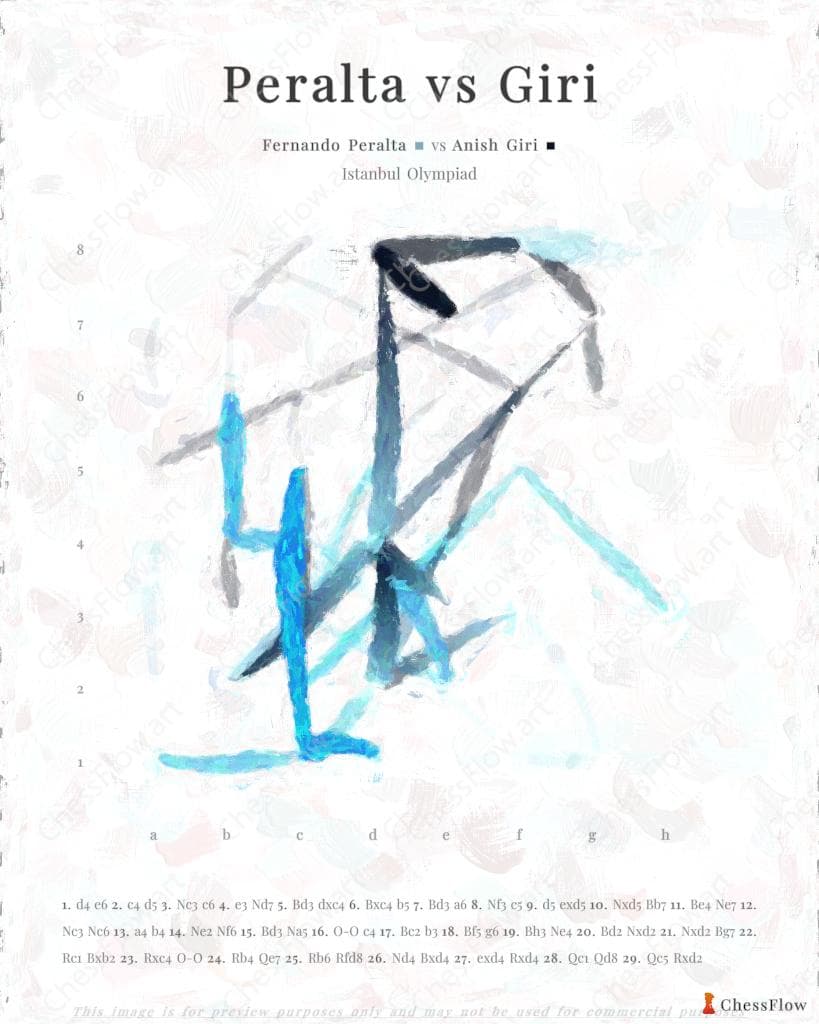
Fernando Peralta vs Anish Giri
Fernando Peralta vs Anish Giri
The Opening Battle Fernando Peralta (2606) faced off against rising Dutch talent Anish Giri (2711) in round 5 of the 2012 Istanbul Olympiad. The game opened with the Queen's Gambit Declined, Semi-Sla...
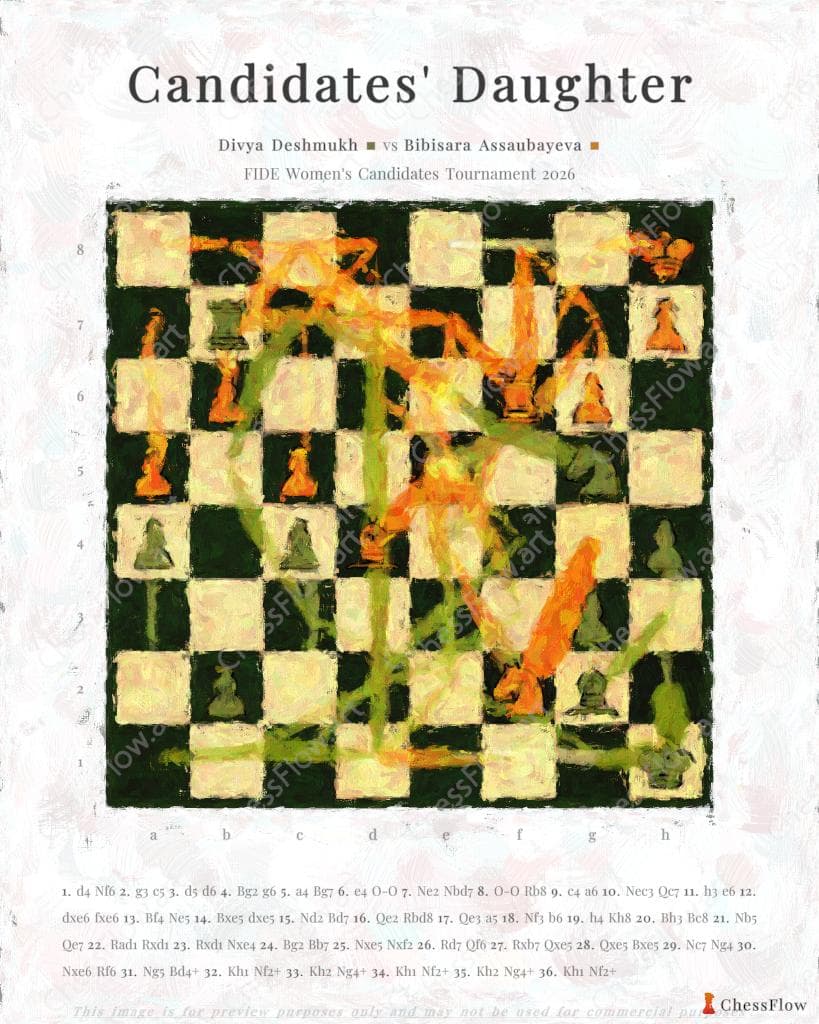
Divya Deshmukh vs Bibisara Assaubayeva
Divya Deshmukh vs Bibisara Assaubayeva
The Final Round Showdown Round 14 of the 2026 FIDE Women's Candidates Tournament delivered a crucial draw between GM Divya Deshmukh (2497) and GM Bibisara Assaubayeva (2516). With Assaubayeva enterin...
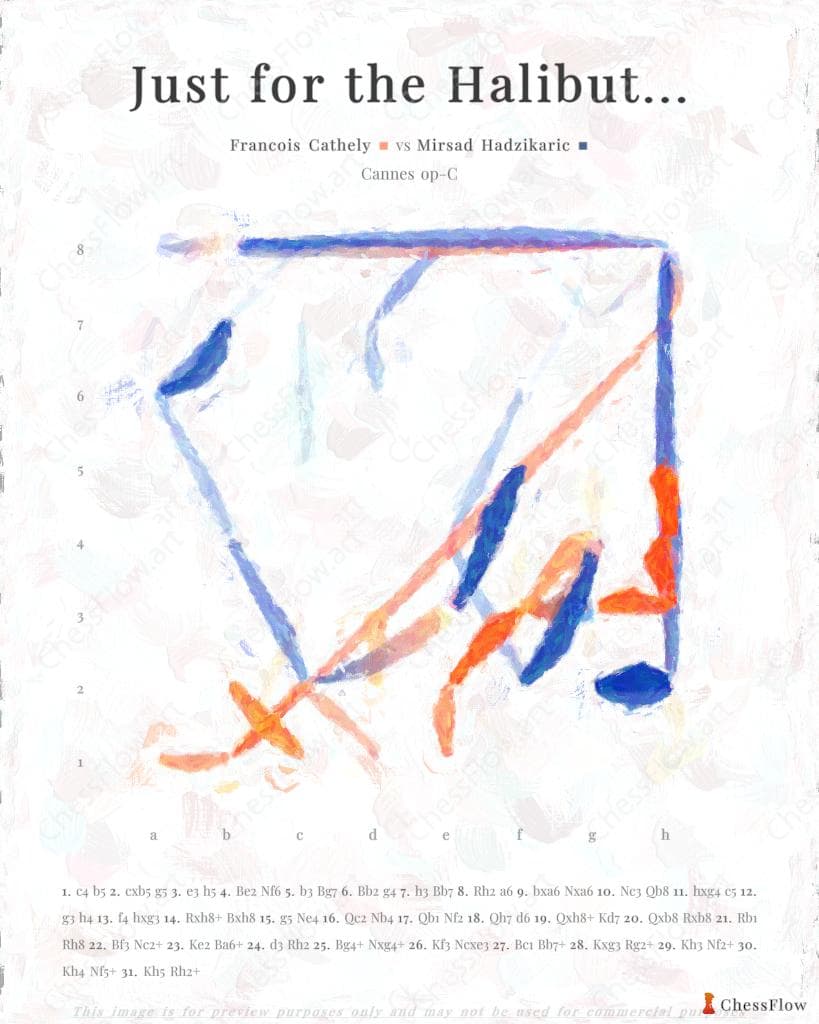
Francois Cathely vs Mirsad Hadzikaric
Francois Cathely vs Mirsad Hadzikaric
The Opening Gambit Francois Cathely and Mirsad Hadzikaric faced off in the 1995 Cannes op-C tournament with an opening that immediately signaled chaos was coming. After 1.c4 b5, Black's Polish Defens...