VII Coop Saaremaa Chess Festival Rapid
Ponomariov-Shirov Draw at Saaremaa 2026: Quick Peace in Round 10


Saaremaa Nocturne
Two Legends Split the Point in Estonia
Ruslan Ponomariov and Alexei Shirov, two players who have been trading blows at the highest levels of chess for over two decades, played to a quiet draw in Round 10 of the VII Coop Saaremaa Chess Festival Rapid in Estonia. The game lasted just 15 moves before the pieces came off and a handshake ended proceedings — a far cry from the fireworks these two have produced in the past, but perhaps fitting for a late-round rapid game where both players were managing energy and standings.
The draw keeps both grandmasters in the mix at the Asa Spa Hotel venue, though neither will look back on this particular encounter as one for the highlight reel. Sometimes chess at this level is about knowing when not to push, and this game had that feeling from early on.
The English Goes Quiet
Ponomariov opened with 1.Nf3 followed by 2.c4, steering the game into English Opening territory. Shirov responded with the Anglo-Indian setup via 1...Nf6 2...e6, and the position quickly took on a Queen's Indian flavor with White's fianchettoed bishop on b2 and Black's solid pawn structure.
The opening sequence 1.Nf3 Nf6 2.c4 e6 3.b3 d5 4.Bb2 Be7 5.g3 O-O 6.Bg2 c5 is well-trodden ground for both players. Ponomariov, the youngest FIDE World Champion in history when he claimed the title in 2002 at just 18 years old, has always been comfortable in these fluid English structures where piece play matters more than pawn breaks. Shirov, ranked number two in the world back in 1994 and known throughout his career for tactical fireworks, seemed content to keep things symmetrical.
After 7.O-O Nc6 8.cxd5 Nxd5, the central tension resolved early. This is a critical decision point in many English lines — White can maintain the tension with moves like d3 or Qc2, but Ponomariov chose to clarify matters immediately. The resulting position offers White a slight spatial advantage but Black has no weaknesses to exploit.
The Knight Dance
The middle game featured a curious sequence where both sides seemed to be trading pieces by mutual agreement. After 9.Nc3 Bf6, Shirov repositioned his bishop to put pressure on the long diagonal. Ponomariov responded with 10.Qc1, an interesting prophylactic move that prepares to recapture on c3 with the queen if needed while also eyeing the c-file.
Shirov then played 10...Nxc3 11.Bxc3, and here the game took its most dynamic turn. Black found 11...Nd4, a strong centralizing move that plants the knight on an excellent outpost. The knight on d4 controls key squares and creates tactical possibilities, but Ponomariov handled the situation calmly.
After 12.Re1 Bd7 13.e3, White forced the knight to make a decision. The engines show the position as dead equal here — around +0.15 for White, which in practical terms means nothing. But what the engines don't capture is the psychology of rapid chess: Shirov had already burned over five minutes on the clock getting to this position, while Ponomariov was still flush with time.
The continuation 13...Nxf3+ 14.Bxf3 Bxc3 15.Qxc3 saw a flurry of exchanges that simplified the position dramatically. By move 15, both bishops had come off the board, and the resulting queen-and-rooks position offered neither side any realistic winning chances.
The Rapid Chess Reality
What's striking about this game is how both players seemed to recognize the limitations of the position early and chose not to overextend. In classical chess, you might see one or both players try to create imbalances even in sterile positions. In rapid, with only 12 minutes plus 3-second increment, the calculus changes.
Ponomariov, now rated 2638, has been a fixture on the European circuit for nearly three decades. His peak came in the early 2000s when he won the FIDE World Championship by defeating his compatriot Vasyl Ivanchuk 4½-2½ in the final. At just 18, he became the youngest world champion in history at that time — a record that stood until Magnus Carlsen's generation came along.
Shirov, rated 2597 in this event, carries his own legendary status. The Latvian-Spanish grandmaster was once considered the most dangerous attacking player in the world, and his book Fire on the Board remains a classic of chess literature. His 1998 match victory over Vladimir Kramnik should have earned him a world championship match against Garry Kasparov, but that match infamously never materialized due to financial and organizational issues.
When these two sit across from each other, there's over 50 years of combined elite chess experience at the board. They've seen every position, every trick, every psychological gambit. Perhaps that's why this game ended so peacefully — mutual respect between two players who know exactly what the other is capable of.
The Position After 15 Moves
After 15...Qb6, Shirov's queen came to an active square, but the position offered no real prospects for either side. The pawn structure was symmetrical, the pieces were balanced, and neither king faced any danger. The game concluded shortly after, though the final moves aren't recorded in the broadcast PGN.
The engine evaluation never exceeded +0.33 throughout the entire game, which tells you everything you need to know about the level of accuracy from both players. In rapid chess, maintaining such precise play is an achievement in itself, even if it doesn't produce memorable combinations.
What This Means for the Festival
The Saaremaa Chess Festival has become a regular stop on the rapid circuit, attracting strong grandmasters to the Estonian island for competitive play in a relaxed setting. For both Ponomariov and Shirov, events like this serve multiple purposes: they keep the competitive edge sharp, provide opportunities to test opening ideas in faster time controls, and offer a chance to earn rating points and prize money outside the grueling classical calendar.
This draw was Round 10, suggesting both players had already played significant chess before sitting down for this encounter. In a multi-round rapid event, energy management becomes crucial. A quick draw against a dangerous opponent can sometimes be the smart play, preserving resources for later rounds where a full point might be more achievable.
For chess fans hoping to see Shirov uncork one of his famous sacrifices or Ponomariov demonstrate the precise technique that made him world champion, this game didn't deliver. But that's the nature of professional chess — not every game can be a classic, and knowing when to take the half-point is its own skill.
The position after move 11, with Shirov's knight landing on d4, is actually the kind of moment we turned into a print. That centralized knight, controlling the board before the simplifications began — there's something visually satisfying about it even if the game itself didn't catch fire.
Two Careers, One Handshake
Ponomariov and Shirov represent a generation of chess players who came of age in the chaotic post-Soviet era, when the chess world was fragmenting between FIDE and classical world championship cycles. Both have world championship credentials — Ponomariov as FIDE champion, Shirov as someone who earned the right to challenge for the classical title but was denied the opportunity.
Now in their fifties (Shirov turned 53 in July 2025, Ponomariov is 42), they continue to compete at a high level, though the days of challenging for world titles are behind them. What remains is the craft itself: the opening preparation, the tactical alertness, the endgame technique built over thousands of games.
This draw at Saaremaa won't appear in any best games collections. It won't be analyzed in opening manuals or cited as an example of either player's style. But it's a reminder that professional chess is built on hundreds of games like this — solid, professional, uneventful encounters between skilled players who respect each other's abilities.
The VII Coop Saaremaa Chess Festival continues, and both grandmasters will have more chances to make their mark on the event. For now, half a point each, and on to the next round.
1.Nf3 Nf6 2.c4 e6 3.b3 d5 4.Bb2 Be7 5.g3 O-O 6.Bg2 c5 7.O-O Nc6 8.cxd5 Nxd5 9.Nc3 Bf6 10.Qc1 Nxc3 11.Bxc3 Nd4 12.Re1 Bd7 13.e3 Nxf3+ 14.Bxf3 Bxc3 15.Qxc3 Qb6 16.Red1 Rac8 17.d4 Bc6 18.Bxc6 Rxc6 19.d5 Rd6 20.dxe6 fxe6 21.Rac1 Rxd1+ 22.Rxd1 Qc7 23.Rd3 b6 24.Qd2 Qe5 25.Rd7 a5 26.Qc2 b5 27.Rb7 c4 28.bxc4 Rc8 29.Qd2 bxc4 30.Qd7 Rf8 31.Rc7 Qf6 32.f4 Qa1+ 33.Kf2 Qxa2+ 34.Kf3 Qa1 35.Qxe6+ Kh8 36.Qxc4 Qh1+ 37.Kg4 Qxh2 38.Qc3 h5+ 39.Kf3 Qh1+ 40.Kf2 Qh2+ 41.Kf3 Qh1+ 42.Kf2 Qh2+ 43.Kf3 1/2-1/2
How would it look as art?


Own a piece of chess history. Transform this legendary game into a unique piece of art for your home or office.
Perfect For
- Unique Gifts for chess enthusiasts and players
- Tournament Prizes that winners will treasure
- Club Decor for chess clubs and gaming spaces
- Office Art showcasing strategic thinking
- Personal Collection of historic games
Turn Your Games Into Art
Whether it's your own game from Chess.com or Lichess, or another historic masterpiece, transform any chess game into a stunning visual artwork.
You might also like
More legendary chess game stories
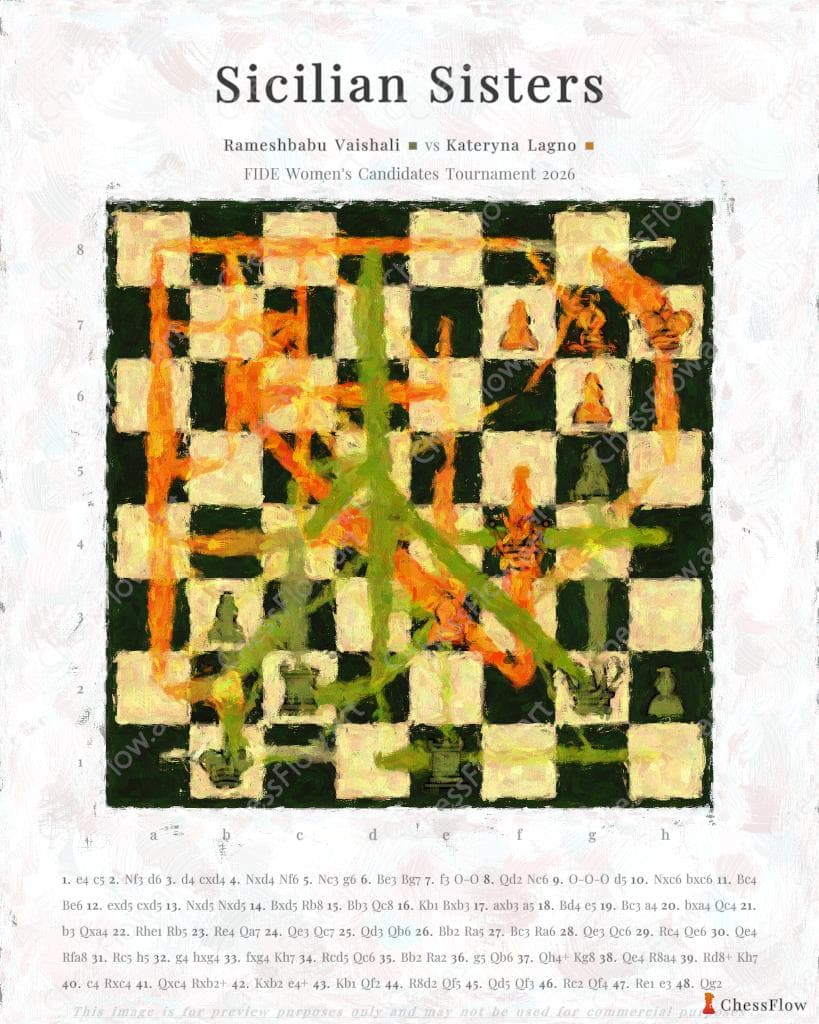
Rameshbabu Vaishali vs Kateryna Lagno
Rameshbabu Vaishali vs Kateryna Lagno
Vaishali Strikes in the Dragon Vaishali Rameshbabu defeated Kateryna Lagno in round 14 of the FIDE Women's Candidates Tournament 2026, playing a sharp Sicilian Dragon that ended in White's favor. The...
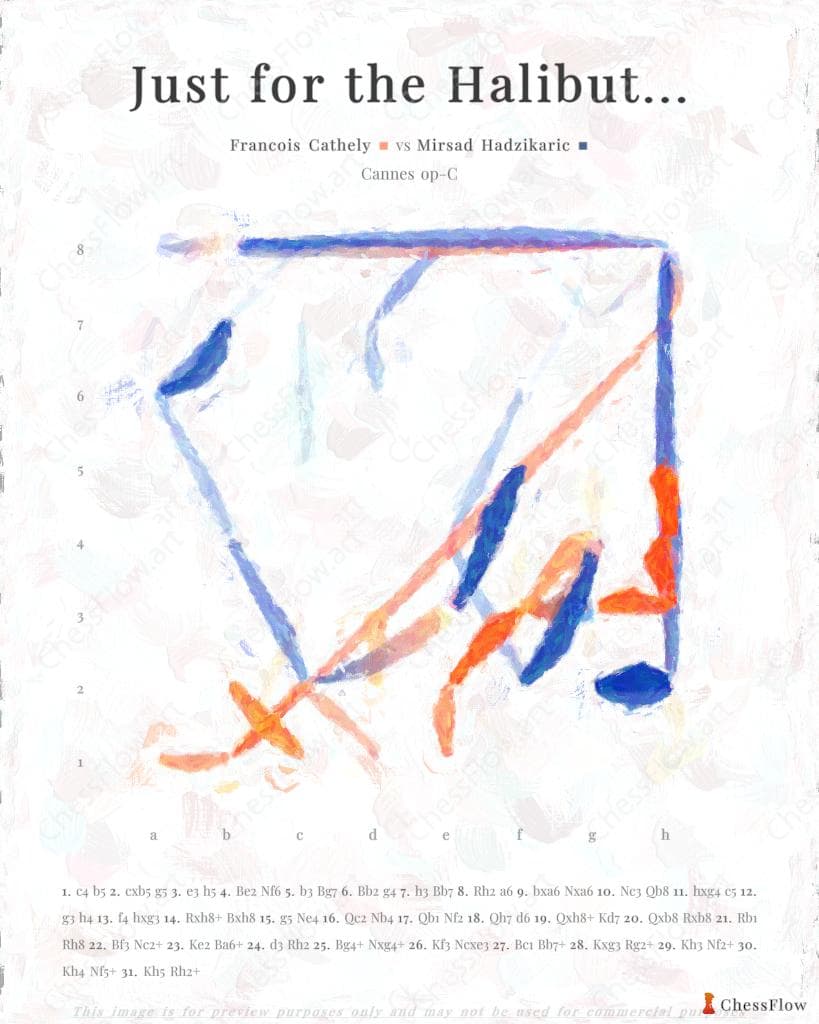
Francois Cathely vs Mirsad Hadzikaric
Francois Cathely vs Mirsad Hadzikaric
The Opening Gambit Francois Cathely and Mirsad Hadzikaric faced off in the 1995 Cannes op-C tournament with an opening that immediately signaled chaos was coming. After 1.c4 b5, Black's Polish Defens...
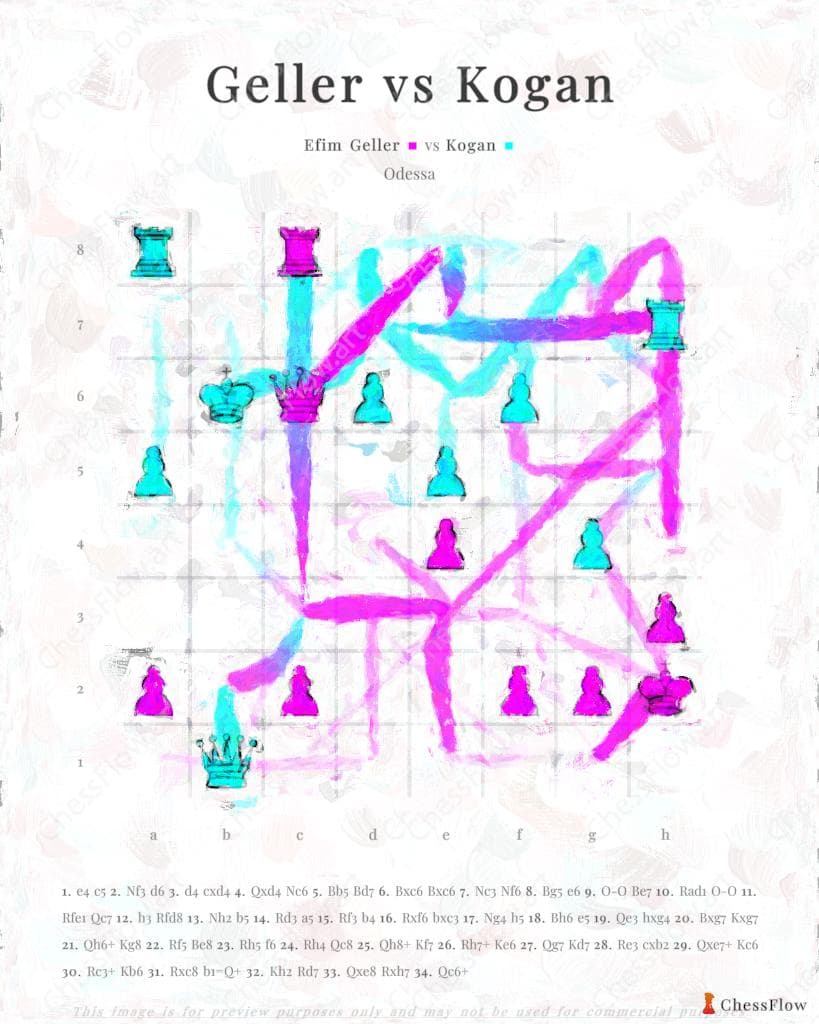
Efim Geller vs Kogan
Efim Geller vs Kogan
The Opening Efim Geller, just 21 years old at the time, faced Kogan in the 1946 Odessa tournament with the Sicilian Defense's Accelerated Dragon variation (ECO B53). The opening followed standard lin...