2026 Dreamhack Atlanta Group A
Sarana Defeats Hong in King's Indian at DreamHack Atlanta 2026


Atlanta Dreaming
Sarana Punishes Hong's King's Indian Ambitions in Atlanta
Alexey Sarana secured a critical quarterfinal victory over Andrew Hong at the 2026 DreamHack Atlanta Group A, converting a positional edge in the Makogonov Variation of the King's Indian Defense. The game ended by resignation after just 14 moves—an unusually short affair for this level—but the position told the whole story: Hong's kingside counterplay had stalled before it ever got going, and Sarana's methodical piece placement left Black facing an uphill battle with no clear path forward.
The result matters for both players' tournament trajectories. Sarana, rated 2664 and currently ranked 52nd in the world according to the May 2026 FIDE list, continues his strong run of form that saw him finish second at the GRENKE Freestyle Open earlier this year. Hong, the American GM rated 2592, had been looking to build on his own impressive 2026 campaign—including a Titled Tuesday victory in 2024—but found himself outmaneuvered in the opening before the middlegame complications he craves ever materialized.
The Makogonov: White's Anti-Fun System
The King's Indian Defense has always been about controlled chaos. Black accepts a cramped position, builds pressure on the kingside, and hopes to unleash a devastating attack before White's queenside play becomes overwhelming. The Makogonov Variation with 5.h3 is White's way of saying: not today.
After the standard sequence 1.d4 Nf6 2.c4 g6 3.Nc3 Bg7 4.e4 d6, Sarana played 5.h3, the move that defines this system. It looks modest—just a pawn move—but it accomplishes several things at once. It prepares Be3 without allowing ...Ng4 exchanges, it takes away the g4 square from Black's knight permanently, and it signals that White intends to play a slow, methodical game rather than racing for quick development.
Hong responded with the thematic 5...e5, staking his claim in the center and preparing the standard King's Indian pawn storm. After 6.d5, closing the center and committing to the classic King's Indian structure, Hong played 6...a5—a useful move that prevents White's b4 expansion and reserves the a6 square for the knight.
The position after the first ten moves was textbook King's Indian territory. White has space and a clear plan: expand on the queenside with c5 or b4, develop the pieces harmoniously, and keep Black's kingside attack under control. Black's plan is equally clear: push ...f5, open the f-file, and throw everything at White's king.
Hong's Knight Maneuver Backfires
The critical sequence began around move 10. After 10.Bd3, Sarana had completed his development with the bishop eyeing the f5 square—a key point in the King's Indian where Black often wants to place a pawn. Hong responded with 10...Nh5, a standard idea in these structures. The knight heads for f4, where it will be a monster piece attacking e2 and supporting the ...f5 break.
Sarana's response was precise: 11.g3, kicking the knight before it could settle on f4 and creating a solid pawn structure around his king. This is the kind of move that engines don't get excited about—the evaluation barely budged from +0.25—but humans understand its significance. White is saying: your knight isn't welcome here, and I'm not afraid of weakening my kingside because you'll never get enough pieces there to exploit it.
Hong pushed forward anyway with 11...f5, the move Black has been preparing since move 5. This is the King's Indian player's moment of truth—the pawn break that's supposed to blow open the position and create attacking chances. But timing is everything in chess, and here the timing felt slightly off.
After 12.exf5 gxf5, the position transformed. Black has an open g-file and a pawn on f5 supporting a potential knight on f4. On paper, this looks like Black is achieving his strategic goals. In practice, White's pieces are better coordinated, the f5 pawn is potentially weak, and Black's king is more exposed than White's.
The Knight Dance: Nh4 and Nf4
Sarana's 13.Nh4 was a clever intermezzo. The knight eyes the f5 pawn and prepares to swing to f3 or even g6 in some lines. It also prevents Black from comfortably playing ...Nf4 immediately, as the knight would be exchanged under favorable circumstances for White.
Hong played 13...Nf4 anyway, the move he'd been planning all along. The knight on f4 is objectively strong—it attacks e2, controls key squares, and can't easily be removed. But Sarana's calm 14.Bc2 revealed the problem with Black's position: White is simply better coordinated.
The bishop retreats to a safe square where it still eyes the kingside, and Black is left wondering what to do next. The knight on f4 looks impressive, but what does it actually threaten? The e2 square is defended, the kingside attack has no other pieces supporting it, and White can continue improving his position while Black struggles to find a plan.
This is where Hong resigned, and while 14 moves feels early, the position explains the decision. In rapid chess with only 10 minutes per side, defending a slightly worse position for 30-40 more moves is exhausting and often futile. Hong's counterplay had been neutralized, his knight on a6 was still out of play, and Sarana's pieces were all pointing at Black's weaknesses.
The Engine Says Equal, The Human Says Otherwise
Looking at the evaluation after move 14, engines assess the position as roughly +0.28—barely anything in computer terms. But this number hides the human reality of the position. Black has no active plan. The knight on f4 is strong but isolated. The knight on a6 is terrible. The f5 pawn could become a target. White can slowly improve with moves like Qf3, 0-0, Nf3, and eventually break through on the queenside.
This is the gap between silicon and carbon that makes chess endlessly fascinating. An engine sees a position where Black can hold with perfect play. A human sees a position where Black has to defend accurately for the next 30 moves while White gets to make natural improving moves. In rapid chess, with the clock ticking, that's not a fair fight.
Sarana's handling of the Makogonov was a clinic in anti-King's Indian strategy. He didn't do anything flashy—no sacrifices, no strong tactical shots. He simply played solid, logical moves that took away Black's counterplay piece by piece. By the time Hong realized his kingside attack was going nowhere, it was already too late to change course.
What This Means for DreamHack Atlanta
The win advances Sarana in the upper bracket of Group A, keeping his tournament hopes alive. For Hong, it's a setback but not a disaster—the double-elimination format means he'll have another chance through the lower bracket.
Sarana's form in 2026 has been consistently strong. His second-place finish at the GRENKE Freestyle Open and his 16 Titled Tuesday wins (including one tie) mark him as one of the most dangerous rapid players in the world right now. At 26 years old and representing Serbia, he's in the prime of his career and clearly comfortable in these high-pressure rapid formats.
Hong, at 2592, is no pushover—his own Titled Tuesday victory in 2024 proves he can compete at the highest level of online rapid chess. But this game caught him on the wrong side of a theoretical debate. The Makogonov is designed to frustrate King's Indian players, and today it worked exactly as intended.
The position after 14.Bc2 is the kind of quiet dominance that looks great as a ChessFlow print—White's pieces all pointing the right direction, Black's counterplay frozen in place.
DreamHack Atlanta continues with more quarterfinal action, and Sarana will be looking to carry this momentum into his next match. For Hong, the lesson is clear: against a well-prepared opponent in the Makogonov, the King's Indian's famous kingside attack needs more than just the standard ...f5 break. It needs precise timing, and today, that timing never came.
1.d4 Nf6 2.c4 g6 3.Nc3 Bg7 4.e4 d6 5.h3 e5 6.d5 a5 7.Bg5 Na6 8.Nf3 h6 9.Be3 O-O 10.Bd3 Nh5 11.g3 f5 12.exf5 gxf5 13.Nh4 Nf4 14.Bc2 Nb4 15.Bb1 Nxh3 16.Nxf5 Nxf2 17.Bxf2 Bxf5 18.Bxf5 Rxf5 19.a3 Na6 20.Ne4 Qe7 21.Qg4 Raf8 22.Be3 Rf4 23.gxf4 exf4 24.Qe6+ Qxe6 25.dxe6 fxe3 26.Rg1 Kh7 27.Ke2 Nb8 28.Raf1 Rxf1 29.Rxf1 Nc6 30.Kxe3 Kg6 31.b4 axb4 32.axb4 h5 33.b5 Ne7 34.Rf7 Nf5+ 35.Rxf5 Kxf5 36.e7 d5 37.cxd5 Bh6+ 38.Kf3 Ke5 39.e8=Q+ Kd4 40.d6 1-0
How would it look as art?


Own a piece of chess history. Transform this legendary game into a unique piece of art for your home or office.
Perfect For
- Unique Gifts for chess enthusiasts and players
- Tournament Prizes that winners will treasure
- Club Decor for chess clubs and gaming spaces
- Office Art showcasing strategic thinking
- Personal Collection of historic games
Turn Your Games Into Art
Whether it's your own game from Chess.com or Lichess, or another historic masterpiece, transform any chess game into a stunning visual artwork.
You might also like
More legendary chess game stories
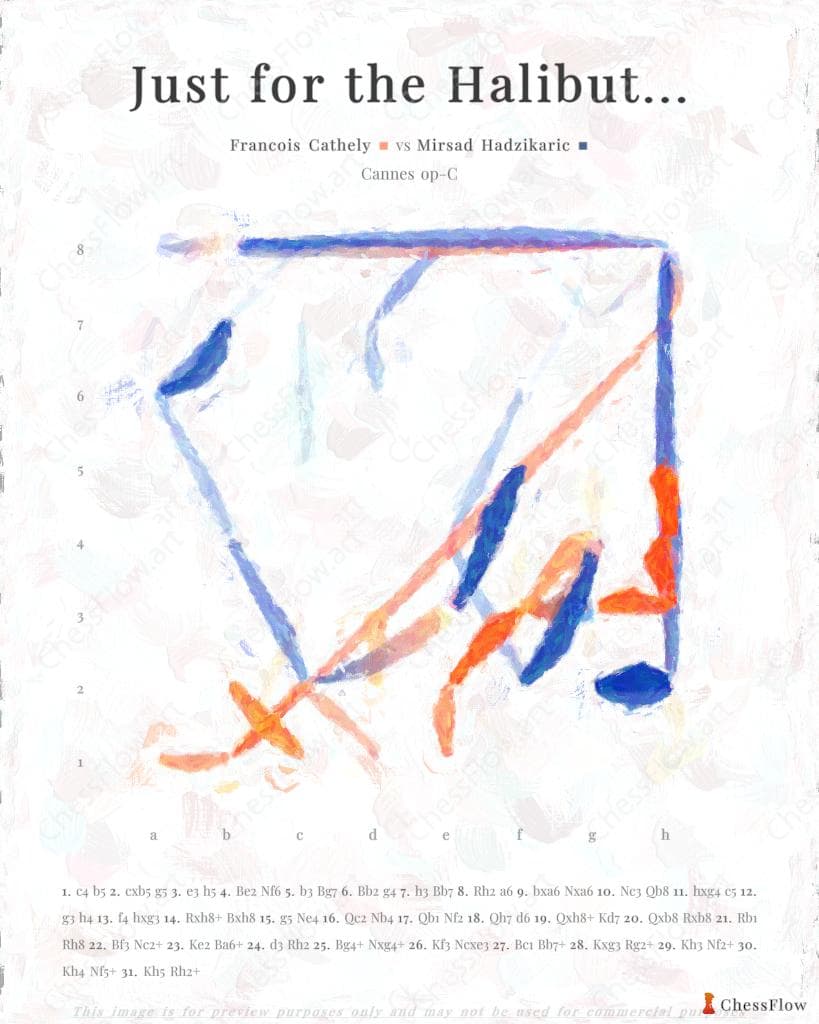
Francois Cathely vs Mirsad Hadzikaric
Francois Cathely vs Mirsad Hadzikaric
The Opening Gambit Francois Cathely and Mirsad Hadzikaric faced off in the 1995 Cannes op-C tournament with an opening that immediately signaled chaos was coming. After 1.c4 b5, Black's Polish Defens...
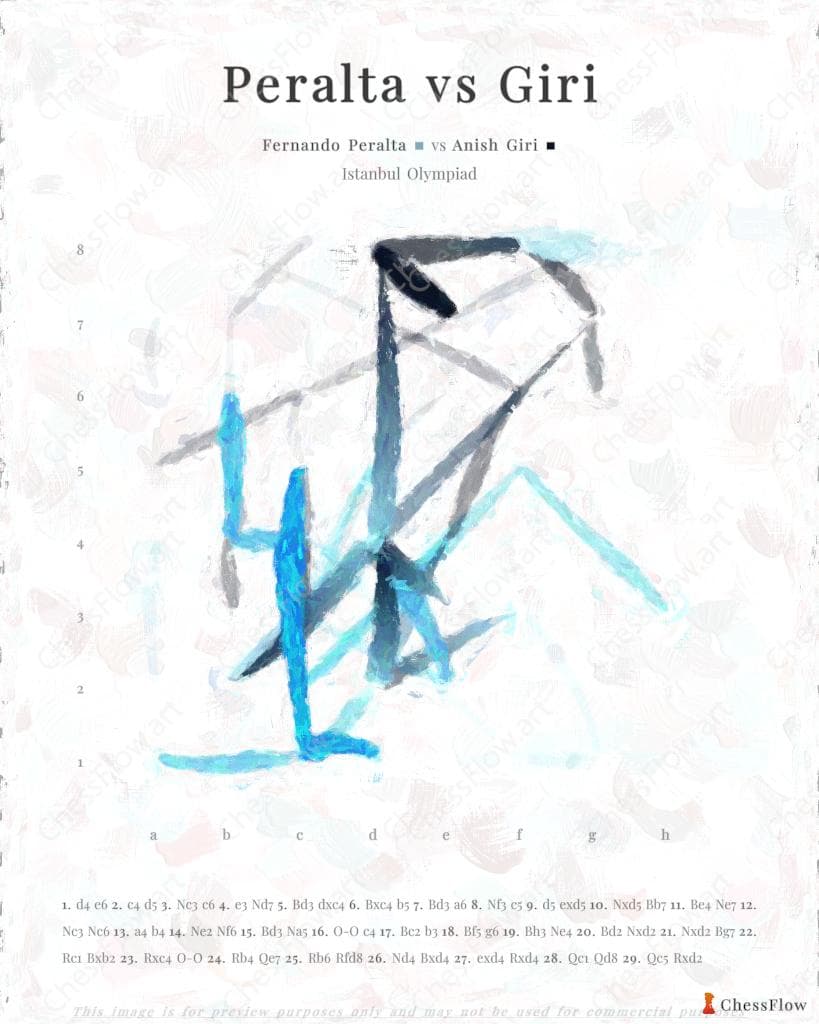
Fernando Peralta vs Anish Giri
Fernando Peralta vs Anish Giri
The Opening Battle Fernando Peralta (2606) faced off against rising Dutch talent Anish Giri (2711) in round 5 of the 2012 Istanbul Olympiad. The game opened with the Queen's Gambit Declined, Semi-Sla...
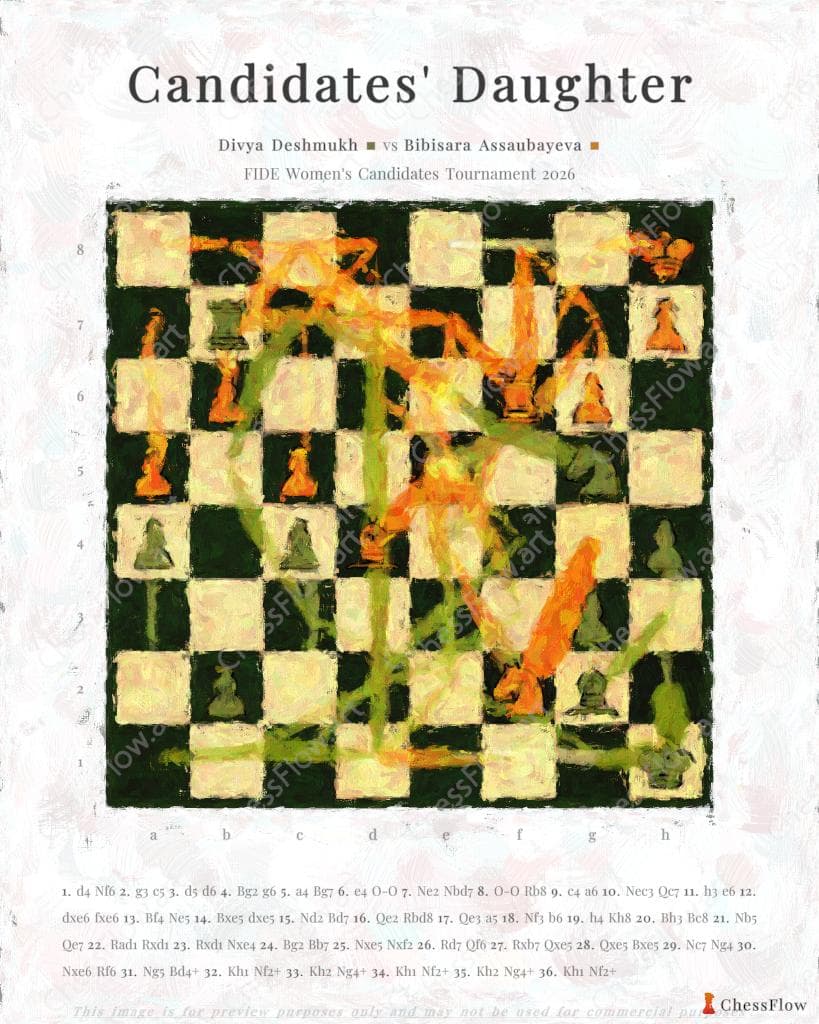
Divya Deshmukh vs Bibisara Assaubayeva
Divya Deshmukh vs Bibisara Assaubayeva
The Final Round Showdown Round 14 of the 2026 FIDE Women's Candidates Tournament delivered a crucial draw between GM Divya Deshmukh (2497) and GM Bibisara Assaubayeva (2516). With Assaubayeva enterin...