Gotha
Sliwa Beats Bronstein in the Immortal Losing Game


The Immortal Losing Game
The Immortal Losing Game
Bogdan Sliwa defeated David Bronstein in 29 moves at Gotha 1957, but this game earned its famous nickname "The Immortal Losing Game" for good reason. Despite losing decisively, Bronstein created one of chess history's most elegant tactical sequences in a hopeless position.
The game opened with the Dutch Defense after 1.d4 f5, leading to the King's Indian Attack setup with 2.g3 g6 3.Bg2 Bg7. Sliwa, a Polish master, chose an aggressive approach with early queenside castling and a pawn storm on the kingside.
The Critical Exchange
The turning point came on move 10 when Bronstein captured with 10...fxe4, opening the center. Sliwa responded with 11.Nxe4, and after the knight retreat 11...Nd5, White launched a powerful attack with 12.Ne2 and 13.c4, forcing Black's pieces into awkward positions.
Sliwa's 15.Bxc7 began a forcing sequence that netted material. After 15...O-O 16.Bd6 Qf7 17.Bxf8 Rxf8, White had won the exchange and maintained a crushing position. The move 18.dxc5 opened more lines, and Black's counterplay never materialized.
Bronstein's Beautiful Trap
Despite being completely lost, Bronstein set an elegant trap starting with 22...Nd4. After 23.Nxd8 Bb5, Black's pieces coordinated beautifully around the exposed white king. The sequence 24.Nxe6 Bd3 25.Bd5 Qf5 created tactical threats that made even a world-class player pause.
Bronstein's 26...Qxd5 and 27...Bxc3 showed his legendary tactical vision. Even in a hopeless position, he found the most challenging defensive resources, forcing White to calculate precisely to convert the advantage.
The Finish
Sliwa navigated the complications correctly with 28.bxc3 Qxa2, and after 29.cxb4, Black's attack had run out of steam. White's material advantage proved decisive, but not before Bronstein had demonstrated why losing games can sometimes be more memorable than victories.
This game perfectly captures why Bronstein was considered one of the most creative players of his generation. Even facing certain defeat, he found beauty in the position and created tactical fireworks that chess players still study today. At ChessFlow, games like this remind us that the most artistic moments in chess often come from the most desperate positions.
1.d4 f5 2.g3 g6 3.Bg2 Bg7 4.Nc3 Nf6 5.Bg5 Nc6 6.Qd2 d6 7.h4 e6 8.O-O-O h6 9.Bf4 Bd7 10.e4 fxe4 11.Nxe4 Nd5 12.Ne2 Qe7 13.c4 Nb6 14.c5 dxc5 15.Bxc7 O-O 16.Bd6 Qf7 17.Bxf8 Rxf8 18.dxc5 Nd5 19.f4 Rd8 20.N2c3 Ndb4 21.Nd6 Qf8 22.Nxb7 Nd4 23.Nxd8 Bb5 24.Nxe6 Bd3 25.Bd5 Qf5 26.Nxd4+ Qxd5 27.Nc2 Bxc3 28.bxc3 Qxa2 29.cxb4 1-0
How would it look as art?


Own a piece of chess history. Transform this legendary game into a unique piece of art for your home or office.
Perfect For
- Unique Gifts for chess enthusiasts and players
- Tournament Prizes that winners will treasure
- Club Decor for chess clubs and gaming spaces
- Office Art showcasing strategic thinking
- Personal Collection of historic games
Turn Your Games Into Art
Whether it's your own game from Chess.com or Lichess, or another historic masterpiece, transform any chess game into a stunning visual artwork.
You might also like
More legendary chess game stories
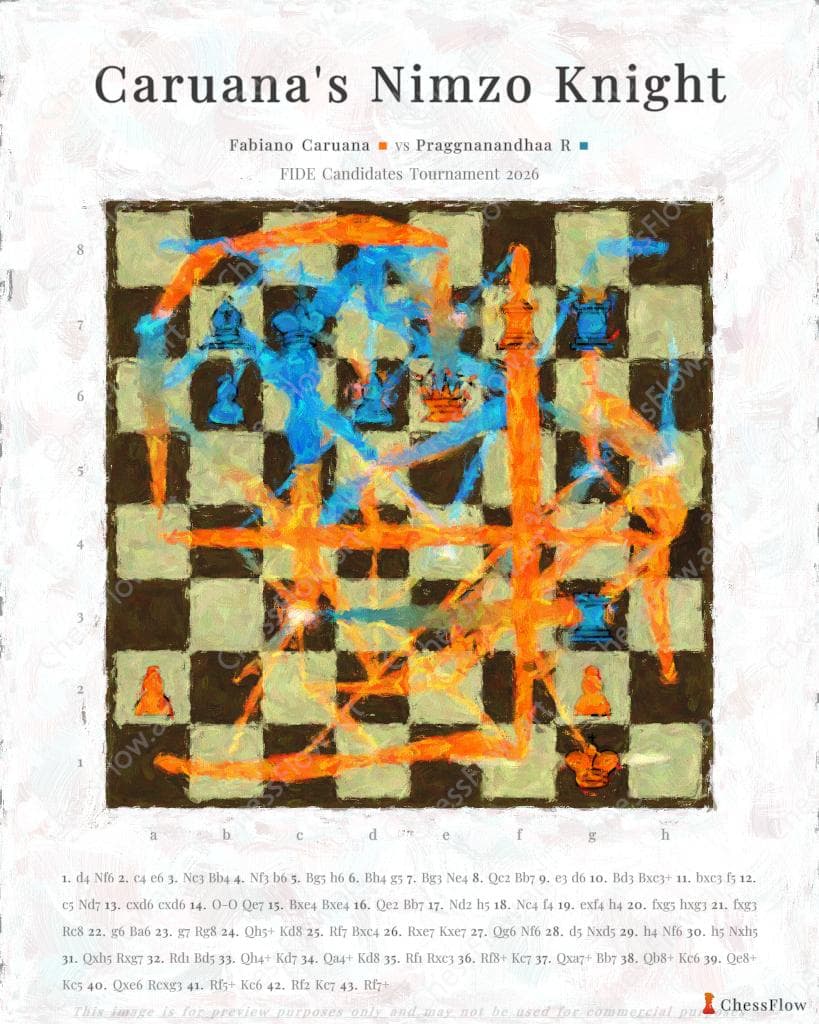
Fabiano Caruana vs Praggnanandhaa R
Fabiano Caruana vs Praggnanandhaa R
The Opening Choice Fabiano Caruana opened with 1.d4 against Praggnanandhaa in round 13 of the 2026 FIDE Candidates Tournament, leading to the Nimzo-Indian Defense after 1.d4 Nf6 2.c4. The American gr...
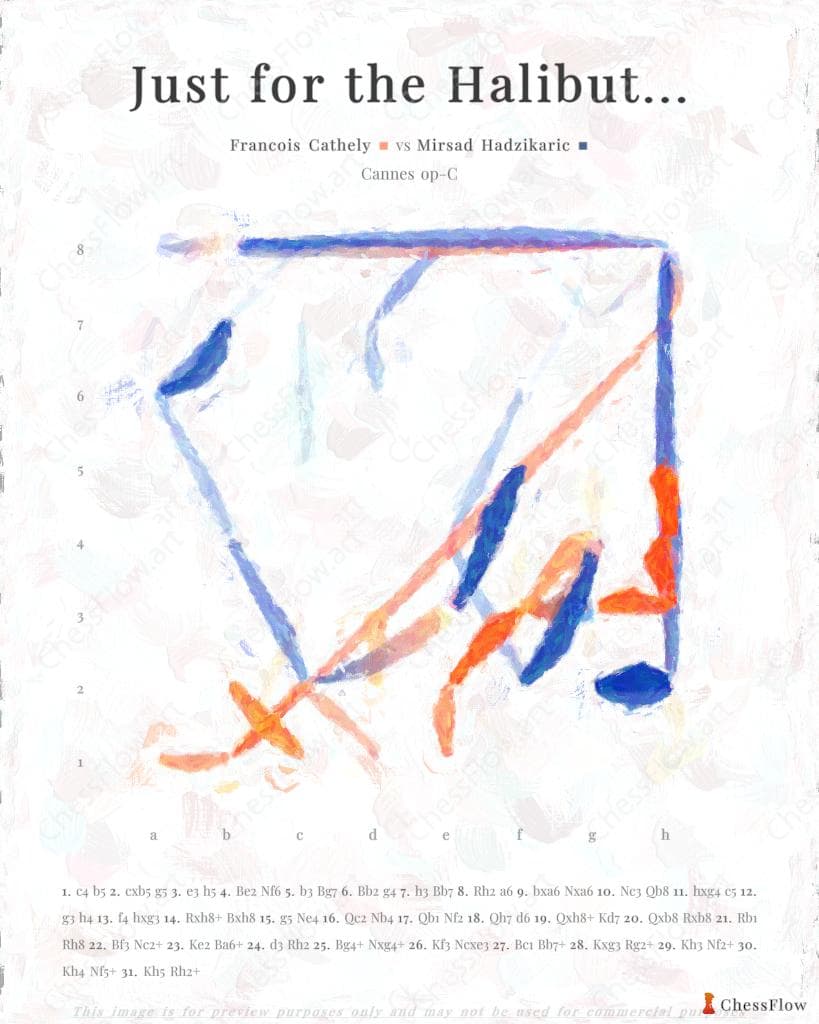
Francois Cathely vs Mirsad Hadzikaric
Francois Cathely vs Mirsad Hadzikaric
The Opening Gambit Francois Cathely and Mirsad Hadzikaric faced off in the 1995 Cannes op-C tournament with an opening that immediately signaled chaos was coming. After 1.c4 b5, Black's Polish Defens...

Fabiano Caruana vs Alireza Firouzja
Fabiano Caruana vs Alireza Firouzja
A Half-Point in the Hunt Fabiano Caruana and Alireza Firouzja traded punches for 38 moves before agreeing to a draw in Round 26 of the 2026 Super Rapid & Blitz Poland, a result that kept Caruana with...