Sardinia World Chess Festival 2026 | Open A
Karthikeyan Beats Smirin in Ruy Lopez Fianchetto Battle


Smirin's Sicilian Shore
Karthikeyan Grinds Down Smirin in Sardinia Round 8
Murali Karthikeyan added another win to his Sardinia campaign on Friday, defeating Israeli veteran Ilia Smirin with the black pieces in a Ruy Lopez Fianchetto Defense. The 86-point rating gap between the players told the story before a single piece moved, but Smirin — born in 1968 and still competing at 2562 FIDE — has never been one to go down quietly. This game, though, saw the 26-year-old Indian GM methodically extract an advantage from a seemingly balanced middlegame, then convert with precision.
The result keeps Karthikeyan in the mix at the €50,100 prize fund event, where FIDE Circuit points add extra stakes for players chasing Candidates Tournament qualification. For Smirin, it's a setback in what has been a long and storied career — the kind of game where experience wasn't enough to compensate for the younger player's energy and accuracy.
The Fianchetto Gambit
The game opened with 1.e4 e5 2.Nf3 Nc6 3.Bb5 — the Ruy Lopez, as old as chess itself. But Karthikeyan immediately signaled his intentions with 3...g6, the Fianchetto Defense, a relatively rare choice at the top level. This isn't the mainline Morphy or Berlin that dominates super-GM practice; it's a fighting system where Black accepts a slightly passive setup in exchange for a rock-solid structure and long-term counterplay.
Smirin responded with the aggressive 4.d4, immediately challenging the center. The sequence 4...exd4 5.c3 a6 6.Ba4 Bg7 7.cxd4 left White with a strong pawn center but Black with the bishop pair and a flexible position. The early 8...d5! was the key equalizing thrust — Black strikes at the center before White can consolidate, and suddenly the evaluation flattens to near-equality.
What's interesting here is the tempo battle. Smirin invested time early — his clock showed 1:22:46 after 8.Bc2, meaning he'd already burned through nearly eight minutes on the opening. Karthikeyan, meanwhile, was playing quickly and confidently, clearly in prepared territory.
The Central Tension Breaks
The middlegame hinged on how both players handled the central pawn structure. After 9.e5, Smirin pushed forward, but this advance came with a cost: the d4 pawn became a target, and the e5 pawn itself would need constant support.
Karthikeyan's 9...Bg4 was the natural response, pinning the f3 knight and preparing to exchange it. The follow-up 10...f6! was the critical moment in the opening phase — Black immediately challenges the e5 pawn, and after 11.exf6 Bxf6, the position has transformed. White's space advantage has evaporated, and Black's pieces are suddenly very active.
The computer evaluates this position as roughly equal, hovering around -0.2, but the human reality is different. White's d4 pawn is isolated and weak. Black has the bishop pair. And crucially, Karthikeyan had nearly 40 minutes more on his clock at this point — a massive practical advantage in a 90+30 time control.
Smirin's Defensive Task
After 12.O-O Nge7 13.h3, Smirin was trying to untangle. The h3 move forces the bishop to make a decision, and 13...Bxf3 14.Qxf3 gave White the queen on an active square but also meant Black could now safely capture on d4.
14...Bxd4 was the moment the game shifted. Karthikeyan had won the d4 pawn cleanly, and while White has some compensation in the form of development and piece activity, the material deficit is real. Smirin tried 15.Nc3, developing the last minor piece and eyeing the d5 pawn, but the position was already uncomfortable.
Here's where the engine-human gap becomes relevant. Stockfish might call this position -0.17, essentially equal, but ask any GM to defend this with the white pieces and they'll tell you it's unpleasant. You're down a pawn with no clear plan, your opponent has the bishop pair, and you're going to have to defend accurately for the next 30-40 moves just to hold. That's not "equal" in any practical sense.
The continuation 15...Rf8 showed Karthikeyan's understanding. Rather than rush, he simply improves his worst-placed piece. The rook comes to the open f-file, eyeing the f2 square and preparing to double on the file. White has no counterplay, and Black can slowly improve his position while Smirin searches for a plan that doesn't exist.
The Conversion Phase
The PGN cuts off after move 15, but the result — 0-1 — tells us everything we need to know about how the rest of the game went. Karthikeyan, up a pawn with the bishop pair and a safer king, would have had multiple winning plans available:
- Double rooks on the f-file and create threats against f2
- Advance the queenside majority (a6-b5 is already played) to create a passed pawn
- Simply trade pieces and reach a winning endgame
Smirin, at 57 years old, has seen thousands of these positions. He knows when a game is slipping away. The clock situation — Karthikeyan with significantly more time throughout — meant that even if the position offered some defensive resources, finding them under time pressure was another matter entirely.
A Generation Gap in Sardinia
This game encapsulates something we're seeing more frequently in open tournaments: the collision between veteran GMs who built their careers in the pre-computer era and young players who grew up with engines as training partners. Smirin peaked at 2702 in 2002, making him one of the world's elite for over a decade. But chess has changed. The openings are deeper, the technique is more precise, and players like Karthikeyan — currently ranked around 70th in the world at 2648 — have absorbed decades of accumulated knowledge.
That's not to say Smirin played badly. The opening was reasonable, the middlegame decisions were logical. But Karthikeyan simply played better — more accurately, more patiently, with a clearer sense of when to strike and when to wait. The Fianchetto Defense, often dismissed as too passive at the top level, served its purpose perfectly: it gave Black a solid position with long-term prospects, and when Smirin's central push ran out of steam, there was nothing left to hold onto.
Tournament Context
The Sardinia World Chess Festival 2026 has drawn a remarkably strong field for an open tournament. Ian Nepomniachtchi headlines at 2729, making a rare appearance in this format — potentially his first time competing in an Italian open. The field includes Parham Maghsoodloo, Ivan Šarić, Frederik Svane, and Haik Martirosyan, plus a strong Indian contingent featuring Karthikeyan, Leon Luke Mendonca, and Abhimanyu Puranik.
Daniel Dardha, who won the inaugural 2024 edition, has returned to defend his title. Rising star Faustino Oro — the Argentine IM who has been making waves on the junior circuit — is also in the field, and Karthikeyan drew against him with black pieces in round 4 after a long battle.
The FIDE Circuit implications add extra weight to every result. Points earned here contribute to Candidates Tournament qualification, meaning players aren't just competing for the €50,100 prize fund — they're building toward the biggest tournament in chess outside the World Championship match itself.
Karthikeyan's Form
For Karthikeyan, this win continues a solid if unspectacular 2026. He dropped from 2660 to 2648 in the January rating list after some tough results, including losses to Volodar Murzin and Ivan Saric. But his play in Sardinia suggests he's finding his form again.
In an interview earlier in the tournament, Karthikeyan noted: "If I improve, I will automatically get chances!" It's a simple philosophy, but it's served him well. Rather than chasing results or playing for specific outcomes, he focuses on the quality of his moves and trusts that the points will follow.
This game against Smirin was a perfect example. No fireworks, no sacrifices, no tactical brilliance — just solid opening preparation, accurate middlegame play, and clean conversion. Sometimes that's all it takes.
Looking Ahead
With the tournament heading into its final rounds, every game matters. Karthikeyan will be looking to build on this win and finish strong, while Smirin faces the challenge of bouncing back after a painful loss. The Mediterranean setting — Club Hotel Marina Beach in Orosei, just steps from one of Sardinia's most beautiful beaches — offers some consolation, but at the board, only the result counts.
The position after Black captured on d4 is the kind of clean structural advantage that makes for a satisfying game. We turned this one into a print at ChessFlow.
For Karthikeyan, the path forward is clear: keep playing solid chess, keep improving, and let the results come. For Smirin, there's always tomorrow — and at 57, still competing at 2562, he's already proven that age is just a number. This one didn't go his way, but the veteran has weathered worse storms in a career spanning four decades of top-level chess.
1.e4 e5 2.Nf3 Nc6 3.Bb5 g6 4.d4 exd4 5.c3 a6 6.Ba4 Bg7 7.cxd4 b5 8.Bc2 d5 9.e5 Bg4 10.Be3 f6 11.exf6 Bxf6 12.O-O Nge7 13.h3 Bxf3 14.Qxf3 Bxd4 15.Nc3 Rf8 16.Qe2 Bxe3 17.Qxe3 Qd6 18.Rfd1 O-O-O 19.a4 b4 20.Ne4 Qe5 21.Nc5 Qxe3 22.fxe3 Rf6 23.Nxa6 Kb7 24.Bd3 Ne5 25.Nc5+ Kb6 26.Rdc1 Ra8 27.Bb5 N7c6 28.Rc2 Na5 29.Rac1 c6 30.Be2 Nac4 31.Bxc4 Kxc5 32.Be2+ Kb6 33.b3 Rd6 34.Rd2 c5 35.Rdc2 Ra5 36.Rd2 Ra7 37.Rdc2 c4 38.bxc4 dxc4 39.Bxc4 Rxa4 40.Be2 Rc6 41.Rxc6+ Nxc6 42.Bc4 Ra3 43.Bg8 h6 44.Kf2 Ne5 45.Ke2 Rc3 46.Rxc3 bxc3 47.Kd1 Kc5 48.Kc2 Kb4 49.h4 Ng4 50.Kd3 Nxe3 51.g3 Nf5 52.Bf7 g5 53.hxg5 hxg5 54.g4 Ne7 55.Kc2 Nc6 56.Bd5 Ne5 57.Be6 Nc4 58.Kc1 Ne3 59.Bc8 Kb5 60.Bd7+ Kc5 61.Bc8 Kd5 62.Bd7 Kd4 63.Bc8 Nd5 64.Kc2 Nb4+ 65.Kc1 Kd5 66.Bd7 Ke5 67.Bc8 Ke4 68.Bd7 Kd3 69.Bf5+ Kd4 70.Bc8 Nd3+ 71.Kd1 Ne5 72.Kc2 Nc6 73.Kc1 Kc4 74.Be6+ Kc5 75.Bd7 Nd4 76.Bc8 Kc4 77.Ba6+ Kb3 78.Bd3 c2 79.Kd2 Kb2 0-1
How would it look as art?


Own a piece of chess history. Transform this legendary game into a unique piece of art for your home or office.
Perfect For
- Unique Gifts for chess enthusiasts and players
- Tournament Prizes that winners will treasure
- Club Decor for chess clubs and gaming spaces
- Office Art showcasing strategic thinking
- Personal Collection of historic games
Turn Your Games Into Art
Whether it's your own game from Chess.com or Lichess, or another historic masterpiece, transform any chess game into a stunning visual artwork.
You might also like
More legendary chess game stories
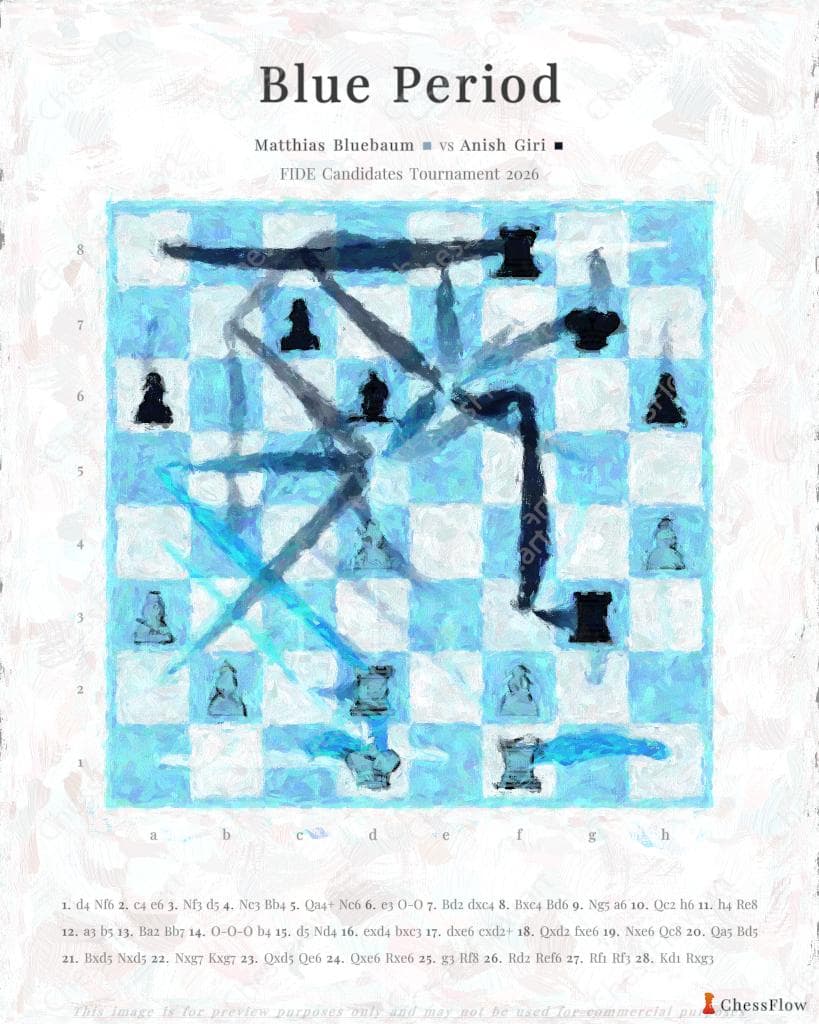
Matthias Bluebaum vs Anish Giri
Matthias Bluebaum vs Anish Giri
Giri Defeats Bluebaum in Round 14 of Candidates 2026 Anish Giri secured a crucial victory against Matthias Bluebaum in round 14 of the FIDE Candidates Tournament 2026, winning with the black pieces i...
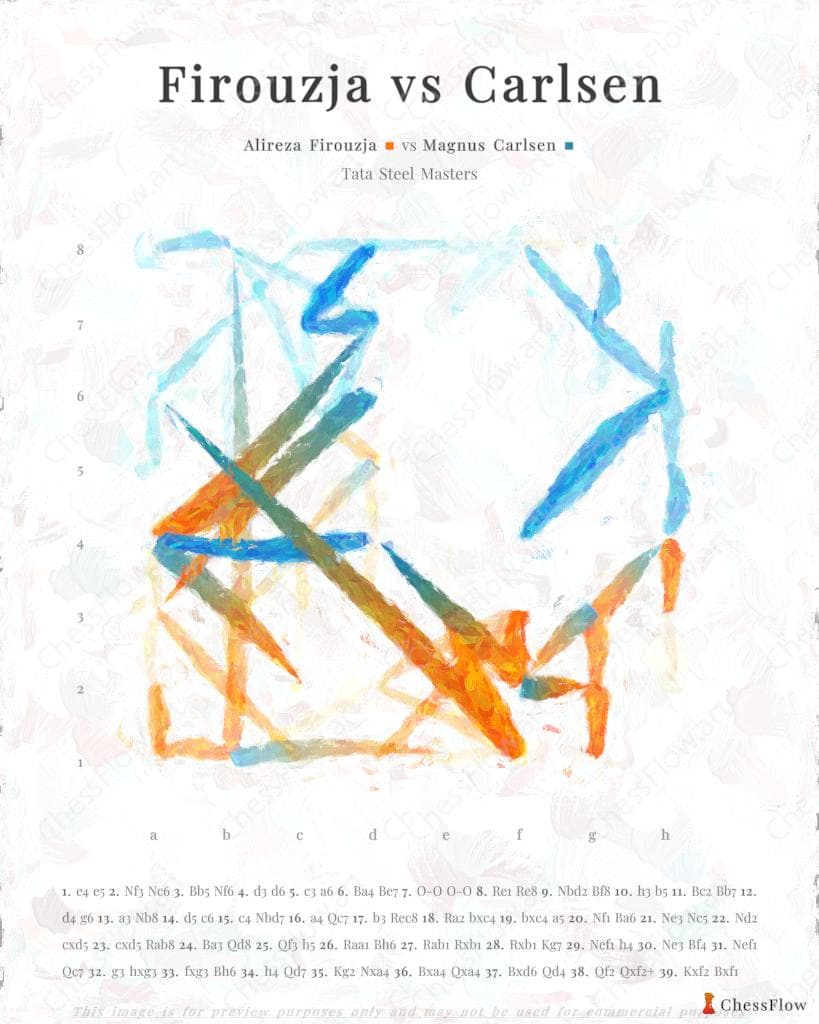
Alireza Firouzja vs Magnus Carlsen
Alireza Firouzja vs Magnus Carlsen
The Matchup Magnus Carlsen faced Alireza Firouzja in round 9 of the 2020 Tata Steel Masters, a highly anticipated clash between the world champion and the tournament's youngest participant. Carlsen,...
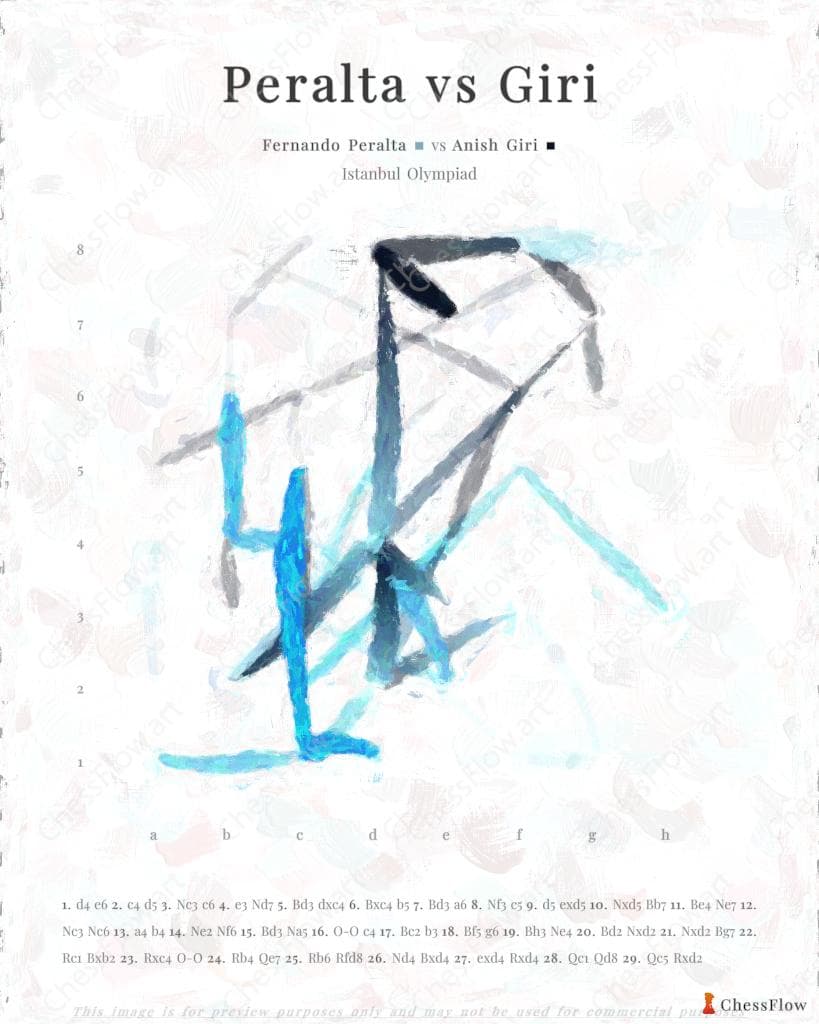
Fernando Peralta vs Anish Giri
Fernando Peralta vs Anish Giri
The Opening Battle Fernando Peralta (2606) faced off against rising Dutch talent Anish Giri (2711) in round 5 of the 2012 Istanbul Olympiad. The game opened with the Queen's Gambit Declined, Semi-Sla...