Super Rapid & Blitz Poland
So vs Fedoseev Draw in Sicilian Grind at Poland Blitz 2026


So's Sicilian Storm
A Half-Point in the Hunt
Wesley So needed wins. After losing to Gukesh in round six of the blitz section at the 2026 Super Rapid & Blitz Poland, the American found himself trailing Hans Niemann in the overall standings. When he sat down against Vladimir Fedoseev in round 17, the defending champion was very much in the hunt himself, lurking just behind the leaders. What followed was a queenless Sicilian that promised grinding chances for White but delivered only a draw—another half-point when So desperately needed a full one.
The game encapsulated So's frustrating day four in Warsaw. Every time Niemann faltered, So seemed to falter too. "Just not losing would have been enough to catch the lead," the chess.com coverage noted about his games against Firouzja and Fedoseev. Instead, So found himself unable to convert promising positions into full points.
The Accelerated Dragon Sidestep
The opening followed a well-trodden path in the Sicilian Defense: Open. After 1.e4 c5 2.Nf3 Nc6 3.d4 cxd4 4.Nxd4 Nf6 5.Nc3, Fedoseev opted for 5...g6, signaling an Accelerated Dragon setup. But So had no interest in allowing the typical Dragon structures. Instead of the mainline 6.Be3 or 6.Be2, he chose the immediate 6.Nxc6, trading knights and fundamentally altering the character of the position.
This exchange on c6 is a well-known weapon against the Accelerated Dragon. White damages Black's pawn structure and, critically, prepares to simplify into an endgame where the doubled c-pawns become a long-term weakness. After 6...dxc6 7.Qxd8+ Kxd8, the queens came off on move seven—unusually early for a Sicilian, but perfectly logical given So's strategic aims.
The resulting position is one that engines evaluate as roughly equal, hovering around +0.4 to +0.5 for White. But there's a gap between what silicon thinks and what humans experience. White has a clear plan: pressure the c6 pawn, potentially create a passed a-pawn, and grind. Black has to defend accurately for potentially dozens of moves. In a 5+2 blitz game, that's no small ask.
Fedoseev's Repositioning
With his king awkwardly placed on d8 after recapturing the queen, Fedoseev immediately played 8...Ke8, getting his monarch toward relative safety. So responded with 8.Bc4, eyeing the f7 square and preparing to castle by hand with his king on e2. The American followed up with 9.a4, a typical move in these structures—preventing ...b5 and preparing to expand on the queenside where Black's doubled pawns are weakest.
Fedoseev countered with 9...e5, grabbing central space and giving his dark-squared bishop a future on the long diagonal. The position was taking shape: White would maneuver slowly, looking to exploit the structural weaknesses; Black would seek counterplay through piece activity and perhaps a kingside pawn storm.
The next phase saw both players jockeying for position. So played 10.Ke2, completing his artificial castling, while Fedoseev pushed 10...h5, gaining space on the kingside and preventing any ideas of g4 from White. So responded in kind with 11.h4, fixing the kingside pawns and ensuring the h5-pawn couldn't advance further.
After 11...b6 12.f3, shoring up the e4 pawn and preparing potential knight maneuvers, Fedoseev began repositioning his pieces. 12...Nd7 headed the knight toward c5, where it would pressure the b3 square and potentially the e4 pawn. So retreated with 13.Nd1, a flexible move that could lead to Nb2 or Ne3 depending on how Black arranged his forces.
13...Nc5 arrived on its ideal square, and after 14.b3, protecting the a4 pawn and preparing Nb2, Fedoseev developed with 14...Be6. The position was balanced but tense—the kind of technical middlegame where the player with better understanding of the nuances holds a practical edge.
The Critical Moment: Fedoseev's Ambitious Pawn Break
This is where the game turned. With his pieces reasonably placed, Fedoseev decided to strike in the center with 15...f5?!, a move that looks aggressive but carries significant risk. The engine immediately flags this as an inaccuracy, jumping from roughly +0.3 to +1.26 for White.
The problem with 15...f5 is multifaceted. First, it weakens the e6 bishop's protection and creates potential holes on e6 and g6. Second, after the likely exf5 gxf5, Black's pawn structure becomes even more compromised—now with isolated pawns on both the c-file and the f-file. Third, it opens lines that favor White's better-coordinated pieces.
The recommended move was 15...Rd8, simply developing the last piece and maintaining the tension. In blitz, though, the temptation to "do something" is enormous. Fedoseev wanted counterplay, and 15...f5 promised activity even if it came at a structural cost.
This is the human-versus-engine tension that defines so much of practical chess. Engines see that Black can hold with precise defense after the quieter 15...Rd8. But Fedoseev, playing a 5+2 blitz game against one of the world's best technical players, knew that passive defense was a recipe for a slow death. Better to create complications, even if objectively dubious.
The Endgame Grind That Wasn't
Unfortunately, the PGN ends at this critical juncture, with the game eventually reaching a draw. What we can infer from the tournament context is telling: So was unable to convert his advantage, and the half-point wasn't enough to close the gap on Niemann.
The position after 15...f5 is the kind where White has all the long-term trumps but no immediate knockout blow. In a classical game, So would have hours to probe and press. In blitz, with the clock ticking down from five minutes, even a +1.26 advantage can evaporate when there's no forcing continuation.
This was the story of So's tournament in microcosm. He kept getting positions where he was "better" according to the engines, but converting in blitz requires both precision and luck. Against Fedoseev, the defending champion from the 2025 edition, neither materialized.
Tournament Implications
The draw left So still chasing Niemann in the standings. After day four, Niemann led despite losing his last three games of the session—a proof of the cushion he'd built earlier. So sat half a point back, with Caruana and Fedoseev another point and a half behind.
So's assessment of his own play earlier in the tournament had been characteristically blunt: "very poor." Even after a better day two, where he beat Sindarov and Firouzja, he acknowledged his form was only "a bit better." The Fedoseev draw fit that pattern—good enough to avoid disaster, not good enough to gain ground.
For Fedoseev, the draw was a reasonable result with Black against a higher-rated opponent. The Slovenian (representing Slovenia after his earlier career in Russia) had shown resilience throughout the tournament, including a remarkable escape against Vachier-Lagrave where he won from what "looked like a game only [MVL] could win." His ability to survive difficult positions and steal half-points was keeping him in contention.
The Broader Picture
So had made his priorities clear earlier in the tournament. "If you get invited to the Grand Chess Tour, you already don't need to play anything else in the year," he said, explaining why he would skip the 2026 Esports World Cup to focus on the GCT circuit. His focus this year was on classical chess, making the rapid and blitz results somewhat secondary—but no competitor at this level enjoys watching points slip away.
The queenless Sicilian against Fedoseev was exactly the kind of technical position So excels in. His knowledge of the classics—he'd referenced Karpov's 1994 Linares games in an earlier interview—and his grinding ability are legendary. But blitz is unforgiving. One inaccuracy from Fedoseev (15...f5) created an advantage; the time pressure and lack of forcing moves let it slip away.
We turned this one into a print—the position after move 15 captures that moment where everything hangs in the balance.
With the final nine blitz rounds still to play on day five, both So and Fedoseev remained in the hunt. Niemann's lead was slim, and in blitz, anything can happen. The American had shown he could beat his closest rival—his win over Niemann in their direct encounter earlier in the blitz had briefly tied them for the lead. But consistency, not brilliance, would decide the tournament. And on this day, against Fedoseev, consistency meant a draw that felt like a missed opportunity.
The Super Rapid & Blitz Poland would conclude the following day, with the final blitz rounds starting two hours earlier than usual. For So, the math was simple: he needed wins, and draws against players like Fedoseev—however hard-fought—wouldn't get him there. For Fedoseev, the draw kept his slim title defense hopes alive. And for chess fans watching the Grand Chess Tour, the game offered a reminder that even queenless middlegames can carry high stakes when the tournament standings are this tight.
1.e4 c5 2.Nf3 Nc6 3.d4 cxd4 4.Nxd4 Nf6 5.Nc3 g6 6.Nxc6 dxc6 7.Qxd8+ Kxd8 8.Bc4 Ke8 9.a4 e5 10.Ke2 h5 11.h4 b6 12.f3 Nd7 13.Nd1 Nc5 14.b3 Be6 15.Nb2 f5 16.Bxe6 Nxe6 17.Be3 Bd6 18.Rhd1 Ke7 19.Nc4 Bc7 20.b4 Rhf8 21.b5 cxb5 22.axb5 fxe4 23.fxe4 Nf4+ 24.Bxf4 Rxf4 25.Ne3 Rxe4 26.Kf3 Rf4+ 27.Ke2 Ke6 28.g3 Rb4 29.Nd5 Rc4 30.Ne3 Rc5 31.c4 e4 32.Rd4 Bxg3 33.Rg1 Ke5 34.Rd7 Bxh4 35.Rxg6 Rf8 36.Rg2 Rf3 37.Rxa7 Bg3 38.Re7+ Kd4 39.Nc2+ Kc3 40.Rxe4 Rd3 41.Re3 Rxe3+ 42.Nxe3 Be5 43.Nd5+ Kxc4 44.Nxb6+ Kd4 45.Nd7 Rc2+ 46.Kf1 Rc1+ 47.Ke2 Bf4 48.b6 Rc3 49.b7 Rb3 50.b8=Q Bxb8 51.Nxb8 Rxb8 52.Kf3 Rf8+ 53.Kg3 Rg8+ 54.Kh3 Rxg2 55.Kxg2 Ke5 1/2-1/2
How would it look as art?


Own a piece of chess history. Transform this legendary game into a unique piece of art for your home or office.
Perfect For
- Unique Gifts for chess enthusiasts and players
- Tournament Prizes that winners will treasure
- Club Decor for chess clubs and gaming spaces
- Office Art showcasing strategic thinking
- Personal Collection of historic games
Turn Your Games Into Art
Whether it's your own game from Chess.com or Lichess, or another historic masterpiece, transform any chess game into a stunning visual artwork.
You might also like
More legendary chess game stories
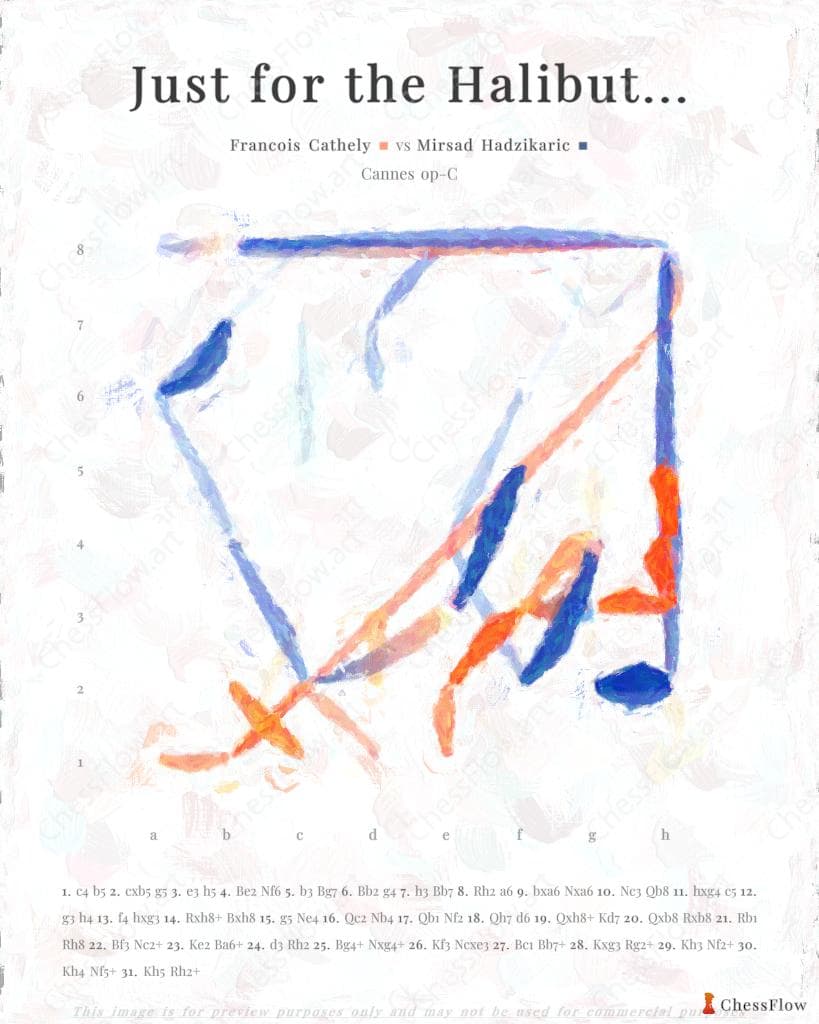
Francois Cathely vs Mirsad Hadzikaric
Francois Cathely vs Mirsad Hadzikaric
The Opening Gambit Francois Cathely and Mirsad Hadzikaric faced off in the 1995 Cannes op-C tournament with an opening that immediately signaled chaos was coming. After 1.c4 b5, Black's Polish Defens...

Wenjun Ju vs Humpy Koneru
Wenjun Ju vs Humpy Koneru
Koneru Finds Redemption Against the World Champion Humpy Koneru entered round ten of Norway Chess Women 2026 in last place with just three points, having lost three Armageddon games already in Oslo....
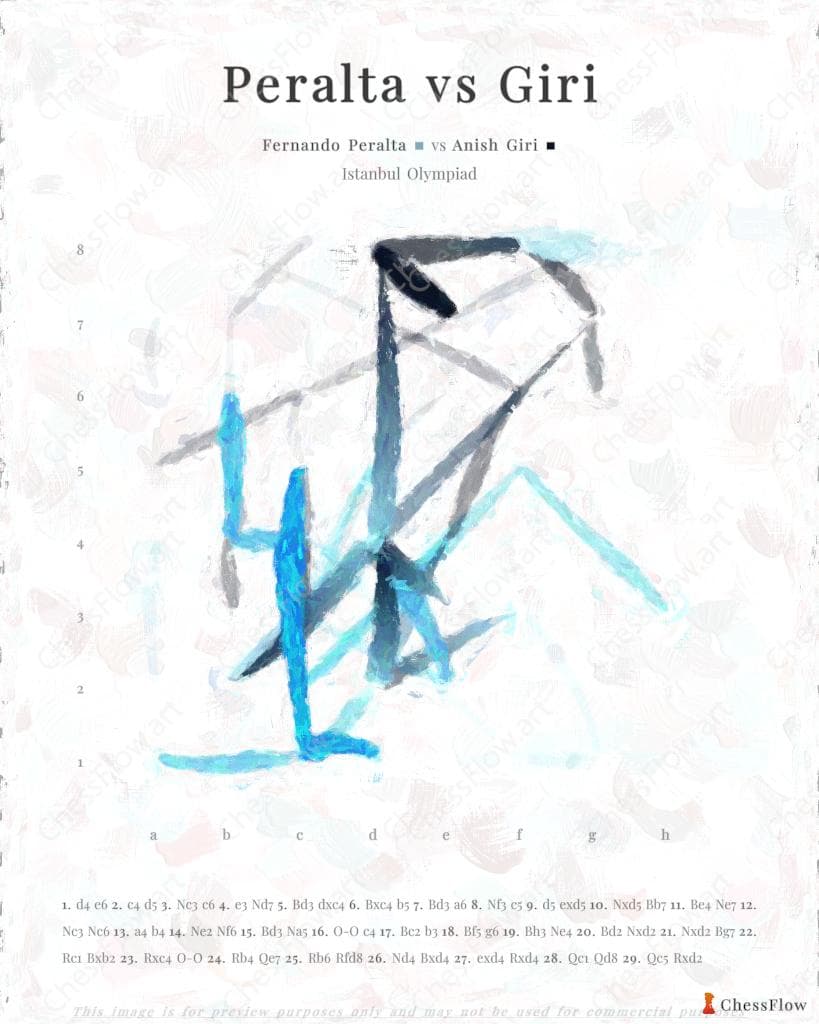
Fernando Peralta vs Anish Giri
Fernando Peralta vs Anish Giri
The Opening Battle Fernando Peralta (2606) faced off against rising Dutch talent Anish Giri (2711) in round 5 of the 2012 Istanbul Olympiad. The game opened with the Queen's Gambit Declined, Semi-Sla...