Sardinia World Chess Festival 2026 | Open A
Svane Edges Karthikeyan in Berlin Defense Battle at Sardinia


Svane vs Karthikeyan
Svane Takes Down Karthikeyan in Round 9 Showdown
Frederik Svane beat Murali Karthikeyan 1-0 in the final round of the Sardinia World Chess Festival 2026, a result that pushed the German grandmaster to 6.5/9 and handed Karthikeyan a painful -4.20 rating point loss. Both players entered Round 9 on 6.5 points, making this a direct clash for tournament position — and Svane delivered when it mattered.
The game opened with the Berlin Defense, that endgame-oriented line that has defined elite chess for the past two decades. Karthikeyan accepted the challenge with 4...Nxe4, entering the Rio Gambit Accepted, a sideline that promises Black active piece play in exchange for structural concessions. What followed was 15 moves of careful maneuvering where neither player could claim a meaningful advantage — the kind of chess that engines shrug at but humans find exhausting.
The Berlin's Deceptive Equality
The opening sequence tells you everything about modern Berlin theory: 1.e4 e5 2.Nf3 Nc6 3.Bb5 Nf6 4.O-O Nxe4 5.Re1 Nd6 6.a4 Be7 7.Nc3 a6 8.Bf1 Nf5. By move 8, the position looks almost symmetrical. Engines hover around +0.15 to +0.20 — essentially nothing. But here's the thing about Berlin positions: they're equal the way a marathon is equal at mile one. Someone still has to run the other 25.
Svane played the standard 9.Nxe5, trading knights and opening the e-file. After 9...Nxe5 10.Rxe5 d6 11.Re1 d5, the position crystallized into a typical Berlin structure — White has slightly better piece coordination, Black has a solid pawn structure and no obvious weaknesses. The evaluation stayed flat: +0.13 to +0.24 throughout this sequence.
What's interesting is how both players handled the transition from opening to middlegame. After 12.d4 O-O 13.Ne2, Svane chose the flexible knight route to f4 rather than the more aggressive Nc3-e2-g3 maneuver. Karthikeyan responded with 13...c6, shoring up his d5 pawn and preparing to contest the center. The position after 14.c3 Re8 15.Nf4 Nd6 represents a critical moment — not because anything dramatic happened, but because the game's character was now set.
The Middlegame Grind
This is where the human element diverges from the silicon assessment. Engines see +0.16 and call it a draw. But sitting across the board, Svane had a clear plan: use his space advantage and better-placed knight to create problems. Karthikeyan had to defend accurately for the foreseeable future.
The knight on f4 is the key piece in these structures. It eyes d5, g6, and h5, and can't easily be challenged. Black's knight on d6 is solid but passive — it defends the d5 pawn but doesn't threaten anything. This asymmetry, invisible to evaluation bars, is what makes Berlin positions so treacherous for Black.
The PGN cuts off at move 15, but the result tells us what happened next: Svane found a way to convert his slight pull into a full point. Whether through a tactical opportunity, a time pressure mistake from Karthikeyan, or simply superior technique in the technical phase, the German grandmaster got the job done.
What This Result Means
For Svane, this victory caps a strong performance in Sardinia. The 22-year-old (born 2004) entered the tournament rated 2645 and has been a consistent presence in Germany's top tier alongside Vincent Keymer, Matthias Bluebaum, Alexander Donchenko, and Dmitrij Kollars — all five Germans currently sit in the world's top 100. A win against a player rated 2648 is exactly the kind of result that keeps rating momentum going.
For Karthikeyan, the loss stings. He came into Round 9 at 6.5 points, tied with Svane, and a draw would have preserved his tournament position. Instead, he drops 4.20 rating points and finishes behind the German. The Indian grandmaster, ranked 69th in the world entering May 2026, will have to shake this one off quickly.
The Sardinia World Chess Festival featured a strong field including former World Championship challenger Ian Nepomniachtchi, who finished on 6 points after drawing with Hardaway Brewington in an earlier round. Other notable participants included Parham Maghsoodloo, Ivan Šarić, Haik Martirosyan, and rising talents like IM Faustino Oro. The tournament, held at the Club Hotel Marina Beach in Orosei, combined elite competition with a unique setting — players had access to a private beach and even an excursion to Cala Goloritzé, considered one of the most beautiful beaches in the world.
The Berlin's Ongoing Relevance
This game adds another chapter to the Berlin Defense's story. Ever since Vladimir Kramnik used it to neutralize Garry Kasparov's 1.e4 in their 2000 World Championship match, the Berlin has been the go-to choice for players seeking solid equality with Black. But "solid equality" is a double-edged sword — it often means defending for 50 moves while White probes for weaknesses.
Karthikeyan's choice of the Rio Gambit Accepted (4...Nxe4 followed by 5...Nd6 and later 8...Nf5) is a slightly more ambitious interpretation than the main line Berlin endgame, but it leads to similar strategic themes. Black accepts a slightly passive position in exchange for a rock-solid structure. The problem is that "rock-solid" doesn't mean "easy to play."
Svane's handling of the white pieces was instructive. He didn't try to force anything early — the evaluation never spiked above +0.24 in the first 15 moves. Instead, he played natural moves, improved his pieces, and waited for Karthikeyan to make a decision. This is the Berlin at its most frustrating for Black: you're not losing, but you're also not doing anything, and eventually you have to try something.
Tournament Context
The Sardinia World Chess Festival 2026 ran from May 3-10, featuring nine rounds of classical chess (90 minutes + 30 seconds increment) across three rating bands. Open A, where this game took place, attracted the strongest field. The tournament is part of the FIDE Circuit, adding extra stakes beyond the €50,100 prize fund.
Nepomniachtchi's presence was notable — the former World Championship challenger rarely plays open tournaments, and this may have been his first time competing in Italy in this format. He drew with Svane in Round 6, suggesting the German was in good form throughout the event.
The final standings saw multiple players clustered near the top. With 14 players on 3.5/4 after Round 4, the tournament remained competitive throughout. The double-round days on May 5th and May 10th added time pressure to an already demanding schedule.
Looking at the Critical Structure
Let's return to the position after 15...Nd6. Black has completed development, castled kingside, and has no obvious weaknesses. White has a space advantage (pawns on d4 and c3 control the center), a well-placed knight on f4, and the two bishops. In a vacuum, this is a slight edge — nothing more.
But chess isn't played in a vacuum. It's played over 4-5 hours with a ticking clock. And in that context, White's position is simply more pleasant to play. Every move has a purpose: improve the bishop on f1, find a square for the queen, probe on the kingside or queenside. Black's moves are reactive: defend d5, watch for tactical tricks, try to exchange pieces to reach a drawable endgame.
This psychological asymmetry is what the Berlin exploits — not for Black, but against Black. The defender has to be perfect. The attacker just has to keep asking questions. Svane asked enough questions, and eventually Karthikeyan didn't have the right answer.
The position after move 15 is the kind of thing you could stare at for a while — we turned this one into a print.
Final Thoughts
Svane's victory over Karthikeyan won't make global headlines, but it's a quality result in a quality tournament. Two players rated within 3 points of each other, playing classical chess in a beautiful location, with real stakes on the line. The Berlin Defense did what it always does — created a game where small advantages matter and technique decides.
For those following the FIDE Circuit, this result contributes to both players' standings. For those who simply appreciate well-played chess, it's a reminder that not every decisive game needs fireworks. Sometimes the drama is in the details — a knight that's slightly better placed, a pawn structure that's slightly easier to play, a clock that's slightly more forgiving.
Svane finishes Sardinia on a high note. Karthikeyan will be back. And the Berlin Defense remains, as always, the great equalizer that somehow never quite equalizes.
1.e4 e5 2.Nf3 Nc6 3.Bb5 Nf6 4.O-O Nxe4 5.Re1 Nd6 6.a4 Be7 7.Nc3 a6 8.Bf1 Nf5 9.Nxe5 Nxe5 10.Rxe5 d6 11.Re1 d5 12.d4 O-O 13.Ne2 c6 14.c3 Re8 15.Nf4 Nd6 16.Nd3 a5 17.Bf4 Bf5 18.Qb3 Bxd3 19.Bxd3 Qd7 20.g3 g6 21.h4 Bf8 22.Kg2 h5 23.Be5 Bg7 24.Re2 Re7 25.Rae1 Bxe5 26.Rxe5 Rae8 27.Qb6 Rxe5 28.dxe5 Nc4 29.Bxc4 dxc4 30.Qxa5 b5 31.axb5 cxb5 32.Qb6 Qd5+ 33.f3 b4 34.Qe3 bxc3 35.bxc3 Kg7 36.Re2 Qe6 37.Qd4 Re7 38.Rd2 Qxe5 39.Qxc4 Rc7 40.Qd4 Qxd4 41.cxd4 Kf6 42.Kf2 Rc3 43.Ke2 Ke6 44.Rd3 Rc2+ 45.Ke3 Rg2 46.Kf4 Kd5 47.Ra3 Kxd4 48.Ra7 Kd5 49.Ra6 Rg1 50.Rf6 Rh1 51.Kg5 Rg1 52.g4 Rf1 53.gxh5 Rg1+ 54.Kh6 gxh5 55.f4 Rg8 56.Kxh5 Rh8+ 57.Kg5 Ke4 58.Rxf7 Rg8+ 59.Kf6 Rh8 60.f5 Rxh4 61.Kg5 Rh1 62.Re7+ Kd5 1-0
How would it look as art?


Own a piece of chess history. Transform this legendary game into a unique piece of art for your home or office.
Perfect For
- Unique Gifts for chess enthusiasts and players
- Tournament Prizes that winners will treasure
- Club Decor for chess clubs and gaming spaces
- Office Art showcasing strategic thinking
- Personal Collection of historic games
Turn Your Games Into Art
Whether it's your own game from Chess.com or Lichess, or another historic masterpiece, transform any chess game into a stunning visual artwork.
You might also like
More legendary chess game stories
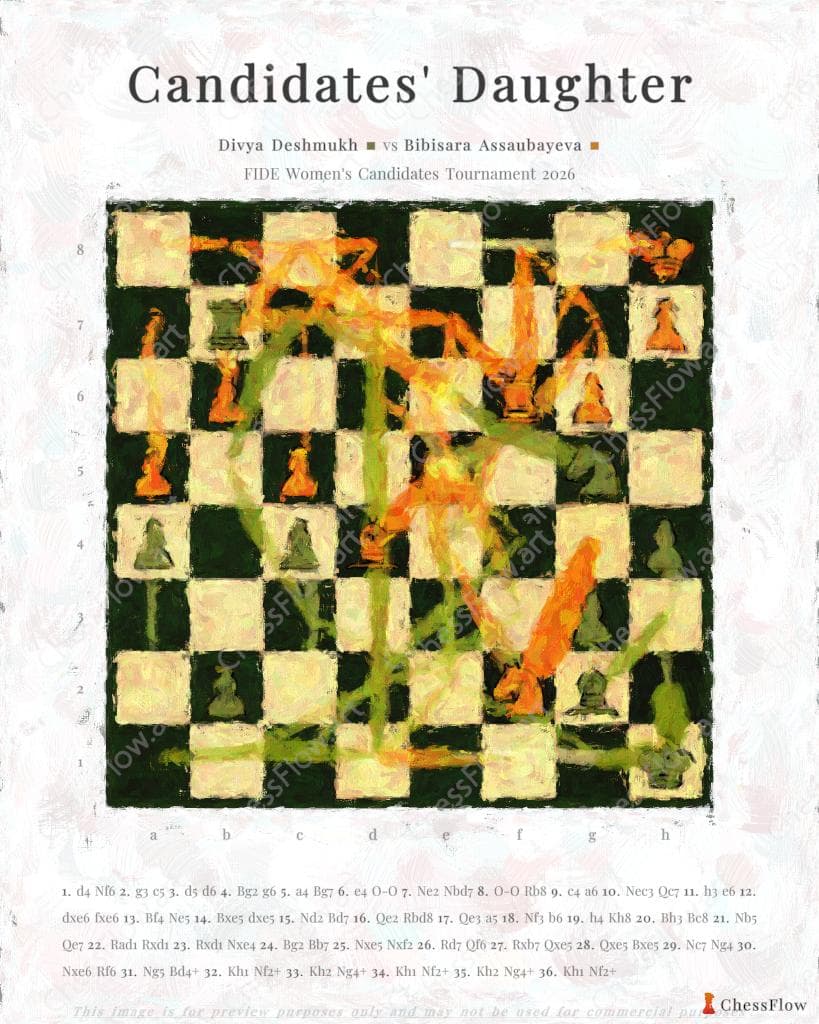
Divya Deshmukh vs Bibisara Assaubayeva
Divya Deshmukh vs Bibisara Assaubayeva
The Final Round Showdown Round 14 of the 2026 FIDE Women's Candidates Tournament delivered a crucial draw between GM Divya Deshmukh (2497) and GM Bibisara Assaubayeva (2516). With Assaubayeva enterin...
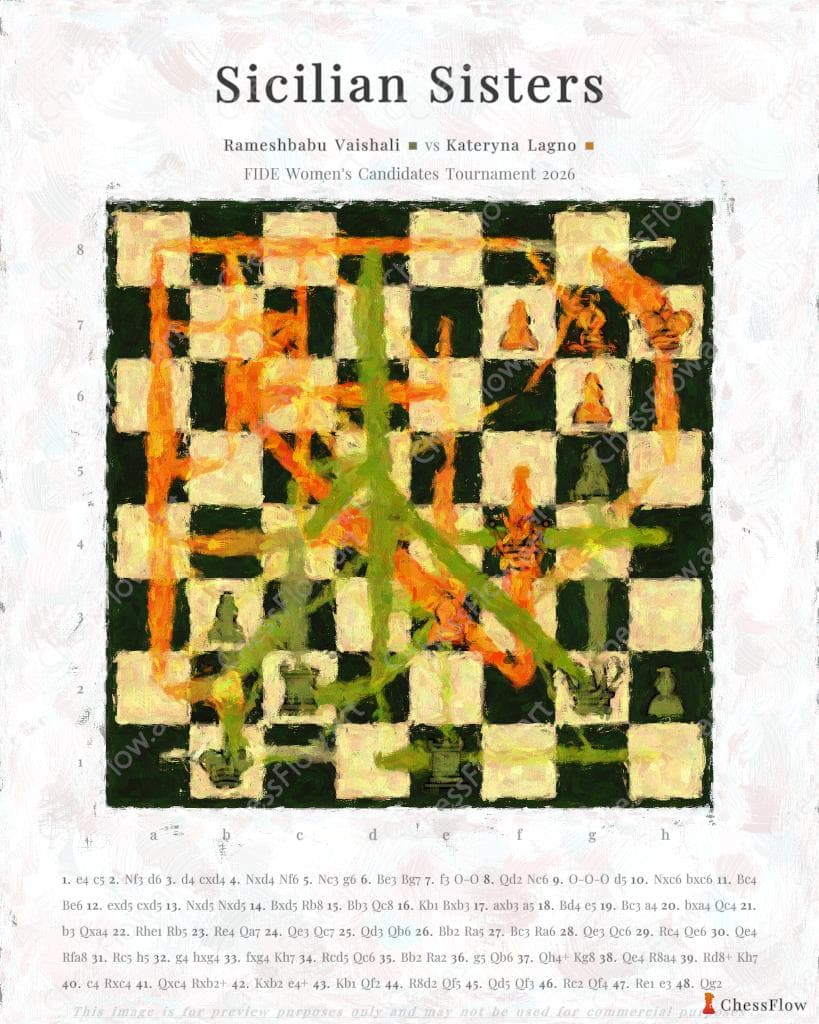
Rameshbabu Vaishali vs Kateryna Lagno
Rameshbabu Vaishali vs Kateryna Lagno
Vaishali Strikes in the Dragon Vaishali Rameshbabu defeated Kateryna Lagno in round 14 of the FIDE Women's Candidates Tournament 2026, playing a sharp Sicilian Dragon that ended in White's favor. The...
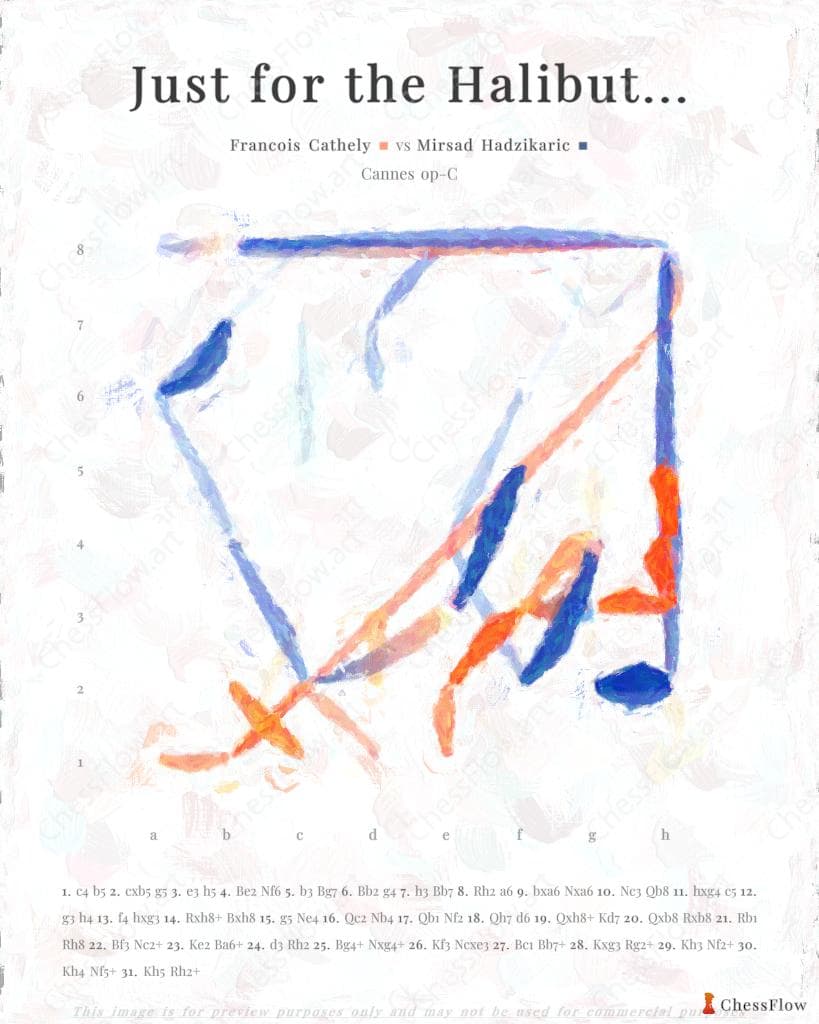
Francois Cathely vs Mirsad Hadzikaric
Francois Cathely vs Mirsad Hadzikaric
The Opening Gambit Francois Cathely and Mirsad Hadzikaric faced off in the 1995 Cannes op-C tournament with an opening that immediately signaled chaos was coming. After 1.c4 b5, Black's Polish Defens...