2026 Dreamhack Atlanta Group A
Esipenko Punishes Tang's London System in Atlanta


Tang's Atlanta Heat
Esipenko Collects Two Pawns and Doesn't Look Back
Andrey Esipenko made Andrew Tang pay for an ambitious pawn sacrifice gone wrong, scooping up the b2 and a2 pawns in a London System and converting without drama. The game, played in the quarterfinals of DreamHack Atlanta 2026's Group A upper bracket, lasted just 14 moves before Tang resigned—though the position had been slipping away for some time before that.
Tang, the American bullet specialist rated 2551, chose the London System against Esipenko's solid setup. What followed was a textbook example of why gambiting pawns in the London requires precise compensation. Tang never found it, and Esipenko, fresh off securing his spot in the 2026 Candidates Tournament, showed the clinical technique that got him there.
The Queen Goes Shopping
The game opened with the standard London moves: 1.d4 d5 2.Nf3 Nf6 3.Bf4 e6 4.e3 c5. Nothing unusual here—Esipenko was steering toward a classical response against the London, and Tang was following the system's typical development pattern with 5.Be2, keeping things flexible.
The fireworks started with 5...Qb6, a well-known idea that immediately puts pressure on the b2 pawn. Tang castled with 6.O-O, essentially offering the pawn. This is a known gambit line in the London where White hopes that rapid development and central control will compensate for the material deficit.
Esipenko took the bait with 6...Qxb2, grabbing the first pawn. The engine still calls this dead equal—White gets the bishop pair, open lines, and a lead in development. But here's the thing: equal according to Stockfish doesn't mean equal at the board. White needs to generate concrete threats, and fast.
Tang continued with 7.c4, trying to open the position and activate his pieces. Esipenko responded calmly with 7...Be7, developing while keeping his options open. The critical moment came after 8.dxc5 O-O 9.Be5, where Tang centralized his bishop aggressively, hoping to create threats against Black's position.
Tang's Rook Lift Misfires
After 9...Qb4 10.Nbd2 Nc6, Tang faced a decision. The engine suggested 11.Bd4 as the best try, keeping tension and maintaining some compensation for the pawn. Instead, Tang played 11.Rb1?!, a natural-looking move that lifts the rook to the b-file but actually allows Black to consolidate.
The problem with 11.Rb1 is that it doesn't create immediate threats. Esipenko simply captured with 11...Qxc5, now up a full pawn with a solid position. Tang tried 12.Rb5, attacking the queen and hoping to generate some activity, but after 12...Qa3, the queen slipped away to safety while eyeing the a2 pawn.
This is where Tang's position started to collapse. He played 13.Nb1, a strange-looking retreat that aims to trap the queen, but Esipenko had seen further. 13...Qxa2 grabbed the second pawn, and now Black was up two pawns with a completely safe position.
The engine evaluation had shifted from equal to roughly -1.0 in Black's favor—not winning by force, but the kind of advantage that a 2684-rated player converts without breaking a sweat.
The Clock Tells the Story
One detail that jumps out from the game: Tang's clock management. After just 13 moves, Tang had burned through over seven minutes, sitting at just 2:02 remaining compared to Esipenko's 7:04. In a 10-minute rapid game, that's a massive time disadvantage on top of being two pawns down.
The time trouble wasn't random—it reflected the difficulty of Tang's position. Every move required calculation to see if there was any compensation, any tactical trick that could justify the pawn deficit. There wasn't.
After 13...Qxa2, the game continued briefly with 14.B... but Tang had seen enough. The position was hopeless: Black is two pawns up, the queen is safe, and there's no attack to speak of. Tang resigned.
What the Engine Misses
This game is a useful illustration of the gap between engine evaluation and human playability. After 6...Qxb2, Stockfish calls the position 0.00—perfectly equal. And technically, it is. White has compensation in the form of development and the bishop pair.
But compensation needs to be converted into something concrete. In a 10-minute game against a Candidates-level player, "theoretical compensation" means very little if you can't find the precise moves to generate threats. Tang's 11.Rb1?! was the moment where the compensation evaporated. Not a blunder, not even a clear mistake—just an inaccuracy that let Black consolidate, and suddenly the two-pawn deficit was real.
This is the kind of position where engines say "equal" but humans say "I'd rather be Black, thanks." Esipenko had all the time in the world to organize his pieces, while Tang was burning clock trying to conjure threats from thin air.
The London's Gambit Problem
Tang's choice to allow 6...Qxb2 isn't objectively bad—it's a legitimate gambit line that has been played at the highest levels. But it requires precise follow-up, and the margin for error is razor-thin. One slightly passive move, one missed opportunity, and suddenly you're just down material with nothing to show for it.
Esipenko's handling was textbook: take the pawns, develop normally, don't get greedy, don't take unnecessary risks. The queen on a2 looks exposed, but it's actually perfectly safe—there's no trap, no discovered attack, nothing. Just two extra pawns and a winning position.
For players who face the London regularly, this game is worth studying. The 5...Qb6 line is a sharp way to test White's understanding of the compensation. If White doesn't know the precise follow-up, Black can emerge with a significant material advantage and a safe position.
DreamHack Stakes
This result matters for the DreamHack Atlanta standings. The top 4 players from this event earn qualification spots to the Esports World Cup, making every game in the upper bracket crucial. Esipenko's win moves him forward in the bracket, while Tang drops to the losers' bracket where the path becomes significantly harder.
For Esipenko, this is part of a strong 2026 campaign. He recently secured the final spot in the 2026 Candidates Tournament—a career-defining achievement for the 24-year-old Russian-born grandmaster. DreamHack represents an opportunity to build momentum and add another qualification to his resume.
Tang, meanwhile, remains one at this level, the gambit approach didn't pay off.
The Bullet Specialist vs. The Candidates Qualifier
The rating gap between these two players—133 points, with Esipenko at 2684 and Tang at 2551—doesn't fully capture the difference in their current trajectories. Esipenko is in the middle of the best stretch of his career, having qualified for the Candidates and performing well in elite events. Tang is a content creator and bullet specialist who occasionally ventures into slower time controls.
That's not a knock on Tang—he's a legitimate grandmaster who can compete with anyone on his day. But this matchup was always going to favor Esipenko if the game reached a technical phase. Tang needed complications, tactics, time pressure on his opponent. Instead, he got a two-pawn deficit and a long conversion.
The game lasted just 14 moves, but the story was written much earlier. Once Esipenko grabbed the second pawn on a2, the outcome was never in doubt. Sometimes chess is like that—no fireworks, no sacrifices, just one player making a small mistake and the other one cashing in.
We turned this one into a print at ChessFlow—there's something satisfying about the simplicity of Esipenko's technique.
What's Next
Esipenko advances in the upper bracket, where he'll face stiffer competition as the field narrows. Tang drops to the losers' bracket, where he'll need to win multiple matches to stay alive in the tournament.
For viewers hoping to see Tang's famous bullet skills, the losers' bracket might actually be more entertaining. With his back against the wall, Tang tends to play more aggressively, and the faster time controls in later rounds could suit his style better.
But for now, this one belongs to Esipenko. Two pawns, no drama, resignation on move 14. The Candidates qualifier continues his strong form heading into the summer.
1.d4 d5 2.Nf3 Nf6 3.Bf4 e6 4.e3 c5 5.Be2 Qb6 6.O-O Qxb2 7.c4 Be7 8.dxc5 O-O 9.Be5 Qb4 10.Nbd2 Nc6 11.Rb1 Qxc5 12.Rb5 Qa3 13.Nb1 Qxa2 14.Bb2 Ne4 15.Nfd2 a6 16.Rb3 Na5 17.Rb6 Bc5 18.Nxe4 Bxb6 19.Bxg7 Kxg7 20.Nbc3 Qa3 21.cxd5 e5 22.Bd3 f5 23.Qh5 Qe7 24.d6 Qf7 25.Qg5+ Kh8 26.Ng3 Bd8 27.Qh6 Qg7 0-1
How would it look as art?


Own a piece of chess history. Transform this legendary game into a unique piece of art for your home or office.
Perfect For
- Unique Gifts for chess enthusiasts and players
- Tournament Prizes that winners will treasure
- Club Decor for chess clubs and gaming spaces
- Office Art showcasing strategic thinking
- Personal Collection of historic games
Turn Your Games Into Art
Whether it's your own game from Chess.com or Lichess, or another historic masterpiece, transform any chess game into a stunning visual artwork.
You might also like
More legendary chess game stories
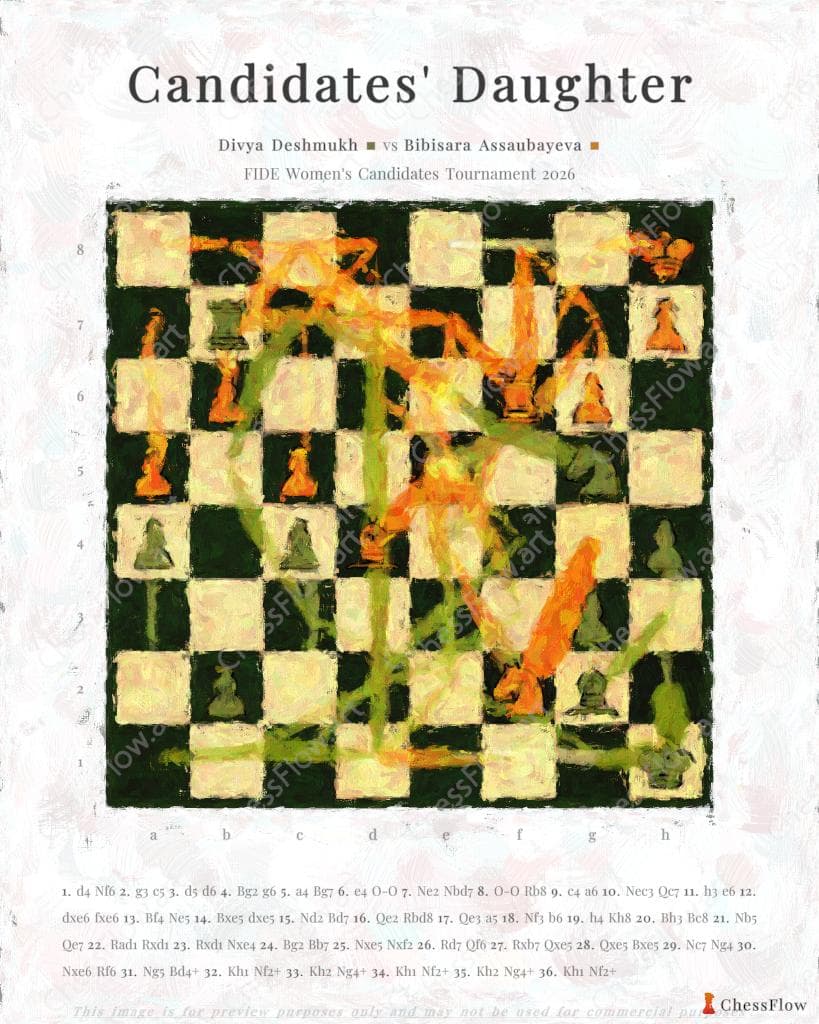
Divya Deshmukh vs Bibisara Assaubayeva
Divya Deshmukh vs Bibisara Assaubayeva
The Final Round Showdown Round 14 of the 2026 FIDE Women's Candidates Tournament delivered a crucial draw between GM Divya Deshmukh (2497) and GM Bibisara Assaubayeva (2516). With Assaubayeva enterin...
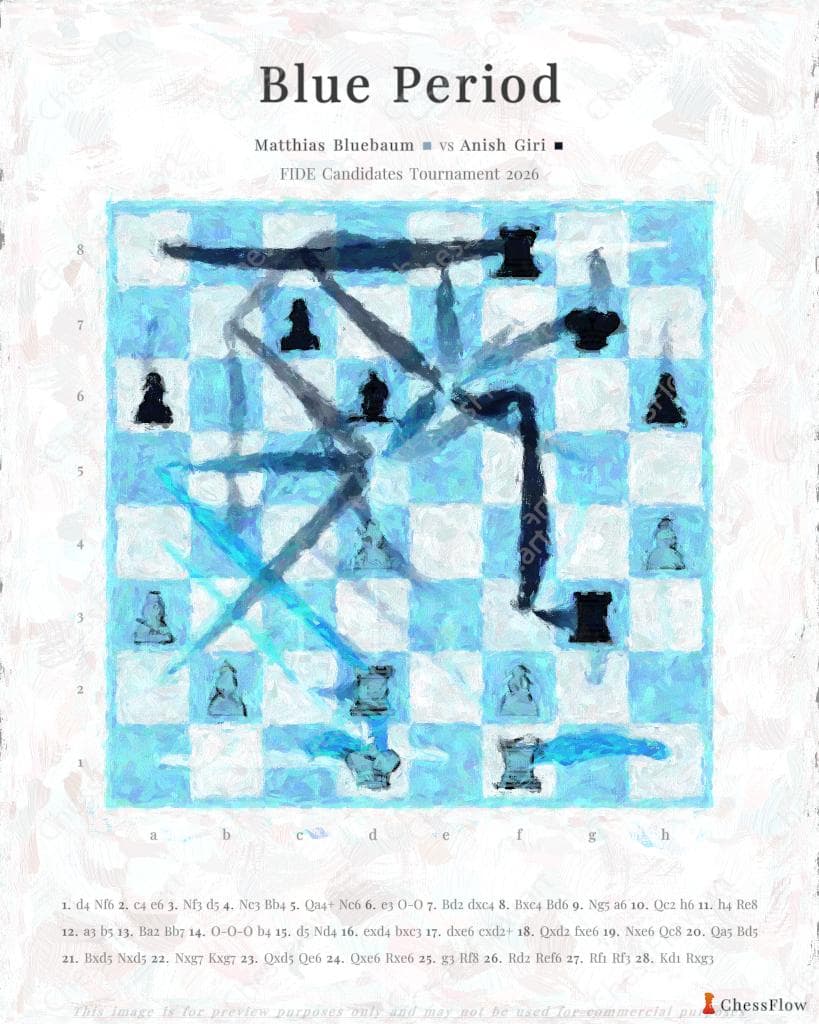
Matthias Bluebaum vs Anish Giri
Matthias Bluebaum vs Anish Giri
Giri Defeats Bluebaum in Round 14 of Candidates 2026 Anish Giri secured a crucial victory against Matthias Bluebaum in round 14 of the FIDE Candidates Tournament 2026, winning with the black pieces i...
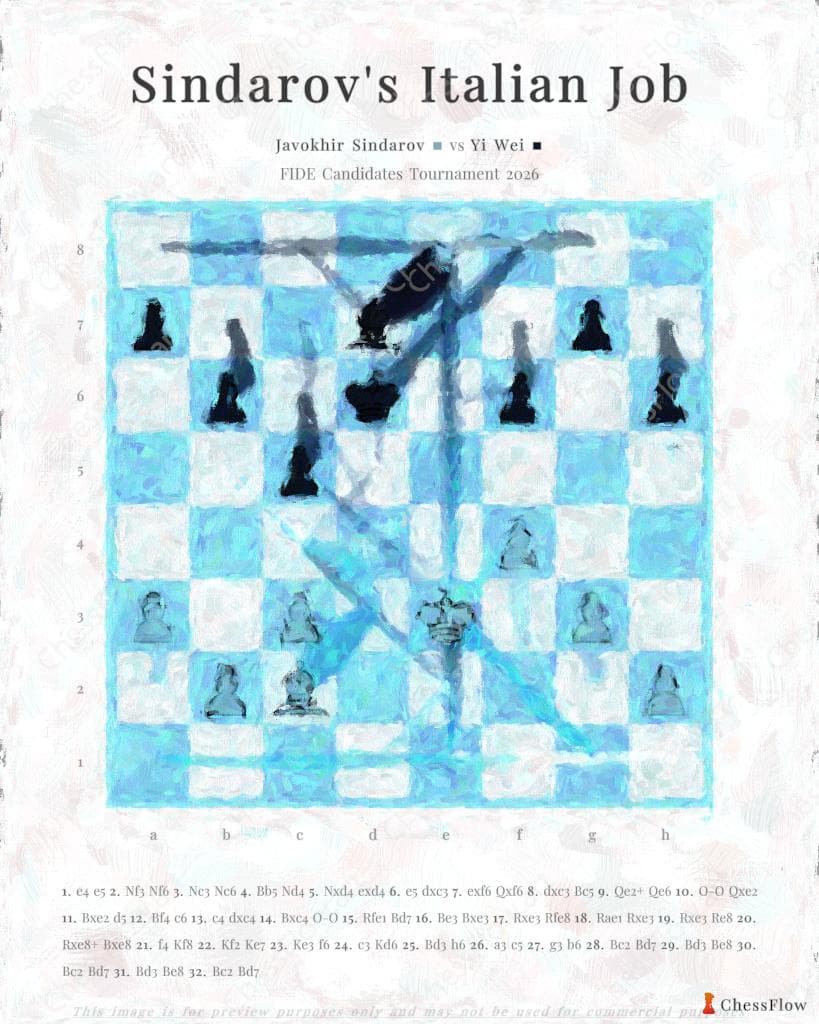
Javokhir Sindarov vs Yi Wei
Javokhir Sindarov vs Yi Wei
The Opening Javokhir Sindarov and Yi Wei opened round 14 of the 2026 FIDE Candidates Tournament with the Four Knights Game, specifically the Spanish Variation, Rubinstein Variation Accepted (ECO C48)...