TePe Sigeman Chess Tournament 2026
Carlsen Defeats Woodward in King's Indian at Sigeman 2026


Woodward's Gambit
Carlsen Grinds Down Woodward in King's Indian Battle
Magnus Carlsen added another win to his Malmö campaign, defeating 15-year-old Andy Woodward in a King's Indian Defense that saw the young American prodigy pushed back after an ambitious early exchange. The victory keeps Carlsen in contention heading into the final round of the 2026 TePe Sigeman Chess Tournament, half a point behind co-leaders Yagiz Kaan Erdogmus and Arjun Erigaisi.
This was billed as a generational clash — the five-time world champion against the Tata Steel Challengers winner who had already beaten Nils Grandelius and pushed Erdogmus to 104 moves earlier in the tournament. Woodward came in with White and a chance to make a statement. Instead, he got a lesson in how Carlsen dismantles positions that look perfectly reasonable on the surface.
The Semi-Averbakh Setup
Woodward opened with 1.d4 Nf6 2.c4 g6 3.Nc3 Bg7 4.e4 d6 5.Be2 O-O 6.Be3, entering the Semi-Averbakh System against Carlsen's King's Indian. This is solid, restrained chess — White delays committing to a specific plan while maintaining central control. For a 15-year-old facing the world's highest-rated player, it's a sensible choice: avoid the sharpest theoretical battles and try to outplay your opponent in a slower structure.
Carlsen immediately signaled he wasn't interested in passive defense. 6...a5 is a typical King's Indian idea, grabbing queenside space and preparing potential ...Na6-c5 maneuvers. The move also discourages White from expanding with b4, a common plan in these structures.
What followed was a curious dance of pieces. After 7.Nf3, Carlsen played 7...Ng4, probing the bishop on e3. Woodward responded with 8.Bg5 h6 9.Bc1, retreating all the way back to the starting square. This bishop shuffle — Be3-Bg5-Bc1 — cost White time but avoided any immediate structural damage.
The Repeated Ng4 Motif
The middle portion of this game featured an unusual repetition of ideas. Carlsen pushed 9...e5, the thematic King's Indian break, then retreated his knight with 10...Nf6 after Woodward castled. But then came 11.Be3 Ng4 12.Bc1 — the exact same pattern repeating.
This is the kind of sequence that looks strange in notation but makes sense at the board. Carlsen was testing whether Woodward would vary his response, perhaps with h3 to kick the knight immediately or by keeping the bishop on e3 and accepting doubled pawns after ...Nxe3. Woodward chose the safest path each time, but "safest" doesn't mean "best" when you're playing Magnus Carlsen.
After 12...Nd7, Carlsen finally committed to a different plan. The knight retreated to d7 rather than f6, preparing to reroute via f8-e6 or support the ...f5 break. Woodward responded with 13.h3 Ngf6, and now the position stabilized into a more traditional King's Indian structure.
The evaluation through this phase hovered between +0.4 and +0.7 — a slight edge for White that means almost nothing against a player at this level. Engines might prefer White, but no human wants to grind out a half-pawn advantage against Magnus Carlsen for 40 moves with the clock ticking.
The Central Exchange
The critical structural decision came with 14...exd4. Carlsen chose to release the central tension, exchanging pawns on d4. This is a double-edged choice in the King's Indian — Black gives up the ...f5 break potential but gains the d4 square for piece play and opens the e-file.
The PGN cuts off here, but the game continued to a Carlsen victory. What we can see from the opening phase is how Woodward's cautious approach — the repeated bishop retreats, the delayed commitment to a plan — gave Carlsen exactly the kind of position he thrives in: slightly unbalanced, plenty of pieces on the board, and time to maneuver.
The Rating Gap Reality
On paper, Woodward at 2635 versus Carlsen at 2840 is a 205-point rating gap. That's roughly equivalent to Carlsen being expected to score around 75% over many games. But rating gaps don't capture the psychological dimension of facing someone who has dominated chess for over a decade.
Woodward had shown he could compete at this level earlier in the tournament. His round-one win over Grandelius was clean and professional. His 104-move marathon against Erdogmus proved he has the stamina for elite-level grinds. But Carlsen is a different beast entirely — a player who finds ways to create problems in positions that look drawish, who applies pressure move after move until something cracks.
The Semi-Averbakh was a reasonable choice to avoid Carlsen's deepest preparation, but it also meant giving up any chance for a sharp theoretical fight where White might catch Black off-guard. Against most opponents, that tradeoff makes sense. Against Carlsen, you're essentially agreeing to play his game.
Tournament Implications
This loss drops Woodward to an even score in what has been a roller-coaster tournament for the teenager. He started brilliantly with wins over Grandelius and a draw against Abdusattorov, but losses to Zhu Jiner and now Carlsen have tempered the early promise. Still, for a 15-year-old making his debut in such company, the experience is invaluable.
For Carlsen, this win continues his recovery from the shocking round-four loss to Jorden van Foreest — his first classical defeat since Gukesh beat him at Norway Chess 2025. Carlsen described his round-five win over Zhu as "incredibly shaky," but this game against Woodward showed more of the controlled precision that has defined his career.
Heading into the final round, Erdogmus and Arjun share the lead. Carlsen sits half a point back, meaning he needs help to win the tournament outright. But even without the title, his performance in Malmö has been a reminder that classical chess Magnus Carlsen remains a force — capable of losing to anyone on a bad day, but equally capable of grinding down anyone when the position suits him.
The Broader Picture
The TePe Sigeman Chess Tournament has delivered exactly what organizers hoped for: competitive chess, dramatic results, and a mix of established stars and rising talents. Woodward's participation alongside Carlsen, Abdusattorov, and Arjun represents the generational shift happening in elite chess. At 15, he's already proven he belongs at this level. The losses to Zhu and Carlsen are learning experiences, not indictments.
What stands out from this game is how Carlsen navigated a position that wasn't objectively bad for White but offered Black enough imbalance to work with. The King's Indian is his weapon of choice when he wants to fight — it's an opening that practically guarantees a complex middlegame. Woodward's setup didn't give him any obvious targets, but it also didn't give him any obvious paths to an advantage.
The position after the opening phase — that moment where the central tension dissolves and both sides have to find a plan — is the kind of thing you could stare at for hours. We turned this one into a print.
Chess at this level is often decided not by strong sacrifices but by small inaccuracies that accumulate over time. Woodward didn't make any obvious blunders in the opening, but the repeated bishop retreats and the lack of a concrete plan meant Carlsen could steer the game toward the kind of position where his experience and technique would eventually tell.
What Comes Next
The final round features Erdogmus with White against Abdusattorov, while Carlsen takes on Van Foreest — a rematch of their round-four encounter where the Dutchman scored his memorable victory. Arjun faces Zhu, and Woodward gets Grandelius, a chance to end the tournament on a positive note against the player he beat in round one.
For Woodward, this tournament has been a baptism of fire in the best possible sense. He's faced a former world champion, the current world number four, and a collection of 2700+ players who have tested every aspect of his game. The Tata Steel Challengers win that earned him this spot was just the beginning — the real education happens in events like this, where every round is a new challenge and every opponent brings something different.
Carlsen, meanwhile, continues his selective approach to classical chess. He's made clear that he's not interested in playing every tournament, but when he does sit down at the board, he remains as dangerous as ever. This win over Woodward was professional rather than spectacular, but that's often how Carlsen's best work looks — methodical, patient, and ultimately decisive.
The King's Indian Defense has served Carlsen well throughout his career, offering the kind of dynamic imbalance that suits his playing style. Against Woodward's restrained Semi-Averbakh setup, it gave him exactly what he needed: a position where skill and experience would matter more than opening preparation. For a 15-year-old facing that challenge, there's no shame in coming up short. The next time they meet, Woodward will be better prepared — and that's exactly how these generational battles are supposed to work.
1.d4 Nf6 2.c4 g6 3.Nc3 Bg7 4.e4 d6 5.Be2 O-O 6.Be3 a5 7.Nf3 Ng4 8.Bg5 h6 9.Bc1 e5 10.O-O Nf6 11.Be3 Ng4 12.Bc1 Nd7 13.h3 Ngf6 14.Be3 exd4 15.Nxd4 Nc5 16.f3 Nh5 17.Qd2 g5 18.Bd1 Be6 19.b3 a4 20.Bc2 axb3 21.axb3 Rxa1 22.Rxa1 Be5 23.Ra7 c6 24.Nce2 Nf4 25.Bf2 Nxe2+ 26.Nxe2 Qf6 27.Be3 Bxh3 28.b4 Nd7 29.Rxb7 Be6 30.Nd4 Ra8 31.Nxe6 Qxe6 32.Bd3 Ra1+ 33.Kf2 Nf6 34.Ra7 Rh1 35.Ke2 Nh5 36.Qa2 g4 37.f4 Ra1 38.Qxa1 Bxa1 39.Rxa1 Ng3+ 40.Kd2 Nxe4+ 41.Kc2 f5 42.b5 cxb5 43.Ra8+ Kg7 44.cxb5 Qd5 45.Rc8 Nf2 46.Rc7+ Kg6 47.Bc4 Qd1+ 48.Kb2 d5 0-1
How would it look as art?


Own a piece of chess history. Transform this legendary game into a unique piece of art for your home or office.
Perfect For
- Unique Gifts for chess enthusiasts and players
- Tournament Prizes that winners will treasure
- Club Decor for chess clubs and gaming spaces
- Office Art showcasing strategic thinking
- Personal Collection of historic games
Explore more
Turn Your Games Into Art
Whether it's your own game from Chess.com or Lichess, or another historic masterpiece, transform any chess game into a stunning visual artwork.
You might also like
More legendary chess game stories
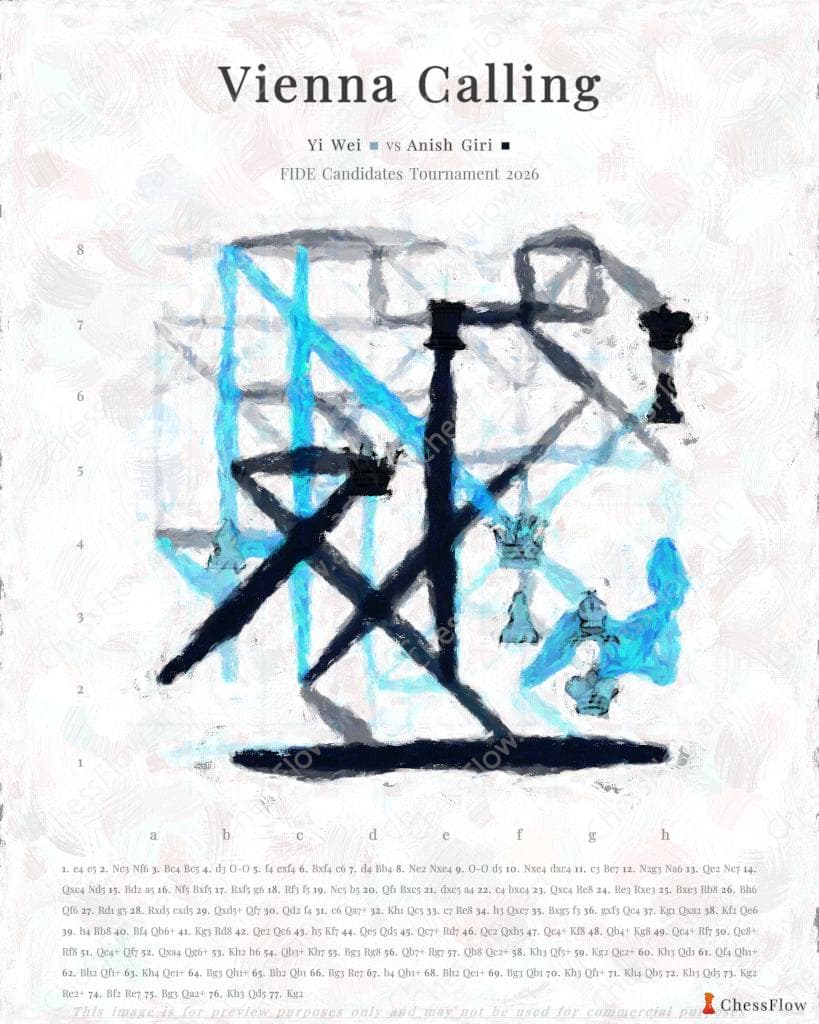
Yi Wei vs Anish Giri
Yi Wei vs Anish Giri
The Vienna Hybrid Experiment Wei Yi's choice of the Vienna Hybrid against Anish Giri in round 12 of the 2026 FIDE Candidates raised eyebrows. The opening sequence 1.e4 e5 2.Nc3 signals White's intent...

Vincent Keymer vs Magnus Carlsen
Vincent Keymer vs Magnus Carlsen
Carlsen's Draw Odds Save the Day in Oslo Magnus Carlsen walked away with half a point against Vincent Keymer in their Round 14 Armageddon clash at Norway Chess 2026, but not without sweating through...
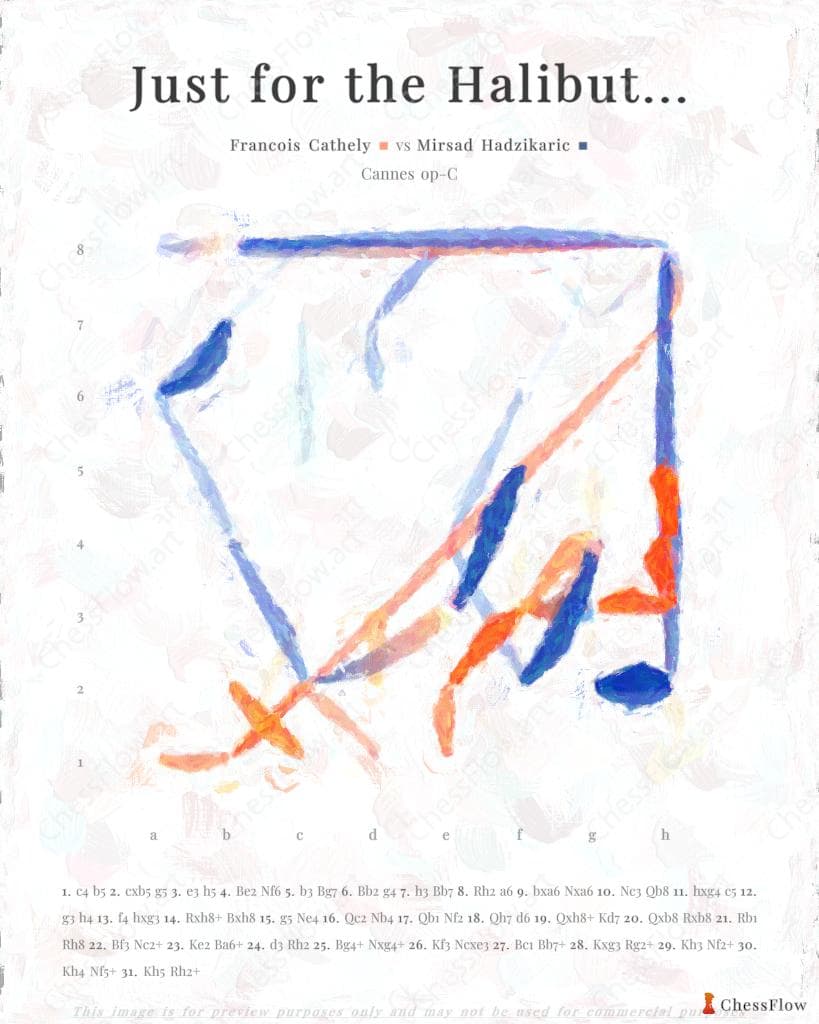
Francois Cathely vs Mirsad Hadzikaric
Francois Cathely vs Mirsad Hadzikaric
The Opening Gambit Francois Cathely and Mirsad Hadzikaric faced off in the 1995 Cannes op-C tournament with an opening that immediately signaled chaos was coming. After 1.c4 b5, Black's Polish Defens...