TePe Sigeman Chess Tournament 2026
Woodward, Erdogmus Draw in Teen Clash at Sigeman 2026


Woodward vs Erdogmus
Teen Stars Split the Point in Malmö
Andy Woodward and Yagiz Kaan Erdogmus, two of the youngest grandmasters in the world, drew their Round 5 encounter at the 2026 TePe Sigeman Chess Tournament. For Woodward, who turned 16 just days ago and was coming off a painful loss to Zhu Jiner, the half-point against the tournament leader represented a small recovery. For Erdogmus, who had been riding high after wins over Zhu and Nils Grandelius, the draw meant surrendering sole first place — though he remains firmly in contention with two rounds to play.
The game itself was a quiet affair, the kind of theoretical Queen's Indian that never really caught fire. Both players seemed content to maneuver within well-known structures, and the position remained balanced throughout the 14 moves we have on record before the game petered out. In a tournament that has already delivered Jorden van Foreest's historic win over Magnus Carlsen and Erdogmus's surge to world number-29, this matchup between rising American and Turkish prodigies was always going to be about tournament arithmetic more than chess immortality.
The Opening: Kasparov-Petrosian Territory
Woodward opened with 1.d4 and after 1...e6 2.c4 b6, the game entered Queen's Indian waters. The American chose 3.a3, signaling the Kasparov-Petrosian Variation — a system designed to prevent Black from pinning the knight with ...Bb4 while maintaining flexibility in the center.
Erdogmus responded with the Andersson Variation, developing naturally with 3...Bb7 4.Nc3 Nf6. The sequence 1.d4 e6 2.c4 b6 3.a3 Bb7 4.Nc3 Nf6 5.Nf3 Ne4 is well-trodden theory, and neither player seemed interested in deviating from established paths.
The early knight exchange after 5...Ne4 6.Nxe4 Bxe4 gave Black a comfortable position — the bishop on e4 is well-placed, controlling key central squares before eventually retreating or being exchanged. Woodward continued with 7.Bf4, developing harmoniously while keeping options open for queenside castling or a kingside setup depending on how Black responded.
Erdogmus Burns Clock in the Early Middlegame
One of the most notable features of this game was the clock situation. By move 9, Erdogmus had already spent nearly 45 minutes on his decisions, dropping from 1:31 to around 46 minutes while Woodward still had over an hour remaining. This time disparity suggested the Turkish teenager was taking the game seriously, perhaps overly so, calculating deeply in positions that didn't require such investment.
The critical decision point came around moves 8-9. After 8.e3 a5, Woodward played the aggressive 9.h4, a move that signals kingside ambitions and prevents Black from expanding with ...g5 in some lines. The engine barely blinks at this — the evaluation hovers around +0.6 throughout — but the move does create some psychological pressure. Erdogmus responded with the solid 9...d6, reinforcing his center and preparing to complete development.
The position after 10.Bd3 Bxd3 11.Qxd3 was completely level. Both players had developed sensibly, and the pawn structure offered no obvious imbalances to exploit. Woodward's h4 pawn looked slightly awkward — it's not clear what attacking prospects it creates with Black having castled kingside — but it wasn't a weakness either.
A Battle of Caution
What followed was a study in mutual respect, perhaps too much of it. After 11...Nd7 12.Rd1 O-O 13.Qc2 Qe8, both players had consolidated their positions. Erdogmus's queen maneuver to e8 is a typical Queen's Indian idea — the queen can swing to the kingside via g6 or h5, or support a potential ...e5 break.
Woodward's 14.e4 was the last move recorded before the draw, and it's a perfectly reasonable attempt to seize more central space. The evaluation at this point was a mere +0.08 — as close to dead equal as chess gets. Engines see nothing for either side, and apparently neither did the players.
The draw agreement likely came shortly after, with both teenagers recognizing that pressing for more would only create losing chances without meaningful winning prospects. For Erdogmus, who had burned significant clock time, avoiding a time scramble against a player at this level was prudent. For Woodward, the half-point helped stop the bleeding after his Round 4 loss.
The Tournament Context
This draw matters more for what it means in the standings than for what happened on the board. Erdogmus entered Round 5 as the sole leader after his win over Grandelius, but splitting the point here opens the door for others to catch up.
Woodward's tournament has been a rollercoaster. He started brilliantly, drawing with Abdusattorov in a game where the Uzbek missed clear winning chances, and was part of the five-way tie for first after Round 3. But his Round 4 loss to Zhu Jiner — where he made a critical capture with the wrong piece on move 10 — dropped him back. This draw against Erdogmus at least keeps him in the hunt, though he'll need wins in the final two rounds to contend for the title.
For Erdogmus, the bigger picture remains extraordinarily bright. At just 14 years old, he became the youngest player ever to cross 2700, and his performance in Malmö has pushed him to 2711.9 and world number-29. As chess.com noted, he has "plenty of time to challenge Wei Yi's record of 2721 as the highest rating ever before the age of 16." In fact, another 20 rating points would put him atop the junior rating list, ahead of the reigning world champion.
The Human Element
There's something worth noting about the psychology of this matchup. Woodward, the American who just celebrated his 16th birthday during this tournament, was facing a 14-year-old who has been making headlines all week. The billing as a "battle of teen stars" might have created pressure on both sides to produce something memorable — but chess doesn't work that way. Sometimes the most professional result is the quiet draw, the acknowledgment that neither side has anything special and that half a point is better than none.
Erdogmus had shown earlier in the tournament that he's not afraid to play for wins. Against Zhu Jiner, he admitted he decided to just "play and have fun" when surprised by her opening choice, and the result was a dominating victory. Against Grandelius, he produced what commentators called a "strong win." But against Woodward, with White's solid setup and the clock situation unfavorable, discretion was the better part of valor.
The engine evaluations throughout this game never exceeded +0.6, and even that was fleeting. This wasn't a case of one player missing chances or the other defending heroically — it was simply a well-played, theoretically sound game that neither player had reason to unbalance.
Looking Ahead
With two rounds remaining, the tournament is wide open. Magnus Carlsen, still reeling from his loss to van Foreest — the first time anyone has beaten him in classical chess since Gukesh's famous win at Norway Chess 2025 — will be desperate to bounce back. Abdusattorov has shown flashes of his Tata Steel Masters-winning form but has also let chances slip. Arjun Erigaisi, back in the world top 10 after his win over Grandelius, remains dangerous.
And then there are the teenagers. Erdogmus and Woodward have both proven they belong at this level, trading blows with the world's elite and emerging with their reputations enhanced. Their Round 5 draw won't make highlight reels, but it tells a story about the depth of talent in the next generation.
This one won't end up on a wall — some games are about the result, not the art. But the tournament's decisive games? Those are exactly the kind of positions ChessFlow turns into prints.
The final rounds promise more drama. Carlsen needs wins, Erdogmus needs to hold his nerve, and Woodward needs to prove his Round 4 stumble was an aberration. In Malmö, the battle for first place continues.
1.d4 e6 2.c4 b6 3.a3 Bb7 4.Nc3 Nf6 5.Nf3 Ne4 6.Nxe4 Bxe4 7.Bf4 Be7 8.e3 a5 9.h4 d6 10.Bd3 Bxd3 11.Qxd3 Nd7 12.Rd1 O-O 13.Qc2 Qe8 14.e4 a4 15.e5 f5 16.exd6 Bxd6 17.Qc1 e5 18.dxe5 Nxe5 19.Nxe5 Bxe5 20.O-O Bxf4 21.Qxf4 Qf7 22.Rfe1 Rad8 23.Rxd8 Rxd8 24.Re5 g6 25.c5 Re8 26.cxb6 cxb6 27.Rxe8+ Qxe8 28.Qc4+ Kf8 29.Qd4 b5 30.Qh8+ Kf7 31.Qxh7+ Kf6 32.Kh2 Qe5+ 33.Kh3 Qc5 34.Qh8+ Kf7 35.f3 b4 36.axb4 Qxb4 37.Qe5 a3 38.bxa3 Qxa3 39.h5 Qc1 40.hxg6+ Kxg6 41.f4 Qc6 42.Qh8 Qe6 43.Qh4 Qe4 44.Qg3+ Kh7 45.Kh2 Kh6 46.Qg5+ Kh7 47.Qh4+ Kg6 48.Kh3 Kg7 49.Qf2 Kg6 50.Qd2 Kh6 51.Qd6+ Kh5 52.Kh2 Qa4 53.Qd2 Qe4 54.Qd1+ Kg6 55.Qd6+ Kh7 56.Qe5 Qc2 57.Qf6 Qe4 58.Qe5 Qc2 59.Qe6 Kg7 60.Kh3 Qb1 61.Qd7+ Kg6 62.Qc6+ Kh5 63.Qe8+ Kh6 64.Kg3 Kg7 65.Qd7+ Kg6 66.Qc6+ Kh5 67.Qe8+ Kh6 68.Qe7 Kg6 69.Qe6+ Kg7 70.Kh2 Qc2 71.Qd7+ Kg6 72.Qd6+ Kg7 73.Kh3 Qb1 74.Qe6 Kh7 75.Qf7+ Kh6 76.Qf6+ Kh7 77.Kh2 Qe4 78.Qh4+ Kg6 79.Kh3 Qb1 80.Qg3+ Kh6 81.Qc3 Kg6 82.Kh4 Qh1+ 83.Qh3 Qa1 84.Qg3+ Kh7 85.Kh5 Qa6 86.Qg5 Qe2+ 87.Kh4 Qe1+ 88.Kh3 Qh1+ 89.Kg3 Qe1+ 90.Kh2 Qb1 91.g3 Qa2+ 92.Kh3 Qe6 93.Qd8 Qh6+ 94.Kg2 Qc6+ 95.Kh2 Qh6+ 96.Kg1 Qe6 97.Qc7+ Kg6 98.Qc3 Qe2 99.Qc6+ Kf7 100.Qd5+ Kf6 101.Qd6+ Kf7 102.Qd7+ Kf6 103.Qd6+ Kf7 104.Qd7+ 1/2-1/2
How would it look as art?


Own a piece of chess history. Transform this legendary game into a unique piece of art for your home or office.
Perfect For
- Unique Gifts for chess enthusiasts and players
- Tournament Prizes that winners will treasure
- Club Decor for chess clubs and gaming spaces
- Office Art showcasing strategic thinking
- Personal Collection of historic games
Explore more
Turn Your Games Into Art
Whether it's your own game from Chess.com or Lichess, or another historic masterpiece, transform any chess game into a stunning visual artwork.
You might also like
More legendary chess game stories
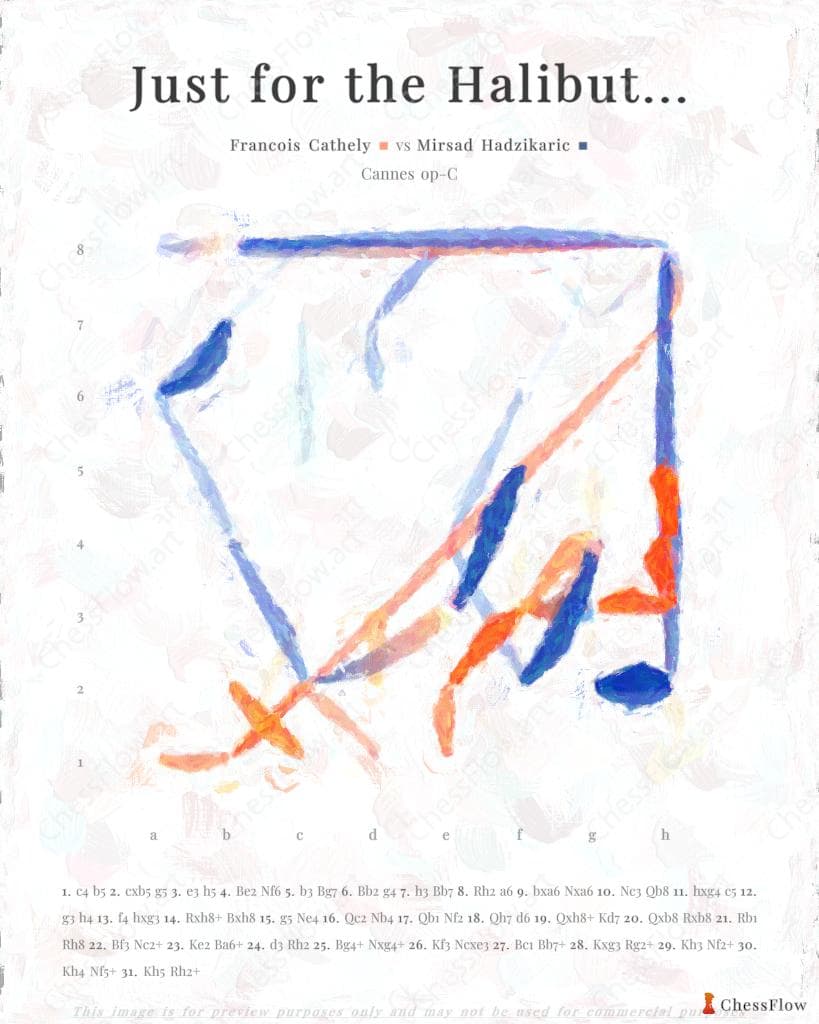
Francois Cathely vs Mirsad Hadzikaric
Francois Cathely vs Mirsad Hadzikaric
The Opening Gambit Francois Cathely and Mirsad Hadzikaric faced off in the 1995 Cannes op-C tournament with an opening that immediately signaled chaos was coming. After 1.c4 b5, Black's Polish Defens...
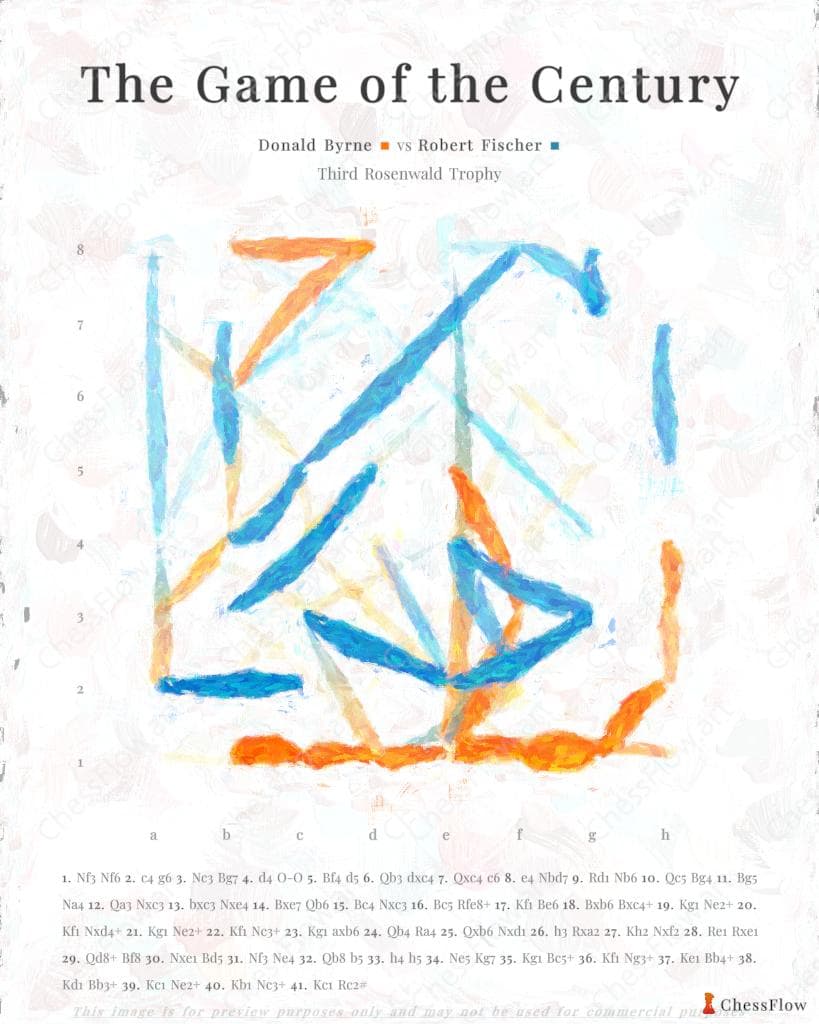
Donald Byrne vs Robert Fischer
Donald Byrne vs Robert Fischer
On the evening of October 17, 1956, inside New York’s Marshall Chess Club, a 13-year-old Bobby Fischer conjured a queen sacrifice so audacious that Chess Review editor Hans Kmoch immediately christene...
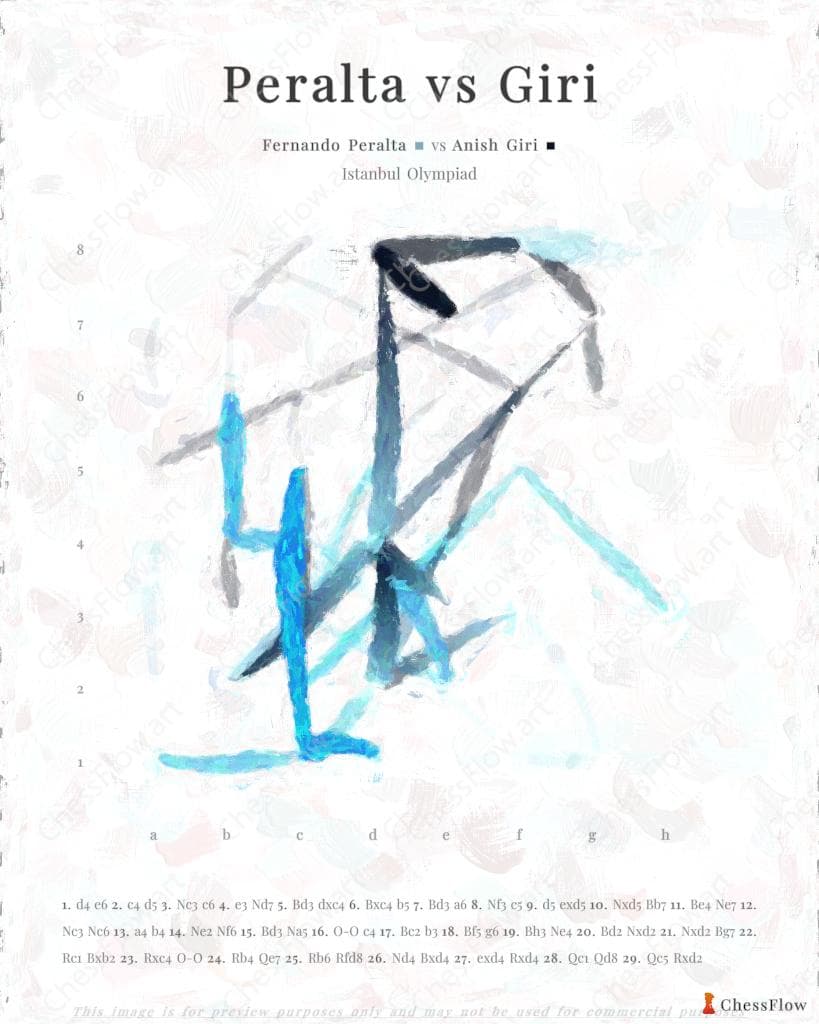
Fernando Peralta vs Anish Giri
Fernando Peralta vs Anish Giri
The Opening Battle Fernando Peralta (2606) faced off against rising Dutch talent Anish Giri (2711) in round 5 of the 2012 Istanbul Olympiad. The game opened with the Queen's Gambit Declined, Semi-Sla...