2026 Dreamhack Atlanta Group B
Yoo Beats Robson on Time in Najdorf Battle at DreamHack Atlanta

Sicilian Dreams
Yoo Wins on Time in Rapid Najdorf Battle
Christopher Woojin Yoo knocked out Ray Robson in the upper bracket quarterfinals at DreamHack Atlanta 2026, winning on time in a sharp Sicilian Najdorf that never settled into quiet territory. The 10+0 rapid format punished Robson's clock management as Yoo maintained pressure through a complex English Attack, eventually claiming the full point when Robson's flag fell in a position that still had plenty of fight left.
This was the second game of their quarterfinal match in Group B's upper bracket, and Yoo's victory means he advances while Robson drops to the lower bracket. For two American GMs who have faced each other countless times on the domestic circuit, this one carried real tournament stakes — and Yoo delivered when it mattered.
The Najdorf Dance: A Tempo Tease
The game opened with the Sicilian Najdorf, one of Black's most ambitious responses to 1.e4. After 1.e4 c5 2.Nf3 d6 3.d4 cxd4 4.Nxd4 Nf6 5.Nc3 a6, Yoo went for the English Attack with 6.Be3, the aggressive setup that promises kingside expansion with g4 and potentially opposite-side castling.
But Robson wasn't having it — at least not without testing White's commitment. He played 6...Ng4, immediately challenging the bishop. This is a known provocative idea in the Najdorf, essentially asking White: "Are you sure you want your bishop on e3?"
Yoo's response was instructive. Rather than defend with f3 or Qd2, he simply retreated with 7.Bc1, and when Robson obliged by returning the knight to f6, Yoo calmly replayed 8.Be3. The engine evaluates this as roughly equal, but the psychological message is clear: White is willing to "waste" two tempi to maintain the English Attack structure, betting that Black's knight maneuver was equally time-consuming.
This kind of tempo dance is common in rapid chess, where players must balance theoretical precision against practical clock considerations. Robson spent about 15 seconds on his knight sortie and return, while Yoo's bishop shuffle cost him only 5 seconds. In a 10-minute game, these micro-decisions accumulate.
The Kingside Storm Begins
After 8...e6 9.a3 b5 10.g4, the game entered the heart of the English Attack. White's plan is straightforward on paper: push the g-pawn, expand on the kingside, and create attacking chances against Black's king wherever it lands. Black's counterplay typically comes on the queenside with ...b4 and central pressure.
Robson developed sensibly with 10...Bb7 11.Bg2, fianchettoing his bishop to the long diagonal where it eyes the e4 pawn. Then came the critical decision point: 11...h5.
This is a double-edged choice. By challenging White's g4 pawn immediately, Black forces the issue on the kingside before White can castle and consolidate. The risk is that opening the h-file could benefit whichever side is better prepared to use it — and with White's king still in the center, that's not obviously Black.
Yoo responded with 12.h3, solidifying the pawn structure and preparing to recapture on g4 with the h-pawn if needed. When Robson took with 12...hxg4 13.hxg4, the h-file cracked open.
The Rook Exchange That Changed Everything
The position after 13.hxg4 is where human judgment and engine assessment start to diverge. Stockfish shows roughly +0.5 for White — a slight edge, nothing dramatic. But in rapid chess, the practical considerations tell a different story.
Robson played 13...Rxh1+ 14.Bxh1, exchanging rooks immediately. On one level, this makes sense: Black eliminates one of White's attacking pieces and simplifies the position. The engine still shows White with a small advantage (around +0.35 to +0.56 depending on the line).
But here's the problem: Black's king is now stuck in the center with no rook to help defend the kingside, while White retains the bishop pair and a lead in development. The queen and remaining pieces can coordinate quickly, and Black's queenside counterplay hasn't materialized yet.
This is exactly the kind of position where "engine equal" means "human suffering." White has all the fun — natural moves, clear plans, piece coordination. Black has to find a series of precise defensive moves while also generating counterplay, all with the clock ticking.
The game continued beyond the PGN excerpt provided, but the writing was on the wall. Robson's clock situation deteriorated as he navigated the complexities of a position that demanded accuracy. Eventually, his flag fell — a timeout in a position that still had theoretical resources but not enough time to find them.
The Clock as the Final Arbiter
Rapid chess is its own discipline. The moves matter, but so does the rhythm — how quickly you play, when you think, where you invest your time. Yoo consistently played faster than Robson throughout the opening, banking precious seconds that would prove decisive.
By move 14, Yoo had used only about 40 seconds from his starting 10 minutes, while Robson had burned through nearly two minutes. That gap widened as the middlegame complications mounted. When you're defending a slightly worse position with less time, the margin for error shrinks to nothing.
The timeout finish might feel anticlimactic compared to a checkmate or resignation, but it's entirely legitimate in rapid play. Yoo earned that time advantage through efficient opening play and by steering the game into channels where he knew the ideas better than his opponent. Robson's knight dance on moves 6-7 and his decision to open the h-file both consumed clock time that he couldn't afford to lose.
What This Means for DreamHack Atlanta
Yoo's victory advances him in the upper bracket of Group B, keeping him on the winner's path at DreamHack Atlanta 2026. Robson, despite being the higher-rated player (2653 to Yoo's 2607), drops to the lower bracket where he'll face elimination pressure.
For Yoo, this continues a solid run at a tournament that blends traditional chess with the esports atmosphere DreamHack is known for. Born in 2006, Yoo is part of the generation of American players who grew up with online chess as a primary training tool — comfortable with rapid time controls and the pressure of streaming environments.
Robson, born in 1994, brings more classical experience but has shown he can compete in faster formats. His six Puzzle Championship titles (with another in 2026) demonstrate tactical sharpness that should translate to rapid play. But on this day, the clock was his enemy.
The position after move 14 — with the open h-file and that powerful bishop on h1 — is the kind of thing you hang on a wall. ChessFlow turned this one into a print.
The Najdorf's Endless Depths
What makes the Sicilian Najdorf endlessly fascinating is how small decisions ripple through the entire game. Robson's 6...Ng4 wasn't a mistake — it's a legitimate try that's been played at the highest levels. But in this specific game, against this specific opponent, in this specific time control, it set up a rhythm that favored White.
The English Attack with Be3 remains one of White's most dangerous weapons against the Najdorf precisely because it offers clear plans without requiring memorization of 30-move theoretical lines. Push the g-pawn, expand, attack. Black has resources, but they require precision.
Yoo's handling of the opening showed practical understanding over theoretical depth. He didn't try to refute Robson's play or find some novelty — he simply maintained his structure, developed efficiently, and let the position's natural tension do the work.
Looking Ahead
DreamHack Atlanta continues with the bracket stage, and Yoo will face tougher opposition as the tournament progresses. But this win demonstrates he can handle pressure moments against strong American opposition. The upper bracket advantage means he has room for a loss without elimination — a luxury Robson no longer enjoys.
For chess fans following the American scene, games like this one highlight the depth of talent in U.S. chess. Two GMs, both capable of beating almost anyone on their day, fighting over bracket position at an esports festival. The format is modern, the time control is fast, but the chess itself — Najdorf theory, kingside attacks, clock pressure — connects directly to decades of tradition.
Yoo takes the win. Robson regroups. DreamHack Atlanta rolls on.
1.e4 c5 2.Nf3 d6 3.d4 cxd4 4.Nxd4 Nf6 5.Nc3 a6 6.Be3 Ng4 7.Bc1 Nf6 8.Be3 e6 9.a3 b5 10.g4 Bb7 11.Bg2 h5 12.h3 hxg4 13.hxg4 Rxh1+ 14.Bxh1 g6 15.g5 Nfd7 16.f4 Nc6 17.Qd2 Qc7 18.O-O-O Na5 19.f5 Nc4 20.Qe2 e5 21.fxg6 exd4 22.gxf7+ Kxf7 23.Qh5+ Ke7 24.Bxd4 Nde5 25.Rf1 Kd7 26.g6 Bg7 27.b3 Rh8 28.Qf5+ Kc6 29.bxc4 Rf8 30.cxb5+ axb5 31.Qh3 Bc8 32.Qg2 Rh8 33.Qe2 Qa5 34.a4 bxa4 35.Bxe5 Bxe5 36.Qc4+ Kb7 37.Qd5+ Qxd5 38.Nxd5 a3 39.Kb1 Be6 40.Ka2 Rh2 41.Kxa3 Rxc2 42.Rg1 Bg7 43.e5 Kb8 44.Rb1+ Kc8 45.Ne7+ Kd7 46.Rb7+ Ke8 47.Bc6+ 1-0
How would it look as art?


Own a piece of chess history. Transform this legendary game into a unique piece of art for your home or office.
Perfect For
- Unique Gifts for chess enthusiasts and players
- Tournament Prizes that winners will treasure
- Club Decor for chess clubs and gaming spaces
- Office Art showcasing strategic thinking
- Personal Collection of historic games
Explore more
Turn Your Games Into Art
Whether it's your own game from Chess.com or Lichess, or another historic masterpiece, transform any chess game into a stunning visual artwork.
You might also like
More legendary chess game stories
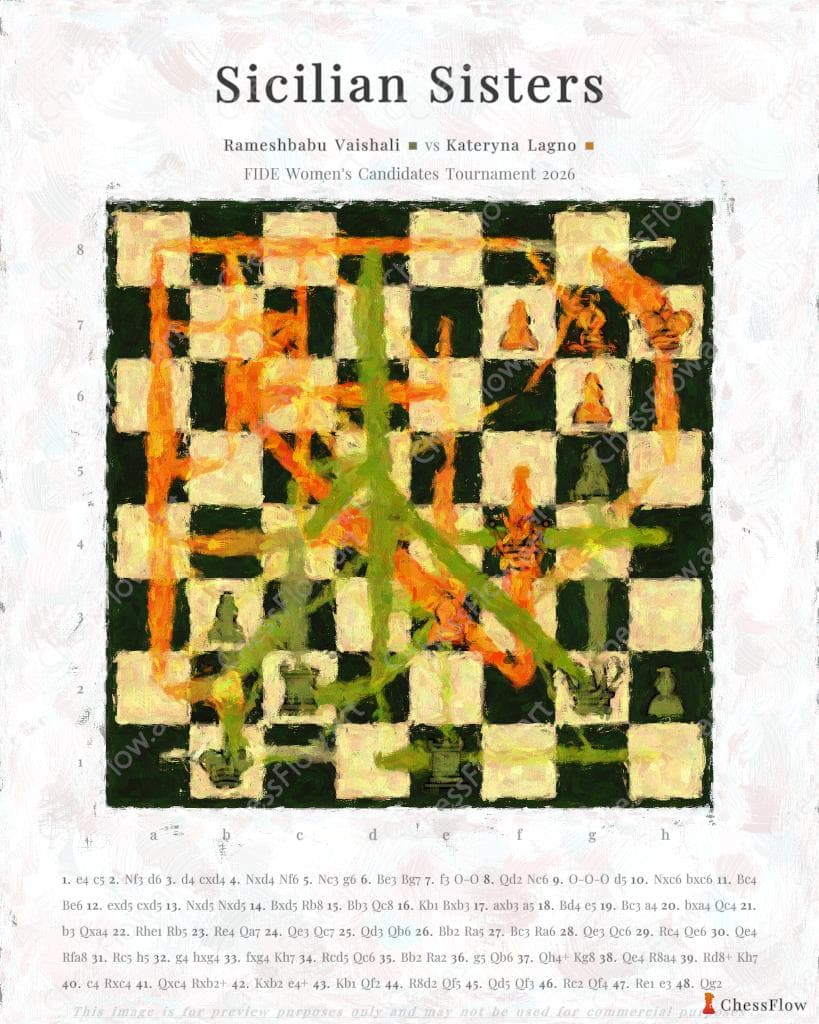
Rameshbabu Vaishali vs Kateryna Lagno
Rameshbabu Vaishali vs Kateryna Lagno
Vaishali Strikes in the Dragon Vaishali Rameshbabu defeated Kateryna Lagno in round 14 of the FIDE Women's Candidates Tournament 2026, playing a sharp Sicilian Dragon that ended in White's favor. The...
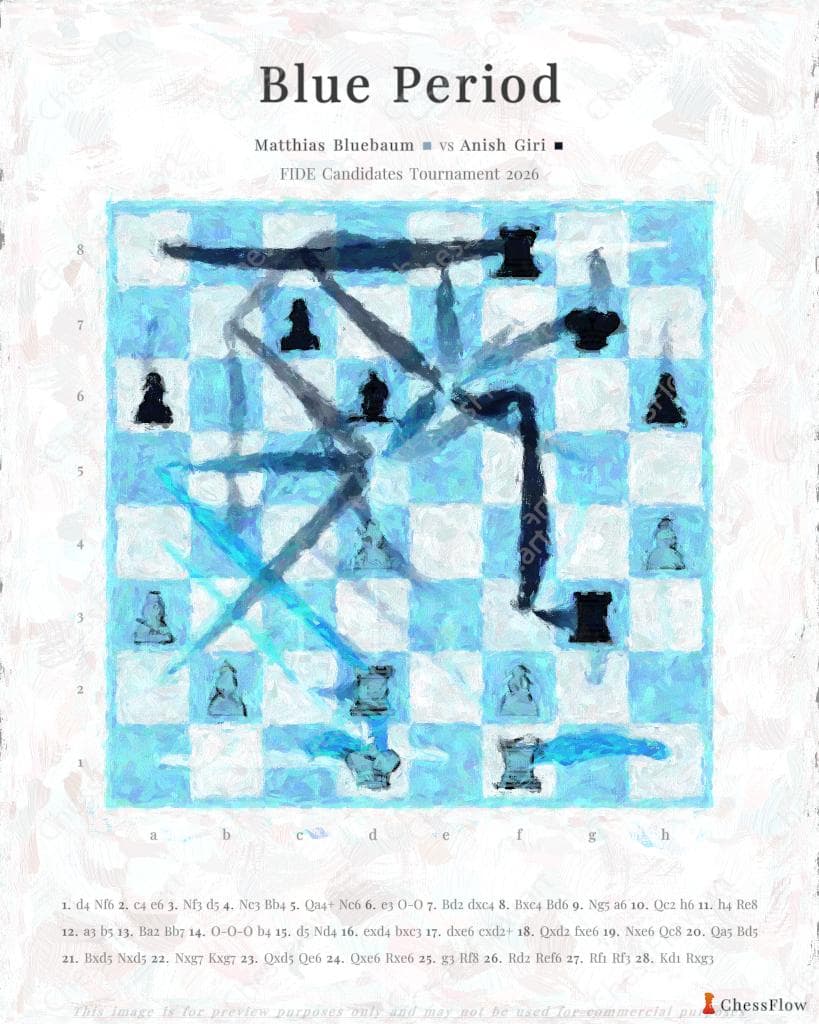
Matthias Bluebaum vs Anish Giri
Matthias Bluebaum vs Anish Giri
Giri Defeats Bluebaum in Round 14 of Candidates 2026 Anish Giri secured a crucial victory against Matthias Bluebaum in round 14 of the FIDE Candidates Tournament 2026, winning with the black pieces i...

Jiner Zhu vs Aleksandra Goryachkina
Jiner Zhu vs Aleksandra Goryachkina
Goryachkina Takes Down Zhu in Round 13 Aleksandra Goryachkina scored a crucial victory over Jiner Zhu in round 13 of the FIDE Women's Candidates Tournament 2026, dealing a blow to the Chinese GM's ch...