TePe Sigeman Chess Tournament 2026
Erigaisi Beats Zhu in Round 6 to Boost Sigeman Title Hopes


Sigeman's Shadow
Erigaisi Keeps Title Hopes Alive Against Zhu
Arjun Erigaisi defeated Zhu Jiner in round six of the TePe Sigeman Chess Tournament, converting a grinding Pirc Defense into a full point that keeps him firmly in the hunt for the tournament title. The Indian GM, rated 2751 and back in the world's top ten after his earlier win over Nils Grandelius, exploited Zhu's passive piece placement and mounting time pressure to secure his third win of the event.
The game was billed as a potential turning point in the tournament race. Erigaisi entered round six tied for the lead with Yagiz Kaan Erdogmus on 3½ points, and his remaining schedule—facing Zhu and Andy Woodward, the two lowest-rated players in the field—looked considerably more favorable than the Turkish teenager's gauntlet of Abdusattorov and Carlsen. This was a game Erigaisi needed to win, and he delivered.
The Pirc and White's Early Drift
Zhu opened with 1.e4 d6 2.d4 Nf6 3.Nc3 g6, entering the Pirc Defense—a hypermodern opening where Black concedes the center early but aims to undermine it later with piece pressure and pawn breaks. The choice was somewhat surprising given Zhu's struggles in Malmö; she had lost to Erdogmus in round three after an aggressive but poorly executed kingside pawn storm, and her only win came against Woodward when he blundered in the opening.
The early moves followed classical Pirc patterns. Zhu developed sensibly with 4.Be3 and 5.Nf3, setting up the standard attacking formation, while Erigaisi castled kingside and prepared his counterplay with 6...a6, a typical Pirc move that prepares ...b5 to challenge White's center from the queenside.
The first moment of interest came with 8.d5, where Zhu pushed her central pawn to gain space but also committed to a structure where Black's dark-squared bishop on g7 would become a monster if the center opened. Erigaisi responded with 8...Ne5, trading knights and accepting doubled pawns after 9.Nxe5 dxe5. This might look strange—Black's pawn structure is now compromised—but the compensation is clear: the e5-pawn controls key central squares, and Black's pieces have excellent prospects.
The Bishop Retreat That Changed Everything
The critical sequence began around move 11. After 10.f3 (preparing to castle queenside) and 10...e6 (challenging White's d5 pawn), Zhu played 11.Bc4?!, a move that looks natural but misses the point. The engine prefers 11.O-O-O, getting the king to safety immediately. Instead, Zhu's bishop found itself awkwardly placed, and Erigaisi immediately punished the hesitation with 11...b5, kicking the bishop and seizing queenside space.
The retreat 12.Bb3 was forced, and now 12...b4 came with tempo, chasing the knight. After 13.Na4, Erigaisi opened the center with 13...exd5 14.exd5 e4, and suddenly the position had transformed. Black's pieces were flowing toward active squares while White's knight on a4 looked stranded on the rim, far from the action.
What makes this sequence instructive is how quickly a small inaccuracy snowballed. Zhu's 11.Bc4?! wasn't a blunder—the engine only gives Black a slight edge—but it set off a chain of events where White was always slightly worse, always slightly passive, always spending time on defense rather than attack. In classical chess with 90 minutes for 40 moves, these small edges compound.
The Grind: When Engines Say Equal But Humans Suffer
The middlegame that followed was the kind of position where engine evaluations tell only part of the story. For many moves, the computer assessment hovered around equality or showed only a marginal Black advantage. But anyone who has played classical chess knows the difference between "equal" and "equal but miserable."
Zhu's position had several practical problems that don't show up in the evaluation bar. Her knight on a4 was offside and needed multiple tempi to return to the game. Her bishop on b3 was blocked by her own d5 pawn. Her king remained in the center longer than comfortable, and when she finally castled, the queenside had already been weakened by the pawn advances.
Erigaisi, by contrast, had a clear plan: activate pieces, probe weaknesses, and wait for the clock to become a factor. The Indian GM is known for his grinding style in such positions—he doesn't need a forced win, just a position where his opponent has to find accurate moves under pressure. And Zhu, who had already shown time management issues earlier in the tournament (she was down to two seconds against Erdogmus before blundering), was the wrong opponent to have in a technical grind.
Time Pressure and the Final Collapse
As the game progressed into the later stages, Zhu's clock became increasingly problematic. The 90+30 time control with 30-second increment provides some safety net, but when you're already behind on time and facing a position that requires constant precision, the increment isn't enough.
The evaluation steadily crept in Black's favor as Zhu's pieces remained passive and her options narrowed. Erigaisi's technique in such positions is well-documented—he had already converted a similar grinding advantage against Grandelius earlier in the tournament, and his win over Abdusattorov in round four (which Abdusattorov let slip into a draw) showed his willingness to press for hours.
The resignation, when it came, felt inevitable rather than sudden. Zhu's position had been slowly deteriorating, and once the evaluation crossed into clearly winning territory for Black, there was no recovery. For the Chinese GM, it was another painful loss in a tournament where she had shown flashes of quality but couldn't sustain them over full games.
Tournament Implications: The Race Tightens
With this win, Erigaisi moved to 4½ points with one round remaining, maintaining pressure on co-leader Erdogmus. The tournament situation heading into the final round is fascinating: Erigaisi faces Woodward in the last round while Erdogmus has the much tougher task of facing Magnus Carlsen, who is half a point back and desperate to salvage his tournament after his shocking loss to Jorden van Foreest.
The contrast in remaining schedules, which ChessBase noted before round six, has played out exactly as expected. Erigaisi's path through the lower-rated half of the field has yielded maximum points, while Erdogmus has had to navigate Abdusattorov and will now face a motivated Carlsen.
For Zhu, the tournament has been a learning experience. At 2546, she was the lowest-rated player in the field, and her results reflect that gap—losses to Erdogmus, Carlsen, and now Erigaisi, with her only win coming against Woodward. But she also held Jorden van Foreest to a draw in a 93-move marathon and showed fighting spirit throughout. The experience of playing against the world's elite, including Carlsen and Abdusattorov, will serve her development well.
A Quiet Win That Speaks Volumes
This wasn't a game of sacrifices and fireworks. There was no queen sacrifice, no king hunt, no tactical explosion. Instead, it was a game that showed why Erigaisi has climbed back into the world's top ten: the ability to squeeze positions, to maintain pressure without overreaching, to convert small advantages into full points against strong opposition.
The Pirc Defense often produces these kinds of games—Black accepts a slightly passive setup in exchange for counterplay opportunities, and the resulting positions reward patience and technique over raw aggression. Erigaisi's handling of the opening and middlegame was a clinic in how to play these structures: challenge the center at the right moment, activate pieces toward the weakest points, and trust that your opponent will crack under sustained pressure.
We turned this one into a print—sometimes the cleanest technique makes for the most satisfying art.
The final round promises drama. Erigaisi will be the heavy favorite against Woodward, meaning a draw might be enough for the title depending on the Erdogmus-Carlsen result. But in Malmö, where Van Foreest already proved that Carlsen can be beaten, nothing is certain. The TePe Sigeman title race goes down to the wire.
1.e4 d6 2.d4 Nf6 3.Nc3 g6 4.Be3 Bg7 5.Nf3 O-O 6.Qd2 a6 7.Bd3 Nc6 8.d5 Ne5 9.Nxe5 dxe5 10.f3 e6 11.Bc4 b5 12.Bb3 b4 13.Na4 exd5 14.exd5 e4 15.O-O-O exf3 16.gxf3 a5 17.h4 Nh5 18.d6 Bb7 19.dxc7 Qxc7 20.Qd7 Qe5 21.Qxb7 Qxe3+ 22.Kb1 Qf4 23.Rd7 Rae8 24.Rhd1 Qf6 25.Qb5 Qxf3 26.Qxa5 Nf6 27.R7d3 Qf4 28.Qg5 Qxg5 29.hxg5 Ne4 30.Rd5 Re5 31.Nb6 Nxg5 32.Rxe5 Bxe5 33.Nd7 Re8 34.a4 bxa3 35.Nxe5 Rxe5 36.bxa3 Kf8 37.Kb2 Ke7 38.a4 f5 39.Bd5 Kd6 40.c4 Kc5 41.a5 Re2+ 42.Ka3 Re3+ 43.Kb2 Ne6 44.Rh1 Nf4 45.Bb7 Nd3+ 46.Kc2 Nb4+ 47.Kd2 Ra3 48.Rxh7 Rxa5 49.Rg7 Ra7 50.Kc3 Ra3+ 51.Kd2 Rg3 52.Bc8 f4 53.Be6 g5 54.Rb7 Rd3+ 55.Kc1 Re3 56.Bg8 f3 57.Kd2 Rd3+ 58.Ke1 Rb3 59.Rg7 Nd3+ 60.Kd2 Ne5 61.Rxg5 Kd4 62.Bh7 f2 63.Ke2 Rf3 64.Kf1 Nxc4 65.Rg4+ Kc3 66.Rxc4+ Kxc4 67.Be4 Rf4 0-1
How would it look as art?


Own a piece of chess history. Transform this legendary game into a unique piece of art for your home or office.
Perfect For
- Unique Gifts for chess enthusiasts and players
- Tournament Prizes that winners will treasure
- Club Decor for chess clubs and gaming spaces
- Office Art showcasing strategic thinking
- Personal Collection of historic games
Turn Your Games Into Art
Whether it's your own game from Chess.com or Lichess, or another historic masterpiece, transform any chess game into a stunning visual artwork.
You might also like
More legendary chess game stories
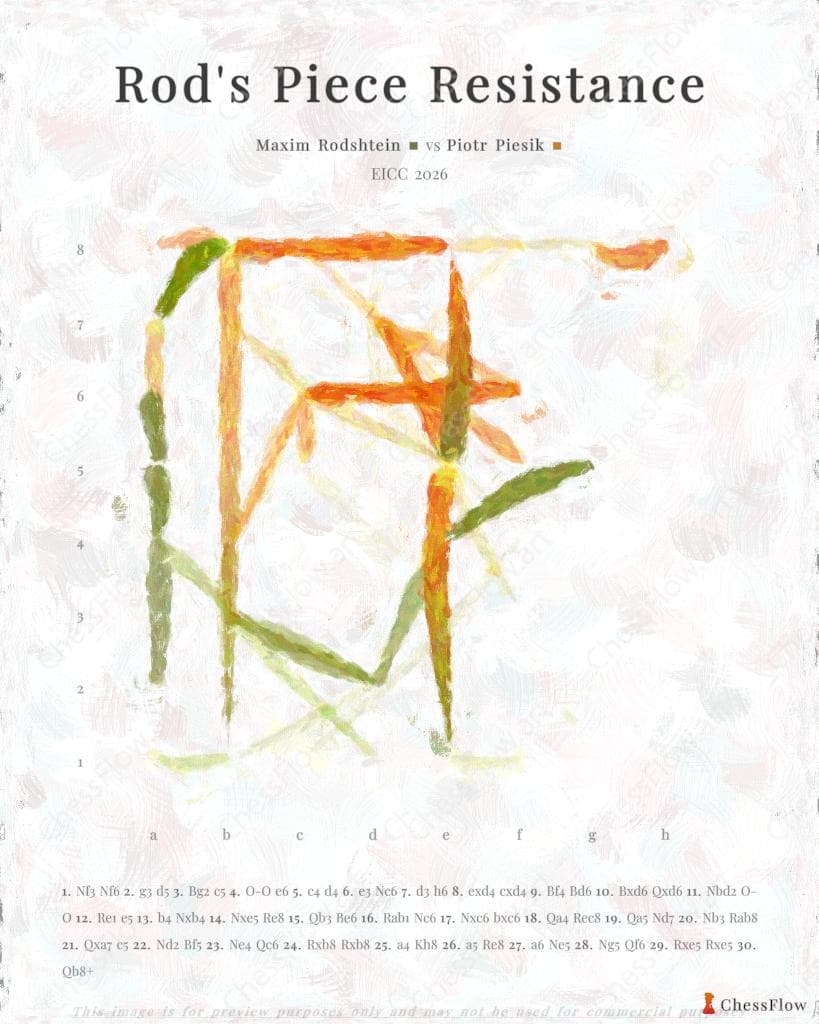
Maxim Rodshtein vs Piotr Piesik
Maxim Rodshtein vs Piotr Piesik
Rodshtein Outplays Piesik in King's Indian Attack GM Maxim Rodshtein (2598) defeated IM Piotr Piesik (2407) in round 2 of the European Individual Chess Championship 2026, showcasing the enduring appe...
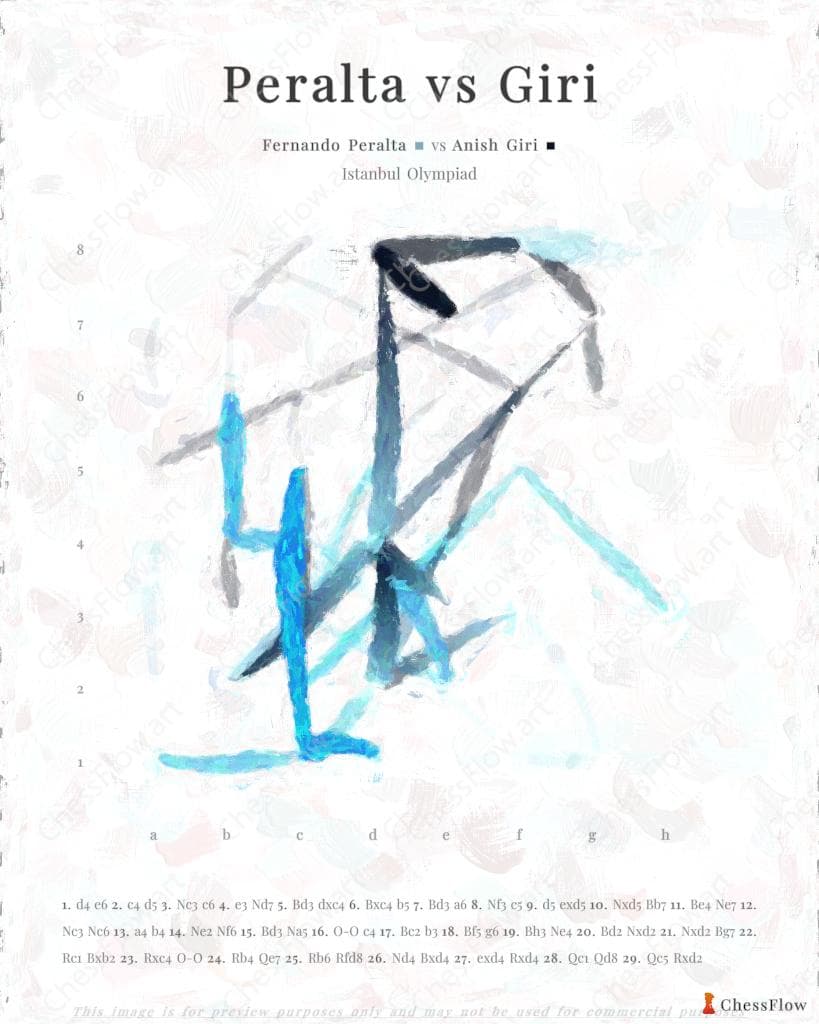
Fernando Peralta vs Anish Giri
Fernando Peralta vs Anish Giri
The Opening Battle Fernando Peralta (2606) faced off against rising Dutch talent Anish Giri (2711) in round 5 of the 2012 Istanbul Olympiad. The game opened with the Queen's Gambit Declined, Semi-Sla...

Jiner Zhu vs Aleksandra Goryachkina
Jiner Zhu vs Aleksandra Goryachkina
Goryachkina Takes Down Zhu in Round 13 Aleksandra Goryachkina scored a crucial victory over Jiner Zhu in round 13 of the FIDE Women's Candidates Tournament 2026, dealing a blow to the Chinese GM's ch...