rated rapid game
Chopra and Liang Draw in University Championship Qualifier


East Meets West
A Half-Point Between Rising Stars
Aryan Chopra and Awonder Liang split the point in a 14-move draw during Round 5 of the FIDE World University Team Chess Championship 2026 Online Qualifier, a game that never truly caught fire despite featuring two of the most accomplished young grandmasters in their respective countries. Chopra, representing Saint Louis University at 2637, faced Webster University's Liang, rated 2718 — an 81-point rating gap that suggested Black might push for more. Instead, the game settled into a symmetrical double-fianchetto structure where neither player found a convincing way to create imbalance.
The result mattered more for the team standings than individual glory. With SLU and Webster both fighting for positioning in the qualifier, every half-point carries weight. This wasn't the kind of game that changes narratives — it was the kind that preserves them.
The Sicilian Invitation Goes Nowhere
Chopra opened with 1.Nf3, the Zukertort Opening, and Liang responded with 1...c5 — the so-called "Sicilian Invitation." White declined the invitation to transpose into a proper Sicilian with d4, instead opting for the quiet 2.g3 g6 3.Bg2 Bg7 4.O-O Nc6 5.c4, steering the game toward an English-flavored symmetrical setup.
This is a common choice at the top level when White wants to avoid heavy theoretical battles. Against a player like Liang — who earlier this year defeated Hikaru Nakamura 6-4 in a training match ahead of the 2026 Candidates — Chopra had every reason to keep the game in quieter waters. The Indian GM has his own credentials: he held Magnus Carlsen to a draw in the final round of the 2026 grenke Freestyle Open, a result that helped Carlsen settle for third place behind Vincent Keymer.
By move 6, both players had developed naturally: 6.Nc3 Be6 7.d3 Qc8. Liang's queen move to c8 is a typical idea in these structures, preparing to trade off the light-squared bishops with ...Bh3 while keeping the queen flexible. The evaluation hovered around +0.10 throughout — engines saw nothing for either side, and neither did the players.
The Bishop Exchange and Kingside Tension
The game's only moment of genuine tension came between moves 8 and 12. After Chopra played 8.Bd2, Liang pushed 8...h5, a slightly ambitious move that the engine flagged at +0.45 — the first time the evaluation meaningfully deviated from zero. The idea is aggressive: Black wants to play ...Bh3, exchange bishops, and potentially create kingside pressure with the h-pawn already advanced.
Chopra responded practically with 9.h4, stopping any further pawn advances and accepting a slightly weakened kingside structure in exchange for stability. The sequence continued: 9...Bh3 10.Bxh3 Qxh3 11.Ng5 Qd7. White's knight jump to g5 looked menacing but achieved little — the queen simply retreated, and the knight would need to find a new home.
Here's where the human element diverges from engine assessment. The computer sees this position as dead equal, around 0.00. But for a human playing rapid chess with 10+5 time control, the position offers nothing concrete for either side. No pawn breaks, no targets, no obvious plans. When both players are 2600+, they recognize these positions quickly — there's simply no path to an advantage without the opponent making a significant error.
12.Kg2 was a sensible prophylactic move, removing the king from any potential back-rank issues and connecting the rooks. Liang developed with 12...Nh6 and 13...O-O, completing his setup. By move 14, with 14.Rb1, the game had reached a position where both players had castled, developed all their pieces, and had no clear plan forward.
When Equal Means Equal
The PGN cuts off at move 14, but the result tells the story: a draw agreed shortly after. In rapid chess, especially in a team competition where match points matter more than individual brilliance, there's no shame in recognizing when a position offers nothing. Engines might suggest that White could try b4 at some point, or that Black could maneuver knights to e5, but these plans take time to execute and carry risk in a 10+5 format.
This is the gap between engine assessment and human reality. Stockfish will happily evaluate a position as +0.15 and suggest 40 moves of maneuvering to convert that edge. But when you're playing for a university team, when the clock is ticking, and when your opponent is a 2718 GM who just beat Nakamura in a training match, "equal" means "draw."
Chopra, at 84th in the world, has shown he can hold his own against the absolute elite — his draw against Carlsen at the grenke Freestyle Open proved that. Liang, the former youngest player to defeat a grandmaster (he beat Larry Kaufman at just 9 years old), has evolved from prodigy to genuine top-100 threat. At 23, he's firmly established among America's best, and his training match victory over Nakamura suggests he's still improving.
The University Chess Landscape
This game took place against the backdrop of an increasingly competitive American collegiate chess scene. The 2026 President's Cup, held earlier this year, saw the University of Missouri claim their second title in three years. SLU — Chopra's team — pulled off an upset in that tournament, defeating the Pan-American champions 2½-1½ thanks to GM Viktor Gazik's win against GM Harsha Bharathakoti.
Webster University, where Liang plays, remains a powerhouse but faced a rough President's Cup, getting trounced 3-1 by UTRGV in one of the rounds. These online qualifiers offer another path to international competition, and every board matters. A draw between two top GMs is a neutral result for both teams — neither gains nor loses ground.
The FIDE World University Team Championship has grown in prestige over recent years, attracting genuine super-GMs to collegiate rosters. When you have players like Chopra (who's battled Carlsen) and Liang (who's beaten Nakamura) facing off on a university board, the level rivals many open tournaments.
What This Draw Means
For Chopra, this was a solid result with the white pieces against a higher-rated opponent. No risk taken, no rating points lost. His April 2026 FIDE rating of 2637 keeps him comfortably in the world's top 100, and his recent performances — including that Carlsen draw — suggest he's capable of more when the stakes demand it.
For Liang, the draw was similarly acceptable. His 2718 rating (April 2026) makes him one of America's strongest players, and his rapid rating of 2522 suggests this time control isn't his primary strength. Taking a half-point against a dangerous opponent on a rival team is pragmatic chess.
The symmetrical fianchetto structure that emerged from the Zukertort Opening is exactly the kind of position that produces these results at the GM level. Without asymmetry, without imbalance, without targets — chess becomes a waiting game that neither player wanted to play.
We turned this one into a print anyway — sometimes the quiet games have their own geometry.
Looking Ahead
The FIDE World University Team Championship Online Qualifier continues, with both SLU and Webster jockeying for position. These team events often come down to the lower boards, where rating differences are larger and decisive results more common. When two top GMs draw on board one, the pressure shifts to boards two, three, and four.
For both Chopra and Liang, the individual result matters less than the team outcome. University chess has become a legitimate pathway for young grandmasters, offering competition, coaching, and community. The fact that a routine Round 5 qualifier can feature two players who've held their own against Carlsen and Nakamura respectively speaks to how strong the collegiate circuit has become.
Not every game produces fireworks. This one produced 14 moves of solid, professional chess between two players who recognized quickly that the position offered nothing. In rapid chess, that recognition is itself a skill — knowing when to fight and when to shake hands.
The double-fianchetto structure will appear again. Chopra and Liang will face each other again. Maybe next time one of them will find a way to create the imbalance that this game lacked. For now, a half-point each, and on to Round 6.
1.Nf3 c5 2.g3 g6 3.Bg2 Bg7 4.O-O Nc6 5.c4 d6 6.Nc3 Be6 7.d3 Qc8 8.Bd2 h5 9.h4 Bh3 10.Bxh3 Qxh3 11.Ng5 Qd7 12.Kg2 Nh6 13.a3 O-O 14.Rb1 a6 15.b4 cxb4 16.axb4 b5 17.cxb5 axb5 18.Nxb5 Rfb8 19.Nc3 Nxb4 20.Nce4 Nd5 21.Nf3 Nf5 22.Qc2 Nf6 23.Rxb8+ Rxb8 24.Nxf6+ Bxf6 25.Rb1 Rc8 26.Qb3 Kg7 27.Qb4 Rc2 28.e4 Nxh4+ 29.Nxh4 Bxh4 30.gxh4 Qg4+ 31.Kf1 Qxh4 32.Rb2 Qh3+ 33.Ke2 Qg4+ 34.f3 Qg2+ 35.Ke1 Qg1+ 36.Ke2 Rc6 37.Be3 Qg2+ 38.Bf2 Rc1 39.Qd4+ Kh7 40.Qd5 Kg7 41.Qd4+ Kh7 42.Qd5 Kg7 43.Qd4+ 1/2-1/2
How would it look as art?


Own a piece of chess history. Transform this legendary game into a unique piece of art for your home or office.
Perfect For
- Unique Gifts for chess enthusiasts and players
- Tournament Prizes that winners will treasure
- Club Decor for chess clubs and gaming spaces
- Office Art showcasing strategic thinking
- Personal Collection of historic games
Turn Your Games Into Art
Whether it's your own game from Chess.com or Lichess, or another historic masterpiece, transform any chess game into a stunning visual artwork.
You might also like
More legendary chess game stories
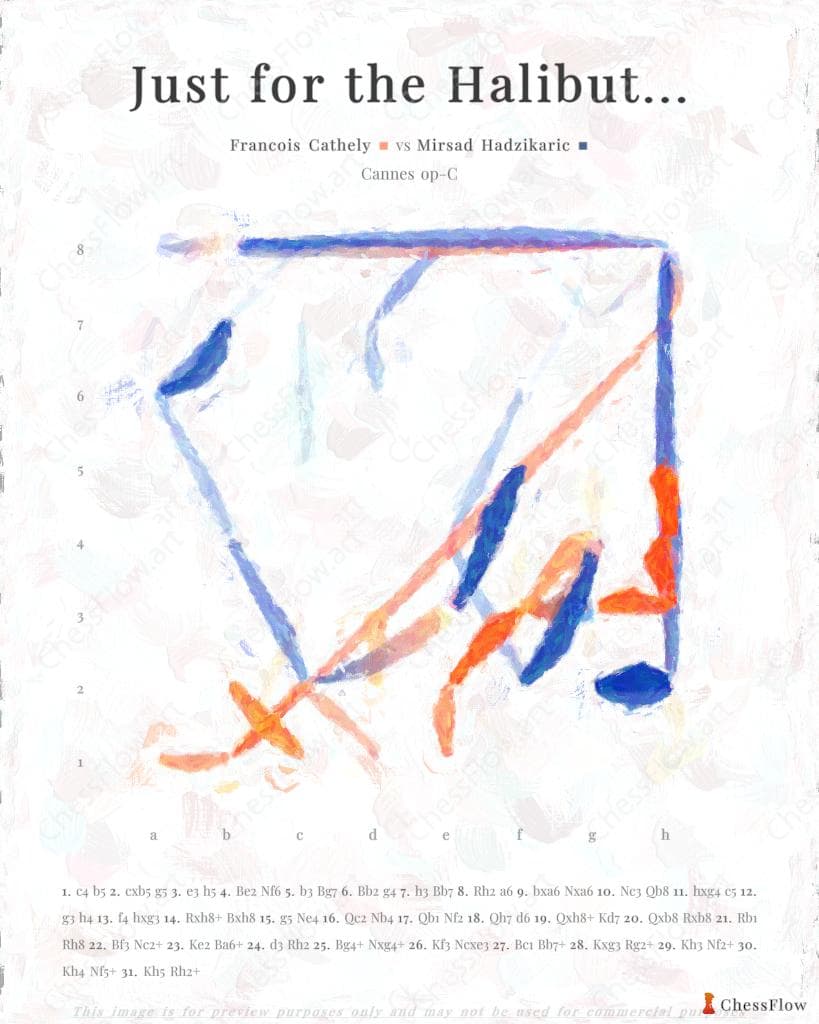
Francois Cathely vs Mirsad Hadzikaric
Francois Cathely vs Mirsad Hadzikaric
The Opening Gambit Francois Cathely and Mirsad Hadzikaric faced off in the 1995 Cannes op-C tournament with an opening that immediately signaled chaos was coming. After 1.c4 b5, Black's Polish Defens...
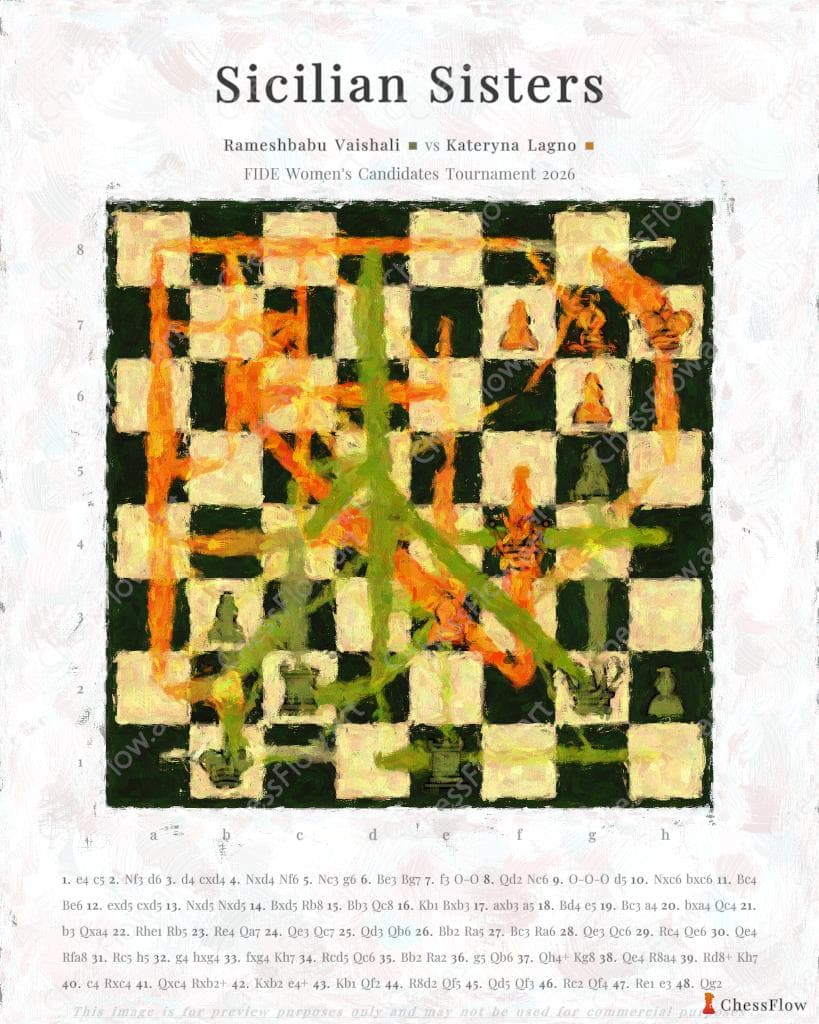
Rameshbabu Vaishali vs Kateryna Lagno
Rameshbabu Vaishali vs Kateryna Lagno
Vaishali Strikes in the Dragon Vaishali Rameshbabu defeated Kateryna Lagno in round 14 of the FIDE Women's Candidates Tournament 2026, playing a sharp Sicilian Dragon that ended in White's favor. The...

Jiner Zhu vs Aleksandra Goryachkina
Jiner Zhu vs Aleksandra Goryachkina
Goryachkina Takes Down Zhu in Round 13 Aleksandra Goryachkina scored a crucial victory over Jiner Zhu in round 13 of the FIDE Women's Candidates Tournament 2026, dealing a blow to the Chinese GM's ch...