Championnat de France des Clubs 2026 | Elimination | Groupe B
Van Foreest Beats Donchenko in French Club Championship 2026


Elimination Blues
Van Foreest Ends Donchenko's Streak in French Club Championship
Jorden van Foreest handed Alexander Donchenko a rare defeat in Round 5 of the Championnat de France des Clubs 2026 elimination stage, snapping what had been an extraordinary run for the German grandmaster. Playing for Aix-En-Provence against Donchenko's Vandoeuvre Echecs, Van Foreest navigated a Nimzo-Indian Defense into a position where White's ambitious pawn structure became a liability rather than a strength.
The result carries extra weight given the recent history between these two. Donchenko had previously beaten Van Foreest during his remarkable 7/7 performance at the French Top 16 earlier this year — a streak that included victories over Arjun Erigaisi and Andrey Esipenko. This time, the Dutch number-two found the antidote.
The Nimzo-Indian Setup
Van Foreest chose the Nimzo-Indian Defense with 1.d4 Nf6 2.c4 e6 3.Nc3 Bb4, steering the game into the Rubinstein System after Donchenko's 4.e3. This is solid, classical territory — the kind of opening where both players know the themes inside out and the battle shifts to understanding and execution rather than memorized novelties.
The critical early decision came with 7...c4, Van Foreest's choice to lock the queenside pawn structure. This move commits Black to a specific plan: the bishop on d3 gets pushed back, White's central pawns become targets rather than assets, and the game becomes about whether White can break through in the center before Black's piece activity becomes overwhelming.
Donchenko retreated with 8.Bc2, keeping the bishop on a useful diagonal while preparing to castle. The position after 9.O-O Re8 10.f3 shows White's plan clearly: prepare e4 and try to open the center. But Van Foreest had seen this coming.
The Maneuvering Battle
What followed was a careful repositioning phase that engines might call equal but humans know is uncomfortable for White. After 10...Nc6 11.Kh1, Donchenko tucked his king away in anticipation of central action. Van Foreest responded with 11...Ba5, a typical Nimzo maneuver — the bishop has done its job on b4 and now looks for better prospects.
The position after 12.a3 h6 13.Rb1 Bc7 deserves attention. Van Foreest has reorganized his pieces smoothly: the bishop on c7 eyes the kingside, the knight on c6 controls key central squares, and Black's structure is rock-solid. Meanwhile, Donchenko's pieces are functional but lack clear targets.
This is where the gap between engine assessment and human experience matters. The computer might show +0.2 or +0.3 for White, suggesting a tiny edge. But practically speaking, White has to find a way to make progress while Black can simply improve his position move by move. Donchenko, who has spoken about how "every World Cup game so far has been a roller-coaster and it is really hard to keep your composure," knows better than most how draining these positions can be.
Donchenko's Queenside Ambitions
With 14.b3, Donchenko attempted to challenge Black's pawn chain. This is the logical continuation — if White can dissolve the c4-d5 structure, his bishop on c2 comes alive and the central majority could become a weapon. But the timing proved problematic.
The position required White to balance multiple concerns simultaneously: the need to break with b3, the desire to advance e4, and the necessity of keeping the kingside secure. Van Foreest had been building pressure methodically, and Donchenko's attempts to force the issue only created new weaknesses.
What makes this game instructive is how Van Foreest handled the transition. In Nimzo-Indian positions with ...c4, Black often has to be patient — the structure gives long-term advantages but doesn't offer immediate tactics. Van Foreest, ranked 22nd in the world with a 2728 rating, showed exactly why he's climbed into the elite: he understood when to wait and when to strike.
The Positional Squeeze
The middle game saw Van Foreest gradually tightening his grip. His pieces found harmonious squares while Donchenko's struggled for coordination. The knight on c6, the rook on e8, the bishop on c7 — each piece had purpose. White's position, by contrast, felt like it was waiting for something to happen rather than making things happen.
This is a theme that runs through Van Foreest's best games. The Dutch grandmaster won the 2021 Tata Steel Masters and has been on a steady upward trajectory, reaching a peak ranking of 14th in the world just two months before this game. His understanding of these closed positions — where the engine says "equal" but one side has all the practical chances — is among the best in the world.
Donchenko, for his part, had been riding an incredible wave of form. His 7/7 at the French Top 16 was described by observers as "simply amazing" and "unreal," with victories over five grandmasters including Esipenko and Erigaisi. But streaks end, and Van Foreest was the one to end this one.
The Decisive Phase
As the game progressed, the evaluation swung in Black's favor. Van Foreest's pressure on the e-file and his superior piece coordination began to tell. Donchenko, who had been spending more time on the clock throughout the opening, found himself in one of those positions where every move feels slightly worse than the last.
The psychological element cannot be ignored here. Donchenko had beaten Van Foreest in their previous encounter during the French Top 16. Coming into this game, he might have expected another tough fight but had reason for confidence. Van Foreest, however, had clearly done his homework. The Nimzo-Indian choice felt deliberate — a structure where Van Foreest's positional understanding could shine and where Donchenko's aggressive tendencies might be blunted.
The final result — a Van Foreest victory — represented both revenge for the earlier loss and a statement about his current form. After spending time below 2700 Elo, the Dutch GM has climbed steadily, and games like this one show why.
What This Means for Both Players
For Donchenko, the loss is a bump in what has otherwise been a remarkable 2026. The German number-three (by rating) has shown he can compete with anyone — his World Cup run where he "defeated three 2700 players" proved that. But consistency at the highest level requires handling defeats like this one and bouncing back.
For Van Foreest, playing for Aix-En-Provence in the elimination stage, this victory adds to his growing reputation as a player who rises to the occasion in team events. The French Club Championship has attracted serious talent — Maxime Vachier-Lagrave is also competing in Groupe B — and Van Foreest's contribution to his team's campaign is significant.
The Nimzo-Indian remains one at this level can find himself slowly squeezed out of the position. Van Foreest's handling of the middlegame — patient, purposeful, and precise — is the kind of chess that wins team matches.
The position after move 14 is the kind of thing you hang on a wall — White's pieces looking for a plan, Black's already executing one.
Looking Ahead
The elimination stage continues, with both teams fighting for advancement. Donchenko will likely shake off this loss quickly — his resilience has been proven repeatedly, including his World Cup run where he "finally converts in the 5+3 blitz" after multiple near-misses. Van Foreest, meanwhile, will look to build on this result and continue his team's push.
For students of the Nimzo-Indian, this game offers a clear lesson: the ...c4 structure isn't about immediate tactics. It's about understanding that White's extra space means nothing if the pieces can't coordinate. Van Foreest understood this perfectly. Donchenko, despite his best efforts, couldn't find a way through.
The French Club Championship has once again delivered a high-quality encounter between two at this level competing, the elimination stage promises more battles to come. Follow the action on ChessFlow as the tournament progresses.
1.d4 Nf6 2.c4 e6 3.Nc3 Bb4 4.e3 c5 5.Bd3 d5 6.cxd5 exd5 7.Ne2 c4 8.Bc2 O-O 9.O-O Re8 10.f3 Nc6 11.Kh1 Ba5 12.a3 h6 13.Rb1 Bc7 14.b3 cxb3 15.Rxb3 Qd6 16.g3 Bb6 17.Qd3 Be6 18.Nf4 Rac8 19.Na4 Na5 20.Rb1 Bd7 21.Nxb6 axb6 22.Rf2 Rc4 23.Bd2 Ne4 24.Kg1 f5 25.Re2 Nxd2 26.Qxd2 Rec8 27.Bd3 Rc3 28.Bb5 Nb3 29.Rxb3 Rxb3 30.Bxd7 Qxd7 31.Qa2 Rcc3 32.Kf2 Qc6 33.h4 g5 34.hxg5 hxg5 35.Nh3 Qh6 36.Kg2 g4 37.Nf4 Rc1 0-1
How would it look as art?


Own a piece of chess history. Transform this legendary game into a unique piece of art for your home or office.
Perfect For
- Unique Gifts for chess enthusiasts and players
- Tournament Prizes that winners will treasure
- Club Decor for chess clubs and gaming spaces
- Office Art showcasing strategic thinking
- Personal Collection of historic games
Explore more
Turn Your Games Into Art
Whether it's your own game from Chess.com or Lichess, or another historic masterpiece, transform any chess game into a stunning visual artwork.
You might also like
More legendary chess game stories
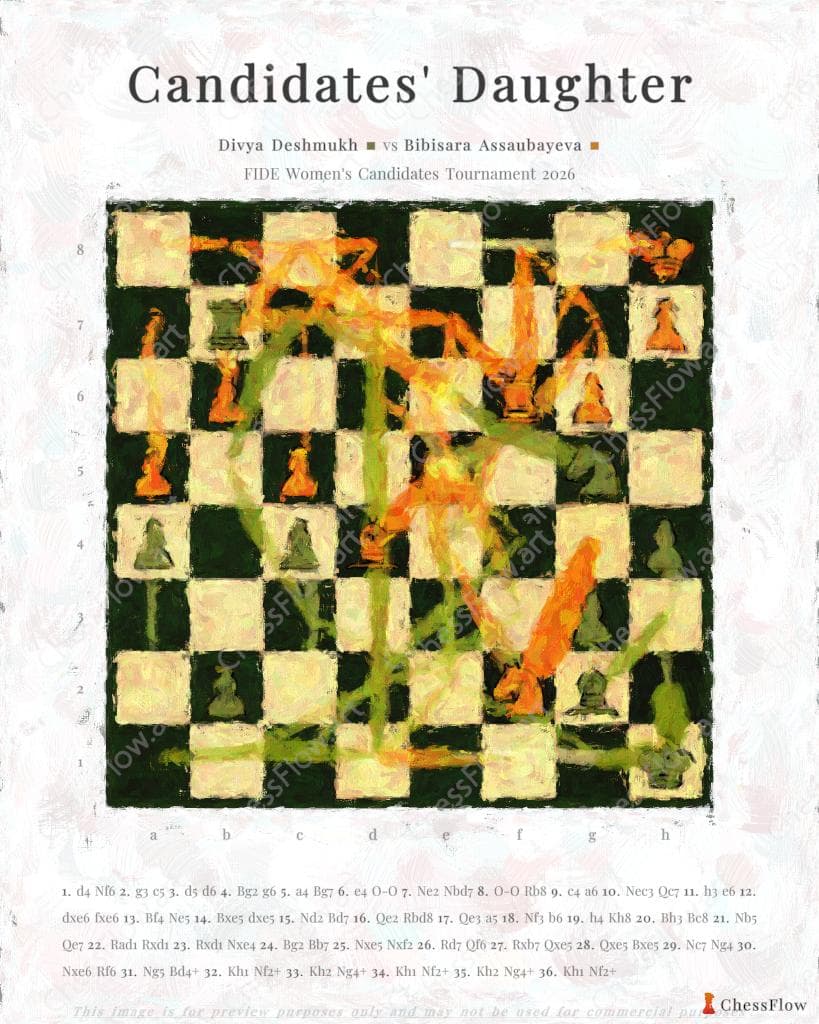
Divya Deshmukh vs Bibisara Assaubayeva
Divya Deshmukh vs Bibisara Assaubayeva
The Final Round Showdown Round 14 of the 2026 FIDE Women's Candidates Tournament delivered a crucial draw between GM Divya Deshmukh (2497) and GM Bibisara Assaubayeva (2516). With Assaubayeva enterin...

Yi Wei vs Andrey Esipenko
Yi Wei vs Andrey Esipenko
Wei's First Strike Wei Yi finally broke through at the 2026 FIDE Candidates Tournament, defeating Andrey Esipenko 1-0 in round 13 with a sharp attacking game that emerged from the normally solid Petr...
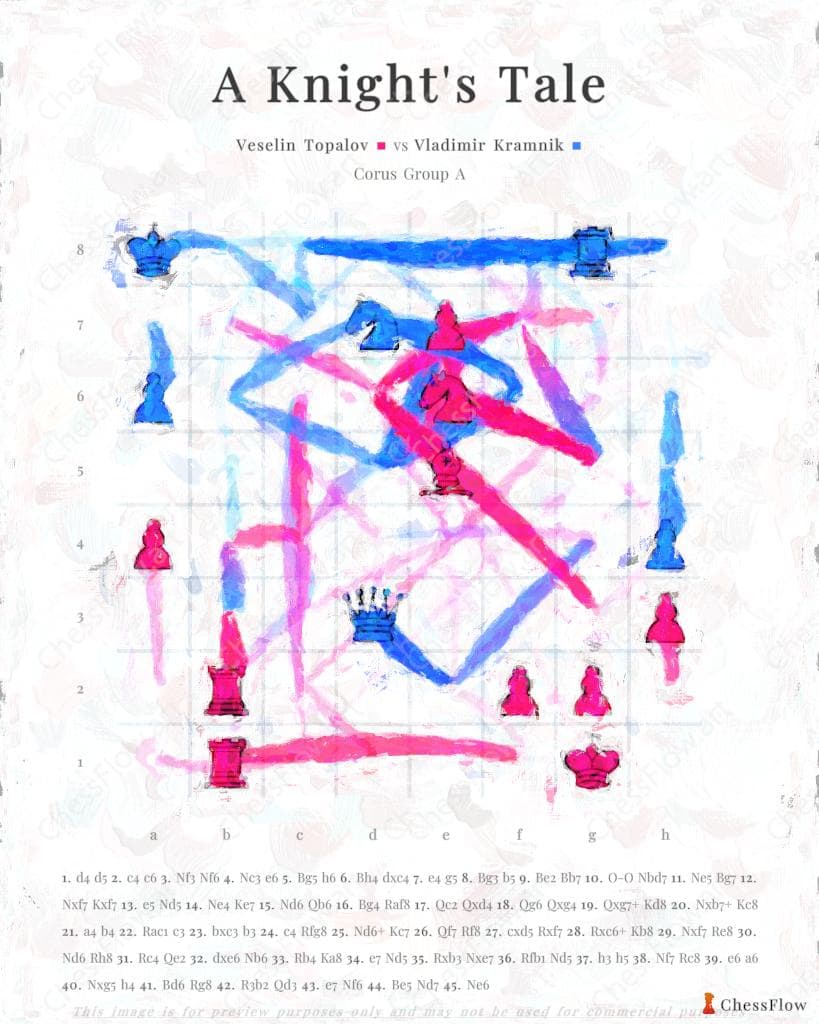
Veselin Topalov vs Vladimir Kramnik
Veselin Topalov vs Vladimir Kramnik
The Knight Sacrifice That Shook Wijk aan Zee Veselin Topalov pulled off one of the most spectacular attacking victories of the 2008 Corus tournament, defeating Vladimir Kramnik with a brilliant knigh...